
Make Tornado Safety Tips Automatic with Study Methods
Learn how to use evidence-based study techniques like spaced repetition, mnemonics, and active recall to memorize tornado safety procedures so you react automatically during an emergency.
Best for: tornado safety, emergency preparedness
A tornado warning is a bad time to discover that “I know the safety tips” really means “I remember reading a page about this sometime in August.” NOAA’s National Weather Service has described the average tornado warning lead time as about 13 minutes, which is long enough to act and short enough to punish hesitation.[1] If the alert wakes you up, or if the sky looks wrong while you are alone in an apartment, you do not have much room for searching, comparing, texting, or deciding whether the basement laundry room is actually where you are supposed to go.

That is why tornado safety tips belong in the same mental category as formulas, clinical algorithms, lab procedures, and language vocabulary: they have to be retrievable without a warm-up. A warning does not ask whether you recognize the right answer when you see it. It asks whether you can produce the next move.
The first card in the deck should probably be the pair that causes the most ordinary confusion: watch versus warning. The National Weather Service defines a tornado watch as conditions being favorable for tornadoes and a tornado warning as a tornado being imminent or occurring, based on radar indication or sighting.[1] In student terms: a watch means “get ready and keep monitoring”; a warning means “go to shelter now.”
Imagine a student who knows tornadoes are possible during severe weather, gets a phone alert, sees the word “warning,” and spends two minutes deciding whether that is the less serious one. That mistake is not dramatic. It is exactly the kind of small vocabulary failure that study methods are good at fixing.
What Has To Become Automatic
Tornado preparedness can sprawl into a long household checklist: weather radios, emergency kits, shoes near the bed, insurance documentation, pet carriers, charging banks. Those things matter, but they are not all the same kind of memory problem. For a student trying to make tornado safety tips usable under pressure, the cleanest first pass is to chunk the procedure into Before, During, and After.
| Chunk | What It Means | What To Memorize First |
|---|---|---|
| Before | Decisions made before the weather turns urgent | Where alerts come from; where your shelter is; what you bring only if it is already within reach |
| During | Actions after a tornado warning or immediate threat | Move to the lowest safe level, use an interior space, protect your body, stay away from windows |
| After | Actions once the immediate threat has passed | Wait for official updates, avoid hazards, contact people only when safe |
The During chunk deserves the most practice because it has the least mercy. Before actions can be done slowly on a Sunday afternoon. After actions happen when the immediate shelter decision is already over. During actions are the ones you may need to retrieve from sleep, stress, embarrassment, or the strange social pressure of not wanting to look alarmed before anyone else moves.
Broader tornado statistics justify taking the problem seriously, but they should not become the main study material. The Insurance Information Institute describes tornadoes and severe thunderstorms as major U.S. catastrophe risks, and WorldMetrics aggregates tornado damage figures that point in the same general direction, though its underlying sourcing is less transparent than primary government or insurance-industry references.[2][3] For memorization, the more useful fact is still the 13-minute warning context: there may be enough time to execute a plan, not enough time to invent one.
Turn The During Chunk Into A Mnemonic
A good mnemonic does not replace official guidance. It gives your brain a handle when everything feels too loud. The University of Arkansas emergency management guidance teaches DUCK for tornado safety: Down, Under, Center, Keep away.[4] It is not a universal national acronym, and other schools or agencies may teach the same ideas differently. Its value is that the four words map neatly onto the shelter decision you need to make fast.
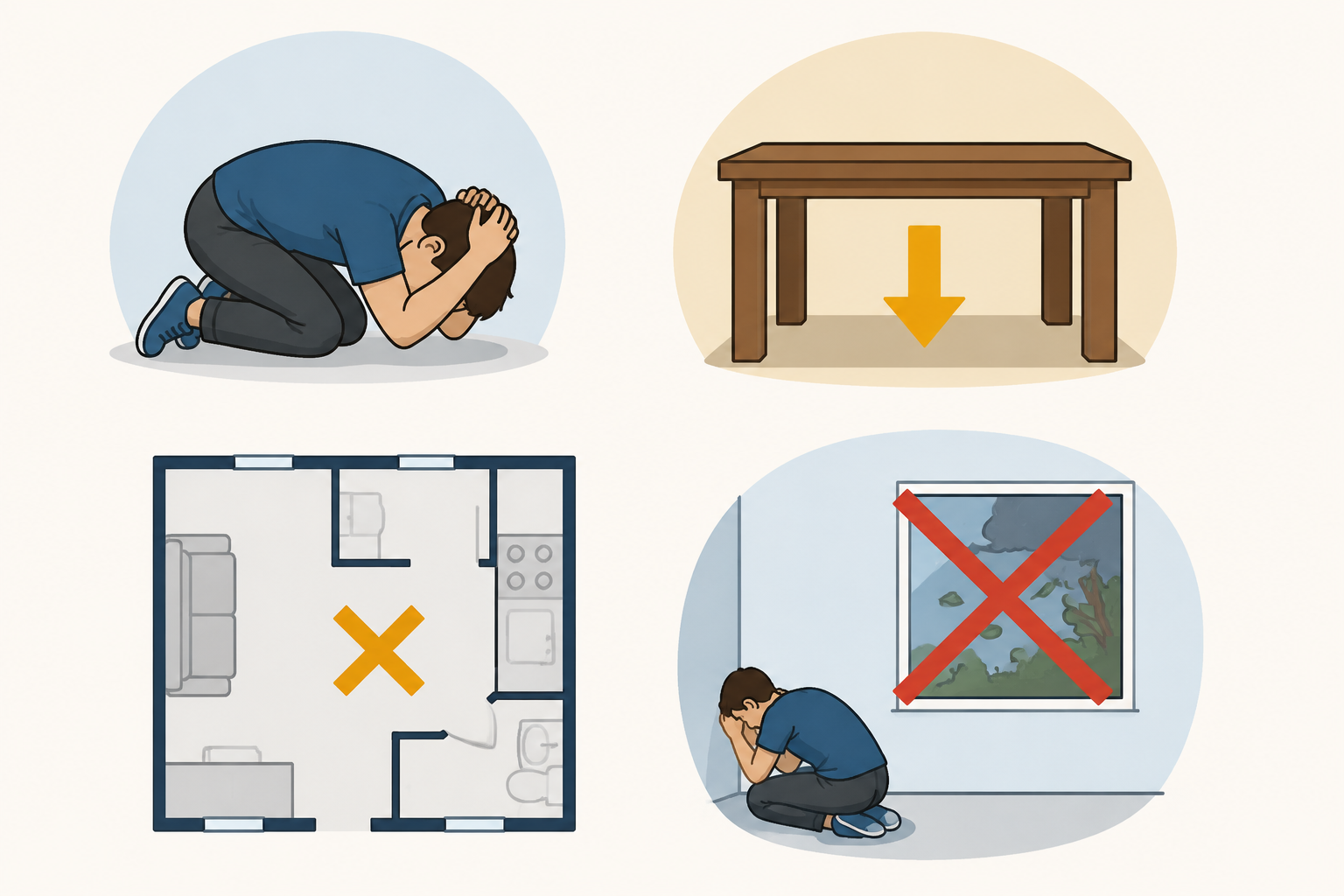
- Down: get to the lowest level you can safely reach, such as a basement or lowest floor.
- Under: get under something sturdy if it is available, or otherwise protect your head and neck.
- Center: choose a small interior space, not a large open room or an outside wall.
- Keep away: stay away from windows and glass.
The point is not to admire the acronym. The point is to attach it to your actual building. “Down” means something different in a dorm with an assigned severe-weather area than in a second-floor apartment where the basement is reached through a back stairwell. “Center” may mean a bathroom, hallway, closet, or designated shelter area. A mnemonic becomes useful only when each word points to a real door, stairwell, room, or body position.
For an apartment, the study object might read like this: “Warning at night: shoes, phone, keys if already beside me; leave the bedroom; take the interior stairs; go to the basement laundry room; crouch near the interior wall away from windows.” That sentence is not elegant, which is fine. Emergency memory does not need to be elegant. It needs to be executable.
Build Flashcards That Ask For Decisions, Not Definitions
A weak tornado safety flashcard asks, “What should you do during a tornado?” and accepts a vague answer like “go somewhere safe.” That card is comforting because it is easy. It is also not close enough to the real task.
Better cards force a choice. They should make you retrieve the difference between a watch and a warning, choose a shelter location, reject bad options, and recite the first few actions in order. If you use Anki, Quizlet, RemNote, or paper cards, the principle is the same: the prompt should create a small version of the pressure.
| Weak Card | Stronger Card |
|---|---|
| What is a tornado warning? | Phone alert says “tornado warning” for your area. What do you do in the next 60 seconds? |
| Where is a safe place? | You are in your bedroom on the second floor. Rank these: windowed living room, interior bathroom, basement laundry room, balcony. |
| What does DUCK mean? | Use DUCK to explain exactly where your body goes in your building. |
| What is the difference between watch and warning? | A watch is issued while you are studying at the library. A warning is issued while you are home. What changes? |
The watch-versus-warning card is worth overlearning because it controls the whole branch of behavior. During a watch, you can charge your phone, check your alert sources, put shoes nearby, and verify your shelter route. During a warning, the study answer should be blunt: stop what you are doing and shelter.
Shelter cards should use your actual environment. A dorm student might need a card about the posted severe-weather area. A renter might need one about whether the basement is accessible after hours. A student in a shared house might need one about the safest interior room if the basement is cluttered or locked. Do not make cards for an imaginary perfect building unless you live in one.
Use Cloze Cards Sparingly
Cloze deletion is useful for exact distinctions: “A tornado watch means conditions are ___; a tornado warning means a tornado is ___ or ___.” But cloze cards can let you win by pattern recognition. For procedures, mix them with open prompts that require the full sequence: “You are in bed and receive a tornado warning. Recite your first five actions.”
Active Recall Should Feel A Little Uncomfortable
Reading a safety page gives the pleasant illusion that the information is now yours. Active recall tests whether it is actually available. Close the page, put the phone down, and produce the action from memory. If you cannot, that is not a moral failure; it is useful data.
The most useful drill is short enough that you will actually do it. Set a timer for one minute and answer one scenario out loud: “Warning issued while I am cooking.” “Warning issued while I am asleep.” “Watch issued while I am on campus.” “Warning issued while I am in a friend’s apartment.” Each answer should include a decision, not just a concept.
- If you pause on the meaning of the alert, review watch versus warning.
- If you know the right room but not the route, walk the route once in normal conditions.
- If you name too many items to grab, reduce the list to what is already beside you.
- If you keep choosing a convenient room with windows, rewrite the card so the wrong choice is visible.
This is where preparedness writing often gets too polished. In real life, the friction is embarrassingly specific. You may not know whether the basement door is locked. You may not want to walk into a shared laundry room in pajamas. You may not know whether your building’s ground-floor hallway is safer than your own bathroom. Active recall brings those weak spots to the surface before the weather does.
Schedule Reviews Until The First Move Is Boring
Spaced repetition has strong support as a general learning method for long-term retention, but there is no need to pretend that researchers have run a tornado-specific randomized trial on Anki decks for shelter behavior. The honest claim is narrower and still useful: the same memory principles that help students retain academic material can be applied to emergency procedures, especially when the goal is fast retrieval rather than recognition.
For tornado safety tips, a reasonable review schedule is simple: learn the cards today, review tomorrow, review again in a few days, then weekly during severe-weather season or whenever you move rooms, buildings, or cities. The exact interval matters less than the fact that the procedure comes back before you have forgotten it completely.
| Review Moment | What To Test |
|---|---|
| Same day | Watch versus warning; DUCK meaning; your exact shelter location |
| Next day | Full warning sequence from memory without looking |
| Later that week | Scenario cards: asleep, cooking, studying, visiting someone else |
| Weekly in active season | One-minute drill plus any changed building details |
| After moving | Rebuild the deck around the new shelter route |
Do not only review while sitting comfortably at a desk. Once you know the route, rehearse the first part physically in safe conditions: stand up, put on shoes if that is part of your plan, pick up the phone, move toward the shelter route, and stop before you disturb anyone or enter a restricted area. The goal is not theater. It is reducing the number of decisions your future self has to make.
Keep The Deck Small Enough To Survive
A tornado deck does not need 80 cards. Too many cards can turn safety into another abandoned productivity project. Start with the cards that change behavior.
- One card for watch versus warning.
- One card for your shelter location at home.
- One card for your shelter location on campus or at work.
- One card for DUCK applied to your building.
- Three scenario cards for the situations you are most likely to be in.
If you want extra cards, add them only after the core sequence is automatic. Emergency kit details, weather radio settings, insurance photos, and post-storm cleanup guidance can be useful, but they should not crowd out the one thing you need during the warning: where to go and what to do with your body when you get there.
The Readiness Standard
The standard is not perfect calm. It is not becoming the person who knows every tornado statistic or can explain storm structure at dinner. The standard is more practical: when a warning arrives, the first move is available.
You know the difference between a watch and a warning. You know your shelter location. You can apply Down, Under, Center, Keep away without reciting it like a slogan. You have practiced the route and reviewed the decision often enough that it feels almost boring. Boring is acceptable. In an emergency, boring may be exactly what you need.
References
- Tornado Safety, National Weather Service, https://www.weather.gov/safety/tornado
- Facts + Statistics: Tornadoes and thunderstorms, Insurance Information Institute, https://www.iii.org/fact-statistic/facts-statistics-tornadoes-and-thunderstorms
- Tornado Damage Statistics, WorldMetrics, https://worldmetrics.org/tornado-damage-statistics/
- Severe Weather, University of Arkansas, https://safety.uark.edu/emergency-preparedness/severe-weather.php
Apply This Method
Related Methods
- Turn the 2026 Perseid Meteor Shower Into an Astronomy Study Session
Learn how to use the 2026 Perseid meteor shower peak (Aug 12–13) as a hands-on astronomy study session. Apply concepts like radiant geometry, ZHR, magnitude estimation, and atmospheric entry physics while collecting real observational data with standard reporting forms.
- How to Analyze a Settlement Case Study for Law Students
Most civil cases settle before trial, yet law school curricula focus almost exclusively on appellate opinions. A five-part framework for analyzing settlement case studies — covering negotiation dynamics, leverage, and economic incentives — gives law students a crucial advantage in exams and clinic preparation.
- Switched at Birth: Legal Steps and Study Guide for Torts
A case-based study guide for law students exploring how switched-at-birth litigation tests negligent infliction of emotional distress, the independent duty exception, multi-party standing, and statute-of-limitations issues across multiple jurisdictions.
Comments
Join the discussion with an anonymous comment.