
Did Homer Exist? A Source Criticism Case Study
Learn how historians evaluate evidence for ancient figures by working through the Homer debate as a hands-on case study. This guide teaches you to apply source criticism principles across multiple evidence categories to reach well-supported, nuanced conclusions.
Best for: history, classics
Start with the empty space. If Homer lived in the eighth or seventh century BC, no surviving inscription from that period names him. No statue, artifact, or contemporary account says, in effect, “this is the poet who made the Iliad and the Odyssey.” The first explicit references to Homer appear one to two centuries later, after the poems were already circulating as cultural treasures rather than as fresh publications with an author’s signature attached.[1]
That is the real beginning of the question: what historical evidence can tell us whether Homer existed. Not the familiar marble bust. Not the story of a blind singer wandering from city to city. Not a quiz about whether a genius was born on Chios, Smyrna, or somewhere else. The historian’s first task is less dramatic: separate evidence that can identify a person from evidence that can explain how two long poems came into being.
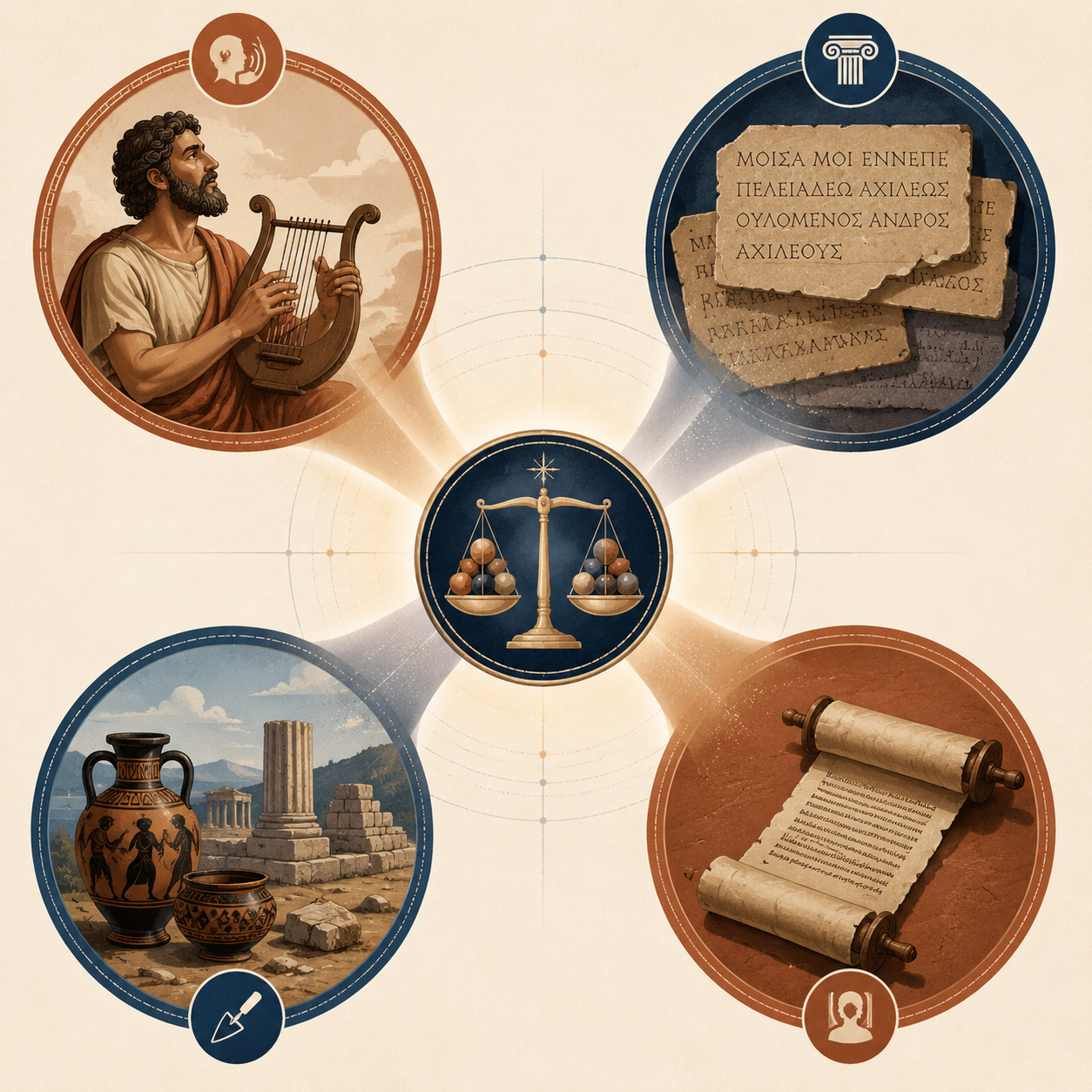
Those are different jobs. A later ancient writer may preserve a useful memory, but distance weakens the claim. Linguistic patterns may help date layers of composition, but they do not point to a birth certificate. Archaeology may show that a city like Troy was real, while still saying nothing about who shaped a verse line. Oral-formulaic evidence may explain why the poems sound the way they do, without turning them into either mechanical folklore or the private invention of one isolated writer.
The Missing Contemporary Witness
For many ancient figures, the evidence begins late. That does not automatically make the figure fictional. It does, however, change the kind of claim we are allowed to make. A contemporary inscription naming an official, a coin bearing a ruler’s title, or an administrative tablet recording a transaction belongs to a different evidentiary class than a biography written centuries later.
In Homer’s case, the absence is not a small inconvenience. The poems traditionally attached to his name are massive, influential, and early in Greek literary history, yet the supposed author leaves no contemporary trace outside the tradition that later revered him. That means Bernheim’s corroboration principle — the basic idea that independent agreement strengthens reliability — cannot do its usual work at the point where many readers most want certainty. There are no independent contemporary witnesses to compare.
The sensible response is not to shrug and say “we will never know anything.” It is to lower the question from courtroom identity to historical explanation. Instead of asking whether the traditional Homer can be proven, ask what model best explains the surviving facts: the late testimony, the language of the poems, their repeated formulas, their mixed material culture, and the uneven evidence of archaeology.
Later Testimony Can Help, But It Has To Be Recalibrated
Herodotus gives one of the most useful examples of how historians handle a source that is not contemporary but not worthless. Writing in the fifth century BC, he said Homer lived “no more than 400 years” before his own time. Taken flatly, that number would place Homer much earlier than many modern estimates. But ancient chronological habits matter. Modern scholars have noted that Herodotus used a forty-year generation estimate rather than the modern twenty-five-year standard, and recalibrating the count brings the date closer to about 700 BC.[2]
That is a small operation, but it is exactly the sort of operation that keeps historical reasoning honest. Herodotus is not treated as an eyewitness. He is not dismissed because he is late. His statement is examined for genre, distance, and counting practice. The result is not proof that a man named Homer lived in 700 BC. It is a bounded inference: by the fifth century BC, Greeks could speak of Homer as a poet of the past, and one major historian placed him several generations before himself.
The ancient biographies of Homer are weaker evidence. Ten ancient Lives survive, including texts such as the Pseudo-Herodotean Life of Homer and the Contest of Homer and Hesiod, but they date from the Roman period, centuries after the supposed lifetime of the poet, and scholars treat them as legendary rather than reliable biography.[3]
Their problem is not that they are colorful. Color is not a historical crime. The problem is provenance. A late biography of an archaic poet may reveal what later communities wanted Homer to be: blind, inspired, local, competitive, divinely marked, claimed by one city rather than another. It is much poorer at proving where he was born, how he worked, or whether one person composed both epics.
| Evidence Type | What It Can Do | What It Cannot Do |
|---|---|---|
| No contemporary inscription or artifact | Set the starting limit for certainty | Prove Homer did not exist |
| Herodotus | Show a fifth-century BC tradition placing Homer in the past | Serve as eyewitness testimony |
| Ancient Lives | Reveal later legendary memory and local claims | Establish reliable biography |
| Linguistic and formulaic evidence | Explain composition, dating, and transmission patterns | Name an individual author |
| Archaeology | Corroborate parts of the world behind the poems | Authenticate Homer as a person |
The Poems Sound Like They Come From Oral Tradition
The most important shift in the Homer debate came when scholars stopped treating repetition as a flaw to explain away. The Iliad and the Odyssey are full of repeated epithets, recurring phrases, type scenes, and large-scale compositional patterns. “Swift-footed Achilles” and “rosy-fingered Dawn” are not merely decorative tags. They fit the meter, help carry the line, and belong to a system of composition.
Milman Parry’s 1928 dissertation argued that this formulaic language was characteristic of oral composition. Albert Lord’s later fieldwork with Balkan bards in the 1930s through the 1950s showed that living oral singers could produce long narrative poems using comparable formulaic systems. Together, the Parry-Lord model reframed the Homeric Question: formulas did not have to be evidence of clumsy patchwork or multiple written authors; they could be evidence of a trained oral tradition.[4][5]
This matters because it changes the meaning of the missing author. In a modern print culture, a long poem usually invites a hunt for the person who drafted, revised, and authorized the text. In an oral tradition, composition, performance, memory, and variation can overlap. A singer does not simply recite a fixed script from memory, nor does he invent every line from nothing. He works within inherited themes, formulas, scenes, and story patterns.
That does not make the poems anonymous sludge. Oral tradition can still allow for extraordinary artistry. The point is that artistry operates inside a different technology of composition. The poet’s originality may lie in selection, ordering, emphasis, pacing, and large-scale design, not in private invention detached from inherited material.
Later refinements to Parry-Lord theory matter here. Scholars such as Ruth Finnegan pushed back against a hard binary between oral and written, emphasizing that oral traditions exist on a spectrum and that some texts may be “oral-derived” — written down during, after, or in relation to performance. That complication weakens simple labels but strengthens the method. The question becomes not “oral or written?” but “which features are best explained by oral composition, written fixation, later editing, or some combination?”[5]
Linguistic Dating Gives Ranges, Not a Signature
Language is one of the best tools for dating the poems, but it is not a neat timestamp. Homeric Greek is artificial and layered. It preserves older forms alongside later ones, partly because metrical formulas can conserve language long after ordinary speech has changed. That is exactly what one would expect in a tradition shaped over time.
Richard Janko’s statistical analysis dates the Iliad to about 750–725 BC and the Odyssey to about 725–675 BC. Martin Litchfield West argued instead that the Iliad echoes events from 664–663 BC, pushing its composition to about 660–650 BC. Those are not tiny disagreements, but they are disagreements inside a shared scholarly effort to use linguistic and historical clues responsibly.[4]
This is where students often want the method to deliver a single date, and the method refuses. That refusal is not failure. If two scholars use related evidence and reach different ranges, the historian asks why: Which linguistic features are being weighted? Are possible historical allusions secure? Is the poem being dated as a whole, or are different layers being detected? The argument has moved from “guesswork” to inspectable reasoning.
Internal Anachronism Points To Layers
The poems also contain material that does not fit comfortably into one historical moment. Heroes fight with bronze weapons, a detail associated with the Bronze Age, yet cremation appears in ways associated with Iron Age practice. That combination is difficult to explain if the poems were straightforward records of one period. It makes much better sense if older memories passed through later performance and composition.[4]
A single anachronism would not prove a theory. Ancient poets could archaize, misunderstand, or deliberately mix settings. But repeated layering across language, technology, burial practice, and social detail gives the oral-tradition model more explanatory power. The poems seem to remember a Bronze Age world through Iron Age voices.
The boar’s tusk helmet in Iliad 10.260–265 is a useful example because it is so specific. Such helmets match artifacts from roughly 1600–1150 BC, centuries before Homer’s supposed lifetime. That does not mean the poet saw one. It means the poem preserves a detail that fits the Bronze Age better than the later world in which the poem likely took shape.[6][7]
Archaeology Confirms A World, Not A Poet
Archaeology is tempting because it feels solid. Stones appear to rescue us from stories. But stones answer their own questions, not always ours. Heinrich Schliemann’s 1873 excavation at Hisarlik helped confirm that Troy was a real city, but his methods damaged the Homeric-era layer now known as Troy VIIa while he dug down toward the earlier Troy II.[6][7]
That gives archaeology both importance and a boundary. It can show that the poems are not floating in a wholly invented landscape. It can connect some details to older material cultures. It can complicate the old assumption that epic poetry is only fantasy. But it cannot identify Homer, prove that one poet composed both epics, or verify the Trojan War exactly as narrated.
The distinction is worth guarding. “Troy existed” is not the same claim as “Achilles existed.” “The poem preserves Bronze Age details” is not the same claim as “the poem was composed in the Bronze Age.” “Archaeology supports parts of the setting” is not the same claim as “archaeology proves Homer’s biography.” Much bad historical argument begins by sliding from one of those sentences into another.
Why The Best Explanation Is Stronger Than A Yes-Or-No Verdict
At this point, the evidence does not support the simplest traditional picture: one blind bard named Homer personally composing both the Iliad and the Odyssey from scratch, with recoverable facts about his birthplace, travels, and biography. The contemporary evidence is absent, the later biographies are legendary, and the poems themselves point toward inherited oral material.
It also does not require the opposite claim, that Homer “never existed” in any meaningful sense or that the poems are nothing but collective accumulation. The structure and artistry of each poem still need explanation. So does the way oral formula, linguistic layering, archaic material details, and later fixation seem to work together.
This is where McCullagh’s best-explanation criterion does more work than simple corroboration can. The stronger model is the one that accounts for the widest range of evidence with the least strain. For Homer, that model is usually some version of this: the Iliad and the Odyssey emerged from older oral traditions, each was shaped substantially by a major poet or compositional intelligence, and the two poems were probably not produced by the same author.[4][5]
That is close to the contemporary mainstream position, though not a unanimous one. Some scholars, including some using stylometric approaches, still defend single authorship of both poems. Other scholars emphasize longer evolution across generations. Within the mainstream, the Doloneia, Iliad Book X, is widely treated as a later interpolation, which reminds us that even a poem shaped by a powerful compositional intelligence may still have a complicated textual history.[4][5]
A Transferable Source-Criticism Method
The Homer case is useful because it refuses to reward either gullibility or easy skepticism. If a source is late, ask what kind of memory it may preserve and what kind of claim it cannot bear. If a text contains repeated formulas, ask whether those patterns are better explained by incompetence, written compilation, oral composition, or a mixed process. If archaeology confirms part of a setting, do not make it certify the entire story. If evidence disagrees, ask whether the disagreement exposes a flaw or simply marks the edge of what the evidence can decide.
- Check proximity: Was the source contemporary, near-contemporary, or centuries later?
- Check independence: Do sources confirm one another, or do they repeat the same tradition?
- Check genre and purpose: Is the source recording, praising, entertaining, explaining, or claiming local prestige?
- Check internal consistency: Does the evidence fit one period, or does it preserve layers?
- Check corroboration: Can material evidence, language, and testimony support the same limited conclusion?
- Choose the best explanation: Prefer the model that explains the widest range of facts without pretending the gaps have disappeared.
So did Homer exist? Source criticism cannot prove the traditional Homer. It can support a narrower and more useful judgment: the Iliad and the Odyssey likely grew out of older oral traditions; each was shaped in a major way by a powerful poet or compositional intelligence; the same person probably did not compose both poems; and later additions, including the Doloneia, complicate the textual history. That answer is less tidy than a legend, but it is stronger because every part of it knows which evidence is carrying the weight.
References
- Homer — Wikipedia
- Homer | Biography, Odyssey, Iliad, Homeric Question — Britannica
- Ancient accounts of Homer — Wikipedia
- Homeric Question — Wikipedia
- Was Homer a real person? — Bad Ancient
- Who was Homer? — British Museum
- Did Homer Really Exist? What Scientific Research Reveals — The Archaeologist
Apply This Method
Related Methods
- How to Analyze a Settlement Case Study for Law Students
Most civil cases settle before trial, yet law school curricula focus almost exclusively on appellate opinions. A five-part framework for analyzing settlement case studies — covering negotiation dynamics, leverage, and economic incentives — gives law students a crucial advantage in exams and clinic preparation.
- Turn the 2026 Perseid Meteor Shower Into an Astronomy Study Session
Learn how to use the 2026 Perseid meteor shower peak (Aug 12–13) as a hands-on astronomy study session. Apply concepts like radiant geometry, ZHR, magnitude estimation, and atmospheric entry physics while collecting real observational data with standard reporting forms.
- How to Master Stroke Symptom Recognition for Medical Training
This guide outlines evidence-based study methods for learning and retaining stroke symptom recognition, combining mnemonic practice with awareness of recall trade-offs, active-recall spaced repetition, and simulation training. Readers will learn how to build a deliberate study strategy that outperforms passive review and prepares them for exams and clinical practice.
Comments
Join the discussion with an anonymous comment.