
AP
A week-by-week AP study schedule from January to exam day that shows exactly when to use an AI tutor to compress setup time and maximize active practice, based on evidence-backed study methods.
Updated:
In January, May looks comfortably distant. It is not. A 16-week AP exam study plan with an AI tutor only works if the AI removes setup work and the student spends the saved time doing the uncomfortable parts: answering from memory, working under time limits, and revising free-response answers against the actual rubric.
The plan below assumes about six focused hours per week for one AP course. If you are taking two or three AP exams, do not simply triple the hours and hope your life cooperates. Keep the same weekly loop, shorten low-value rereading, and rotate which course gets the full timed section that week.
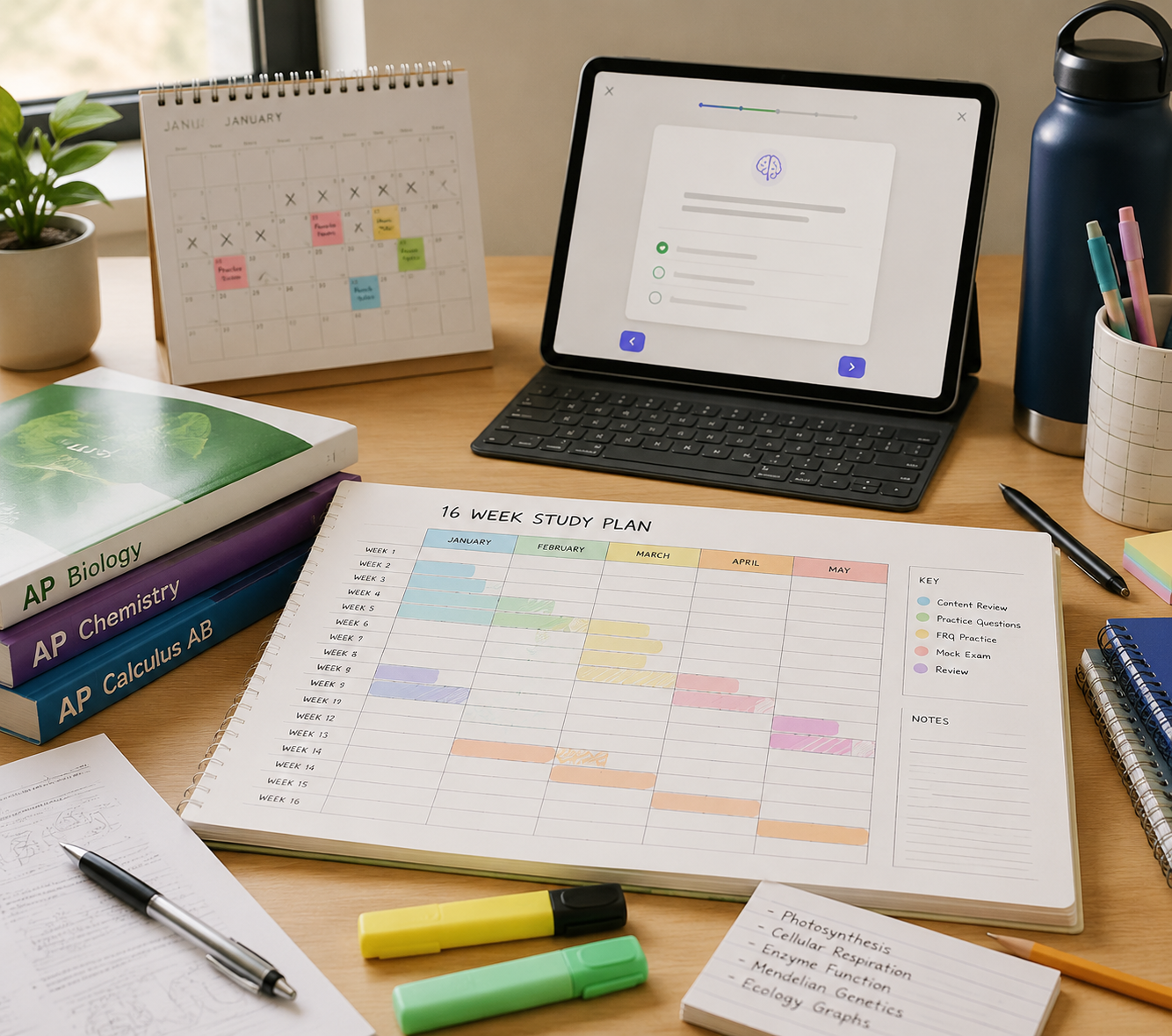
The 16-Week Map From January to Exam Day
The calendar has five phases. The work gets less comfortable as you move through it, which is the point. January is for finding the gaps. February is for filling them. March is where topics stop arriving one at a time. April is for full mocks and error patterns. May is for tapering, not cramming.
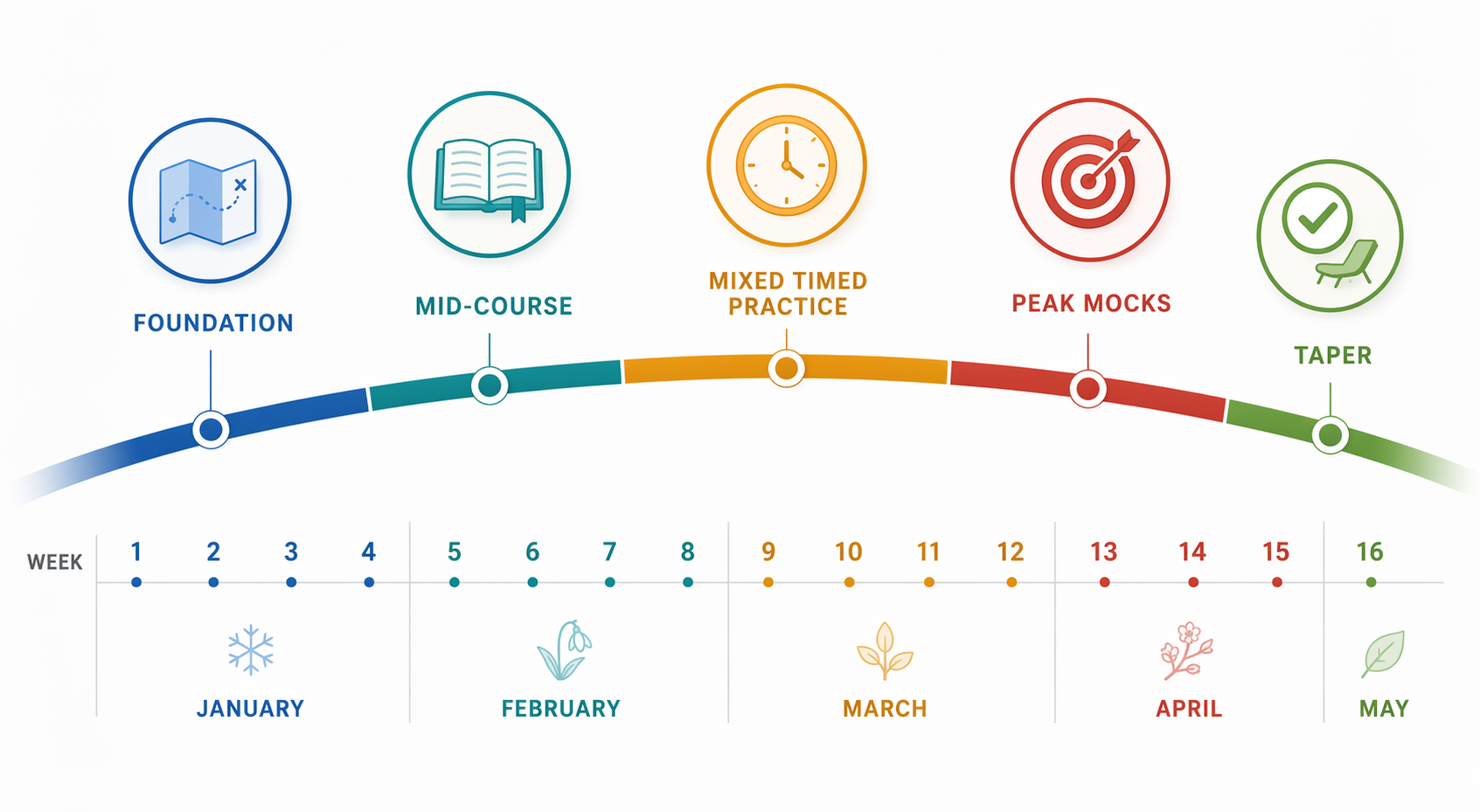
| Weeks | Phase | Main Job | AI Tutor Job | What You Produce |
|---|---|---|---|---|
| Weeks 1-4 | Foundation | Map the course, take a baseline diagnostic, identify weak units | Generate short quizzes by unit and organize missed concepts | A ranked gap list and first error log |
| Weeks 5-8 | Mid-Course | Cover weak and current units topic by topic | Create targeted MCQs, explain missed steps, build verified flashcards | Stronger unit coverage and spaced-repetition cards |
| Weeks 9-12 | Mixed Timed Practice | Practice mixed topics under time pressure | Score FRQs against official rubrics and sort recurring mistakes | Timed-section records and rewritten FRQs |
| Weeks 13-15 | Peak Mocks | Take full-length digital mocks and review them deeply | Analyze error patterns and turn misses into a final review plan | Mock scores, timing notes, and a narrowed final list |
| Week 16 | Taper | Light retrieval, confidence, logistics, sleep | Run short review sets and quiz only the highest-yield misses | A calm final review sheet, not a new system |
The evidence behind this structure is not that AI is magical. It is that self-testing and distributed practice are unusually strong study methods. Dunlosky and colleagues ranked practice testing and distributed practice as the two highest-utility learning techniques in a major 2013 review, which is why this plan keeps coming back to quizzes, spaced review, and delayed correction rather than polished notes.[1]
There is also encouraging evidence for structured AI tutoring, with an important qualifier. A 2025 randomized controlled trial by Kestin and colleagues found that students using a purpose-built AI tutor reached a median post-test score of 4.5, compared with 3.5 for in-class active learning; reported effect sizes ranged from 0.73 to 1.3 standard deviations, with p < 10^-8, and 70% of AI-tutored students spent under 60 minutes on the lesson.[2] That is not the same as saying a casual chatbot conversation will raise an AP score. The useful part is the structure: targeted prompts, active responses, feedback, and time compression.
The Weekly Operating System
Six focused hours is enough for real movement if those hours are not eaten by deciding what to study. The weekly routine should be boring enough to repeat when practice is busy, homework is heavy, and motivation is ordinary.
| Weekly Block | Time | Student Work | AI Support |
|---|---|---|---|
| Diagnostic retrieval | 60-75 minutes | Answer questions from memory before reviewing notes | Generate 15-20 MCQs for one weak unit, then hide explanations until after the attempt |
| Targeted correction | 60 minutes | Redo missed questions and write why the first answer failed | Cluster misses by concept, process error, vocabulary gap, or timing problem |
| FRQ or essay practice | 75-90 minutes | Write one response under time pressure, then revise it | Score the response against the official College Board rubric and identify missing evidence, reasoning, or setup |
| Spaced repetition | 30-45 minutes | Review older misses without looking at notes first | Turn missed items into cards, then schedule them for later review |
| Mixed timed set | 75-90 minutes | Complete a mixed set or partial section under exam-like timing | Afterward, summarize patterns without giving away answers during the attempt |
| Planning and reset | 15-30 minutes | Choose next week's weak unit and file the error log | Convert the error log into a short priority list |
Notice the order. The AI does not explain first while the student nods along. The student attempts first, then uses the AI tutor to make correction faster and more specific. That one change prevents a good-looking study session from turning into assisted rereading.
A useful target is to keep more than 80% of the weekly block in retrieval, timed practice, correction, or revision. The AI can spend 30 minutes generating weak-unit MCQs, 45 minutes helping score one FRQ against a rubric, and 15 minutes converting misses into spaced-repetition cards. It should not become the main event.
Weeks 1-4: Foundation
January starts with a map, not a masterpiece. Pull the course and exam description, your teacher's unit sequence, recent quizzes, and any official practice questions you already have. Then take a baseline diagnostic or a representative mixed set before reviewing. The score is not a verdict. It is a sorting tool.
Use the AI tutor to turn the diagnostic into a ranked gap list. The useful categories are simple: content you do not know, procedures you recognize but cannot execute, careless errors under time pressure, and free-response points you keep failing to earn. A student who writes “Unit 3 bad” in an error log has not learned much. A student who writes “can identify equilibrium shift but forgets to justify with concentration change” has something to practice.
- Week 1: take a baseline diagnostic, create the error log, and identify the first two weak units.
- Week 2: quiz the weakest unit with 15-20 AI-generated MCQs, then verify explanations against class notes or official materials.
- Week 3: write one short FRQ or essay response under time, then compare it to the official rubric.
- Week 4: review all missed items from Weeks 1-3 and retest without looking at notes.
For the AI prompt, keep it constrained: “Create 20 AP-style multiple-choice questions on this unit, one at a time. Do not show the answer until I respond. After each answer, explain why the correct option is correct and why my chosen option is wrong. Track my misses by concept.” The phrase “one at a time” matters. Bulk question dumps invite skimming.
Weeks 5-8: Mid-Course Coverage
February is the least glamorous phase and often the most useful. You are still learning new material in class while repairing January's gaps. The temptation is to make beautiful flashcard decks for everything. Resist that. Make cards from misses, not from the table of contents.
Each week gets one main weak unit and one current class unit. The AI tutor can generate short retrieval sets for both, but the student still has to verify answers. This is especially important for vocabulary-heavy courses, where an AI-generated definition that is almost right can become a durable misconception. A hybrid workflow, where AI drafts cards and the student checks them before review, is safer than trusting an automatic deck; this is the same verification problem covered in Are AI Flashcard Makers Accurate?.
- Monday or Tuesday: 30-45 minutes of spaced review from old misses.
- Midweek: one targeted AI-generated quiz on the current weak unit.
- Weekend: one timed FRQ, essay, problem set, or mixed MCQ section.
- After the weekend block: update the error log and choose the next weak unit.
If you use a named tool, use it inside this loop rather than building your week around its dashboard. A tool such as StudyCrush may help frame a 16-week sequence, Jenova AI describes adaptive diagnostics across AP subjects, QuizFlex presents step-based AI study workflows, and Knowt-style flashcard tools can speed card creation.[3][4][5] The question is still the same: did the tool produce more retrieval and better correction this week?
Weeks 9-12: Mixed Timed Practice
March is where students find out whether they know the course or only recognize the chapter they just studied. Mixed practice feels worse than unit practice because the question itself no longer announces which method to use. That friction is valuable.
Move from “give me questions on Unit 5” to “give me a mixed timed set across Units 1-6 with no topic labels.” For STEM courses, ask the AI tutor to identify the first wrong step after you finish. For history, language, and literature courses, ask it to score a thesis, evidence use, commentary, sourcing, or sophistication claim against the official rubric. Do not ask it whether the essay is “good.” Ask which rubric points it earns and which sentence earns each point.
The weekly FRQ routine should now include a rewrite. Write under time. Score against the rubric. Then rewrite only the weakest part: the claim, the setup, the evidence connection, the calculation explanation, or the final justification. Rewriting the whole response every time is often too slow. Rewriting the exact point you failed to earn is where the gain usually is.
| If the miss is... | Do this next | Ask the AI tutor to... |
|---|---|---|
| Content recall | Create two flashcards and retest in 2-3 days | Draft cards from the missed item, then quiz you without hints |
| Wrong method choice | Compare two similar problems side by side | Explain what cue should have triggered the correct method |
| Timing | Repeat a shorter timed set | Separate slow-but-correct items from rushed wrong items |
| Rubric miss | Rewrite the missing sentence or step | Match each earned point to exact language in the rubric |
| Careless error | Name the pattern and add a check step | Track whether the same error appears again next week |
Weeks 13-15: Peak Mocks
April is not the month for collecting new resources. It is the month for sitting through the exam experience before the exam experience counts. Full-length mocks are tiring, inconvenient, and more honest than another evening of notes.
This matters more in 2026 because the College Board has moved most AP exams to digital delivery. The College Board says 28 AP exams are delivered through Bluebook, so students need practice with the digital testing environment, not just the content.[6] For 2026, the AP exam administration is scheduled for May 4-15, but individual subject dates should be checked on the official College Board schedule before building the final two-week taper.[6]
A good April mock has three parts. First, take the test in the closest available format to the real one, including timing and breaks. Second, review the same day only enough to mark obvious categories. Third, do the deeper error-log work the next day, when the emotional sting has dropped and the patterns are easier to see.
- Week 13: full or near-full mock; AI helps categorize errors after you finish.
- Week 14: second mock or full timed section; compare error patterns with Week 13.
- Week 15: final heavy mock for the highest-priority AP course; use the error log to build the taper list.
This is the one phase where a digital AP platform can be worth considering if it gives you realistic timing, navigation, and review. Acely publishes AP prep pricing, DeAP Learning describes AI tutors with Heimler's History integration, and comparison posts from RewindNotes, Vertech Academy, and KidsAiTools discuss subject-specific tools.[7][8][9][10][11] Prices and features change quickly, so verify them before paying. A cheaper tool that gets you to a timed mock is more useful than an expensive one that keeps you organizing.
Week 16: Taper
The final week is not for a new textbook, a new app, or a heroic overnight reset. It is for short retrieval, familiar formats, sleep, food, logistics, and confidence built from evidence. The student should be able to say, “I know my recurring misses, and I know what I do when I see them.”
Use the AI tutor lightly. Ask for 10-question review sets from the final error log. Ask it to quiz old flashcards in random order. Ask it to check whether a rewritten thesis or justification would likely earn the missing rubric point. Do not ask for a 200-card emergency deck. That is panic disguised as productivity.
- Two to three days out: one short timed set, then review only the misses.
- The day before: light flashcards, formula or rubric review, Bluebook logistics, and sleep.
- The morning of: no new concepts; review the final one-page error pattern list if it calms you.
What Changes by Subject
The weekly loop stays the same, but the AI tutor's best job changes by course type. Do not force every AP class into the same flashcard-heavy routine.
STEM Courses
For AP Calculus, Chemistry, Physics, Biology, and similar courses, the AI tutor is strongest when it generates varied problems and helps identify the step where your reasoning first went off track. The danger is reading step-by-step solutions too early. Work the problem first, even badly, then compare.
For formula-heavy material, flashcards should not only ask for definitions. They should ask when a method applies, what a graph shape implies, or what the next algebraic step should be. For a deeper version of that process-based approach, see How to Study Math with Flashcards: The Three-Layer Method.
History, Language, and Essay-Heavy Courses
For APUSH, AP World, AP Euro, AP Lang, and AP Lit, the AI tutor should spend less time summarizing readings and more time interrogating claims. A useful prompt is: “Score this response against the official rubric. Quote the sentence that earns each point. If a point is missing, name the smallest revision that would make it earnable.”
The student still needs official examples. AI feedback can be plausible and wrong, especially on nuance-heavy rubric points. Treat it as a first-pass coach, then compare with College Board scoring guidelines, sample responses, and teacher feedback.
Memorization-Heavy Courses
For AP Psychology, biology vocabulary, government terms, and similar material, AI-generated flashcards can save a great deal of setup time. The card still has to be checked. A wrong definition reviewed five times is not efficient; it is just well-spaced damage.
Keep cards short, test from memory, and mix old and new terms. The same active-recall principle applies whether the exam is AP Psychology or a vocabulary-heavy graduate exam; the practical mechanics are similar to those described in How to Use GRE Vocabulary Flashcards the Right Way.
What the AI Tutor Should Not Do
The fastest way to waste an AI tutor is to ask it to make studying feel finished. Summaries, color-coded plans, and giant decks can all create the pleasant sense that preparation is happening. None of them proves that you can answer a hard question cold.
- Do not let the AI answer before you attempt the question.
- Do not trust AI-generated AP questions as equal to official College Board questions.
- Do not use rubric feedback without checking it against official scoring guidelines.
- Do not replace Bluebook practice with ordinary chat-based practice for digital exams.
- Do not pay for a tool until you know exactly which weekly task it improves.
One secondary-source estimate cited by RewindNotes says students using AI-assisted study tools scored an average of 0.7 AP points higher than students using traditional methods alone.[9] That number should be treated cautiously because it could not be independently verified from the cited materials. It is better used as a reason to investigate structured AI support than as a promise to any one student.
A Simple Prompt Set for the Whole Plan
You do not need elaborate prompt engineering to run the plan. You need prompts that force attempts, delay explanations, and leave behind an error log.
- For MCQs: “Quiz me one question at a time on this AP unit. Do not reveal the answer until I respond. After each response, explain my error and tag it by concept.”
- For FRQs: “Score my answer against the official AP rubric. Quote the exact sentence or step that earns each point. Tell me the smallest revision needed for one missing point.”
- For error logs: “Group these missed questions into patterns: content gap, method choice, calculation or evidence error, timing, and careless mistake.”
- For flashcards: “Turn only these missed items into short active-recall cards. Include the answer and one common trap. Do not create cards for material I already answered correctly.”
- For taper week: “Create a 20-minute review quiz from my recurring misses. Mix units. No hints unless I ask after answering.”
If an AI tutor makes the plan easier to run, use it. If it turns into another place to decorate the plan, close it and take the timed set. The score gains come from the extra retrieval, timed practice, and rubric-based revision that the saved setup time makes possible.
References
- Improving Students’ Learning With Effective Learning Techniques: Promising Directions From Cognitive and Educational Psychology, Psychological Science in the Public Interest, 2013, https://journals.sagepub.com/doi/10.1177/1529100612453266
- AI tutoring outperforms active learning, Scientific Reports, 2025, https://pmc.ncbi.nlm.nih.gov/articles/PMC12179260/
- AP Exam Study Plan with AI Tutor, StudyCrush, https://studycrush.ai/blog/ap-exam-study-plan-ai-tutor
- AP Exam Tutor AI, Jenova AI, https://www.jenova.ai/en/resources/ap-exam-tutor-ai
- How to Use AI for AP Exam Preparation: 8 Steps, QuizFlex, https://quizflex.ai/blog/how-to-use-ai-for-ap-exam-preparation-8-steps
- College Board Transitions Most AP Exams to Digital in May, College Board, https://newsroom.collegeboard.org/college-board-transitions-most-ap-exams-digital-may
- AP Prep, Acely, https://acely.com/ap-prep
- DeAP Learning, DeAP Learning, https://deaplearning.com/
- Best AI Tools for AP Exam Prep, RewindNotes, https://www.rewindnotes.com/blog/best-ai-tools-ap-exam-prep
- Best AI Exam Prep Tools, Vertech Academy, https://www.vertechacademy.com/blog/best-ai-exam-prep-tools
- AI Study Tools for Teens Exam Prep, KidsAiTools, https://www.kidsaitools.com/en/articles/ai-study-tools-for-teens-exam-prep
Supporting Resources
- The 6 Best Catholic Bible Study Apps in 2026 — A Feature-by-Feature Comparison for Students and Adult Learners →
Choosing the right Catholic Bible study app can be overwhelming. This comparison of Ascension, Ignatius Catholic Study Bible, Verbum, Hallow, Amen, and Catena helps Catholic college students, young adults, and converts find the best app for their study goals, budget, and theological depth preferences.
- MCAT Study Prep Guide: Best Tools, Timelines, and a Phase-by-Phase Plan →
A comprehensive hub for pre-med students planning MCAT preparation — covers how the exam is structured, how to set a realistic study timeline based on your content baseline, and which free and paid tools to use at each phase of prep from content review through full-length simulation.
- ASVAB Exam Prep Guide: How to Study Smarter by Subtest Priority →
Most ASVAB guides treat all 10 subtests equally — but the AFQT formula double-weights Verbal Expression, meaning Word Knowledge and Paragraph Comprehension deliver twice the score return per hour studied. This hub walks prospective military recruits through the AFQT scoring formula, a subtest priority strategy, a week-by-week study plan, and the right study tools matched to each section type.
Comments
Join the discussion with an anonymous comment.