
Method
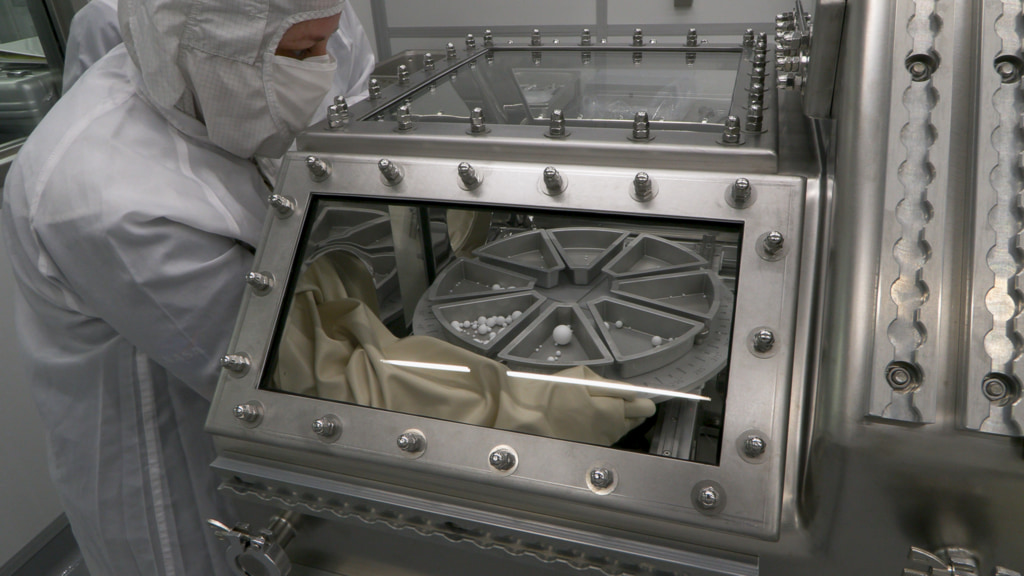
How Scientists Analyze Meteorites for Life's Building Blocks
This explainer walks through the step-by-step analytical pipeline — from hot-water extraction to isotope ratio mass spectrometry — that scientists use to confirm meteorites contain extraterrestrial amino acids and other prebiotic compounds. Readers will understand why contamination controls and chiral analysis are essential before any claim about life's cosmic origins can be trusted.
Evidence panel
- Evidence level
- pending review
- Primary citation
- citation pending review
A meteorite can carry amino acids, nucleobases, and other small organic molecules. So can a fingerprint, a lab bench, a rainstorm, or a patch of soil. That is why the central question in studies of meteorite chemistry and life’s origins is not simply, “Did the instrument detect an interesting molecule?” It is, “Can the lab show that the molecule survived a chain of handling, separation, identification, and contamination checks strongly enough to be called extraterrestrial?”
That question has become sharper in the sample-return era. NASA’s OSIRIS-REx mission returned material from asteroid Bennu in a sealed sample system, and reports on the Bennu analyses described all five DNA/RNA nucleobases and 33 amino acids in the returned material.[1] JAXA’s Hayabusa2 samples from Ryugu gave researchers another unusually clean test case: amino acids were identified in material collected directly from the asteroid and protected from the ordinary messiness of a meteorite fall.[2] These missions do not make contamination disappear, but they move the problem from “this rock lay on Earth” to “what exactly touched this sample, and what did the blanks show?”
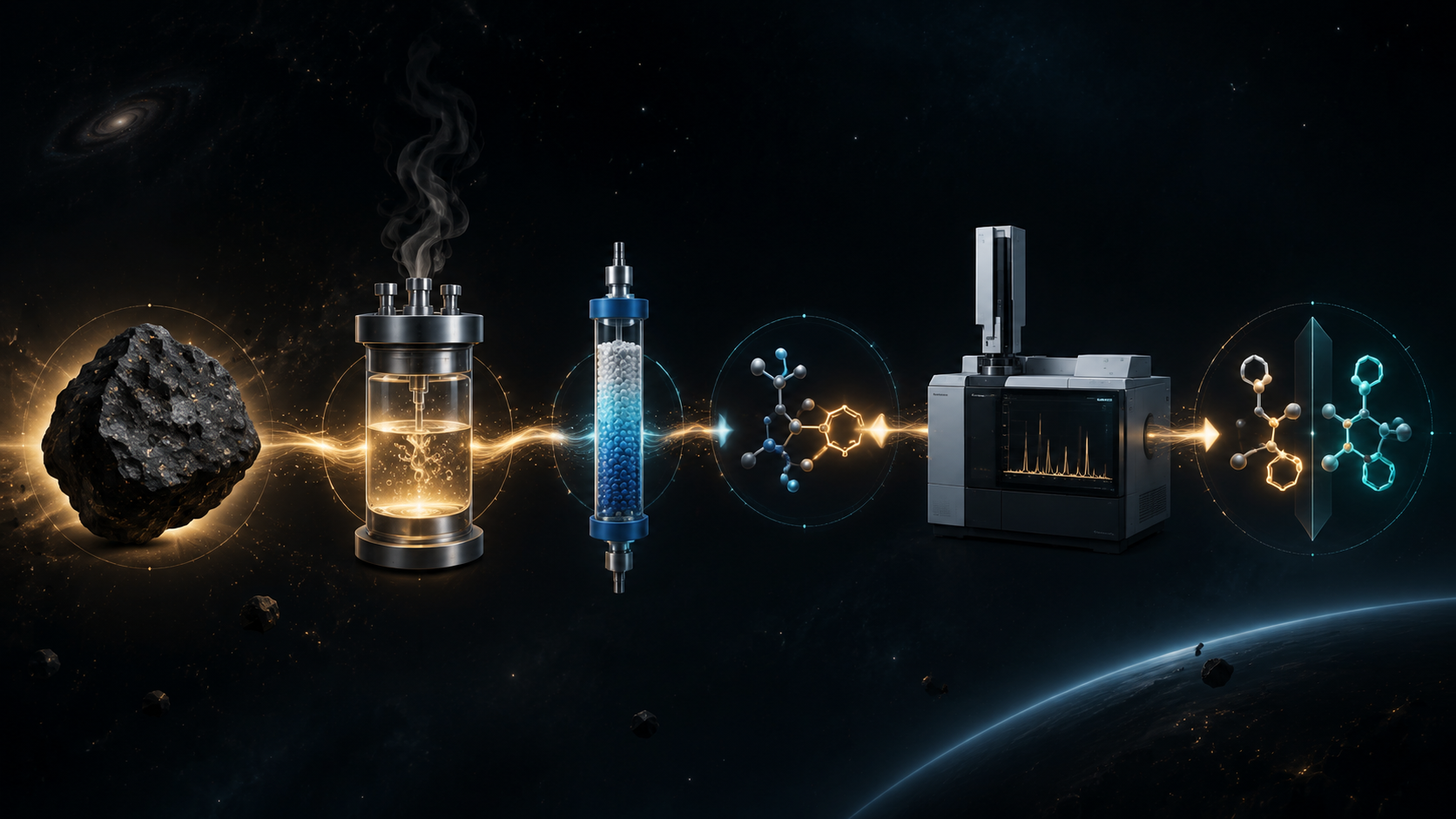
The useful way to follow the evidence is not as a treasure hunt for “life’s ingredients,” but as a narrowing series of lab decisions. A powdered sample is extracted. Salts and minerals are removed. Molecules are chemically prepared so instruments can separate and detect them. Mirror-image forms are compared. Isotope ratios are checked. At each stage, the claim becomes either cleaner or weaker.
| Lab stage | What it does | Why it matters for contamination |
|---|---|---|
| Hot-water extraction | Pulls water-soluble organic compounds out of powdered meteorite material | Creates a controlled extract instead of treating the whole rock as a black box |
| Cation-exchange desalting | Removes salts and concentrates target compounds such as amino acids | Prevents salts and minerals from swamping later measurements |
| Derivatization | Chemically modifies small molecules so they separate and detect better | Makes similar compounds easier to distinguish |
| GC-MS or LC-MS | Separates compounds and measures mass-related signatures | Identifies candidate molecules, but does not alone prove origin |
| Chiral and isotope analysis | Compares molecular handedness and isotope ratios | Tests whether the pattern looks extraterrestrial or plausibly terrestrial |
The First Trick Is Getting the Molecules Out Without Fooling Yourself
A carbon-rich meteorite is not dropped into a machine and read like a barcode. The soluble organic compounds have to be coaxed out of a solid mixture that contains minerals, salts, and a long record of thermal and aqueous history. A common method begins with powdered sample and hot water. In one detailed workflow for extraterrestrial soluble organics, meteorite material is extracted with water at 100–110°C for 24 hours.[3]
Hot water is doing a practical job here. Many of the compounds that matter for prebiotic chemistry, including amino acids, are polar and water-soluble. Heating increases extraction efficiency, while using a defined protocol lets researchers compare samples and controls rather than improvising a soup. The extract that comes off this step is not “proof of space organics.” It is the beginning of a controlled chemical fraction that can be tested.
This is also where blank controls matter. A blank is a sample-free run through the same containers, reagents, water, heating, and handling steps. If a compound appears in both the meteorite extract and the blank, the result has a problem. If the meteorite signal is distinct from the blank, the work can continue. The blank is not glamorous, but it is often the difference between a credible detection and a nice-looking chromatogram that should not be trusted.
Desalting Is Not Cleanup Busywork
After extraction, the sample is chemically crowded. Meteorites can contain inorganic salts and other matrix components that interfere with later analysis. In the Simkus et al. workflow, cation-exchange resin is used to desalt and concentrate amino acids and related compounds before instrumental analysis.[3]
A cation-exchange resin is useful because many amino acids can carry positive charge under the right chemical conditions. The resin holds onto those charged molecules while unwanted salts and other material can be washed away. Later, the retained compounds are eluted into a cleaner fraction. Students often want to jump straight to the mass spectrometer, but the mass spectrometer only performs as well as the chemistry fed into it. A dirty extract can hide peaks, distort signals, or make a weak contaminant look more important than it is.
Desalting also changes the evidentiary status of the sample. The lab is no longer asking whether anything interesting exists somewhere in a rock powder. It is asking whether a purified, targeted fraction contains molecules that behave like known amino acids, nucleobases, or other soluble organics under controlled analytical conditions.
Derivatization Makes Small Molecules Legible
Many amino acids are not naturally ideal for gas chromatography. They may be too polar, insufficiently volatile, or too similar to one another in their unmodified forms. Derivatization solves that problem by attaching chemical groups that make the compounds easier to separate and detect. For chiral work, derivatization can also help distinguish left- and right-handed forms of the same molecule.[3]
This step can sound like tampering if it is introduced too quickly. It is not changing the question from “what was in the meteorite?” to “what did the lab create?” The point is to transform target molecules in a predictable way so the instrument can read them. Standards are treated the same way, so the meteorite-derived derivatives can be compared against known compounds. If the standards, blanks, and sample derivatives do not line up properly, the identification should not be treated as secure.
GC-MS and LC-MS Separate Before They Identify
Gas chromatography-mass spectrometry and liquid chromatography-mass spectrometry are often mentioned as if they are single magic detectors. The names hide two different jobs. Chromatography separates compounds over time. Mass spectrometry then measures mass-to-charge patterns that help identify what came off the column.
In GC-MS, compounds travel through a gas chromatograph and emerge at different retention times. The mass spectrometer records fragmentation patterns or mass signals that can be compared with standards. LC-MS uses liquid chromatography, which is especially useful for compounds that are less volatile or less suitable for gas-phase separation. Simkus et al. describe both GC-MS and LC-MS approaches in the broader workflow for soluble organic compounds in extraterrestrial samples.[3]
A good match is not just one peak in the right neighborhood. Researchers want retention behavior, mass information, standards, and blanks to agree. Even then, GC-MS or LC-MS mainly answers the identification question: does this fraction contain a molecule consistent with the target compound? The origin question still needs stronger evidence.
A Compact Case: HMT in Meteorites
The discovery of hexamethylenetetramine, usually shortened to HMT, is a useful case because it stays at the right scale. NASA Goddard reported that HMT was identified in meteorites using hot-water extraction followed by GC-MS.[4] HMT matters because it can decompose into formaldehyde and ammonia under hydrothermal conditions, making it relevant to pathways that could feed prebiotic organic chemistry.[4]
That result is interesting without needing to be inflated. HMT is not life. It is not a fossil. It is not even an amino acid. It is a plausible precursor-type molecule whose presence helps chemists think about how more complex organic inventories could arise or transform in parent-body environments. The important lesson is methodological: a compound that had been difficult to see became detectable when extraction and GC-MS conditions were tuned carefully enough.
Isotope Ratios Ask Where the Carbon and Hydrogen Have Been
Once a molecule is identified, the next question is whether its atoms carry an extraterrestrial fingerprint. Isotope ratio analysis compares versions of elements that have different numbers of neutrons, such as heavier and lighter forms of carbon, hydrogen, or nitrogen. Terrestrial biology and extraterrestrial chemistry can leave different isotope patterns, so isotope ratios can help distinguish a molecule made or altered on Earth from one inherited from a meteorite parent body.
This is where the claim becomes much more demanding. A terrestrial amino acid contaminant can have the same molecular formula as an extraterrestrial amino acid. It can produce a convincing mass spectrum. It can even appear in the expected part of a chromatogram. But if its isotope ratios match ordinary terrestrial material rather than the meteorite’s extraterrestrial organic inventory, the interpretation changes.
The Ryugu analyses are important for exactly this reason. Researchers did not merely report amino acids as names on a list; they used isotopic evidence to support the conclusion that the detected amino acids were extraterrestrial in origin.[2] That is a narrower and stronger statement than saying an instrument “found life’s ingredients.” It says that specific compounds in a carefully handled sample have chemical signatures consistent with an asteroid source.
Chirality Is Fascinating, but It Is Not a Shortcut to Life
Many amino acids come in left- and right-handed forms, called enantiomers. Life on Earth uses mostly L-amino acids in proteins, so meteorite reports that discuss L-enantiomer excesses naturally attract attention. The careful version of the argument is more modest: if a meteorite contains more of one enantiomer than the other, and contamination controls and isotope data support an extraterrestrial source, that asymmetry may tell researchers something about chemical processes before biology.
It does not prove that life began in space. Enantiomeric excess can be suggestive, but it has to be interpreted alongside the sample’s alteration history, terrestrial exposure, analytical blanks, and isotope ratios. A left-handed excess in a meteorite is not the same thing as a living system choosing left-handed amino acids. It is a chemical pattern that may help constrain origin-of-life scenarios if the surrounding evidence is strong enough.
This is why chiral derivatization and chiral separation occupy such an important place in the workflow. They let researchers compare enantiomers directly rather than treating “alanine” or “isovaline” as a single undifferentiated label. The handedness result becomes one more line of evidence, not a verdict by itself.
Murchison Shows Why the Field Became So Demanding
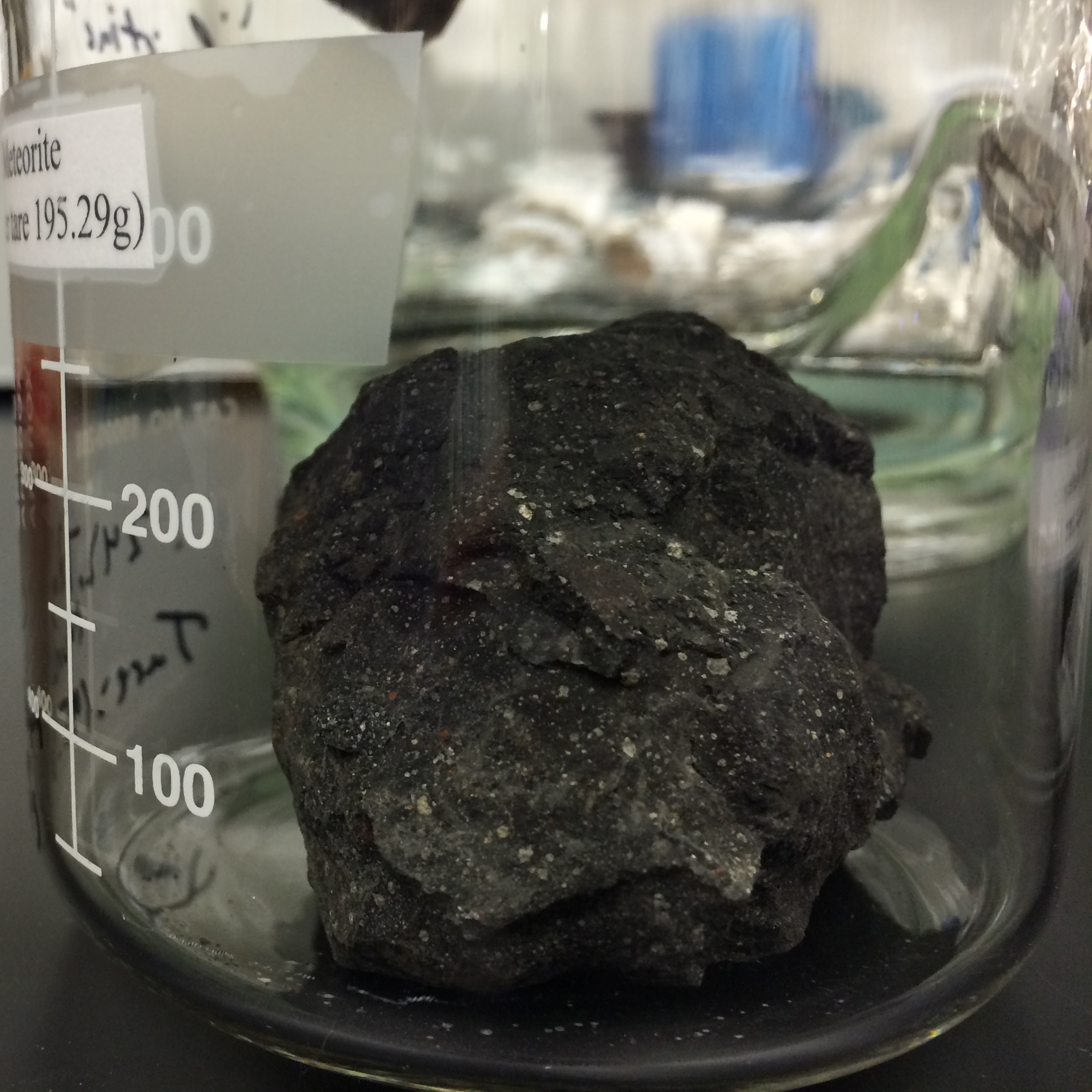
The Murchison meteorite, which fell in 1969, became one of the most famous carbonaceous meteorites for organic chemistry.[5] It helped establish that meteorites could contain diverse organic compounds, including amino acids. It also taught the field a less comfortable lesson: a meteorite that falls through Earth’s atmosphere, lands on Earth, and is collected by humans enters a planet already rich in organic molecules.
That does not make older Murchison work worthless. It means the standards of proof have had to improve. Earlier studies opened the question; later methods put more weight on blanks, compound-specific isotope ratios, chiral measurements, cleaner extraction procedures, and comparison with less contaminated material. Murchison is best understood as part of a historical trajectory rather than as a simple headline about amino acids in a space rock.
Bennu and Ryugu change the comparison because their samples were collected directly from asteroids and returned under controlled mission conditions. The same basic logic still applies—extract, clean, separate, identify, check isotopes—but the starting material is less entangled with Earth exposure. That is why sample return is so valuable for students trying to understand evidence quality, not just discovery drama.
Detection and Formation Are Related Questions, Not the Same Question
Analytical chemistry tells researchers what is present in a sample and how confidently they can interpret its origin. A different kind of study asks how such molecules might form. Fischer-Tropsch-type catalysis experiments, including work described by the Max Planck Society, explore whether simple starting materials reacting on mineral catalysts under relevant conditions can produce organic compounds connected to prebiotic chemistry.[6]
Those simulations are complementary, not interchangeable with meteorite detections. A lab experiment can make a pathway plausible, but it does not prove that a particular meteorite molecule formed that way. A meteorite analysis can show that a compound is present, but it does not automatically reconstruct the full chemical history that produced it. The two approaches become stronger when they constrain each other: real samples show what needs explaining, and simulations test which chemical routes deserve attention.
What a Careful Claim Sounds Like
A careful claim about meteorite organics usually has several parts. It names the compound class. It names the sample type and handling context. It describes extraction and cleanup. It reports how the molecule was identified. It says what the blanks showed. It uses isotope ratios, and sometimes chirality, to address origin. It avoids turning amino acids or nucleobases into evidence of life.
- Weak version: “Scientists found life in a meteorite.”
- Still too loose: “Scientists found life’s ingredients in a meteorite.”
- Stronger version: “Researchers identified specific soluble organic compounds in a meteorite extract using chromatographic separation and mass spectrometry, then used blanks and isotope data to evaluate whether the compounds were extraterrestrial.”
That stronger version is less flashy, but it is the one that can survive a lab meeting. It also leaves room for real excitement. Bennu, Ryugu, Murchison, and targeted compounds such as HMT are not interesting because they let us skip from chemistry to biology. They are interesting because they show that asteroids and meteorites can preserve organic inventories relevant to prebiotic chemistry, and that modern methods can sometimes separate those inventories from Earthly noise.
For readers who want the companion “what was found?” angle, A Student Guide to the Meteorite Building Blocks of Life and Did meteorites deliver the building blocks of life? cover the broader evidence. For a similar look at how method controls shape scientific trust in a very different setting, see How Scientists Study Legionella Prevention in Water Systems.
Modern meteorite chemistry can credibly detect extraterrestrial amino acids, nucleobases, and precursor molecules when the extraction, cleanup, separation, identification, isotope, and contamination evidence all line up. It has not detected life itself. It has not solved the origin of life in one chromatogram. The achievement is more disciplined than that: it shows how chemistry can turn a dark fragment of rock into a testable record of organic processes beyond Earth.
References
- NASA’s OSIRIS-REx discovery of all five DNA/RNA nucleobases and 33 amino acids in pristine Bennu samples, CNN, Jan. 2025
- Extraterrestrial amino acids and amines identified in asteroid Ryugu samples returned by the Hayabusa2 mission, Nature Communications, 2023
- Methodologies for Analyzing Soluble Organic Compounds in Extraterrestrial Samples, PMC, 2019
- Key Building Block for Organic Molecules Discovered in Meteorites, NASA Goddard, 2023
- Murchison Meteorite, NASA
- Fischer-Tropsch catalysis experiment, Max Planck Society, 2023
Applies to
Exam applicability isn't specified for this technique yet. See all exam hubs.
Comments
Join the discussion with an anonymous comment.