
How Scientists Study Legionella Prevention in Water Systems
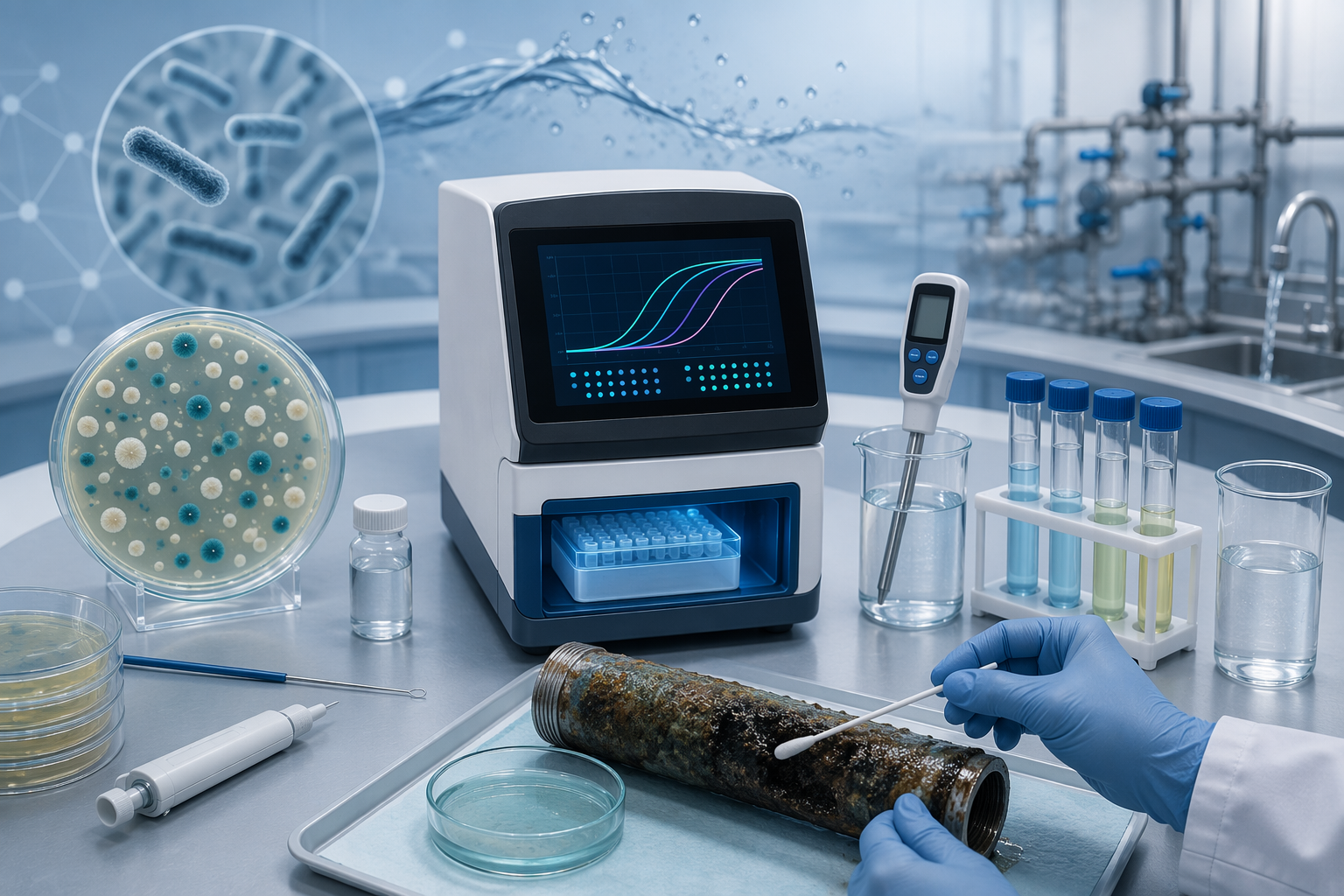
This explainer walks through the key research methods — culture, molecular detection, water quality profiling, and modeling — that scientists use to study Legionella prevention in building water systems. The 2024 Grand Rapids outbreak investigation (published in CDC Emerging Infectious Diseases) serves as a running case study to show how each method works and why combining them is essential.
Updated:
The Grand Rapids outbreak study begins with the kind of problem that makes Legionella prevention research difficult to read well: investigators were not just asking whether Legionella pneumophila could be found. They were trying to decide whether a prevention intervention was working inside a real water system while people were still at risk.
In 2024, an outbreak linked to a groundwater-supplied community water system in Grand Rapids, Minnesota, involved 34 cases of Legionnaires’ disease, 30 hospitalizations, and 2 deaths. Before the intervention, L. pneumophila was detected in 50% of premise plumbing samples, with concentrations reported up to 10^4 MPN/L. After chloramine disinfection was introduced, detection fell to 0% after 24 weeks, and investigators reported zero new cases after the intervention.[1]
That result is important, but the more useful lesson for students is how the investigators got there. They did not rely on one test and call the water safe. They used Legiolert culture, digital PCR targeting mip and wzm genes, qPCR, assimilable organic carbon testing, and temperature and chlorine profiling in parallel.[1] Each method answered a different question. Together, they made the prevention claim more defensible than any single measurement could have made it.
That is the main skill in reading a Legionella prevention study in water systems: separate what the method can see from what the conclusion claims. A culture result, a PCR result, and a temperature profile may all appear in the same table, but they are not measuring the same biological fact.
Start With the Question Each Method Can Actually Answer
Legionella prevention studies often sound operational: raise the temperature, maintain disinfectant, flush stagnant lines, change the secondary disinfectant, monitor high-risk fixtures. The methods underneath those recommendations are less tidy. A sample can be culture negative while genetic material is still detectable. A PCR result can rise after treatment because DNA from damaged or dead cells remains in the system. A distal outlet can meet a temperature target on one day and fail it after water sits in a long branch line.
A good study design does not make those disagreements disappear. It makes them interpretable. The usual toolkit can be read as a set of partial windows:
| Method | What it is best at showing | Main blind spot |
|---|---|---|
| Culture, including Legiolert or BCYE agar | Whether culturable viable Legionella are detected in a sample | Slow turnaround and missed viable-but-nonculturable cells |
| qPCR and digital PCR | Rapid detection and quantification of Legionella genetic targets | DNA detection does not prove the cells are alive or infectious |
| Temperature, disinfectant, pH, and AOC profiling | Whether water conditions favor growth, persistence, or suppression | Risk conditions are indirect evidence, not organism detection |
| Biofilm sampling | Whether organisms may persist on pipe or fixture surfaces | Sampling is technically difficult and may not represent the whole system |
| QMRA modeling | How exposure scenarios might translate into estimated health risk | Outputs depend on assumptions and input quality |
The Grand Rapids study is useful because it did not ask these methods to do the same job. Culture gave the clearest evidence about culturable L. pneumophila. Molecular methods gave faster genetic tracking. Water quality profiling explained why the system might have supported the organism before disinfection and why chloramine might have changed that environment.[1]
Culture Is Still the Anchor, but It Is Not Omniscient
Culture methods remain central because they answer the question public health investigations most want answered first: are viable, culturable Legionella present in the sample? In the Grand Rapids investigation, Legiolert was used to estimate L. pneumophila concentrations as most probable number per liter, which is why the pre-intervention result could be reported as detection in half of premise plumbing samples and up to 10^4 MPN/L.[1]
That kind of result has practical weight. It is not just a signal that some fragment of Legionella DNA passed through a filter. It suggests organisms were able to grow under the test conditions. When a prevention study reports a sustained drop in culture-based detection, it is giving evidence that the intervention reduced the culturable population captured by that sampling and incubation protocol.
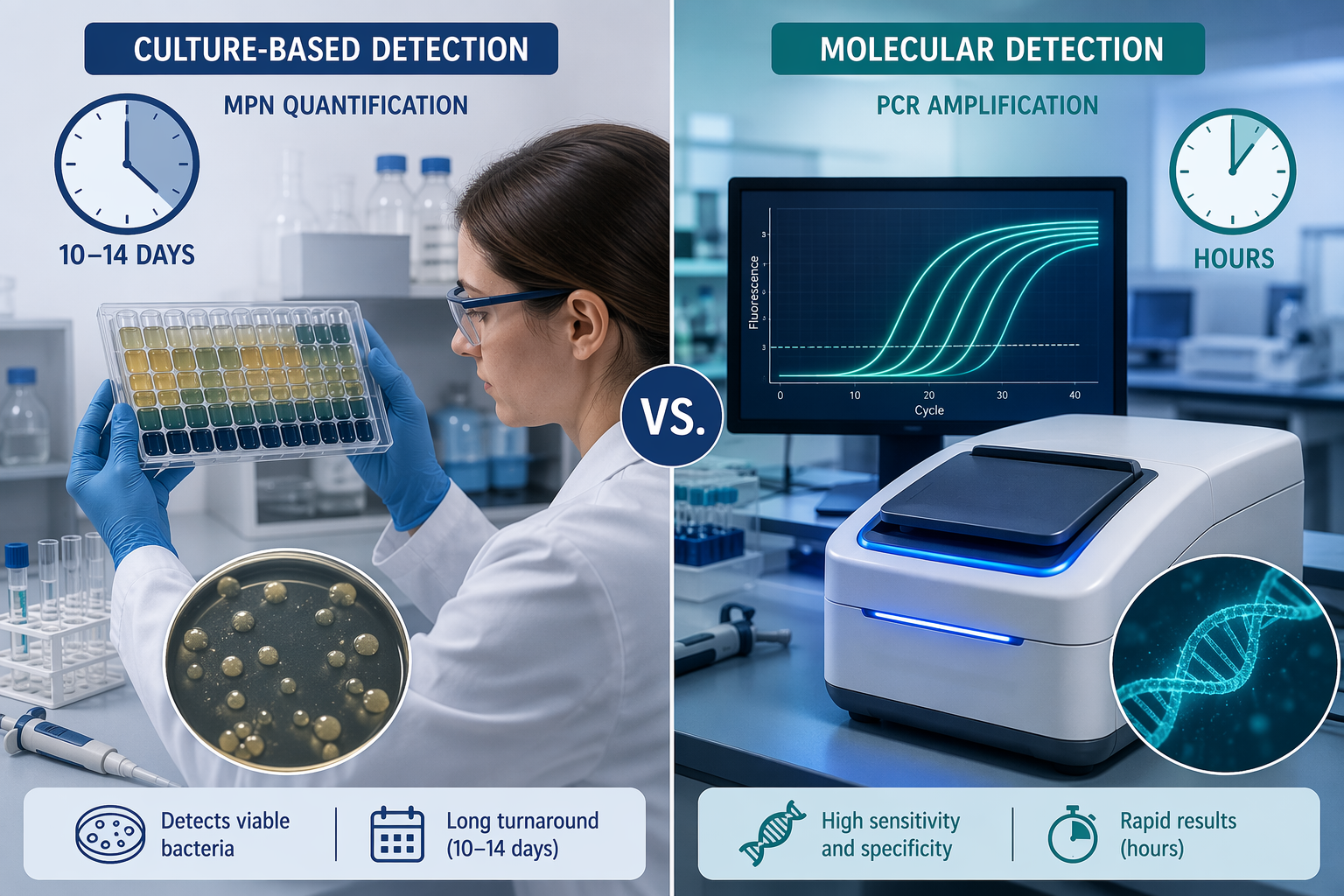
The delay matters. Culture methods such as Legiolert require 10–14 days, which is a long time during an active outbreak or a hospital investigation.[1] By the time the result is available, a building water manager may already have changed temperatures, flushed lines, replaced fixtures, or adjusted disinfectant. The result may still be valuable, but it is rarely a real-time steering wheel.
Culture also has a biological blind spot: viable-but-nonculturable Legionella. These cells may remain viable but fail to grow under standard culture conditions. Legionella management research consistently treats this as a reason not to equate culture-negative water with total absence of potential risk.[2] That distinction is not academic nitpicking. It changes how confidently a study can claim elimination.
There is also a unit problem that students should not skip. Culture studies may report colony-forming units per liter, most probable number per liter, or detection frequency across outlets. These numbers are related to organism recovery, but they are not interchangeable. A concentration result, a percentage of positive samples, and a before-after change across sites each support a slightly different inference.
Molecular Detection Is Fast, Sensitive, and Easy to Overread
Molecular methods are attractive for the obvious reason: speed. In a building investigation, waiting nearly two weeks for culture can feel mismatched to the urgency of the decision. qPCR and digital PCR can detect Legionella genetic targets much faster, and the Grand Rapids investigators used both molecular approaches alongside culture rather than choosing one as a replacement.[1]
Digital PCR in the Grand Rapids study targeted mip and wzm genes and could detect L. pneumophila at levels as low as 10^2.34 gene copies/L.[1] That sensitivity is useful when investigators want to follow a signal through a complex system or compare samples before and after an intervention. It can also catch evidence that culture might miss because the organism is stressed, injured, present at low levels, or not recovered well by the culture method.
The interpretive limit is just as important as the sensitivity. qPCR can amplify DNA from dead cells, so a positive molecular result does not automatically mean active infectious risk. The right reading is narrower: the target DNA was detected. To move from that statement to a claim about viable organisms, ongoing growth, or disease risk, a study needs supporting evidence from culture, water conditions, epidemiology, or another viability-informed method.
This is where many weak interpretations drift. “PCR positive” can become shorthand for “Legionella problem,” and “PCR negative” can become shorthand for “no problem.” Neither shortcut is safe. A molecular result is strongest when the study explains what gene target was used, how results were quantified, how inhibition was handled, and whether the molecular pattern agrees with culture or environmental conditions.
In the Grand Rapids case, molecular testing did not need to carry the whole conclusion. It sat beside culture and water chemistry. That matters because the study’s prevention claim was not based on a single fast test; it was based on convergence across methods after chloramine was introduced.[1]
Water Quality Profiling Explains Why Detection Changes
Detection methods answer whether Legionella or its genetic material was found. Water quality profiling asks a different question: are the conditions in this system friendly or hostile to persistence? That bridge is easy to undervalue because temperature logs, disinfectant residuals, pH, and organic carbon do not look as dramatic as a positive organism result. But without them, a prevention study can show a change without explaining why it happened.
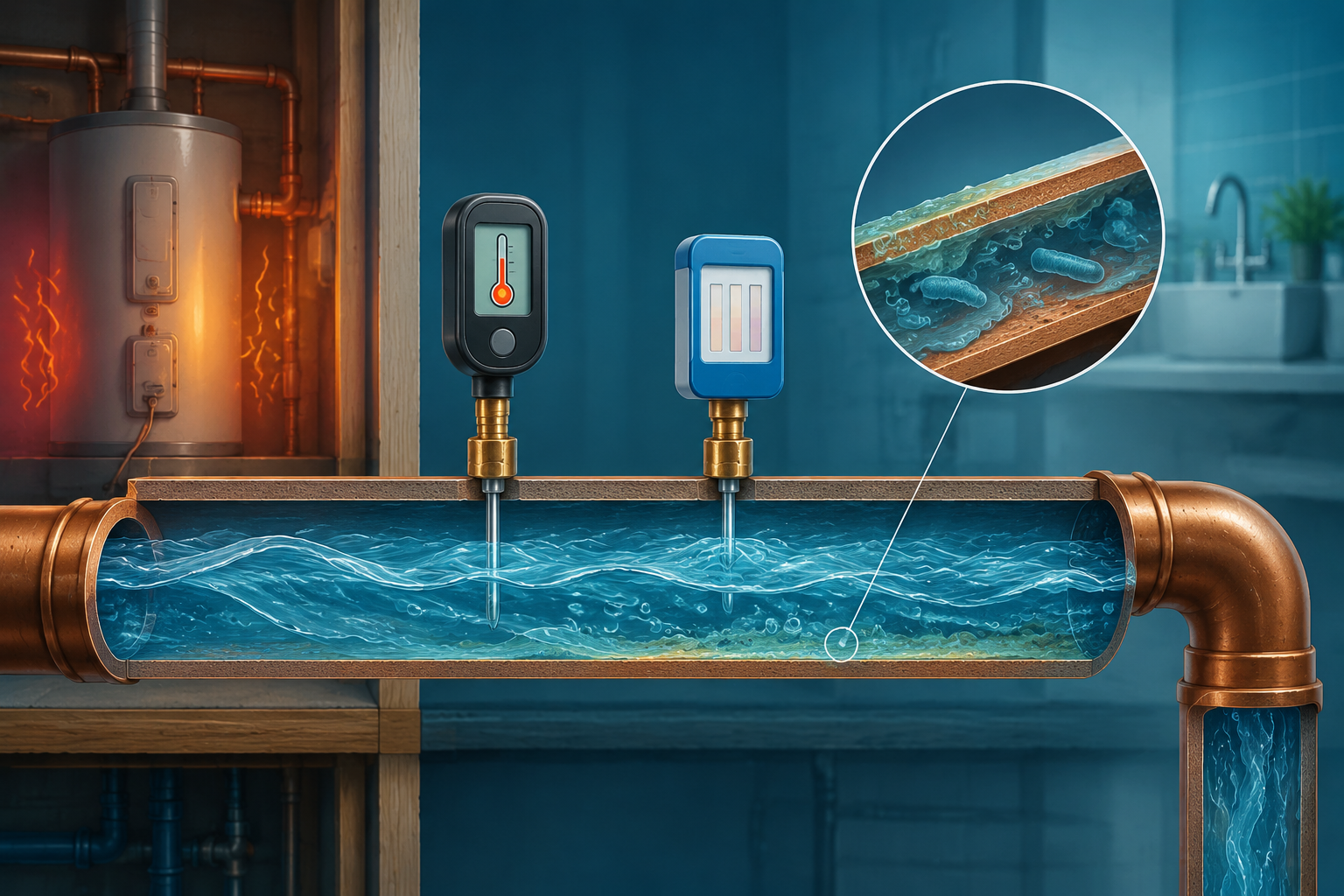
Temperature is the most familiar example. The National Academies report identifies temperature control as a paramount strategy and recommends maintaining water above 60°C at the heater and above 55°C at distal points.[2] Those values are not decorative thresholds. They tell the reader where a sample sits in relation to conditions expected to suppress Legionella growth.
The distal point matters because the water heater is not the whole building. A heater can be hot while remote taps, recirculation loops, dead legs, storage tanks, or low-use areas cool into a more permissive range. A study that measures only central heater temperature may describe the equipment setting but miss what organisms experience near outlets where exposure occurs.
Disinfectant residuals require the same caution. In Grand Rapids, the central intervention was chloramine disinfection of a groundwater-supplied community water system. The observed disappearance of L. pneumophila detection after 24 weeks is impressive, and it is consistent with older epidemiologic evidence reviewed by the National Academies, including a reported 10.2-times higher odds of nosocomial outbreak with free chlorine than with monochloramine.[1][2]
Still, that does not turn chloramine into a universal answer for every premise plumbing system. The Grand Rapids result came from one outbreak investigation in one community water system. Its strength is that it combined microbiology, molecular testing, water quality measurements, and case surveillance. Its boundary is that it was not a multi-site randomized trial.
Assimilable organic carbon is the quieter variable in the case, and possibly the one students should linger over. AOC is the fraction of organic carbon that microbes can readily use for growth. The stability benchmark is below 10–20 µg/L, and Grand Rapids groundwater routinely exceeded that benchmark.[1] In plain terms, the water carried enough usable carbon to help explain why microbes could persist if disinfectant and temperature control were not enough.
AOC is especially useful because it connects water chemistry to biological plausibility. A culture result tells the reader what grew from a sample. AOC helps explain whether the water itself may support regrowth. Yet AOC is rarely monitored in U.S. water systems despite its value as a risk predictor.[1] That gap makes prevention studies thinner than they may look when they include only organism detection and a disinfectant measurement.
pH and biofilm relevance sit in the same interpretive layer. pH can affect disinfectant chemistry. Biofilms can protect organisms from disinfectant and create microenvironments that do not match bulk water readings. A study that samples only flowing water at a tap may miss organisms embedded on surfaces, while a biofilm sample may be hard to generalize across an entire plumbing network.
Why Real Studies Produce Messy Method Results
Students often expect methods to validate one another neatly: culture positive, PCR positive, warm water, low disinfectant; then after intervention, everything reverses. Field studies rarely behave that cleanly. Plumbing systems have variable water age, intermittent use, pipe materials, mixed temperatures, fixture-level differences, and biofilms that do not release organisms uniformly.
A culture-negative, PCR-positive sample is not automatically a contradiction. It may mean dead-cell DNA remains after treatment. It may mean cells are viable but not culturable under the chosen conditions. It may reflect low organism abundance, sample heterogeneity, or method sensitivity. The study’s job is not to force a single interpretation; it is to show which explanation is most consistent with the full dataset.
A warm distal temperature with no Legionella detection is also not a guarantee of safety. It may reflect a real low-risk condition at the time of sampling, or it may reflect missed biofilm reservoirs, recent flushing, limited sample volume, or ordinary spatial variability. Conversely, detection at one outlet does not prove the whole building is colonized at the same level.
The National Academies report gives a useful benchmark for culture interpretation by identifying 5 × 10^4 CFU/L as an action level.[2] But action levels do not remove the need to understand sampling design. A result above or below a threshold means less if the study does not explain where samples were collected, why those sites were chosen, whether first-draw or flushed samples were used, and how often sampling occurred.
The Building Itself Is Part of the Evidence
Legionella prevention evidence is conditional because buildings are conditional. The same disinfectant strategy can perform differently depending on water age, pipe layout, hot water temperatures, fixture use, and incoming water quality. That is why a prevention study that ignores building context is hard to interpret, even if its laboratory methods are strong.
Green building design creates one of the more awkward examples. Water conservation measures can increase water age, and lower hot water temperatures can make premise plumbing more permissive for Legionella. The National Academies report explicitly recommends against low-flow fixtures in hospitals because of these concerns.[2] The point is not that conservation goals are wrong; it is that plumbing design can change microbial risk conditions in ways a prevention study has to measure rather than assume away.
This is also why broad prevalence numbers need careful handling. AIHA reported in 2026 that Legionella colonizes 12–70% of building water systems and about 50% of U.S. hospitals.[3] Those figures explain why the problem is common enough to justify serious prevention research. They do not tell the reader whether a specific intervention will work in a specific building, or whether detection in a particular system translates into disease.
Regulation and Guidance Help, but They Are Not Study Results
Guidance documents are useful because they translate accumulated evidence into water management practices. The CDC potable water systems toolkit points building teams toward structured water management programs and references ASHRAE Standard 188.[4] For a student reading primary research, though, guidance should not be mistaken for direct evidence that a particular measured intervention caused a particular observed decline.
Regulations have the same limitation. AIHA’s 2026 discussion of prevention efforts includes New York City cooling tower regulations and the 2025 Harlem outbreak, which involved 114 cases, 90 hospitalizations, and 7 deaths.[3] Those events are relevant because they show how severe failures can be even in places with oversight. They do not replace system-specific sampling, method interpretation, or exposure investigation.
Grand Rapids adds another regulatory wrinkle: the outbreak was linked to a groundwater-supplied community water system, and the study notes that no federal requirement exists for disinfection of groundwater systems. More than 250 undisinfected community water systems remained in Minnesota alone.[1] That context helps explain why the chloramine intervention mattered, but it still leaves the method question intact: how did investigators show the intervention changed microbial and environmental conditions?
Where Modeling Fits
Quantitative microbial risk assessment, or QMRA, sits downstream from measurement. It can estimate how different exposure scenarios might change health risk, especially when direct disease outcomes are rare, delayed, or difficult to attribute. For Legionella, that can mean combining assumptions about organism concentrations, aerosol exposure, inhalation, and dose-response relationships.
The appeal is obvious: modeling can compare scenarios that would be impractical or unethical to test directly. The weakness is equally obvious once the model is opened. If the concentration data come from limited sampling, if viability is uncertain, or if exposure assumptions are poorly matched to the building, the model can look more precise than the evidence deserves.
The 2025 FEMS Microbiology Reviews foresight article treats improved Legionella management as a continuing research agenda rather than a solved technical problem.[5] That framing is helpful for modeling, genomics, viability methods, and premise plumbing studies generally. Better tools may narrow uncertainty, but they will not remove the need to ask what each method actually measured.
How to Read a Prevention Claim Without Overstating It
When a study says an intervention helped prevent Legionella in a water system, the first check is not whether the conclusion sounds reasonable. It is whether the measurements line up with the conclusion’s scope. A claim about eliminating culturable L. pneumophila needs culture evidence. A claim about reducing genetic signal needs molecular evidence. A claim about changing growth conditions needs water quality evidence. A claim about preventing disease needs epidemiologic evidence, and even then attribution has to be handled carefully.
The Grand Rapids study makes a strong case within its boundaries because several things moved together: the outbreak investigation identified the water system link, premise plumbing samples were frequently positive before intervention, chloramine was introduced, L. pneumophila detection fell to 0% after 24 weeks, and no new cases were reported after the intervention.[1] That is much stronger than a study that reports only a pre-post PCR change or only a disinfectant adjustment.
Its boundaries are just as important. It was a single outbreak investigation. It supports the conclusion that chloramine disinfection was effective in that setting and is consistent with earlier evidence favoring monochloramine in some contexts.[1][2] It does not prove that every groundwater system, every hospital, or every building with Legionella detection will respond the same way.
A useful reading sequence is simple: identify the method, identify the claim, then look for mismatch. If culture is absent, be cautious about statements on viable organisms. If molecular methods are absent, ask whether low-level or nonculturable signals could have been missed. If water quality data are absent, ask how the study explains persistence or control. If sampling locations are vague, ask whether the measured water represents the exposure points that matter.
The best Legionella prevention studies are not the ones with the most dramatic outbreak numbers. They are the ones that make uncertainty visible enough to judge. Culture, molecular detection, and water quality profiling each leave gaps, but the gaps are different. A prevention claim becomes stronger when those methods are combined, when their disagreements are explained rather than hidden, and when the conclusion stays proportional to what the evidence could actually see.
References
- Effect of Chloramine Disinfection of Community Water System on Legionnaires’ Disease Outbreak, Minnesota, USA, 2024. Emerging Infectious Diseases, January 2026.
- Management of Legionella in Water Systems. National Academies of Sciences, Engineering, and Medicine, 2019.
- Assessing Legionella Prevention Efforts. AIHA, June 2026.
- Potable Water Systems Toolkit. CDC.
- Foresight 2035: a perspective on the next decade of research on the management of Legionella spp.. FEMS Microbiology Reviews, 2025.
Comments
Join the discussion with an anonymous comment.