
The MCAT Anki Workflow: How to Turn Practice Questions Into High-Value Flashcards
A step-by-step guide for intermediate pre-med students who use Anki but aren't seeing score improvements. Learn how to close the loop between practice questions and card creation to build application-level retention and boost your MCAT score.
Deck Sources
Why 'Doing Anki' Doesn't Always Mean 'Improving'
You've been grinding Anki for weeks. Your review count is green, your retention stats look respectable, and you can recite the steps of glycolysis in your sleep. Then you sit down for a full-length practice test, hit a passage on renal physiology, and freeze. The numbers on the screen don't reflect the hours you logged in the app.
This experience is common enough that it has a pattern behind it. According to observations reported by Residency Advisor, students who rely on Anki as their primary or only study method tend to score in the low 500s, while those who use a balanced approach that includes active practice testing average around 513. That gap — roughly 11 points — isn't about how many cards you've seen. It's about what kind of cards you're reviewing and where those cards came from.
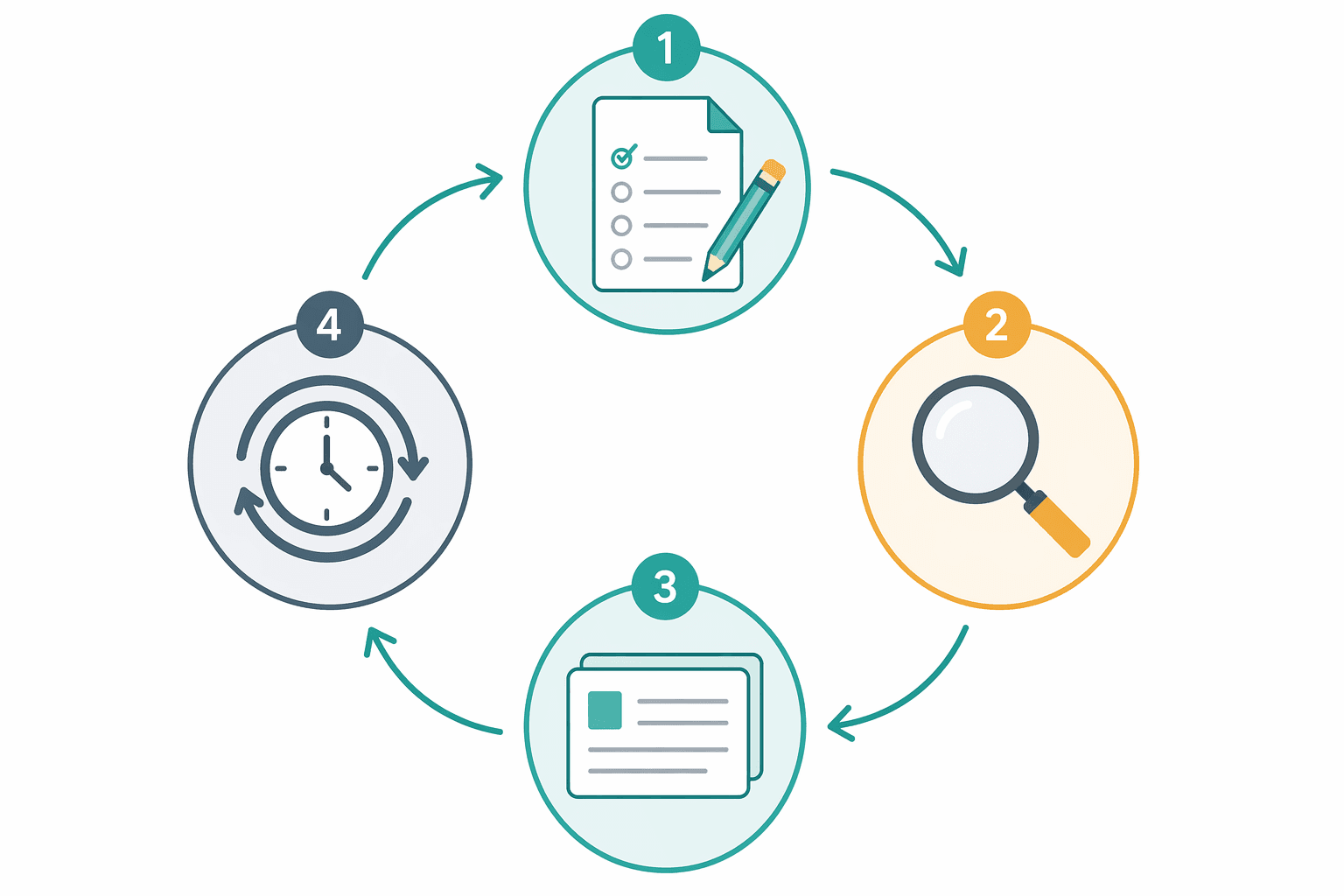
The core thesis of this guide is straightforward: the highest-leverage Anki workflow for MCAT score improvement is a closed loop. You do practice questions, identify the conceptual mistakes behind your misses, create one to three targeted Anki cards from those mistakes, and review those cards at spaced intervals. Then you repeat the cycle. This method directly connects your retention work to the patterns the MCAT actually tests — not the patterns a deck creator assumed you would need.
If you are an intermediate Anki user who already has a base deck and understands spaced repetition basics, this workflow is the missing link between passive review and passage-level performance. The rest of this article walks through every stage of the loop with concrete examples, templates, and a maintenance schedule you can start using today.
The Problem with Pure Content-Review Decks
Premade MCAT decks — MilesDown, AnKing, JackSparrow, Aidan — are excellent tools for building foundational knowledge. They cover the high-yield facts, definitions, and pathways that form the floor of your MCAT preparation. If you haven't yet chosen a base deck, the site's comparison of MCAT Anki decks can help you pick the right one for your timeline and score goal.
But here is the limitation that no premade deck can solve: the MCAT does not test your ability to recall isolated facts. It tests your ability to apply those facts to novel passages, interpret data, and reason through multi-step problems. A cloze deletion that asks you to fill in the name of an enzyme is testing recognition, not application. When you encounter that enzyme in a passage about a metabolic disorder, your brain has to do something fundamentally different from what it does during card review.
The Jack Westin guide to effective Anki use (February 2026) frames this problem clearly: students who treat Anki as a content-review treadmill — unsuspend a chapter's worth of cards, review them until the due count hits zero, then move to the next chapter — are training their brains to recognize facts in the context of a flashcard. That context is almost nothing like the context of a 10-question MCAT passage. The result is a painful mismatch between review stats and practice test performance.
This is not an argument against using premade decks. It is an argument for supplementing them with a second layer of cards that come directly from your own mistakes. The premade deck gives you the vocabulary. The practice-to-card loop gives you the grammar.

The Practice-to-Card Workflow: A Step-by-Step Guide
The practice-to-card loop has four stages. Each stage is simple on its own, but the power comes from executing them in sequence without shortcuts.
Stage 1: Do Timed Practice Questions
The Jack Westin workflow recommends 2 to 4 sets of timed practice questions per week. Each set should mimic test conditions: timed, no distractions, no pausing to look up an answer. Use AAMC material, UWorld, or third-party question banks that match the MCAT style. The goal is not to get through as many questions as possible — it is to generate high-quality mistakes that reveal your conceptual weak points.
Stage 2: Identify Conceptual Mistakes
After each set, review every missed question deeply. Do not just read the explanation and move on. Ask yourself: Did I miss this because I didn't know the fact, or because I couldn't apply the fact in this passage context? Did I confuse two similar concepts? Did I misread a graph axis? The Residency Advisor article emphasizes that the most valuable cards come from questions where you understood the topic in isolation but failed under passage pressure. Those are the gaps that premade decks cannot fill.
Stage 3: Create 1–3 Targeted Anki Cards
For each missed question, create one to three new Anki cards. Not ten. Not zero. One to three. The Jack Westin guide explicitly recommends this range as a way to force precision: if you cannot capture the mistake in three cards or fewer, you probably haven't identified the actual gap yet. Each card should target a single concept or relationship that, if you had it locked in, would have prevented the mistake.
Stage 4: Review with Spaced Repetition
Add the new cards to your daily review rotation. The Jack Westin article suggests capping daily new cards at 0 to 20 and total daily Anki time at 15 to 40 minutes. If you are in the thick of practice-test season, you may want to set new cards to zero on test days and let the algorithm surface only the cards that are due for review. The spaced repetition system — whether SM-2 or the newer FSRS algorithm — will handle the timing. Your job is to feed it the right cards.
Then repeat. The loop is continuous. Every practice session feeds new cards into the system, and every review session strengthens the connections that will surface on test day.
What Makes a Mistake 'Anki-Worthy'?
Not every missed question deserves a card. If you can distinguish between mistakes that are worth encoding and mistakes that are not, you will keep your deck lean and your review time efficient.
Mistakes That Deserve a Card
- Conceptual errors: You thought the proximal convoluted tubule reabsorbs glucose via active transport, but you confused it with the mechanism in the small intestine. This is a specific, fixable gap.
- Recurring patterns: You missed three questions in a row about acid-base compensation because you keep mixing up respiratory and metabolic causes. That pattern needs a card.
- Application failures: You knew the definition of Vmax but could not interpret a Lineweaver-Burk plot under time pressure. The card should test the graph interpretation, not the definition.
Mistakes That Do Not Deserve a Card
- Careless errors: You misread 'excreted' as 'reabsorbed.' That is a reading-speed issue, not a knowledge gap. No card will fix it — timed practice will.
- One-off trivia: You missed a question about the year a specific study was published. The MCAT does not test trivia. Let it go.
- Calculation slip: You inverted a fraction in a physics problem. A card about the formula is fine, but a card about the arithmetic error is not useful.
| Mistake Type | Anki-Worthy? | Example Card Idea |
|---|---|---|
| Conceptual confusion | Yes | "What distinguishes primary from secondary active transport in the nephron?" |
| Careless misreading | No | None — practice pacing instead |
| Recurring pattern across questions | Yes | "Which acid-base disorder presents with low pH and low HCO3-?" |
| One-off obscure fact | No | None — unlikely to repeat |
| Application failure on a known concept | Yes | "If [S] is doubled and Vmax stays the same, what changed?" |
Card Templates for Application-Level Retention
The format of your card matters as much as the content. A well-designed application-level card can replace five cloze fact cards because it forces you to reason through a relationship rather than recall a single word. The Residency Advisor article gives a clear example: a bad card asks 'List the steps of glycolysis,' while a better card asks 'What enzyme catalyzes the rate-limiting step of glycolysis?' The difference is precision and application pressure.
Below are three card templates that go beyond basic cloze deletions. Use them as starting points and adapt them to the specific mistakes you are capturing.

Template 1: Cause-Effect Cards
These cards test your understanding of directional relationships. They are especially useful for physiology, biochemistry, and organ system questions.
- Front: 'If aldosterone secretion increases, what happens to potassium excretion in the distal tubule?'
- Back: 'Potassium excretion increases (because aldosterone upregulates Na+/K+ ATPase and ENaC, increasing the electrochemical gradient for K+ secretion).'
- Why it works: It tests a mechanism, not a definition. You cannot answer it by recognizing a single word.
Template 2: Direction-Change Cards
The MCAT loves to ask what happens when a variable is increased or decreased. These cards train you to think in terms of shifts rather than static facts.
- Front: 'If the partial pressure of CO2 in the blood increases, what happens to blood pH and bicarbonate concentration (immediate vs. compensated)?'
- Back: 'pH decreases immediately (more H+ from carbonic acid). Bicarbonate increases over time as the kidneys compensate by retaining HCO3-.'
- Why it works: It forces you to separate immediate effects from compensatory responses — a classic MCAT trap.
Template 3: Passage-Style Recall Cards
These cards simulate the kind of reasoning you will need to do when reading a passage. They are longer than standard cards but train a different cognitive muscle.
- Front: 'A patient with a genetic defect in GLUT4 translocation presents with postprandial hyperglycemia. Which hormone signaling pathway is most likely impaired?'
- Back: 'Insulin signaling (insulin stimulates GLUT4 vesicle fusion with the plasma membrane in adipose and muscle tissue).'
- Why it works: It presents a clinical scenario and asks you to connect the symptom to the underlying mechanism — exactly what the MCAT does.
Tagging and Filtered Decks for Targeted Weekly Reviews
As your deck grows, you need a way to isolate cards by source and topic. The Jack Westin article recommends tagging every card you create with the resource it came from — AAMC, UWorld, Kaplan — and the relevant MCAT topic (e.g., 'Biology: Endocrine,' 'Chemistry: Acid-Base'). This tagging system lets you run targeted reviews that focus on your weakest areas.
Here is how to set up a filtered deck for a weekly weakness review:
- Create a tag for each resource: 'AAMC_questions', 'UWorld_questions', 'Kaplan_questions'.
- When you create a card from a missed question, add the appropriate resource tag and a topic tag (e.g., 'Bio_Cardiovascular').
- At the end of each week, create a filtered deck in Anki that pulls only cards tagged with the resource you struggled with most that week.
- Set the filtered deck to show a maximum of 20–30 cards. Review them in one focused session.
- After the session, delete the filtered deck (the cards remain in your main deck with their original scheduling).
If you need help configuring filtered decks or adjusting your Anki settings, the site's step-by-step Anki settings tutorial covers the setup in detail, including FSRS configuration for users on Anki 24.04 or later.
Monthly Deck Cleanup: Delete, Merge, Rewrite
A deck that never gets cleaned up becomes a liability. Cards that were useful in month one become obvious by month three. Duplicate cards accumulate. Poorly worded cards waste review time because you spend more time parsing the question than answering it.
The Jack Westin article recommends a monthly deck maintenance session. Set aside 30 minutes at the end of each month to go through your deck with a critical eye. Here is a simple checklist:
- Delete cards that have become obvious. If you can answer a card without thinking, it is no longer adding value. Remove it to keep your daily review count manageable.
- Merge duplicate cards. If you created two cards that test the same concept from different practice questions, keep the better-worded one and delete the other.
- Rewrite confusing cards. If a card's wording makes you pause to figure out what it is asking, rewrite it. The goal is instant recognition of the question, not a puzzle.
- Check for orphan tags. If you have a tag with only one or two cards, consider whether those cards should be merged into a broader topic tag.
A lean, high-quality deck of 500 application-level cards will serve you better than a bloated deck of 3,000 cards that you are skimming through without engagement. Monthly cleanup is not optional — it is the maintenance that keeps the practice-to-card loop efficient.
Putting It All Together: Your Practice-to-Card Workflow Template
Here is the complete workflow as a single actionable template. Print it, save it, or pin it to your study space. Each week, run through these steps in order.
- Complete 2–4 timed practice question sets (AAMC, UWorld, or third-party).
- Review every missed question. Separate conceptual errors from careless errors.
- For each conceptual error, create 1–3 Anki cards using the cause-effect, direction-change, or passage-style templates.
- Tag each new card by resource (AAMC, UWorld) and topic (e.g., 'Bio_Endocrine').
- Add the cards to your daily review rotation. Cap new cards at 0–20 per day and total Anki time at 15–40 minutes.
- At the end of each week, run a filtered deck review targeting your weakest resource or topic.
- At the end of each month, spend 30 minutes cleaning up: delete obvious cards, merge duplicates, rewrite confusing ones.
This workflow is documented in high-scorer interviews across multiple sources and is the method many 515+ scorers use to bridge the gap between content review and passage performance. It is not a shortcut — it is a systematic way to make every minute you spend on Anki count toward the skills the MCAT actually rewards.
Related Resources
- How to Use Spanish Alphabet Flashcards: 6 Evidence-Based Study Techniques That Actually Work →
Owning Spanish alphabet flashcards is only the first step. This guide presents six research-backed study techniques — from active recall and spaced repetition to sentence expansion — that turn flashcard exposure into real pronunciation skills and long-term retention for self-directed learners and homeschooling parents.
- Best AI Flashcard Makers Compared (2026): Which Tool Saves the Most Time While Maximizing Retention? →
A neutral, comprehensive comparison of 11 AI flashcard tools for students actively evaluating their options. This guide covers input formats, AI card quality, spaced repetition algorithms, pricing, and platform support, with a focus on the critical gap between tools that produce shallow definition-recall cards versus application-level questions.
- Spanish Alphabet Flashcards for Adult Learners: Digital SRS Tools, Anki Decks, and How to Go Beyond ABC Memorization →
A methodology guide for adult Spanish learners (16+) who want to use digital SRS tools like Anki, Refold decks, and StudyCards AI to master the alphabet efficiently. Covers sound-to-letter mapping, sustainable study pacing, and how to transition to sentence-mining for real fluency.
Comments
Join the discussion with an anonymous comment.