
The Best MCAT Anki Deck for Your Timeline, Score Goal & Learning Style
Choosing the right MCAT Anki deck depends on your study timeline, target score, and preferred card format. This decision-first guide helps you pick the best deck or combo for your personal situation, from MileDown to AnKing to Aidan.
Deck Sources
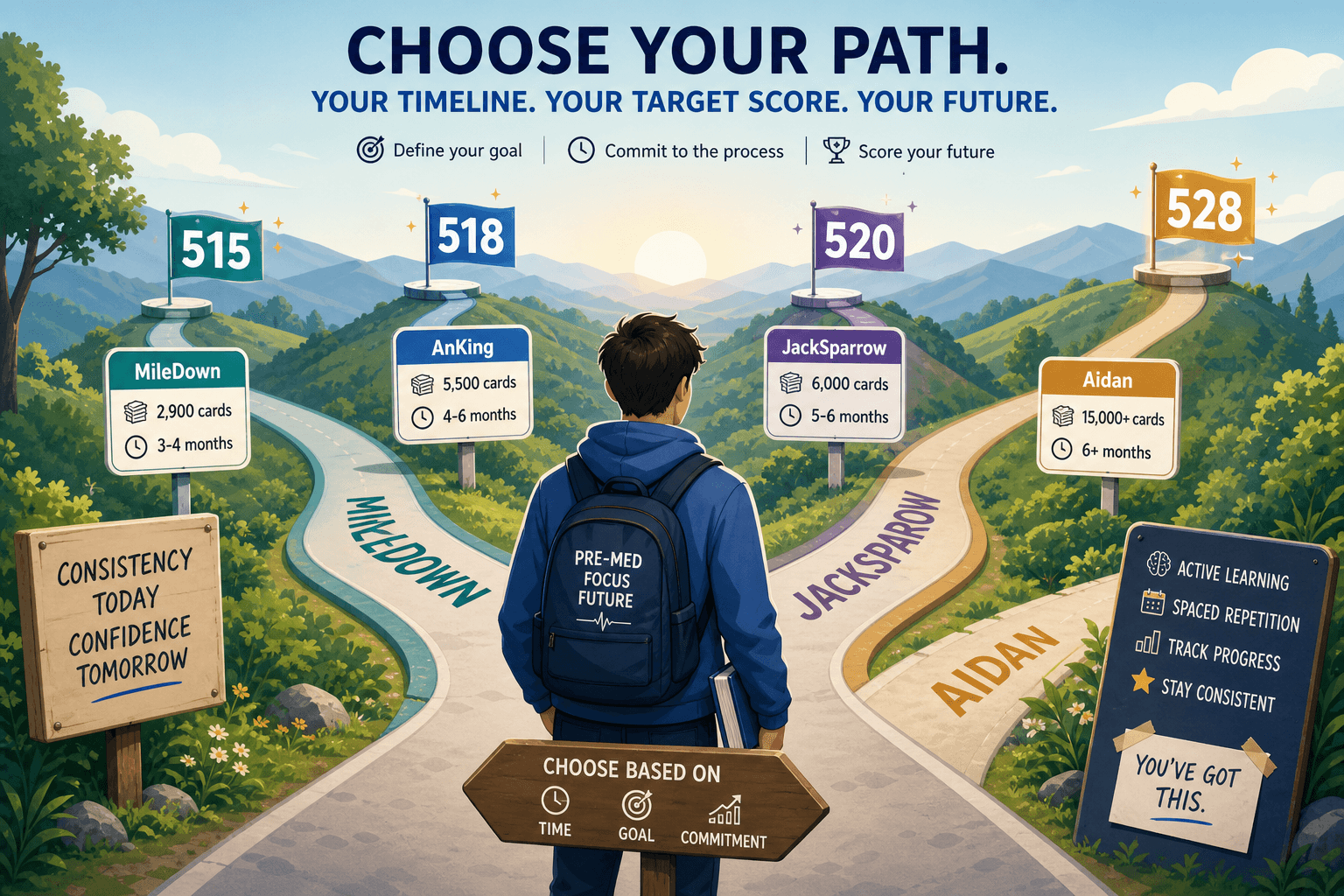
Start Here: 3 Questions to Find Your Perfect Deck
There is no single "best" MCAT Anki deck. The deck that launched a classmate to a 520 will bury you in review cards if you only have three months. The deck your premed advisor recommended might use a card format that doesn't stick in your brain. A 2026 meta-analysis of 21,415 learners (PubMed, standardized mean difference = 0.78) confirmed that spaced repetition dramatically outperforms standard study methods — so Anki itself is a proven tool. But which deck you load into it depends entirely on your personal constraints.
Before you download anything, answer these three questions:
- How many months do you have before test day? (Timeline) — 3–4 months? 6 months? More? This sets a hard ceiling on how many new cards you can sustainably learn per day.
- What is your target score? — Aiming for 505–510 on a tight timeline? 515+ with room to go deep? 520+ where no topic is too low-yield? Smaller decks focus on high-yield content; massive decks cover every corner of the AAMC outline.
- Do you prefer cloze deletion or basic Q&A format? — Cloze cards (fill-in-the-blank) are faster to review but can encourage passive recognition. Basic cards (question on front, answer on back) force recall from scratch. Most decks favor one format, and switching mid‑prep can be jarring.
Deck Profiles: Key Stats at a Glance
The table below captures the essential numbers for the most popular MCAT Anki decks. Use it as a quick reference when you narrow down your choices in the next section.
| Deck | Card Count | Upload Year | Format | Source Materials | Update Status | Score Claims (self-reported) |
|---|---|---|---|---|---|---|
| MileDown | ~2,900 | 2018 | Cloze + images | Khan Academy, Kaplan | Static (no updates) | N/A |
| JackSparrow2048 | 5,978 | 2020 | Basic Q&A | Kaplan, Khan Academy | Static (no updates) | Creator scored 527 |
| AnKing (AnkiHub) | ~5,500 | 2024 (active) | Mixed, cloze-heavy | MileDown, Abdullah, Coffin, MrPankow | Weekly updates via AnkiHub | N/A |
| Aidan | 15,000+ | 2022 | Cloze | Kaplan, Khan Academy, UWorld, Altius, Blueprint | Static (no updates) | N/A |
| Bouras | 13,333+ | 2020 | Cloze, hierarchical tags | JackSparrow, MileDown, Ortho528, PsychAnswers4U | Static (no updates) | N/A |
| Ortho528 | 4,351 | 2021 | Cloze | Kaplan | Static (no updates) | Creator scored 132 on all sections |
| Mr. Pankow (Psych/Soc) | 2,200 | 2023 | Cloze | Khan Academy, UWorld, AAMC | Static (minor updates) | Users report 5+ point score improvements |
| Abdullah | 16,000 | 2022 | Cloze | Multiple sources | Static (no updates) | N/A |
Notice that only the AnKing deck is actively maintained with weekly community updates. Static decks like MileDown or JackSparrow were created years ago and may contain errors, outdated references, or incompatibilities with the current AAMC content outline. That doesn't mean they're unusable — it means you'll need to verify and update cards yourself.
Decision Matrix: Matching Decks to Your Timeline, Score Target & Learning Style
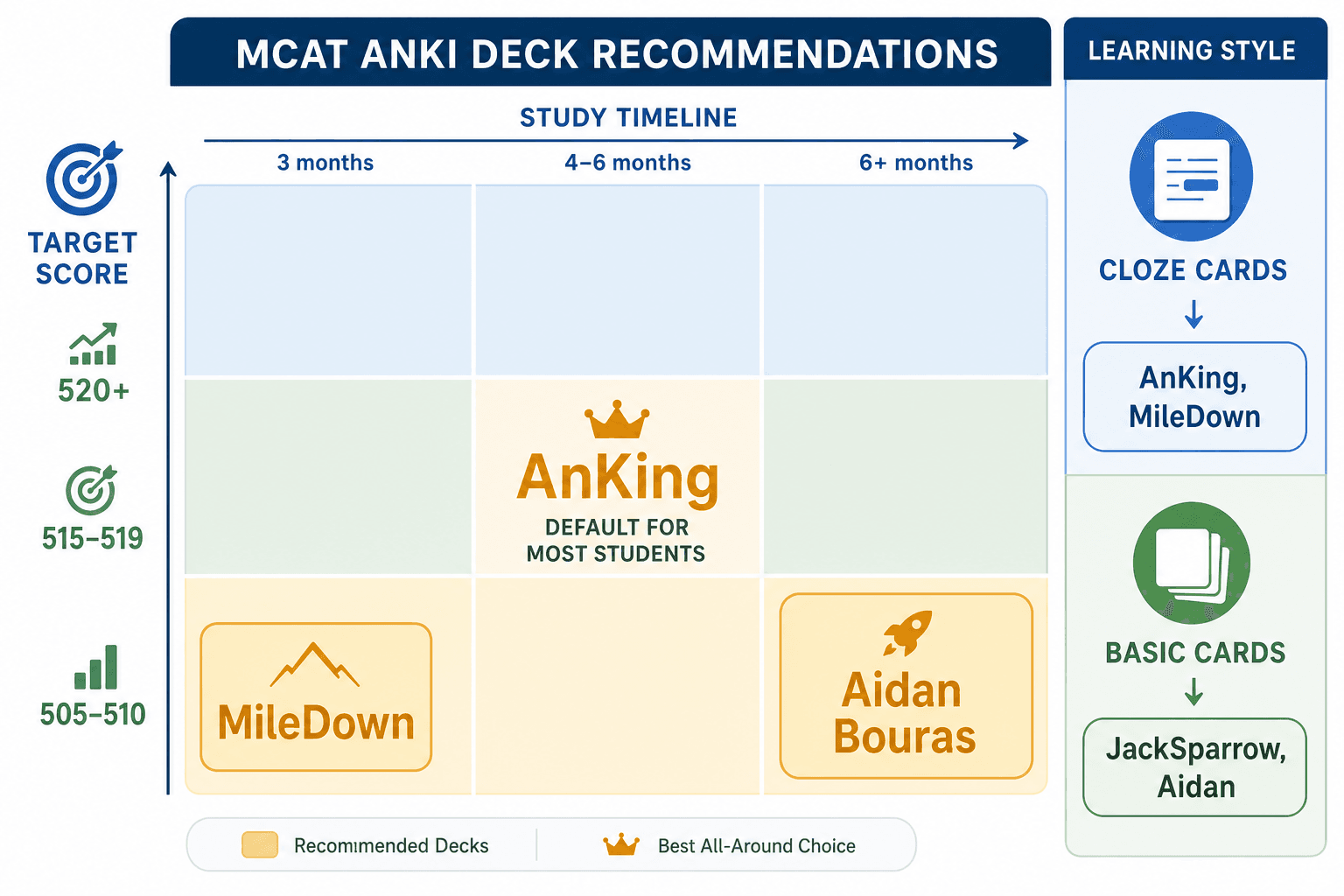
Use the matrix below to find your recommended deck based on your answers to the three questions. This is a starting point — many students combine decks (see Section 4) to get the best of both worlds.
| Timeline | Target Score Range | Recommended Primary Deck | Notes |
|---|---|---|---|
| 3–4 months | 505–515 | MileDown (~2,900 cards) | High-yield coverage; efficient daily new card count (~35–40) achievable. |
| 3–4 months | 515+ | AnKing (~5,500 cards) + supplement with custom cards | AnKing is broader than MileDown; suspend low-yield cards to stay within time. |
| 5–6 months | 505–515 | AnKing (default) or MileDown + Mr. Pankow (Psych/Soc) | Enough time to cover AnKing comfortably (~20 new/day). |
| 5–6 months | 520+ | Aidan (15,000+) or Bouras (13,000+) + Mr. Pankow | Massive decks require disciplined suspension; plan 25+ new cards/day. |
| 6+ months | Any | AnKing (default for balance) or Aidan/Bouras for depth | Plenty of time to master even the largest decks. Prioritize active recall frequency. |
For learning style:
- Prefer cloze deletions? AnKing, Aidan, Bouras, Mr. Pankow, and MileDown are all cloze-heavy. You'll be comfortable with any of them.
- Prefer basic Q&A (retrieval from scratch)? JackSparrow is the only major deck built entirely in basic format. If you pick a cloze deck but convert cards to basic, that adds overhead; consider JackSparrow instead.
Recommended Deck Combos by Section
No single deck perfectly covers every MCAT section. Many top scorers use a primary deck for most subjects and add a section-specific deck for their weakest area. Here are commonly recommended combinations:
- AnKing (all subjects) + Mr. Pankow (Psych/Soc) — The most popular combo. AnKing covers Bio/Biochem, Chem/Phys, and CARS passages well; Mr. Pankow's 2,200-card Psych/Soc deck is the gold standard for that section, with users reporting 5+ point score improvements after switching.
- MileDown (base) + custom cards from UWorld missed questions — For a shorter timeline. Use MileDown's 2,900 cards as the core and create targeted cards for every UWorld question you get wrong. This keeps your card volume manageable while deepening coverage where you need it.
- Aidan or Bouras (full coverage) + AnKing's UWorld QID tags — Power-users aiming for 520+ sometimes use AnKing's UWorld question ID tags within the AnkiHub deck to unsuspend specific cards after practice, while relying on Aidan or Bouras for encyclopedic depth. This approach requires careful suspension management to avoid review overload.
- JackSparrow (basic-format lovers) + Mr. Pankow (Psych/Soc) — If you thrive on basic Q&A cards, JackSparrow's 5,978 cards (in basic format) pair naturally with Mr. Pankow's cloze-based Psych/Soc deck. The format mismatch is manageable because Psych/Soc is only one section; you'll adapt quickly.
Once you've chosen your deck or combo, follow our step-by-step import guide to get it into Anki correctly.
Common Pitfalls and How to Avoid Them
- Review overload from an oversized deck — If you download Aidan (15,000+ cards) with 3 months to go, you'll need 50+ new cards daily just to finish, and total reviews will soar past 200+ per day after a few weeks. Solution: suspend any card you already know cold, and limit new cards to a number that keeps your daily reviews at 150–250 total.
- Passive reading instead of active recall — Clicking "Show Answer" too quickly and thinking "yeah, I knew that" is not reviewing. Force yourself to say the answer out loud or write it down before flipping. If you can't retrieve it, the card is working.
- Ignoring deck updates — If you use a static deck like MileDown or JackSparrow, check for community-maintained correction lists or updated versions. The AnKing deck on AnkiHub updates weekly; subscribe to receive fixes and new cards automatically.
- Not customizing cards from your mistakes — Pre-made decks can't cover every gap. For every UWorld or AAMC question you miss, create 1–2 of your own cards. This personalises your deck and targets your weakest areas. See our flashcard writing guide for rules on making effective cards.
Sample Review Schedules for Different Deck Sizes
Your daily new-card count and total review time depend on deck size and study timeline. The table below gives realistic starting points for three common scenarios. Adjust based on your performance: if your retention drops below 85% on mature cards, reduce new cards until it recovers.
| Scenario | Deck Size | Study Duration | New Cards / Day | Est. Daily Review Time | Notes |
|---|---|---|---|---|---|
| Short timeline, high-yield only | MileDown ~2,900 | 3 months | 35–40 | 1.5–2 hours | Start with 40 new/day for 2 weeks, then taper to 25–30 to consolidate. |
| Moderate timeline, balanced coverage | AnKing ~5,500 | 5 months | 20–25 | 1.5–2 hours | After 3 months reviews will peak at ~200/day; hold new cards at 20. |
| Long timeline, deep coverage | Aidan/Bouras 13,000+ | 7+ months | 25–30 (with suspension) | 2–3 hours | Suspend cards you already know; keep new cards at 25 to finish in ~7 months. |
For detailed guidance on adjusting your Anki interval settings, learning steps, and review limit caps, see our step-by-step configuration guide. Fine-tuning those settings can cut your daily review time by 20–30% without hurting retention.
Related Resources
- Spanish Flashcards for Beginners: What to Study, How to Make Cards, and Which App to Use →
A practical, science-backed guide for absolute beginners (A0–A1) on how to use Spanish flashcards effectively — covering which vocabulary to prioritize first, how to design cards that build real speaking ability, and how to choose between Anki, Quizlet, and Brainscape based on how much setup you're willing to do.
- How to Make Effective Flashcards: Writing Rules, Review Systems, and Common Mistakes to Avoid →
Most students make flashcards but don't see results because they skip two essential steps: writing cards that force genuine retrieval and reviewing with a system built on active recall and spaced practice. This guide covers the science-backed rules for both — with annotated card examples, format comparisons, and review methods that actually build lasting memory.
- MCAT Anki Decks: Best Pre-Made Decks, Where to Get Them, and How to Study →
A complete guide for pre-med students on choosing the right MCAT Anki deck for their timeline and section weaknesses — covering every major pre-made deck with honest pros, cons, and download sources, plus a proven study system built around the suspend-first workflow and AAMC integration.
Comments
Join the discussion with an anonymous comment.