
Best Spanish Flashcard Apps in 2026: A Head-to-Head Comparison by SRS, Pricing, and AI Features
Choosing the right flashcard app for Spanish vocabulary depends on your learning style. This guide compares eight top apps — Anki, Quizlet, Brainscape, ReWord, MosaLingua, Memrise, Flica, and Speak — across SRS algorithm quality, pricing, pre-made decks, and AI features, helping beginner to intermediate learners find their best fit.
Deck Sources
Why Spanish Vocabulary Needs a Dedicated Flashcard Strategy
Spanish vocabulary acquisition is not a linear process. The most common 1,000 words in the language account for roughly 87% of everyday spoken communication, according to the Davies frequency corpus. That statistic is both encouraging and deceptive: it means a learner can achieve basic conversational competence with a relatively small lexicon, but the jump from that foundation to genuine fluency — typically defined as an active vocabulary of around 4,000 words for a B2 level — requires a systematic, long-term approach that most general-purpose study methods cannot deliver.
This is where a dedicated flashcard strategy, powered by spaced repetition, becomes essential. The core problem with traditional vocabulary learning — writing lists, repeating words aloud, or relying on passive exposure — is that the brain forgets information at a predictable rate unless it is reviewed at strategically increasing intervals. Spaced repetition algorithms (SRAs) solve this by scheduling reviews just before a memory is about to fade, which dramatically increases retention efficiency. Without this mechanism, a learner might spend hours reviewing words they already know while neglecting the ones they are about to forget.
However, not all flashcard apps implement spaced repetition with the same rigor. Some use proprietary algorithms that prioritize engagement over precision; others, like Anki, offer open-source schedulers that have been refined over decades. The choice of app directly impacts how many words you retain per hour of study. For a Spanish learner targeting B2 in six to twelve months, that difference can mean the difference between reaching the goal and plateauing at an intermediate level.
The Spanish Flashcard App Landscape: A Comparison Matrix
The following matrix compares eight apps across the dimensions that matter most for Spanish vocabulary acquisition: the quality of the spaced repetition algorithm, the availability of a meaningful free tier, the price of a full subscription or one-time purchase, the quality and quantity of pre-made Spanish decks, the presence of AI-powered features, and the learner persona each app serves best. This is not a ranking — the best app for a medical student preparing for a DELE exam is different from the best app for a casual learner who wants to hold a conversation during a trip to Mexico City.
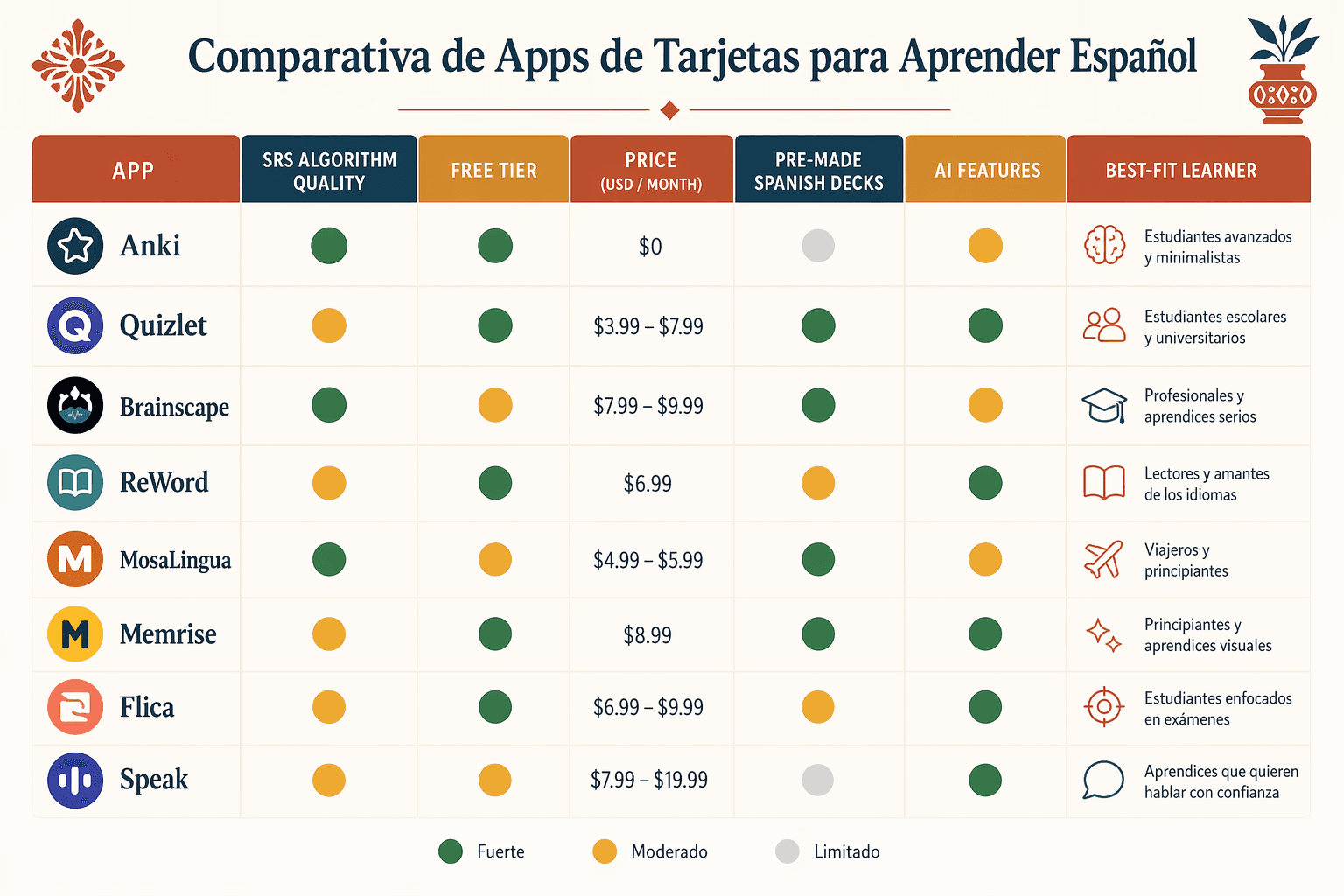
| App | SRS Algorithm | Free Tier | Price | Pre-made Spanish Decks | AI Features | Best For |
|---|---|---|---|---|---|---|
| Anki | SM-2 / FSRS (open-source) | Yes (Android, Desktop) | Free (Android/Desktop); $24.99 (iOS one-time) | Thousands of user-shared decks (variable quality) | None native; add-ons available | Power users, long-term learners, exam prep |
| Quizlet | None (removed Long-Term Learning in 2020) | Yes (limited) | $19.99/yr (Quizlet Plus) | Large library of user-created sets | None | Beginners, classroom use, quick review |
| Brainscape | Proprietary confidence-based repetition | Yes (limited) | ~$19.99/mo or ~$119.99/yr | Pre-made Spanish grammar & vocab decks | None | Structured learners who want a guided path |
| ReWord | Proprietary smart algorithm | Yes (limited) | ~$15.99/yr | 4,500+ words in 40 categories | None | Learners who want a curated, organized library |
| MosaLingua | Proprietary SRS | Yes (limited) | Freemium (subscription) | Audio dialogues, vocabulary packs | MosaDiscovery browser extension | Learners who want integrated web-to-deck workflow |
| Memrise | Proprietary | Yes (limited) | Freemium (subscription) | Official Spanish courses with native-speaker video clips | None | Learners who benefit from visual and audio context |
| Flica | FSRS (built-in) | Yes (full) | Free | AI-generated from Netflix, YouTube, PDF | AI card generation from video & PDF | AI-first learners, content-based learners |
| Speak | Proprietary | Yes (limited) | ~$6.99/mo | AI-driven speaking practice | AI speech recognition & feedback | Learners focused on speaking and pronunciation |
Deep Dives on Top Contenders
Anki: The Gold Standard with a Learning Curve
Anki remains the benchmark for spaced repetition. Its default algorithm, SM-2, has been used by millions of learners for over a decade, but the more recent FSRS (Free Spaced Repetition Scheduler) offers a significant upgrade. FSRS analyzes your individual review history to predict retention more accurately than SM-2, which uses fixed intervals. For a Spanish learner studying 15 new words per day, FSRS can reduce review time by 20-30% while maintaining the same retention rate.
The trade-off is setup complexity. Anki's interface is not intuitive for beginners. Creating effective cards — especially for Spanish grammar concepts like the subjunctive mood or the distinction between ser and estar — requires understanding cloze deletion, card templates, and note types. The app does not come with pre-made Spanish decks; you must either download shared decks from AnkiWeb (which vary wildly in quality) or build your own. For learners willing to invest the initial time, the long-term payoff is unmatched retention efficiency.
Pricing is a strong advantage: the Android and desktop versions are free, while the iOS app costs a one-time $24.99. There are no subscriptions. For learners who want to optimize their Anki setup, our Anki Settings for Beginners guide covers the five most impactful FSRS configuration changes, and our curated guide to the best Spanish Anki decks helps you avoid low-quality shared decks.
Flica: AI-Generated Decks from Your Content
Flica represents a new category of flashcard app that removes the most common barrier to consistent study: card creation. The app has FSRS built in and can generate contextual Spanish flashcards from Netflix subtitles, YouTube URLs, or PDFs in under a minute. A 25-minute Netflix episode, for example, becomes a 30-word deck with sentences extracted at the i+1 level — meaning each card contains only one unknown word, which is the optimal difficulty for language acquisition.
Flica is free on both iOS and Android, and it includes speech recognition for pronunciation practice. The AI generation feature is particularly valuable for intermediate learners who have exhausted the top 1,000 frequency words and need to acquire vocabulary from authentic content. Instead of manually typing sentences from a Netflix show, the app extracts them automatically and schedules them with FSRS. The caveat is that Flica is a newer app with limited independent review data — its SRS quality claims come from its own documentation rather than long-term user studies.
Quizlet: Gamified but Algorithmically Shallow
Quizlet is the most widely recognized flashcard platform in education, but its suitability for long-term Spanish vocabulary retention is limited by its algorithmic approach. The app offers gamified study modes like Match and Gravity, and its 'Learn' mode tracks which cards you have seen across sessions. However, this is not true spaced repetition. Quizlet removed its Long-Term Learning feature in 2020, which was the closest approximation to SRS it offered. The current system may mark a card as 'mastered' after a few correct answers, but it does not schedule reviews at the exponentially increasing intervals that drive long-term memory consolidation.
For a Spanish learner who needs to memorize 20 new words for a Friday quiz, Quizlet is perfectly adequate. For a learner who wants to retain 4,000 words over two years, it is not. The platform's strength is its massive library of user-created sets — you can find a set for almost any Spanish textbook chapter or DELE exam topic. But the lack of algorithmic depth means that words studied in September may be completely forgotten by December unless the learner manually reviews them. Our detailed Quizlet review covers the full feature set and pricing breakdown.
Brainscape: Confidence-Based Repetition with a Bold Claim
Brainscape uses a proprietary confidence-based repetition algorithm that asks users to rate their confidence in each answer on a 1-5 scale. The app then schedules reviews based on that self-assessment. Brainscape claims that its system can help learners 'learn four years' worth of Spanish' — a marketing claim that should be taken with context. The app offers pre-made decks for Spanish grammar, vocabulary, and verb conjugation, which reduces setup time. However, the confidence-based approach depends heavily on the learner's self-awareness; users who consistently overestimate their knowledge will see reduced effectiveness.
Brainscape's pricing is on the higher end, with a subscription around $19.99 per month or $119.99 per year. There is a limited free tier, but access to the full Spanish library requires a paid plan. For learners who want a structured, guided path through Spanish grammar and vocabulary without the setup complexity of Anki, Brainscape is a viable option — provided the subscription cost is acceptable.
ReWord: Curated Libraries at a Low Price
ReWord focuses on providing a well-organized flashcard library rather than AI generation or gamification. The app includes 4,500 Spanish words and phrases divided into 40 categories, with automatic translations when creating custom cards. Its subscription pricing is approximately $15.99 per year, making it one of the most affordable options among paid apps. Some earlier reviews cited an $8 per year price, but the current App Store listing shows the higher figure — pricing for freemium apps is volatile and should be verified at time of purchase.
ReWord's smart learning algorithm tracks performance over the last week, month, three months, and year. Users can customize recall direction — seeing the Spanish word and recalling the English translation, or vice versa — and the app works offline. For a learner who wants a curated, no-fuss vocabulary builder with a low annual cost, ReWord is a strong contender. It lacks the algorithmic depth of Anki's FSRS and the AI features of Flica, but it fills a specific niche: the organized library approach at a budget-friendly price.
MosaLingua, Memrise, and Speak: Beyond Flashcards
MosaLingua combines SRS with audio dialogues and a browser extension called MosaDiscovery that lets users add words from any web page to their review queue. This integration is useful for learners who encounter new vocabulary while reading Spanish news or blogs. The app uses a proprietary SRS algorithm and offers a freemium model.
Memrise distinguishes itself with 'Learn with Locals' video clips that show native speakers using vocabulary in real street contexts. This contextual exposure is valuable for developing listening comprehension and understanding regional pronunciation variations. Memrise also offers official Spanish courses with structured progression. Its SRS algorithm is proprietary and less transparent than Anki's, but the video component adds a dimension that text-only flashcards cannot replicate.
Speak takes a different approach entirely: it is an AI-driven speaking practice app that uses speech recognition to provide feedback on pronunciation. While not a traditional flashcard app, it is included in this comparison because it addresses a critical gap in vocabulary acquisition — the ability to produce words correctly in spoken conversation. Speak costs approximately $6.99 per month and is best used as a complement to a dedicated flashcard app rather than a replacement.
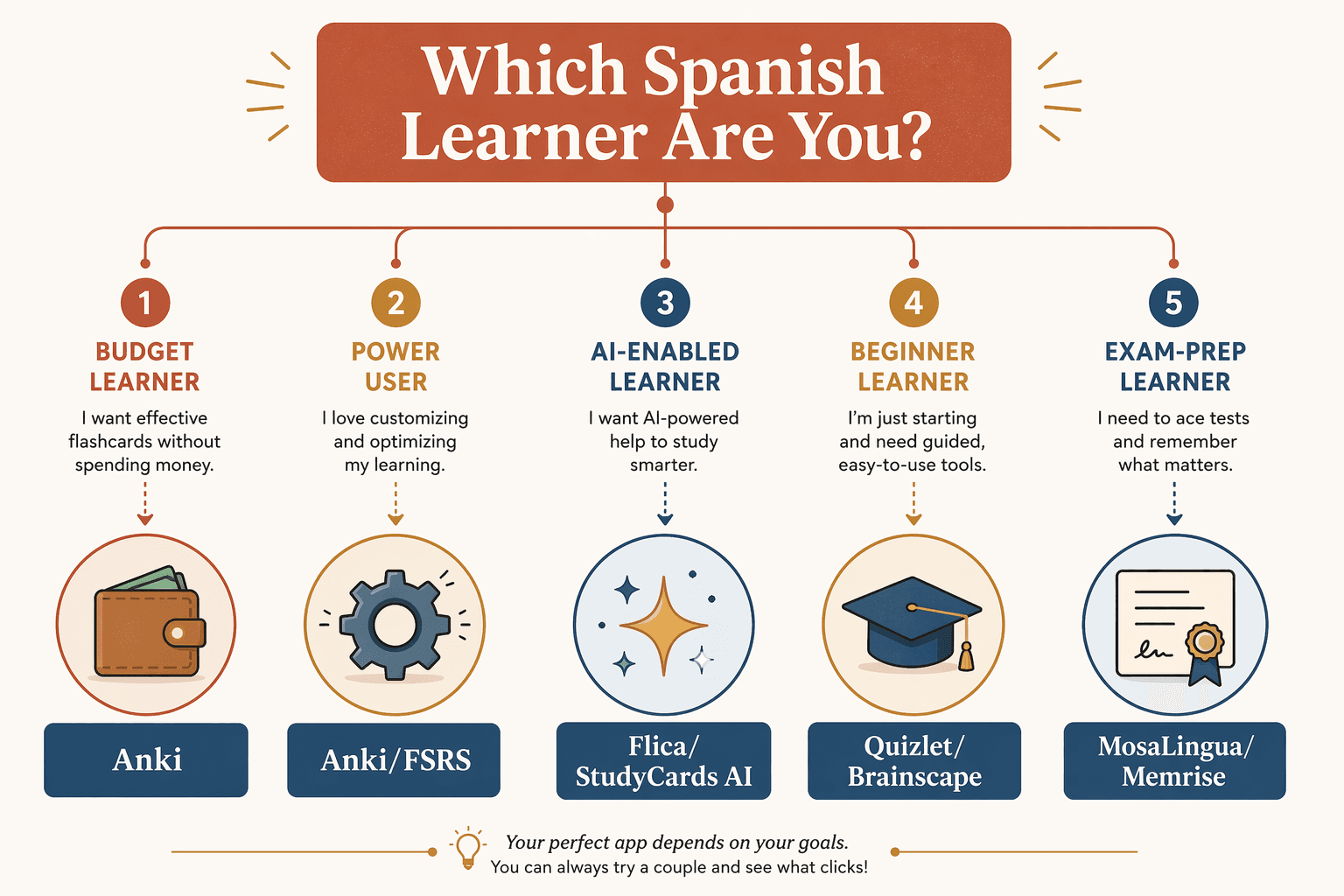
Decision Guide: Which Spanish Learner Are You?
The following five personas represent the most common learner profiles among Spanish students. Each persona includes a recommended app and a brief rationale based on the comparison data above.
The Budget Learner
You want maximum retention per dollar spent. You are willing to invest time in setup to avoid recurring subscription fees.
- Best choice: Anki (free on Android and desktop; one-time $24.99 on iOS)
- Runner-up: Flica (free on iOS and Android with FSRS built-in)
- Rationale: Anki's FSRS algorithm provides the best retention per study hour, and the absence of a subscription makes it the most cost-effective option over a multi-year learning journey. Flica is a strong alternative if you want AI card generation without paying.
The Power User
You want full control over your SRS parameters, card design, and review statistics. You are comfortable with configuration and want the most algorithmically precise tool available.
- Best choice: Anki with FSRS enabled
- Rationale: No other consumer flashcard app offers the level of algorithmic customization that Anki does. You can tune desired retention, interval modifiers, and learning steps to match your specific memory patterns. The FSRS optimizer can analyze your review history and suggest optimal parameters.
The AI-First Learner
You want to minimize manual card creation. You consume Spanish content through Netflix, YouTube, or PDFs and want those materials converted into flashcards automatically.
- Best choice: Flica (free, AI generation from video and PDF)
- Runner-up: StudyCards AI (AI PDF-to-deck generation, exportable to Anki)
- Rationale: Flica's ability to turn a 25-minute Netflix episode into a 30-word FSRS-scheduled deck in under a minute is a genuine workflow innovation. StudyCards AI is a good alternative if you prefer to generate decks and then import them into Anki for review.
The Absolute Beginner
You have never used a flashcard app before. You need a guided, low-friction introduction to Spanish vocabulary without worrying about algorithm configuration or card design.
- Best choice: Brainscape or ReWord
- Runner-up: Quizlet (for classroom-style vocabulary review)
- Rationale: Brainscape offers pre-made Spanish decks with a confidence-based system that requires no setup. ReWord provides a curated library of 4,500 words organized by category. Both are more approachable than Anki for a first-time user. Our Spanish Flashcards for Beginners guide provides additional foundational advice on what to study and how to make effective cards.
The Exam-Prep Student
You are preparing for a specific Spanish proficiency exam (DELE, SIELE, or a university placement test) and need to cover a defined vocabulary list with high retention reliability.
- Best choice: Anki with a targeted exam deck
- Runner-up: MosaLingua (for integrated web-to-deck workflow)
- Rationale: For exam-specific vocabulary, Anki's FSRS provides the most reliable retention. You can find or create a deck that covers the exact vocabulary list for your target exam. MosaLingua's browser extension is useful for adding exam-related vocabulary encountered during practice reading.
A 6-Month Study Plan from A2 to B2
The following plan integrates multiple apps and strategies across three phases. It assumes a starting level of A2 (basic conversational ability) and targets B2 (independent user) within six months, with approximately 30 minutes of daily study. The plan is adapted from the A2-to-B2 roadmap described in Flica's documentation and the StudyCards AI phased approach.
Months 1-2: Foundation Phase
Goal: Acquire the top 1,500 most frequent Spanish words, which will cover approximately 90% of everyday spoken language.
- Use Anki with a frequency-based deck (e.g., the 'Top 5,000 Spanish Words' deck from AnkiWeb, filtered to the first 1,500 words).
- Set a pace of 15 new words per day. At this rate, you will complete the first 1,500 words in approximately 100 days.
- Enable FSRS in Anki and set a desired retention of 0.85 (85%) for mature cards. This balances review load with retention.
- Use basic front/back cards with the Spanish word on the front and the English translation plus a simple example sentence on the back.
- Daily review time: approximately 15-20 minutes for new cards plus 10-15 minutes for reviews.
Months 3-4: Context Phase
Goal: Shift from isolated word lists to contextual vocabulary acquisition using authentic content.
- Introduce Flica or StudyCards AI to generate decks from Spanish Netflix shows or YouTube channels (e.g., 'Curiosamente,' 'Luisito Comunica').
- Increase to 15-20 new words per day, now drawn from content-generated decks rather than frequency lists.
- Add production cards: for each new word, create a card that shows the English definition and requires you to produce the Spanish word aloud.
- Use Flica's speech recognition feature to check pronunciation on production cards.
- Daily review time: approximately 20-25 minutes for new cards plus 15-20 minutes for reviews.
Months 5-6: Nuance Phase
Goal: Master grammar distinctions (subjunctive mood, ser/estar, por/para) and transition to authentic materials like Spanish news articles and podcasts.
- Create cloze-deletion cards for grammar concepts. For example: 'Es importante que [él estudie] (estudiar) para el examen.' — the cloze deletion forces recall of the subjunctive conjugation.
- Use Anki's cloze deletion note type for grammar cards. StudyCards AI can generate cloze-deletion cards from PDFs of grammar explanations.
- Reduce new card intake to 10-15 per day as review load increases from accumulated cards.
- Incorporate MosaLingua's browser extension to add words encountered while reading Spanish news (El País, BBC Mundo).
- Daily review time: approximately 15-20 minutes for new cards plus 25-30 minutes for reviews (mature cards require less frequent review).
Frequently Asked Questions
Is Quizlet good for Spanish vocabulary?
Quizlet is adequate for short-term vocabulary review — such as preparing for a weekly quiz or memorizing a specific list of 20-30 words. It is not effective for long-term retention because it lacks true spaced repetition scheduling. If you plan to study Spanish for more than a few months, choose an app with a dedicated SRS algorithm.
Can I use Anki on my phone for free?
Yes, if you have an Android device. The Android version of Anki is free. The iOS version costs a one-time $24.99. The desktop version (Windows, macOS, Linux) is also free. You can sync your decks across all platforms using AnkiWeb, so you could study on a free Android or desktop app and only pay for iOS if you need mobile access on an iPhone or iPad.
Are AI-generated flashcards as effective as hand-made ones?
AI-generated flashcards are effective for vocabulary acquisition from content you are already consuming — Netflix shows, YouTube videos, or PDFs. The key advantage is that they eliminate the friction of manual card creation, which is the most common reason learners abandon flashcard study. However, AI-generated cards may lack the personal connection that makes hand-made cards memorable. The optimal approach is a hybrid: use AI generation for bulk vocabulary extraction from content, and create hand-made cards for grammar concepts or words that require nuanced explanations.
Which app is best for learning Spanish grammar through flashcards?
Anki is the best app for grammar flashcards because its cloze deletion note type is specifically designed for testing grammatical knowledge. You can create cards like 'Si yo [tuviera] (tener) más tiempo, viajaría a España.' — the cloze deletion forces recall of the correct imperfect subjunctive conjugation. Brainscape also offers pre-made grammar decks, but they use a confidence-based system rather than cloze deletion. For learners who want to generate grammar cards from PDF explanations, StudyCards AI can automate the process.
How does Duolingo compare to these flashcard apps for Spanish vocabulary?
Duolingo teaches approximately 5,000 Spanish words across its 200+ units, but its review system is tuned for engagement and streak maintenance rather than spaced repetition precision. The app is designed to keep you coming back daily, not to optimize the retention of each individual word. For a learner who wants to build a broad vocabulary base with gamified motivation, Duolingo can be a useful supplement. For a learner who wants to reach B2 efficiently, a dedicated flashcard app with FSRS or SM-2 will deliver better results per hour of study.
Related Resources
- How to Make Mandarin Flashcards That Actually Stick: Card Design, Pacing, and the Input Loop →
Most Mandarin learners struggle with flashcards not because they lack discipline, but because their card design is wrong. This guide prescribes a complete system for Chinese-specific card types, research-backed daily pacing, leech card triage, and the input loop that connects flashcard study to real-world fluency.
- The Algorithm Divide: Why FSRS Is Making SM-2 Obsolete and What It Means for Choosing a Flashcard App →
Most flashcard app comparisons ignore the single most important technical differentiator: the spaced repetition algorithm. This guide explains how FSRS, SM-2, confidence-based, and Leitner systems work, why FSRS can reduce daily reviews by 20-30%, and how to choose an app based on its underlying SRS engine.
- The Science Behind Anki Flashcards: What Peer-Reviewed Research Actually Shows About Spaced Repetition and Exam Scores →
This article examines the peer-reviewed evidence behind Anki flashcards, covering how spaced repetition and active recall translate into measurable exam score improvements for medical and graduate students, and what the research reveals about Anki's limitations for conceptual learning.
Comments
Join the discussion with an anonymous comment.