
How to Make Mandarin Flashcards That Actually Stick: Card Design, Pacing, and the Input Loop
Most Mandarin learners struggle with flashcards not because they lack discipline, but because their card design is wrong. This guide prescribes a complete system for Chinese-specific card types, research-backed daily pacing, leech card triage, and the input loop that connects flashcard study to real-world fluency.
Updated:
Why Your Mandarin Flashcards Aren't Working (And It's Not Your Discipline)
You review your flashcards every day. You hit the "Again" button on the same characters for weeks. You can recognize hundreds of words on a card, but when you hear them in a conversation or spot them in a movie subtitle, your brain draws a blank. This is not a willpower problem. It is a design problem.
Most Mandarin learners build their flashcard systems around a single card type: Chinese character on the front, English meaning and pinyin on the back. This approach produces what researchers call passive vocabulary — words you can recognize in a controlled setting but cannot retrieve in real time. The problem compounds for Mandarin because the language layers three distinct memory demands onto every word: the visual form (character), the auditory signal (sound plus tone), and the orthographic motor pattern (handwriting). A single-direction recognition card trains only one of those three pathways.
Three specific mistakes account for the vast majority of stalled progress:
- All recognition, no production. You can read the character, but you cannot write it or recall it when you need to speak. Your deck is a one-way street.
- No audio component. Pinyin becomes a visual crutch. You read the pinyin, not the tone. Your ear never learns to distinguish mā from má because you never have to hear the difference.
- Too many new cards, too fast. You add 30 words after a single reading session, your reviews balloon to 200+ per day, and you start clicking "Good" on cards you barely remember just to get through the queue. The spaced repetition algorithm cannot work when you overwhelm it.
Six Mandarin-Specific Card Types That Build Real Recall
The solution to passive vocabulary is simple in theory but rarely applied: use multiple card types that force your brain to retrieve the same word from different directions. The CLI SRS guide provides a useful taxonomy of six card types that cover the full spectrum of Mandarin recall. Each type trains a different cognitive pathway, and together they prevent the single-direction trap.
| Card Type | Front | Back | What It Trains | When to Use |
|---|---|---|---|---|
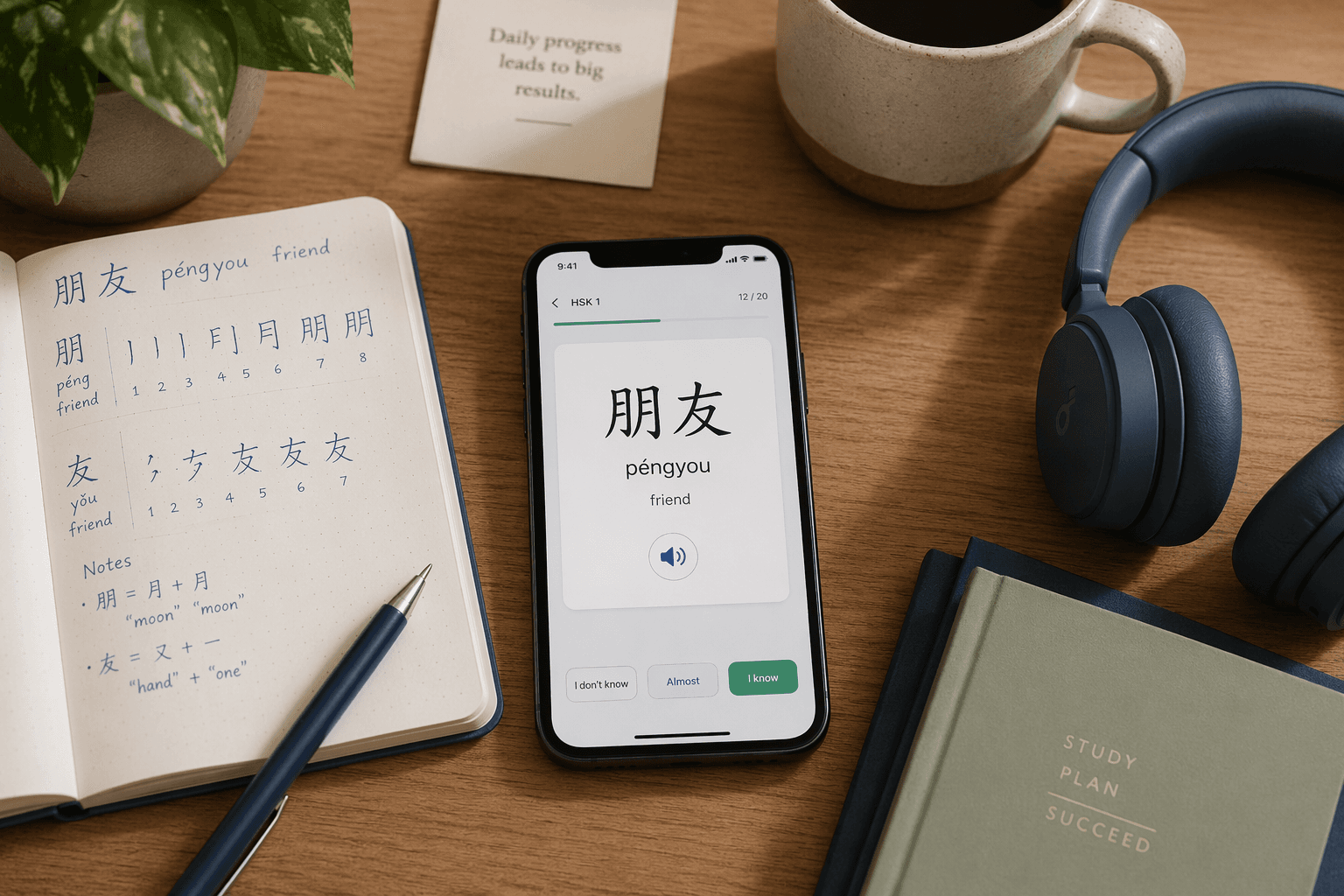
| Recognition | Hanzi (朋友) | Meaning + pinyin + audio | Visual character recognition | First encounter with a new word |
| Audio-First | Audio recording only | Meaning + Hanzi + pinyin | Tone discrimination, listening recall | After you can recognize the character visually |
| Production | English meaning or prompt | Hanzi + pinyin + audio | Active recall for speaking and writing | After recognition is solid (1–2 days later) |
| Sentence Cloze | Sentence with blank (我___你) | Full sentence + missing word | Contextual usage, grammar patterns | After you know the word's basic meaning |
| Tone Recall | Hanzi with tone marks hidden | Full pinyin with tones + audio | Tone accuracy in isolation | For words you consistently mis-tone |
| Handwriting | English meaning or audio | Stroke order + character grid | Motor memory for writing | For high-frequency characters you want to write |
Comments
Join the discussion with an anonymous comment.