
The Best Spanish Anki Decks for Every Level: A Curated Guide
Most shared Spanish Anki decks are poorly constructed. This guide curates the few genuinely good decks—organized by frequency, with native audio and sentence context—so you can stop searching and start learning efficiently, from absolute beginner to intermediate.
Deck Sources
Why Most Spanish Anki Decks Fail (and What to Look For)
If you have spent any time browsing AnkiWeb for a Spanish deck, you have likely encountered the same problem: hundreds of shared decks, most of them poorly constructed. The team at Migaku reviewed roughly 200 free Spanish Anki decks and concluded that not a single one met all quality criteria. There is no perfect deck waiting for you — only serviceable ones that require careful selection.
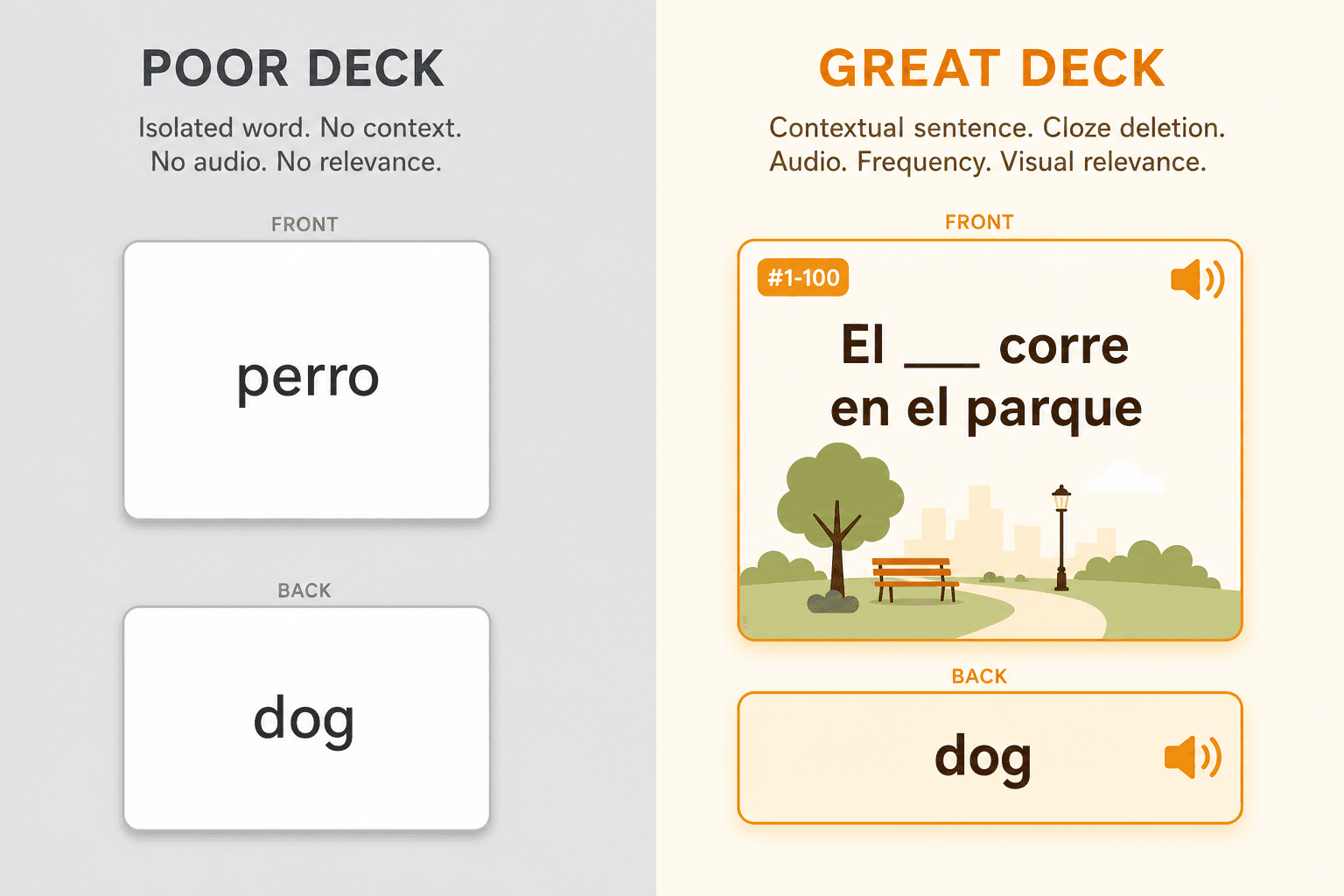
The common failure modes are predictable. Many decks present vocabulary in random order, ignoring how often words actually appear in real speech. Others give you isolated words with no sentence context, which makes recall fragile when you encounter the word in a conversation. Some lack audio entirely, leaving you to guess at pronunciation. And a surprising number put English on the front of the card, turning the review into a passive recognition exercise rather than an active recall challenge.
To cut through the noise, use these six criteria — adapted from the Migaku analysis — as your quality filter. A deck that meets most of them will serve you well; one that fails on several is probably not worth your time.
- Frequency order. Words should be introduced roughly in the order they appear in natural speech. Learning "the" before "photosynthesis" is not just common sense — it is how you build usable vocabulary fast.
- Sentence context. Each card should contain a level-appropriate example sentence that shows how the word behaves grammatically. Isolated words train recognition; sentences train comprehension.
- One new word per card. If a sentence introduces three unfamiliar words at once, you cannot know which one you actually failed to recall. Clean cards isolate the learning target.
- Native audio. Hearing the word spoken by a native speaker — not a text-to-speech voice — builds accurate pronunciation and listening comprehension simultaneously.
- Grammar notes. Brief annotations about verb conjugations, gender, or usage patterns turn a vocabulary card into a mini grammar lesson.
- Spanish on the front. Seeing the Spanish word or sentence first forces you to retrieve the meaning from memory — that is active recall in action. English-first cards let you cheat by pattern-matching.
Absolute Beginner: Your First 50 Words and Simple Sentences
If you are starting from zero, the single most important rule is: do not overwhelm yourself. A deck with 5,000 cards is useless if you abandon it on day three because the daily review load feels impossible.
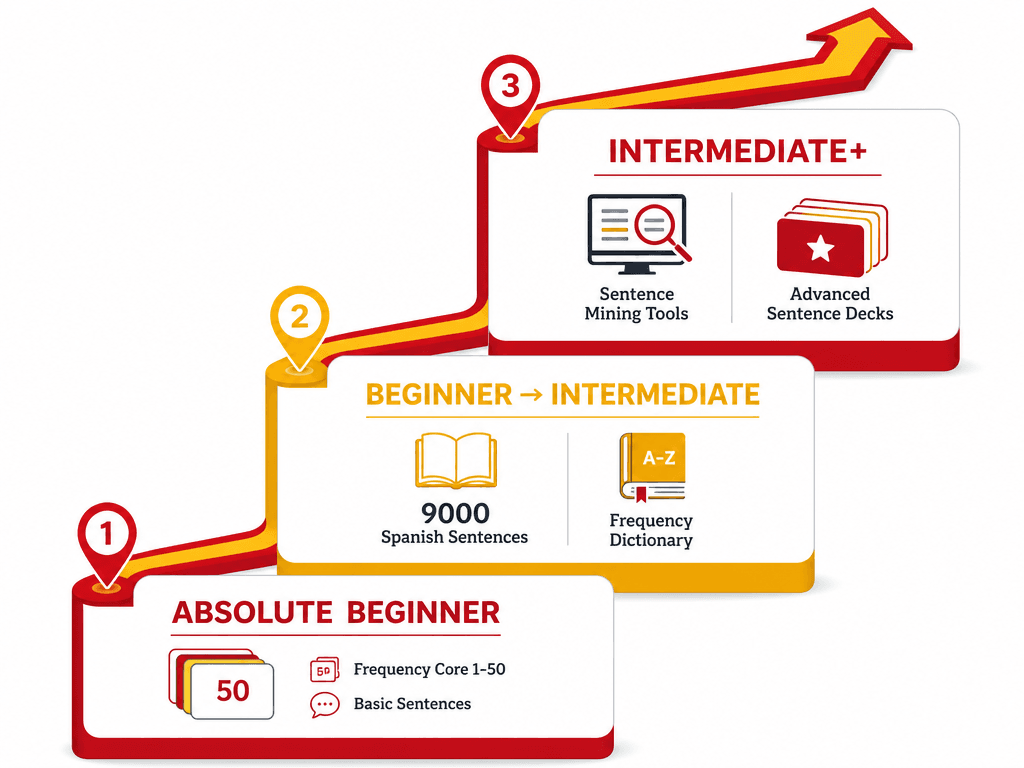
The best starting point is the Spanish Frequency Core Vocabulary 1–50 deck. It contains exactly 50 cards covering the most common words in the language. You can complete the entire deck in a few days with a 10-minute daily commitment. Finishing a deck — even a tiny one — builds momentum and proves to yourself that the system works.
From there, move immediately into sentence-level learning. The Basic European Spanish Sentences or Basic Latin American Spanish Sentences decks are designed for this stage. Each card presents a simple sentence with one new word, native audio, and a clear translation. The jump from isolated words to sentences feels uncomfortable for about three days — then your brain adapts, and you start recognizing grammatical patterns without conscious effort.
Why sentences from day one? When you learn a word in a sentence, you are also learning its gender, its typical position in a clause, and the prepositions it commonly pairs with. Isolated vocabulary cards cannot deliver that context. Research on language acquisition consistently shows that contextual learning produces stronger long-term recall than rote memorization of word lists.
Beginner to Intermediate: Building a Core Vocabulary
Once you have the basics down, your goal shifts from survival phrases to genuine conversational range. At this stage, two decks stand out as the most effective options, each with a different trade-off.
9000 Spanish Sentences (Difficulty-Sorted with Native Audio)
This is the closest thing to a complete Spanish course in Anki format. The deck contains roughly 9,000 cards, each with a Spanish sentence, a native audio recording, and an English translation. The sentences are sorted by difficulty, so you start with simple structures and gradually progress to complex ones.
The main drawback is the card format. The deck ships as a "basic (and reversed)" type, meaning you see both Spanish-to-English and English-to-Spanish directions. For language learning, you generally want Spanish on the front and English on the back — the reverse direction is less useful. Migaku recommends converting the cards to a basic format and reorganizing them by the difficulty field to get a cleaner learning experience.
A Frequency Dictionary of Spanish (5000 Words)
Based on the Routledge frequency dictionary, this deck contains 5,000 words ordered by how often they appear in spoken and written Spanish. It is a pure frequency list — no sentence context, no audio. That makes it less effective for building comprehension than the 9000 Sentences deck, but it is unmatched for rapidly expanding your recognition vocabulary.
| Deck | Card Count | Audio | Sentence Context | Best For |
|---|---|---|---|---|
| 9000 Spanish Sentences | ~9,000 | Native | Yes (every card) | Building comprehension and listening skills |
| A Frequency Dictionary of Spanish | 5,000 | None | No | Rapid vocabulary expansion for reading |
Conjugation and Pronunciation: Two Targeted Decks
Your main vocabulary deck handles the bulk of your daily learning. But two specific areas — verb conjugation and pronunciation — benefit from dedicated supplementary decks that you run alongside your primary deck.
Ultimate Spanish Conjugation (Lisardo's KOFI Method)
Conjugation is the single biggest hurdle for English speakers learning Spanish. The Ultimate Spanish Conjugation deck, built around Lisardo's KOFI method, teaches roughly 70 verbs across all major tenses. Instead of drilling isolated verb forms, it presents them in short phrases that mimic natural speech patterns.
Run this deck at a low daily new-card rate — 5 new cards per day is enough. The goal is gradual exposure over weeks, not cramming. After two months, you will notice that conjugations that once required conscious thought now feel automatic.
Learn to Read Spanish — The Spanish Writing System
Spanish spelling is largely phonetic, but there are still patterns — the pronunciation of "c" before "e" and "i," the distinction between "b" and "v," the trilled "r" — that trip up beginners. This deck teaches the writing system explicitly, with audio examples for each letter and digraph.
Most learners only need this deck for the first two to three weeks. Once you can reliably predict pronunciation from spelling, suspend the deck and focus your time on vocabulary and sentences.
- How to combine supplementary decks: Set your main vocabulary deck to 15–20 new cards per day. Set the conjugation deck to 5 new cards per day. Set the pronunciation deck to 5 new cards per day. Your total daily new cards will be 25–30, which is manageable in a 25-minute session. After the pronunciation deck is finished, your daily load drops back to 20–25 cards.
Listening and Native Audio: Decks That Train Your Ear
Reading comprehension and listening comprehension are separate skills. You can recognize a word on paper and completely miss it in a fast conversation. These two decks are designed specifically to close that gap.
Spanish 7000 Intermediate/Advanced Sentences with Audio
This deck covers roughly the top 4,000 vocabulary items in Spanish, presented in intermediate-to-advanced sentences. The audio is text-to-speech (TTS), not native recordings. That is a meaningful limitation — TTS cannot capture the rhythm, elision, and regional variation of natural speech. However, the deck is useful as a bridge: it trains you to process spoken Spanish at sentence speed before you move to native-content listening.
WordBrewery Core Spanish
WordBrewery takes the opposite approach: every sentence is built from only the most common words in the language, and every sentence has a native audio recording. The vocabulary range is narrower than the 7000 Sentences deck, but the audio quality is dramatically better. For learners who want to train their ear with authentic pronunciation from day one, this is the better choice.
| Deck | Audio Type | Vocabulary Range | Best For |
|---|---|---|---|
| Spanish 7000 Sentences | TTS | Top ~4,000 words | Building processing speed for spoken Spanish |
| WordBrewery Core Spanish | Native | High-frequency words only | Developing accurate pronunciation and listening comprehension |
Intermediate+: Sentence Mining with Migaku and ASBplayer
At a certain point, pre-made decks stop being enough. You have learned the most common 2,000–3,000 words, and the remaining vocabulary is highly specific — words that appear in the TV shows you watch, the articles you read, and the conversations you have. This is where sentence mining becomes the most effective method.
Sentence mining means creating your own flashcards from real Spanish content. You watch a YouTube video or a Netflix episode with Spanish subtitles, encounter an unfamiliar word, and generate a card that shows the sentence with the word in context, the audio from the video, and an image if relevant. The card is personal — it is tied to a moment you remember — which makes it far more memorable than any pre-made deck.
Two tools make this workflow practical:
- Migaku is a browser extension that integrates with Anki. When you are watching content on YouTube, Netflix, or other supported platforms, you can click a word to see its definition, then create a card with one click. The card automatically includes the sentence, the timestamped audio, and an image from the video frame.
- ASBplayer is a subtitle-focused tool that works with local video files or streaming content. It lets you browse subtitles, select sentences, and export them to Anki with audio. It is more manual than Migaku but gives you finer control over which sentences you capture.
For intermediate learners who have exhausted the pre-made decks in this guide, sentence mining is the natural next step. It is also the method most likely to carry you to advanced fluency, because it forces you to engage with authentic, unscripted Spanish every day.
Deck Comparison at a Glance: Sizes, Time, and Best For
The table below summarizes every deck recommended in this guide. Use it to decide which decks fit your current level and how much time you need to commit.
| Deck Name | Card Count | Audio | Difficulty Level | Suggested Daily New Cards | Daily Time |
|---|---|---|---|---|---|
| Spanish Frequency Core 1–50 | 50 | Native | Absolute Beginner | 10–15 | 5–10 min |
| Basic European/Latin American Sentences | ~500 | Native | Absolute Beginner | 10–15 | 10–15 min |
| 9000 Spanish Sentences | ~9,000 | Native | Beginner–Intermediate | 15–20 | 20 min |
| A Frequency Dictionary of Spanish | 5,000 | None | Beginner–Intermediate | 15–20 | 15 min |
| Ultimate Spanish Conjugation | ~70 verbs | Native | Beginner+ | 5 | 5 min |
| Learn to Read Spanish | ~50 | Native | Absolute Beginner | 5 | 5 min |
| Spanish 7000 Sentences | ~7,000 | TTS | Intermediate | 15–20 | 20 min |
| WordBrewery Core Spanish | ~1,000 | Native | Beginner–Intermediate | 10–15 | 10–15 min |
Practical Setup Guide and Daily Review Recommendations
Getting started with Anki is straightforward, but a few configuration choices make a significant difference for language learning.
Downloading and Importing Decks
- Download the deck file (.apkg) from AnkiWeb or the source link provided by the deck author.
- Open Anki on your desktop (Windows, macOS, or Linux). Click "File" → "Import" and select the .apkg file.
- The deck will appear in your Anki deck list. Click on it to start reviewing.
- If you use Anki on mobile (iOS or Android), sync your account after importing on desktop. The deck will appear on your phone after syncing.
Recommended Daily Settings for Language Learning
Anki's default settings are designed for medical school students memorizing thousands of facts. For language learning, you want a gentler pace that prioritizes retention over speed.
- New cards per day: Set this to 10–20 for your main vocabulary deck. Lower is better if you are also running supplementary decks. Consistency matters more than volume.
- Maximum reviews per day: Leave this at 9999 (unlimited). Anki will automatically limit your daily load based on your new-card setting and your review history.
- Steps (in minutes): Use 1 10 for your learning steps. This means you see a new card, then again after 1 minute, then again after 10 minutes. If you pass both steps, the card moves to review.
- Graduating interval: 1 day. Easy interval: 4 days.
Combining Multiple Decks Without Overwhelm
If you are running a main vocabulary deck plus one or two supplementary decks, you can either keep them separate or merge them into a single deck. Keeping them separate gives you more control over daily limits per topic. Merging them creates a single review queue that feels simpler but makes it harder to adjust individual deck settings.
A practical approach: keep your main deck (e.g., 9000 Spanish Sentences) separate, and put all supplementary decks into a single "Spanish Supplements" deck. Set the main deck to 15 new cards per day and the supplements deck to 5–10 new cards per day. Your total daily new cards stay under 25, and your review queue stays manageable.
Related Resources
- AI-Generated vs. Handmade Flashcards: What the Research Says and How to Choose →
Research shows handmade flashcards have a measurable memory advantage when students actively process and phrase content themselves — but AI-generated cards cut creation time by 50–80% and integrate seamlessly with spaced repetition. This guide helps students decide which method fits their subject, timeline, and learning goals, with a hybrid workflow that captures the best of both.
- MCAT Anki Decks: Best Pre-Made Decks, Where to Get Them, and How to Study →
A complete guide for pre-med students on choosing the right MCAT Anki deck for their timeline and section weaknesses — covering every major pre-made deck with honest pros, cons, and download sources, plus a proven study system built around the suspend-first workflow and AAMC integration.
- GRE Vocabulary Flashcard Decks Compared: Magoosh, Anki, Brainscape, and Quizlet →
A deck-by-deck evaluation of the most-used GRE vocabulary flashcard options — comparing word count, SRS support, cost, and post-2023 test alignment — so you can choose the right deck for your timeline and learning style before committing study time.
Comments
Join the discussion with an anonymous comment.