
SAT
Not sure how to use Khan Academy for SAT Math based on your current score? This guide breaks down exactly which topics to focus on and how to study for maximum score gains at every level — from below 600 to 700+.
Updated:
If your current SAT Math score is below 600, 600–700, or above 700, your Khan Academy SAT Math plan should not look the same. That sounds obvious until you watch a 540 scorer spend an afternoon on advanced circle questions while still missing data-table questions, or a 730 scorer keep collecting easy linear-equation points they already had. Khan Academy is useful because it is free, official, and organized. It becomes much less useful when the dashboard decides your study plan for you.
Start with your score band, then decide what Khan Academy is allowed to do for you.
| Current SAT Math score | Khan Academy's best role | What to do first | What to avoid |
|---|---|---|---|
| Below 600 | Primary teacher | Work through Foundations, especially Problem Solving & Data Analysis | Jumping into Medium or Advanced lessons because they look more impressive |
| 600–700 | Targeted repair shop | Use a Bluebook diagnostic to pick your weakest 3–4 high-frequency skills | Completing every Khan Academy skill in order |
| Above 700 | Refresher and mistake-review tool | Review missed concepts, then move to harder timed practice | Expecting Khan Academy alone to manufacture a 750+ |

The reason to be this selective is not that Khan Academy is weak. It is that SAT Math rewards some skills more often than others. PrepScholar's topic-frequency analysis found that 9 skills account for about 67% of SAT Math, with linear functions alone making up about 15%, or roughly 7 questions per test.[1] On a 44-question digital SAT Math section, treating every skill as equally urgent is a strange way to spend limited study time.[1]
First, Make the Score Band Decision
Use a recent Bluebook practice test or official SAT score, not a feeling. The digital SAT Math section has 2 modules and 44 total Math questions: 20 in Module 1 and 24 in Module 2, with the second module adapting based on performance.[1] That adaptive structure matters because careless early misses can change the difficulty level of what you see later.
If you have not taken a diagnostic yet, do that before opening a long Khan Academy unit sequence. A diagnostic-first workflow is the difference between studying and decorating your account with progress bars. For a fuller walkthrough of that setup, use How Khan Academy SAT Practice Works with Bluebook.
The College Board's best-known practice study is still worth taking seriously: students who used Official SAT Practice for 20 hours had an average score gain of about 115 points, while 6–8 hours was associated with about a 90-point gain.[2] That study was published in 2017, before the current digital SAT, so it should not be read as a promise for your next test. It does give you a useful floor of confidence: structured practice can move scores, and a few focused hours are better than vague panic.
Below 600: Let Khan Academy Teach, But Do Not Let It Distract You
Below 600, Khan Academy SAT Math can be your main teacher. That is where the platform is strongest: clear lessons, repeated practice, and enough structure that you are not trying to rebuild algebra from scattered YouTube videos at midnight. The mistake is assuming “main teacher” means “click everything in the order it appears.”
Your first job is to stabilize Foundations. If a Foundations lesson feels too easy, prove it by getting through the practice accurately and quickly. If it feels slow, stay there. A student scoring below 600 usually does not need a clever strategy for rare topics first; they need fewer leaks in the questions that appear again and again.
Give Problem Solving & Data Analysis early attention. That includes rates, ratios, percentages, units, tables, graphs, scatterplots, and basic statistical reading. These questions are often less algebraically fancy than advanced geometry, but they punish students who skim. They also tend to be repairable: once you learn to slow down on what the table actually measures, many errors stop being “math ability” errors and start being reading-and-setup errors.
- Start with Foundations-level lessons before Medium or Advanced, even if the harder labels feel more productive.
- Prioritize linear equations and functions, ratios, percentages, data tables, graphs, and basic word-problem setup.
- After each lesson, write down the error type: concept gap, setup mistake, calculator mistake, or misread question.
- Do not move on just because you watched the explanation. Move on when you can solve similar questions without needing the hint.
This is also the score band where “I understand it when Khan Academy explains it” can trick you. Watching a worked solution is recognition. Solving the next one cold is recall. The SAT pays you for recall under time pressure, so keep the practice active: cover the solution, set up the equation yourself, and only then compare.
A reasonable below-600 week can be simple: 3 or 4 Khan Academy sessions, each built around one Foundations topic, plus one short mixed review session. The mixed review matters because real SAT Math does not announce, “This is a percentages problem.” If you need a broader weekly structure, use How to Structure Your SAT Prep with Khan Academy and Bluebook rather than inventing a new calendar every Sunday.
What should you skip for now? Anything that requires three unstable skills at once. If a Medium or Advanced problem collapses because you cannot translate the first sentence into an equation, the advanced topic is not the real issue yet. Go back to the lower-level version and make that automatic. There is nothing noble about losing the same foundational point in a harder costume.
600–700: Stop Completing Khan Academy and Start Repairing
The 600–700 range is where Khan Academy can either help a lot or quietly waste your month. Students here usually know enough math to survive the section, but their mistakes are uneven: strong on linear equations, shaky on quadratics; fine with percentages, careless with graphs; good untimed, messy when the second module gets harder.
This is the repair-shop phase. You are not trying to become equally polished in every Khan Academy skill. You are finding the few high-frequency weaknesses that are currently expensive.
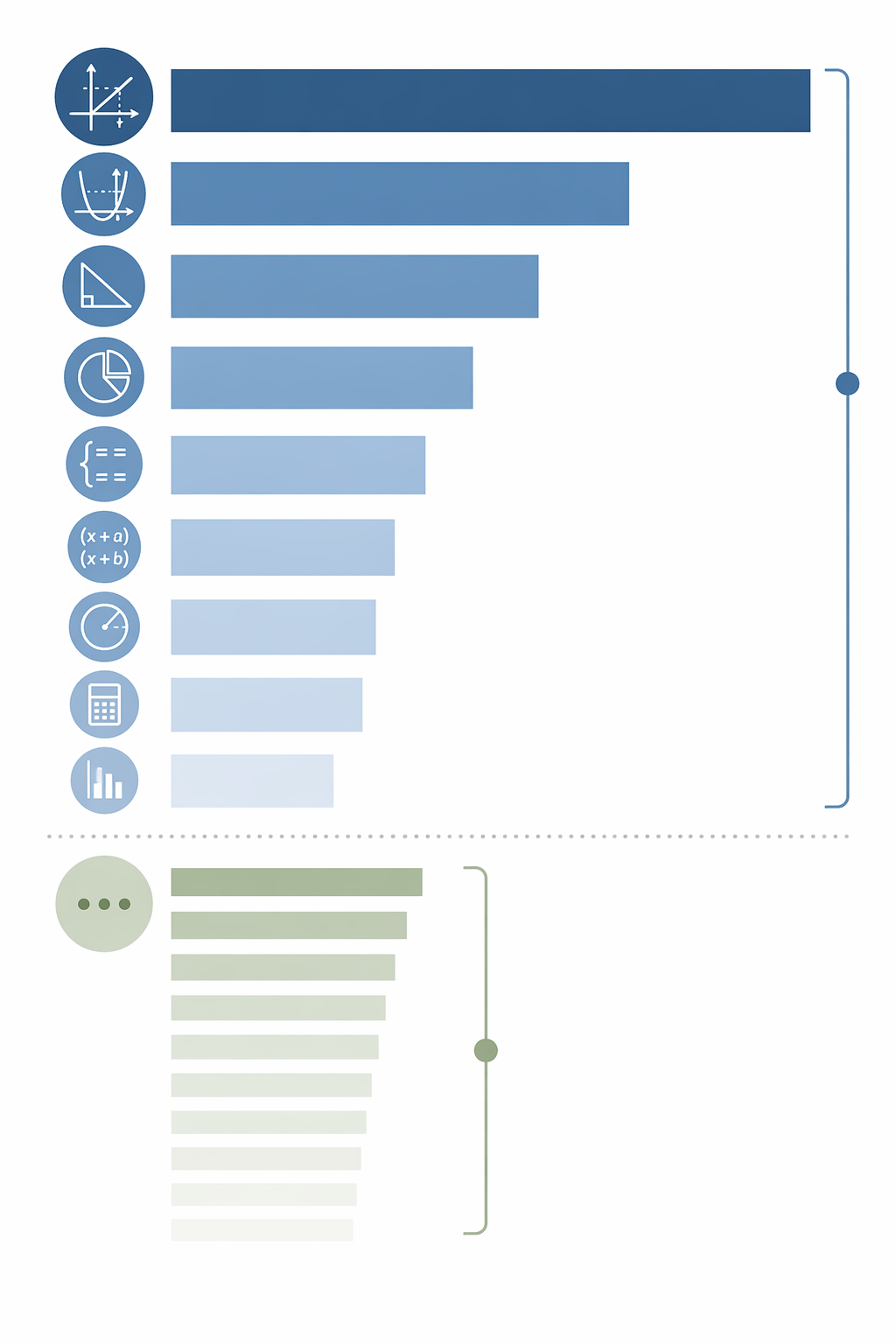
The topic-frequency data is the reason. If 9 skills cover about 67% of Math, and linear functions alone are about 15%, your study order should respect that hierarchy.[1] A missed linear-function pattern is not the same as a missed rare geometry detail. They both hurt, but one is more likely to hurt repeatedly.
The 600–700 Workflow
- Take a full Bluebook practice test under realistic timing.
- Sort every missed or guessed Math question by skill, not by whether you “should have known it.”
- Choose the weakest 3–4 high-frequency skills, starting with linear functions if they are not solid.
- Drill those skills in Khan Academy until you can answer accurately without hints.
- Return to mixed, timed practice so the repaired skill survives outside its labeled unit.
The sorting step is where most students get lazy. “I missed it because I was dumb” is not an error log. “I missed it because I treated slope as the y-intercept” is useful. “I knew the formula but used the wrong value from the table” is useful. “I could solve it untimed but ran out of time after overworking the algebra” is useful.
For many students in this band, the first repair targets should come from these areas: linear functions, systems, ratios and percentages, interpreting graphs and tables, quadratics, equivalent expressions, and word-problem translation. That is not a complete list of SAT Math. It is a practical starting list for score movement.
| If your diagnostic shows... | Use Khan Academy to... | Then prove it with... |
|---|---|---|
| Repeated misses on slope, intercepts, and function notation | Drill linear functions and graph interpretation | Mixed questions where the function is written, graphed, and described in words |
| Wrong setups on percent change, ratios, or units | Practice Problem Solving & Data Analysis foundations and medium questions | Timed word problems with tables or real-world quantities |
| Algebra mistakes after a correct setup | Review equivalent expressions, systems, and quadratics | Short sets where you must show each line of work |
| Correct answers untimed but frequent late-module misses | Use Khan Academy for concept refreshers only | Timed Bluebook-style practice and post-test review |
Notice what is missing from that table: “Finish the entire course.” PrepScholar describes Khan Academy's SAT Math course as having about 12–13 Math units across Foundations, Medium, and Advanced difficulty levels.[3] That structure is helpful when you need teaching. In the 600s, it can also tempt you into treating already-stable skills as homework just because the unit is there.
A 660 scorer who already nails basic linear equations does not need another long session proving they can solve for x. They need the version of the skill that still breaks: maybe interpreting the y-intercept in context, maybe choosing the right model from a word problem, maybe handling a system where the answer is a parameter instead of a number. Khan Academy can help with that, but only if you choose the lesson because your diagnostic exposed the weakness.
Work toward Mastery in the selected skills, not cosmetic completion everywhere. If you are drilling quadratics this week, stay with quadratics long enough to see the patterns: factoring, vertex form, zeros, graph meaning, and word-problem context. Then leave the labeled unit and test whether you recognize a quadratic when nobody tells you it is a quadratic.
This is where Khan Academy and Bluebook should trade jobs. Khan Academy teaches and repairs the skill. Bluebook checks whether the repair holds under official-style timing and adaptive pressure. If you only do Khan Academy, you may overestimate yourself because the practice environment is cleaner than the test.
Above 700: Use Khan Academy Briefly, Then Move to Timed Practice
Above 700, Khan Academy SAT Math still has a job. It is good for reviewing a concept you missed, warming up after time away, or checking whether a careless error was hiding a real skill gap. It is not where I would spend weeks if the goal is 750+.
The limitation is volume and intensity. PrepScholar's 2026 analysis identifies about 270 Math-dedicated Khan Academy practice questions.[3] That can be plenty for a student rebuilding foundations, but it is thin for a high scorer who needs harder, adaptive, timed repetitions and exposure to traps that only appear once the easy points are already secured.
There is also a community pattern worth noting carefully: Reddit SAT discussions and tutor analyses often describe Khan Academy Math as reliably helpful up to roughly the 700–720 range, then less sufficient by itself.[4] That is not controlled research. It is self-reported hallway wisdom. Still, it matches what you see when strong students keep practicing easy and medium skills but do not get enough pressure on the hardest questions.
For a 700+ scorer, Khan Academy should be tied to mistakes from full practice tests. Missed a function transformation? Review that lesson. Forgot a circle equation? Refresh it. Misread a table? Do a short PSDA set. Then move back to timed mixed practice from official or harder sources. If you need help choosing those, use Which Free SAT Practice Tests Actually Boost Your Score in 2026.
- Use Khan Academy after a missed question, not as your main daily grind.
- Prioritize timed mixed sets over labeled single-skill practice.
- Review explanations for speed, not just correctness.
- Supplement with harder question banks once your errors are mostly late-module or high-difficulty misses.
The above-700 problem is usually not “I have never seen this math.” It is more often speed, recognition, precision, or the ability to choose the shortest path under pressure. Khan Academy explanations can clean up a concept, but they cannot fully replace timed adaptive practice.
How Much Khan Academy Is Enough?
The answer depends less on the platform and more on the gap between your current score and your target. OnePrep's 2026 score-gap framework puts it plainly: use Khan Academy as a teacher when you are 200+ points below goal, as warm-up or repair when you are 50–150 points below, and as a targeted refresher when you are close to goal.[5]
That framework is useful because it stops the all-or-nothing thinking. A student at 520 aiming for 650 may need Khan Academy almost every study day for a while. A student at 670 aiming for 720 should use it surgically. A student at 730 aiming for 780 should not be comforted by a long streak of easy practice.
| Score goal situation | Khan Academy time | Non-Khan Academy time |
|---|---|---|
| Far below goal and missing foundations | Most Math study time | Occasional Bluebook checks and error review |
| Moderately below goal with uneven skills | Focused repair sessions on selected skills | Regular timed mixed practice |
| Close to goal and chasing top-score points | Short reviews after specific misses | Harder timed sets and full practice tests |
If you are not sure what Foundations, Medium, and Advanced differences actually look like, compare examples before choosing your lane. Sample SAT Math Questions by Difficulty Level can help you see whether you are missing the underlying math or just the harder presentation.
A Practical Topic Order by Score Level
You do not need a perfect topic order. You need one that prevents obvious misallocation. Start with the topics most likely to return points, then add less frequent or more advanced topics after the base holds.
| Score band | First priority | Second priority | Later priority |
|---|---|---|---|
| Below 600 | Foundations in linear equations, functions, ratios, percentages, tables, and graphs | Problem Solving & Data Analysis word problems | Medium algebra and geometry only after accuracy improves |
| 600–700 | Weakest 3–4 high-frequency skills from your diagnostic | Mixed timed practice after each repair cycle | Lower-frequency advanced topics if they are still costing points |
| Above 700 | Missed-question review from full practice tests | Harder timed mixed sets | Khan Academy refreshers only when a specific concept breaks |
This order is not glamorous, which is part of why it works. The SAT does not care that you studied the most advanced-looking lesson. It cares whether you can read the graph, choose the equation, keep units straight, and finish the section with enough time to catch the trap.
Khan Academy SAT Math works best when you refuse to use it evenly. Below 600, let it teach. From 600–700, make it repair weaknesses. Above 700, use it briefly and move to harder timed practice.
References
- What's Actually Tested on SAT Math Topics? - PrepScholar - https://blog.prepscholar.com/whats-actually-tested-on-sat-math-topics
- Studying on Official SAT Practice on Khan Academy Is Linked to Substantial Score Gains - College Board Newsroom - 2017 - https://newsroom.collegeboard.org/studying-official-sat-practice-khan-academy-linked-substantial-score-gains
- Is Khan Academy SAT Prep Good? What It Does Well and What It Doesn't - PrepScholar - May 2026 - https://blog.prepscholar.com/is-khan-academy-sat-prep-good
- r/Sat - Reddit - https://www.reddit.com/r/Sat/
- Is Khan Academy Enough for SAT Prep? - OnePrep - 2026 - https://oneprep.co/blog/is-khan-academy-enough-for-sat-prep
Supporting Resources
- How to Choose the Right SAT Prep Course for Your Situation →
The SAT prep market is overwhelming. This article gives you a four-factor framework—format preference, budget, timeline, and target score gap—to systematically match courses to your situation, so you can stop comparing rankings and start preparing.
- Why Your Digital SAT Practice Scores Dropped and How to Fix It →
The College Board's new digital SAT practice tests are significantly harder, with tougher math, more obscure vocabulary, and stricter adaptive cutoffs. Learn the specific changes and how to adjust your study plan to avoid a score drop.
- How to Make SAT Math Practice Questions Actually Work →
Learn how to use SAT math practice questions effectively, from taking a diagnostic to mastering test-day timing. This guide covers the deliberate practice cycle that helps students gain 150–200 points.
Comments
Join the discussion with an anonymous comment.