
How to Make SAT Math Practice Questions Actually Work
Learn how to use SAT math practice questions effectively, from taking a diagnostic to mastering test-day timing. This guide covers the deliberate practice cycle that helps students gain 150–200 points.
Updated:
A student can do 300 SAT math practice questions and still not improve much. That is not because practice questions are useless. It is usually because the student is only answering them, checking the score, feeling either relieved or annoyed, and then moving on.
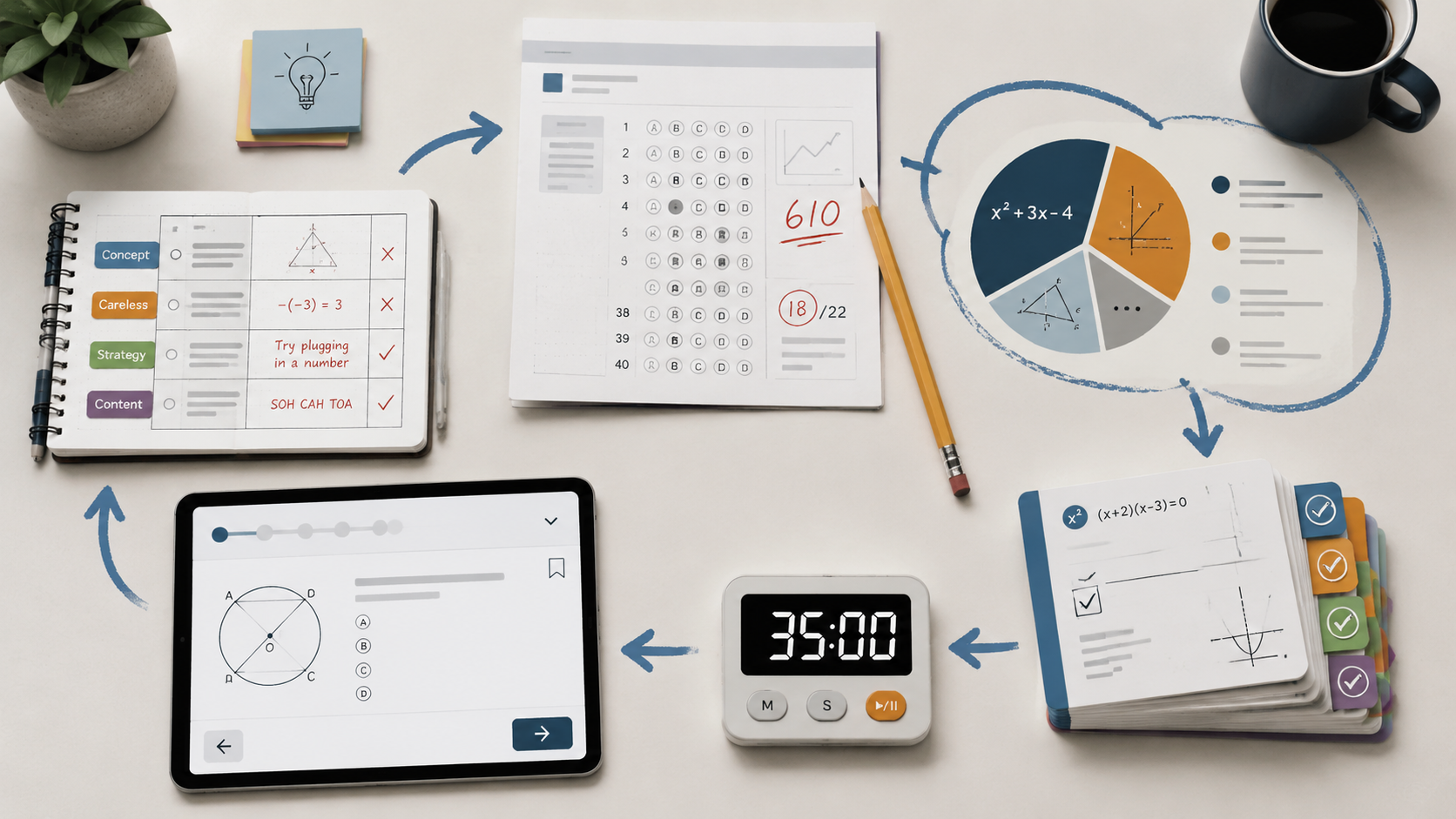
Used well, SAT math practice questions are not a pile to grind through. They are a feedback system. One question tells you whether you can solve a linear equation under pressure. A missed question tells you whether the problem was the concept, the reading, the arithmetic, the calculator, the clock, or the answer format. The improvement comes from doing something with that information before the next set.
Start With a Diagnostic, Not a Stack of Random Questions
The first job is not to prove whether you are “good” or “bad” at SAT Math. The first job is to get a map. Take one full math section or a full-length digital SAT practice test under realistic timing, then treat the results as a sorting task.
The digital SAT Math section is built as two modules of 22 questions each, with 35 minutes per module. The section includes scored questions and unscored pretest questions; Mometrix’s 2026 practice format summary describes 44 math questions across two 35-minute modules, with 40 scored and 4 pretest questions.[1] That structure matters because a student who only practices loose, untimed questions may never notice that the last five minutes change their decision-making.
After the diagnostic, do not just write down the score. Make a simple table: question number, topic, correct or incorrect, confidence level, time problem or not, and error type if missed. If you guessed correctly, mark it. Lucky right answers are not mastered skills; they are warnings with better public relations.
If you need places to find a baseline test or extra sets later, use a resource list like Best Free SAT Math Practice Tests in 2026. But pick the source after you have the review system. More questions without a way to read the results just makes the mess larger.
Let the Domain Weights Decide What Gets Attention
Many students want to study the topics that feel cleanest. That often means geometry, a few formulas, maybe some data questions, and then a quiet avoidance of algebra. The SAT does not reward that arrangement.
Test Ninjas summarizes the SAT Math domain distribution as about 35% Algebra, 35% Advanced Math, 15% Problem-Solving and Data Analysis, and 15% Geometry and Trigonometry, citing College Board-aligned categories.[2] PrepMaven reports the same broad weighting pattern in its SAT Math breakdown.[3] The exact question mix on a given test can vary, but the study implication is clear enough: Algebra and Advanced Math usually deserve first attention, especially for students scoring in the 400–650 range.
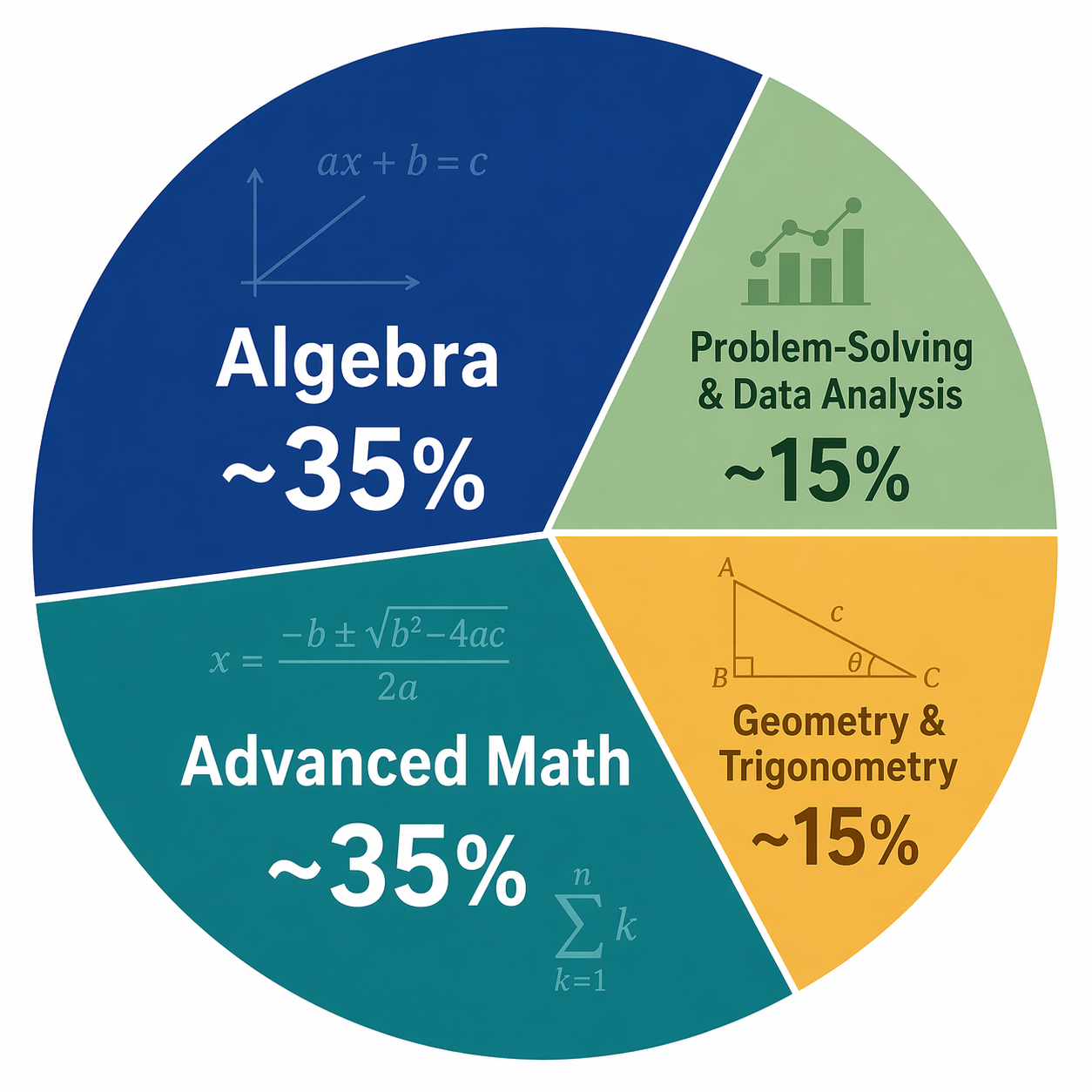
| Domain | Approximate Weight | What to Look For in Your Diagnostic |
|---|---|---|
| Algebra | About 35% | Linear equations, systems, inequalities, expressions, word problems that translate into equations |
| Advanced Math | About 35% | Quadratics, nonlinear equations, functions, equivalent forms, graphs of more advanced relationships |
| Problem-Solving and Data Analysis | About 15% | Ratios, percentages, rates, tables, scatterplots, probability, interpreting data in context |
| Geometry and Trigonometry | About 15% | Area, volume, angles, circles, right triangles, basic trigonometric relationships |
This is where the diagnostic becomes useful. If a student misses five Algebra questions and five Geometry questions, those are not equal study signals. Algebra appears more often, connects to more question types, and tends to expose messy habits: distributing incorrectly, losing a negative sign, solving for the wrong variable, or translating a sentence into the wrong equation.
A practical first pass looks like this: circle the two weakest high-weight domains, choose one narrow skill inside each, and drill those before returning to broad mixed practice. “Advanced Math” is too large to practice well in one sitting. “Factoring a quadratic when the coefficient of x squared is 1” is narrow enough to fix.
Respect the Adaptive Format Early
The digital SAT is not just a shorter paper test on a screen. It is section-adaptive. Performance on Module 1 affects the difficulty of Module 2, and UWorld and Test Ninjas both emphasize that this changes the score ceiling a student can reach.[2][4] Test Ninjas estimates that students routed to the easier second math module generally max out around the 560–600 range.[5]
That does not mean Module 1 has to be perfect. It does mean early care matters. A student who races through the first module, misses two medium questions from avoidable algebra slips, and saves three minutes they did not need has not played the format wisely.
For practice, this means timed work should enter the plan before the final week. Not every drill needs a timer, but students need repeated experience with 22 questions in 35 minutes because that is the unit the test uses.[1][4] Speed is not a personality trait. It is partly a byproduct of knowing when to solve, when to substitute, when to graph, when to estimate, and when to skip and return.
Use Targeted Drills Before Full Timed Modules
Once the diagnostic points to weak areas, do not immediately take another full test. That is like weighing yourself twice and calling it a workout. Full tests measure progress; targeted drills create it.
A targeted drill should be small enough that you can review it the same day. Ten to fifteen questions on one skill is often more useful than 50 mixed questions that no one has the patience to analyze. If the issue is systems of equations, stay with systems long enough to see the patterns: substitution, elimination, graphing, interpreting intersection points, and spotting when the question asks for x + y instead of x alone.
- Choose one narrow skill from the diagnostic, not a whole domain.
- Do a short set without rushing, marking confidence as you go.
- Review every missed, guessed, and slow question.
- Write the error type, not just the correct solution.
- Find a few similar questions before moving to a new topic.
That last step is where many students stop too early. Redoing the same missed question can be comforting because the second attempt feels smoother. But if the student remembers the answer, the question is no longer testing the original weakness. Similar questions are the test. They show whether the habit changed.
Build a Mistake Log That Says More Than “Careless”
“Careless mistake” is usually too vague to be useful. It lets the student feel as if the problem is not real: I knew how to do it, so it does not count. On test day, it counts.
UWorld’s SAT Math study guidance recommends categorizing mistakes by root cause rather than simply rereading the explanation and moving on.[4] That is the right instinct. A sign slip, a misread, and a concept gap need different repairs. Calling all three “careless” guarantees they will come back wearing different clothes.
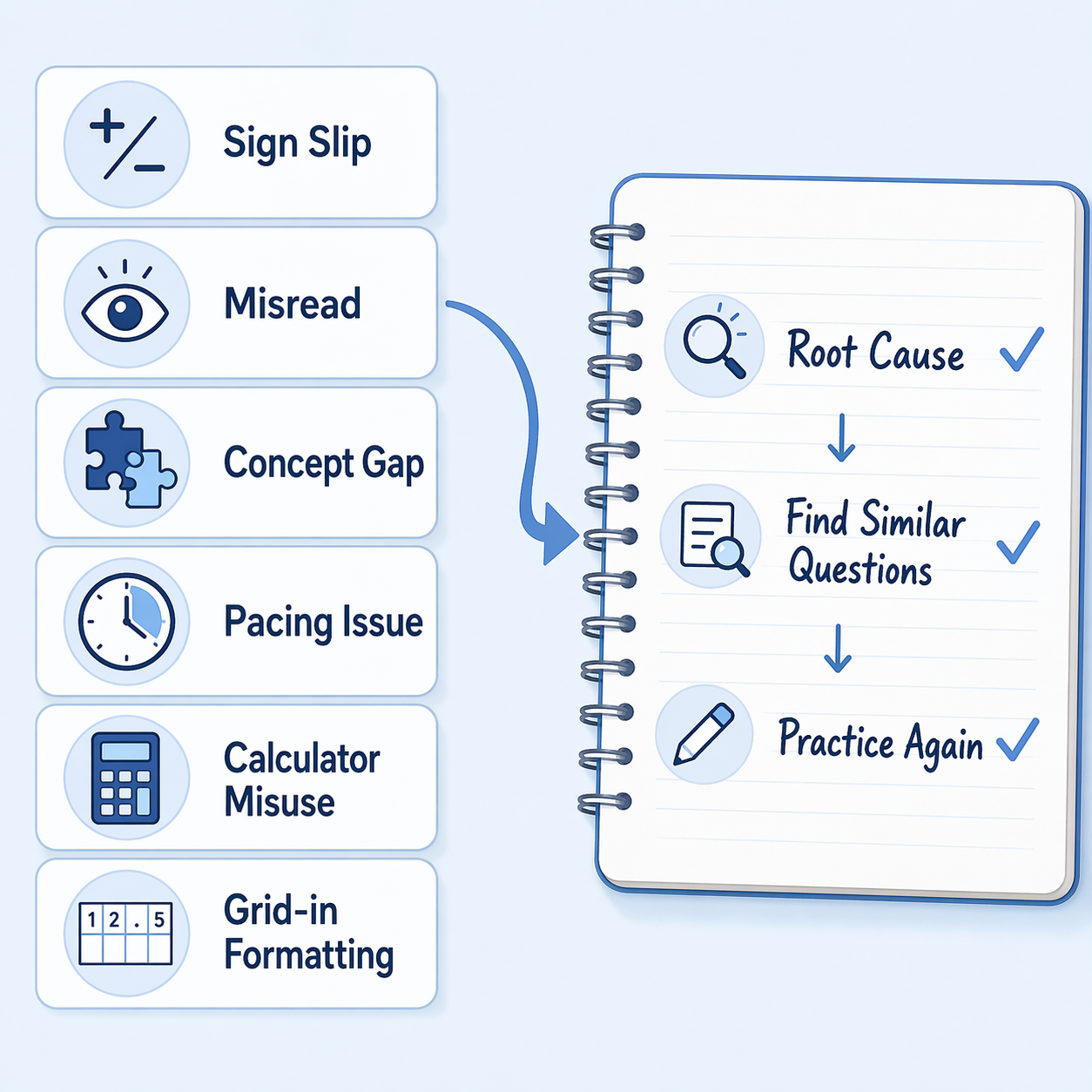
| Error Type | What It Usually Looks Like | What to Do Next |
|---|---|---|
| Sign slip | The setup is right, but a negative sign changes or disappears. | Redo the algebra line by line, then practice similar equations slowly before adding time pressure. |
| Misread | You solved for the wrong value, ignored a constraint, or missed a word like least, maximum, or not. | Underline the requested quantity and write a one-line translation before solving the next few questions. |
| Concept gap | The explanation uses a rule or relationship you did not actually know. | Pause mixed practice and relearn that skill with focused examples. |
| Pacing issue | You knew a path but ran out of time, or spent too long on one question. | Practice skip-and-return decisions inside a timed 35-minute module. |
| Calculator misuse | The calculator gave an output, but you entered the wrong expression or trusted the graph without interpreting it. | Repeat the question using the built-in calculator and write what the display means in the problem context. |
| Grid-in formatting | The math is correct, but the entered answer does not follow SAT response rules. | Practice student-produced response entries separately until the format is automatic. |
The mistake log does not have to be beautiful. It has to be honest. A useful entry might say: “Question 14, Advanced Math, quadratic function, misread. I found the x-intercepts, but the question asked for the y-intercept. Next: do five function-graph questions and write the requested value before solving.” That entry changes tomorrow’s work. “Careless” does not.
For students stuck in the middle score range, the log often exposes a pattern they could not feel while practicing. Maybe the student understands linear equations but misses word problems because they assign variables casually. Maybe they know quadratics in a lesson but panic when the answer choices show equivalent forms. Maybe they lose points only after minute 25. None of that is visible from a raw score alone.
The Review Rule: One Missed Question Should Produce More Than One Redo
After reviewing a missed question, find two or three similar questions. They do not need to be identical; they need to test the same decision. If the missed problem involved choosing the best equivalent form of a quadratic, the follow-up questions should force that same recognition. If the missed problem involved interpreting a percent increase in context, do not replace it with a geometry problem just because both are “math.”
Practice Desmos Before You Need It
The SAT provides a built-in Desmos calculator throughout the Math section, and College Board states that students can use the embedded calculator for the entire Math section, with access to both graphing and scientific calculator functions.[6] That is helpful only if the student has practiced with it before test day.
Desmos can protect time on systems, intersections, function behavior, and checking numerical answers. It can also create false confidence. A graph answers the question you entered, not necessarily the question the test asked. If the original equation was typed with missing parentheses, or if the graph’s intersection point is rounded and the answer choices are exact, the calculator has not saved you.
- Use Desmos during practice modules, not only during review.
- Check whether graphing, substitution, or hand-solving is fastest for each question type.
- Write down calculator mistakes in the same log as algebra mistakes.
- Practice interpreting outputs instead of copying numbers blindly.
A student does not need to turn every problem into a calculator performance. The goal is judgment: when the tool clarifies, use it; when it slows you down or hides the structure, solve another way.
Do Not Donate Points on Grid-In Questions
Student-produced response questions deserve their own small practice routine. The Princeton Review describes these grid-in questions as a portion of SAT Math where students enter their own answers rather than choosing from options, and notes that they make up about one-quarter of the Math questions.[7] Test Ninjas also identifies student-produced response questions as part of the digital SAT Math format.[2]
The math can be right and the submitted answer still be wrong if the format is wrong. Princeton Review’s guidance warns students not to enter mixed numbers, not to include units, and to pay attention to decimal entry limits.[7] These are deeply annoying mistakes because they are fixable. No one becomes better at algebra by losing a point for entering a mixed number incorrectly.
- Convert mixed numbers to improper fractions or decimals.
- Do not enter units, even if the problem context uses them.
- If using a decimal, make sure the entered value fits the allowed format.
- Check whether the question asks for x, y, a sum, a product, or a value in context.
Grid-in practice should be brief but repeated. Mix a few student-produced response questions into weekly work so the format becomes boring. Boring is good here. Boring means the student is not using test-day attention on avoidable formatting rules.
Move From Targeted Drills to 35-Minute Modules
Timed modules should come after some targeted repair, not before. If a student has no idea why the last test went badly, another timed module mostly rehearses stress. Once the student has worked on a few weak skills, timed practice becomes useful because it shows whether the skill survives under real conditions.
UWorld recommends timed single-module drills as an efficient SAT Math practice format, using the test’s 35-minute, 22-question module structure.[4] That is a sensible middle step between tiny topic drills and full-length exams. It is long enough to test pacing and switching between topics, but short enough to review carefully afterward.
During a timed module, track more than the score. Mark any question where you felt stuck for more than a minute. Mark any question you guessed. Mark any question where Desmos helped, and any question where it wasted time. When reviewing, those marks are often more useful than the answer key.
| Practice Mode | Best Use | What to Review |
|---|---|---|
| Untimed targeted drill | Repairing one narrow skill | Concept gaps, setup errors, repeated algebra habits |
| Short mixed set | Checking whether a repaired skill appears outside its topic label | Recognition, question reading, flexible method choice |
| 35-minute module | Practicing pacing and Module 1 accuracy under realistic pressure | Slow questions, skip decisions, calculator choices, late-module mistakes |
| Full-length test | Measuring readiness and endurance | Score trend, domain pattern, timing across the whole exam |
Use Full-Length Tests as Checkpoints, Not Daily Medicine
Full-length tests are valuable, but they are expensive in time and attention. Taking one every day is rarely the smartest plan, especially if the student does not review them properly. A full test should answer a bigger question: Is the current practice cycle raising the score, stabilizing timing, and reducing repeated mistakes?
PrepMaven argues that the SAT is highly coachable and reports students achieving 200-point score increases with structured preparation.[3] UWorld also describes 150–200 point score gains as possible through consistent, focused SAT preparation.[4] Those claims are encouraging, but they should not be read as a guarantee for every student on every timeline. They support the more modest and more useful point: structured practice gives a student a better chance than raw volume.
After a full-length test, return to the same review process. Sort the misses by domain and error type. Look for old mistakes that came back. If the student has improved in Algebra but is now losing points to pacing, the next week should change. If Geometry is still weak but only 15% of the section, it may deserve steady maintenance rather than taking over the whole plan.[2]
A Flexible Practice Cycle for Different Timelines
The same cycle can fit different timelines. A student with several months can move more gradually; a student with two weeks has to make sharper choices. These are frameworks, not promises, because score growth depends on starting point, consistency, accuracy of review, and how much unfinished math content the student is carrying.
| Time Available | Main Job | Reasonable Practice Pattern |
|---|---|---|
| 3–6 months | Build weak domains and habits steadily | Diagnostic, weekly targeted drills, regular 35-minute modules, occasional full-length tests |
| 1–2 months | Prioritize high-weight weaknesses | Diagnostic, Algebra and Advanced Math focus, two or more timed modules per week, full test checkpoints |
| 2–3 weeks | Protect the most fixable points | Mistake-log review, Module 1 accuracy, Desmos fluency, grid-in formatting, selected high-yield drills |
| Final week | Stabilize, do not reinvent everything | Light targeted review, one realistic timed check if needed, sleep, calculator familiarity, answer-format reminders |
The shorter the timeline, the less room there is for comforting detours. If Algebra is the biggest leak, the student does not need three days of favorite geometry review. If grid-ins keep costing points, the student needs a small formatting routine. If Module 1 accuracy is shaky, the student needs slower first-pass work and better skip decisions, not just harder questions.
What Tomorrow’s Practice Should Look Like
If you already have a diagnostic, start there. Pick the weakest high-weight domain, choose one narrow skill, and do a short drill. Review every miss with an error type. Then find similar questions and prove the fix works.
If you do not have a diagnostic, take one before buying another book or opening another random question set. The first score may sting, but it is not a verdict. It is a map. The student who uses that map has a better shot than the student who keeps wandering through question after question hoping effort will eventually organize itself.
SAT math practice questions work when they are connected to decisions: what to study, how to time it, when to use Desmos, how to enter an answer, and what to repair after a miss. Consistent structured use is more reliable than raw volume because test day rewards practiced behavior, not just accumulated pages.
References
- Free SAT Math Practice Test 2026, Mometrix
- SAT Math Section Overview, Test Ninjas
- 25 of the Hardest SAT Math Problems, PrepMaven
- How to Study for SAT Math, UWorld College Prep
- Digital SAT Adaptive Testing, Test Ninjas
- SAT Calculator Policy, College Board
- SAT Math Practice, The Princeton Review
Comments
Join the discussion with an anonymous comment.