
Why Your Digital SAT Practice Scores Dropped and How to Fix It
The College Board's new digital SAT practice tests are significantly harder, with tougher math, more obscure vocabulary, and stricter adaptive cutoffs. Learn the specific changes and how to adjust your study plan to avoid a score drop.
Updated:
If your digital SAT practice tests looked steady for weeks and then suddenly dropped on a newer Bluebook test, the first thing to check is not whether you somehow forgot algebra or lost your reading skills overnight. Check which test you took.
That score drop may be real in the narrow sense: you answered fewer questions correctly, missed the hard-module route by a thinner margin, or got pinned down by harder vocabulary and longer math setups. But it may not mean your preparation collapsed. It may mean the practice-test yardstick changed while you were using it.
The timeline matters. In February 2025, College Board retired Bluebook Practice Tests 1-3 and released Tests 7-10. Piqosity’s analysis notes that Test 7 is the clearest fully new signal, while Tests 8-10 recycle some questions from the retired tests.[1] That makes a student’s 2026 practice history unusually uneven: an older test score, a Test 4 score, and a Test 7 score may not be measuring readiness against the same difficulty profile.
So the useful question is not simply, “Are the digital SAT practice tests harder?” It is: “Which practice scores still tell me what I am likely to face now?”
The Newer Bluebook Tests Changed the Baseline
For students who started with older Bluebook tests, the trap is understandable. Tests 1-3 were official. They were not random worksheets, and students were not wrong to trust them when they were available. The problem is that those tests are no longer the best final check for a 2026 test date.
Piqosity’s February 2025 breakdown compared the retired Test 1 with the newly released Test 7 and found several difficulty shifts that line up with what many students report after a newer practice test: the math hard module has fewer easy questions, more multi-step work, and less forgiving routing; Reading and Writing leans more technical; and vocabulary becomes less common by a measurable margin.[1]
That last phrase matters: Piqosity is not College Board. Its analysis is a detailed third-party observation, not an official announcement that the SAT has been made harder. But it is specific enough to be useful. It does not just say, “Test 7 feels rough.” It points to the kinds of questions that changed, which is exactly what a student needs after a score drop.
If you need the official-platform basics, the Bluebook and Khan Academy guide is still the right place to start. Here, the issue is more specific: how to interpret your score when your older practice results and newer practice results disagree.
Why Test 7 Can Feel Like a Different Exam
The most important part of Piqosity’s analysis is not the headline that Test 7 is harder. It is the mechanism. A harder SAT does not have to look dramatic. It can look like two fewer softballs in the second math module, one technical passage where you expected a friendlier topic, or a vocabulary question where all four choices are less familiar than the words you drilled.
Math: fewer easy exits in the hard module
On the digital SAT, many students experience the second math module as a confidence test. If they reach the harder route, they expect a few bruising questions, but they also expect enough manageable ones to stabilize the score. Piqosity’s Test 1 vs. Test 7 comparison suggests that Test 7 gives students less of that cushion: its hard math module has fewer easy questions and more multi-step problems.[1]
That kind of change can punish a student who has been preparing by topic but not by question density. A student may know linear equations, quadratics, ratios, and geometry in isolation. The newer module asks more often whether they can decide which tool belongs in the problem, carry the setup cleanly, and still have enough time left to avoid a preventable mistake.
Piqosity also notes the appearance of concepts such as the slant height of a cone in Test 7, a concept absent from Test 1.[1] That does not mean every student should panic-study every obscure geometry formula. It does mean that a prep plan built only around the friendliest older Bluebook math can leave students surprised by the outer edge of what the test may ask.
The practical consequence is simple: if you were missing mostly the last few math questions on older tests, the newer tests may expose whether your score depended on having enough easy and medium questions earlier in the module. A drop in that situation is not mysterious. The cushion in the hard module shrank.
Reading and Writing: fewer easy subtopics to bank
The Reading and Writing change is just as important because it affects the students who usually feel safe there. Piqosity found that Test 7’s hard Reading and Writing module has only 7 questions in easier subtopics such as words in context, grammar, and transitions, compared with 12 in Test 1.[1]
That is not a small shift. Easier subtopics are where many students quietly build their margin. They are the questions a strong student expects to answer quickly and use to offset a dense inference question or an awkward evidence pair. When those easier categories shrink, the section becomes less forgiving even if the official format looks the same.
Piqosity also counted 10 technical passages in Test 7’s hard Reading and Writing module, compared with 7 in Test 1, and 2 literary passages instead of 1.[1] That helps explain a very specific student complaint: “I understood the words, but I kept rereading.” Technical passages slow students down because the relationships are less familiar. The task is not just to read; it is to track a claim, a qualification, and a narrow piece of evidence under time pressure.
Vocabulary: the words really did get less common
Vocabulary complaints are often too vague to be useful. “The words were weird” can mean the student did not know the answer choices, misread the sentence, or got thrown by a technical context. Piqosity’s comparison gives that complaint a sharper shape.
In its Ngram-based analysis, Piqosity compared Test 7 hard-module words such as “rectify,” “arduous,” “demarcated,” and “notional” with Test 1 words such as “reciprocates,” “recognizable,” “ambivalence,” and “diverse.” The Test 7 set averaged 0.000116% usage frequency in 2022, while the Test 1 set averaged 0.000776%, making the Test 7 words 6.7 times more obscure by that measure.[1]
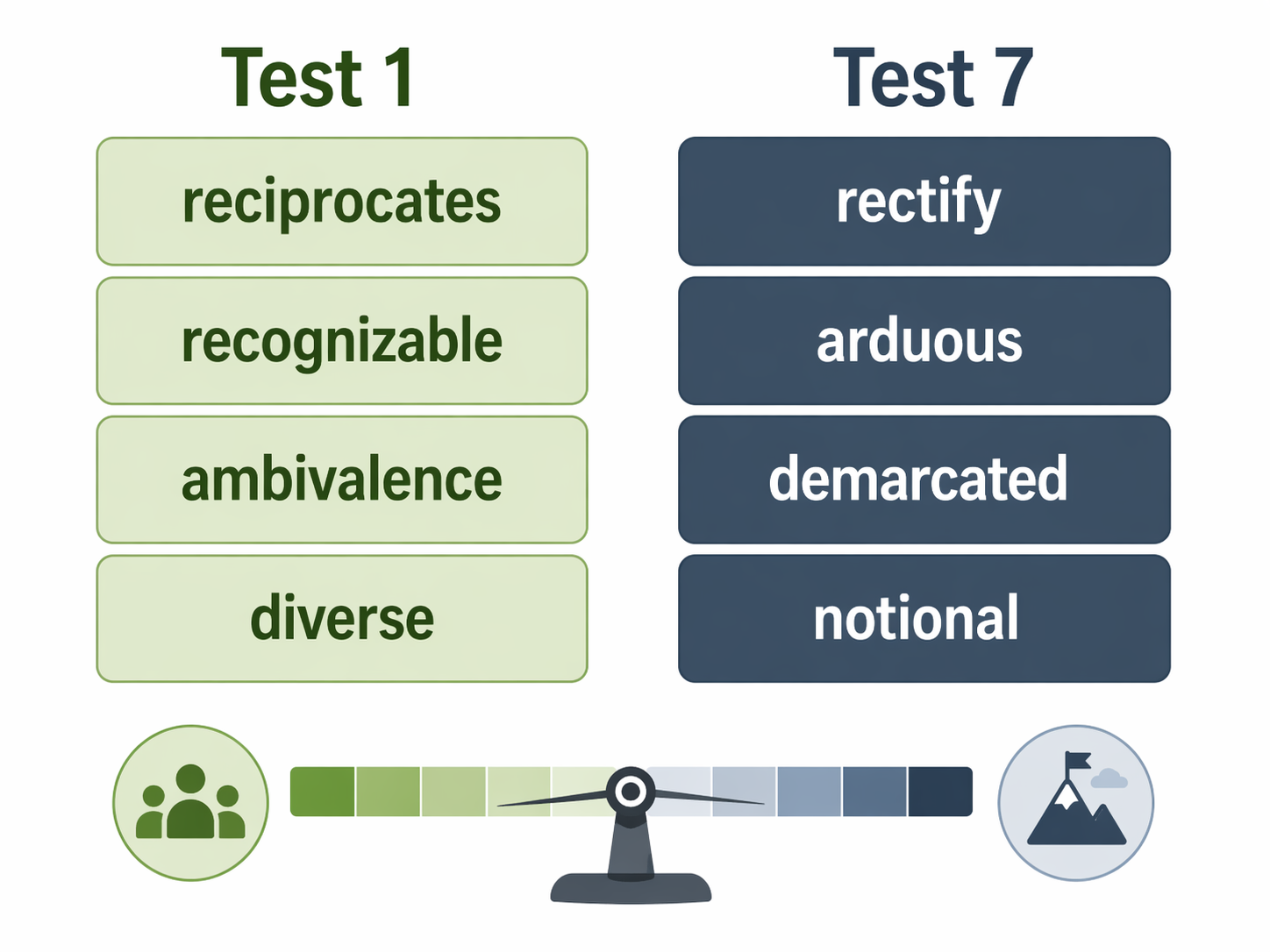
That does not turn the digital SAT into an old-style vocabulary test. Context still matters. But if a student’s vocabulary prep consisted mostly of recognizing common academic words in friendly sentences, Test 7 may feel like the test suddenly changed its manners. It asks for the same general skill with a less familiar word bank.
Adaptive cutoffs may be stricter, but treat that as inferred
The most sensitive claim is about module routing. Piqosity’s analysis indicates that the effective cutoff for reaching the hard module may have risen from about 60% to about 70% accuracy in Math and from about 70% to about 80% in Reading and Writing.[1] That is a big deal if true, because it means a student can feel “mostly fine” in Module 1 and still miss the route that supports a higher score.
But this is exactly where the language has to stay careful. Those cutoff figures are inferred from Piqosity’s work, not confirmed by College Board. They are useful for planning because they match the student experience of needing more early accuracy, but they should not be treated as official scoring rules.
| Area | What Piqosity observed in Test 7 | What it means for a student |
|---|---|---|
| Math hard module | Fewer easy questions and more multi-step problems than Test 1 | You need cleaner setup and pacing, not just topic familiarity |
| Math content edge | Concepts such as slant height of a cone appear in Test 7 but not Test 1 | Older tests may understate the range of math that can show up |
| Reading and Writing | 7 easier-subtopic questions in Test 7 vs. 12 in Test 1 | There are fewer quick points to bank in the hard module |
| Passage type | 10 technical passages in Test 7 vs. 7 in Test 1 | Dense wording and unfamiliar topics can slow accurate readers |
| Vocabulary | Test 7 word set measured 6.7 times more obscure than Test 1’s set | Context skills need support from broader academic vocabulary |
| Adaptive routing | Piqosity inferred higher hard-module cutoffs | Early-module accuracy may matter more than older practice suggested |
What Your Score Drop Does and Does Not Prove
A lower score on Test 7 does not automatically prove that your real SAT score will be lower by the same amount. It also does not prove that your earlier scores were fake. Older digital SAT practice tests still show something: they can reveal whether you understand the format, whether you have major content gaps, and whether your pacing strategy collapses under official timing.
What they may not show is whether your preparation survives the newer difficulty mix. That distinction matters. A student who scored well on an older test has evidence of competence, but not complete evidence of readiness.
The estimated score gap sometimes attached to this discussion, roughly 50-100 points for students who relied heavily on older tests, should be treated as an estimate rather than a rule. Piqosity’s evidence supports the idea that older tests can overstate readiness, but it does not give every student the same predictable penalty.[1] The size of the drop depends on where the student was vulnerable: routing, math depth, vocabulary, technical reading, or time management.
This is also why Test 4 deserves special caution. It remains available, but Piqosity identifies it as notably easier than the current tests, which makes it a poor final readiness check for a 2026 test date.[1] If Test 4 is the last full practice exam before the real SAT, the student may walk in with a clean-looking score and an incomplete stress test.
How to Rebuild Your 2026 Practice Plan
The fix is not to throw away every older score. The fix is to change the job each practice test performs. Older Bluebook tests can still diagnose broad weaknesses. Newer Bluebook tests should carry more weight when you are judging final readiness.
Re-rank your official practice tests
For a 2026 test date, do not treat every official Bluebook score as equally predictive. A sensible ranking looks like this:
- Use newer Bluebook material, especially Test 7, as the strongest calibration point for current difficulty.
- Use Tests 8-10 carefully because they include some recycled retired questions, so they are useful but not as clean a signal as Test 7.
- Use Test 4 for practice, review, and stamina, but not as the final word on readiness.
- Treat scores from retired or older-style materials as evidence of skill, not as a current score promise.
This is the same reason students should avoid the common mistake of burning through official tests casually and then using the wrong one as the final benchmark. If that has already happened, the Bluebook practice mistakes guide is a useful reset.
Review missed questions by failure type, not just topic
A Test 7 review should not stop at “missed geometry” or “missed vocabulary.” That is too shallow for the newer difficulty pattern. Sort misses by what actually broke:
- Content gap: you did not know the rule, formula, word, or concept.
- Setup gap: you knew the math or reading skill but did not translate the question correctly.
- Module-pressure error: you rushed because earlier questions took too long.
- Vocabulary uncertainty: you narrowed the choices but lacked enough word knowledge to finish.
- Technical-reading drag: you lost time because the passage topic was unfamiliar or dense.
That classification tells you what to do next. A content gap needs targeted study. A setup gap needs slower untimed reconstruction. A module-pressure error needs pacing practice. A vocabulary miss needs repeated exposure to academic words in context, not just a one-time definition check.
Train math for multi-step pressure
For math, the adjustment is not “do harder questions forever.” It is to practice the handoff between steps. After each missed or slow problem, write the first move you should have made: define a variable, draw the diagram, isolate the expression, use the answer choices, or convert the wording into an equation. The first move is where many multi-step problems are won or lost.
Then add mixed sets. Topic-by-topic practice is useful while learning, but the harder module does not announce, “This is a ratios question” or “This is a function transformation.” Mixed practice forces the decision step, which older easier modules may not have punished as strongly.
Make vocabulary prep less decorative
The Test 7 vocabulary evidence does not justify memorizing thousands of antique words. It does justify taking vocabulary seriously again. Students should collect missed or uncertain words from practice, write a plain-English meaning, and add one sentence showing how the word behaves in context. Words such as “notional” and “demarcated” are not helped much by a flashcard that never appears inside a sentence.
Reading also has to get a little less comfortable. Add short technical passages from science, history, and social science sources. The goal is not background knowledge for its own sake. The goal is to practice tracking claims when the subject is not something you would have chosen to read.
Protect the first module
If adaptive routing cutoffs are indeed stricter, then casual first-module mistakes become more expensive. Even without treating Piqosity’s inferred cutoffs as official rules, students should prepare as if the first module deserves full attention. That means no “warm-up” mentality, no saving focus for later, and no assuming that one or two careless errors will disappear inside the scoring system.
A good review question after any full test is: “Did I lose points before the test got hard?” If the answer is yes, that is the first fix. Hard questions are tempting to study because they feel impressive. Early preventable misses are often the faster score recovery.
Supplement, but do not let substitutes become the benchmark
Because official Bluebook tests are limited, most students need some supplemental practice. That is fine, as long as the supplement has a clear job. Use third-party material to build volume, target weak skills, and practice timing. Use the newest official tests to calibrate.
The difference between those jobs is important. A free test can be helpful without being equally predictive. If you are comparing options, start with the free SAT practice-test comparison. If you are experimenting with AI-generated practice, the Gemini SAT practice article explains where that kind of tool fits and where it should not replace official calibration.
A Better Way to Read Your Next Practice Score
After a newer Bluebook test, do not look only at the total score. Ask what the score measured.
- If the drop came mostly from Math Module 2, the issue may be hard-module density and multi-step endurance.
- If Reading and Writing slowed down, the issue may be technical passages or fewer easy subtopic questions.
- If vocabulary misses increased, the issue may be word familiarity rather than general reading ability.
- If the second module looked easier than expected, the issue may be first-module accuracy and routing.
- If Test 4 looked much better than Test 7, the issue may be calibration rather than sudden regression.
That last one is the emotional trap. Students often treat the lower newer score as the truth and the higher older score as a lie. A better reading is that each score came from a different practice environment. The older score showed what you could do against an easier or less current mix. The newer score shows what still needs to hold up against the sharper version.
For a full timeline, a 90-day digital SAT practice schedule can help you place official tests, review weeks, and targeted practice in the right order. The main adjustment, though, is already clear: do not use stale confidence as your final readiness check. Older digital SAT practice tests are not useless. They are incomplete evidence. For 2026, your plan needs at least one serious encounter with the newer standard before test day.
References
- The SAT Digital Test is Getting Harder, Piqosity, February 14, 2025, https://www.piqosity.com/2025/02/14/digital-sat-practice-test-announcements/
Comments
Join the discussion with an anonymous comment.