
ASVAB Exam Hub
How to Study Volcano Eruptions for Geology Exams
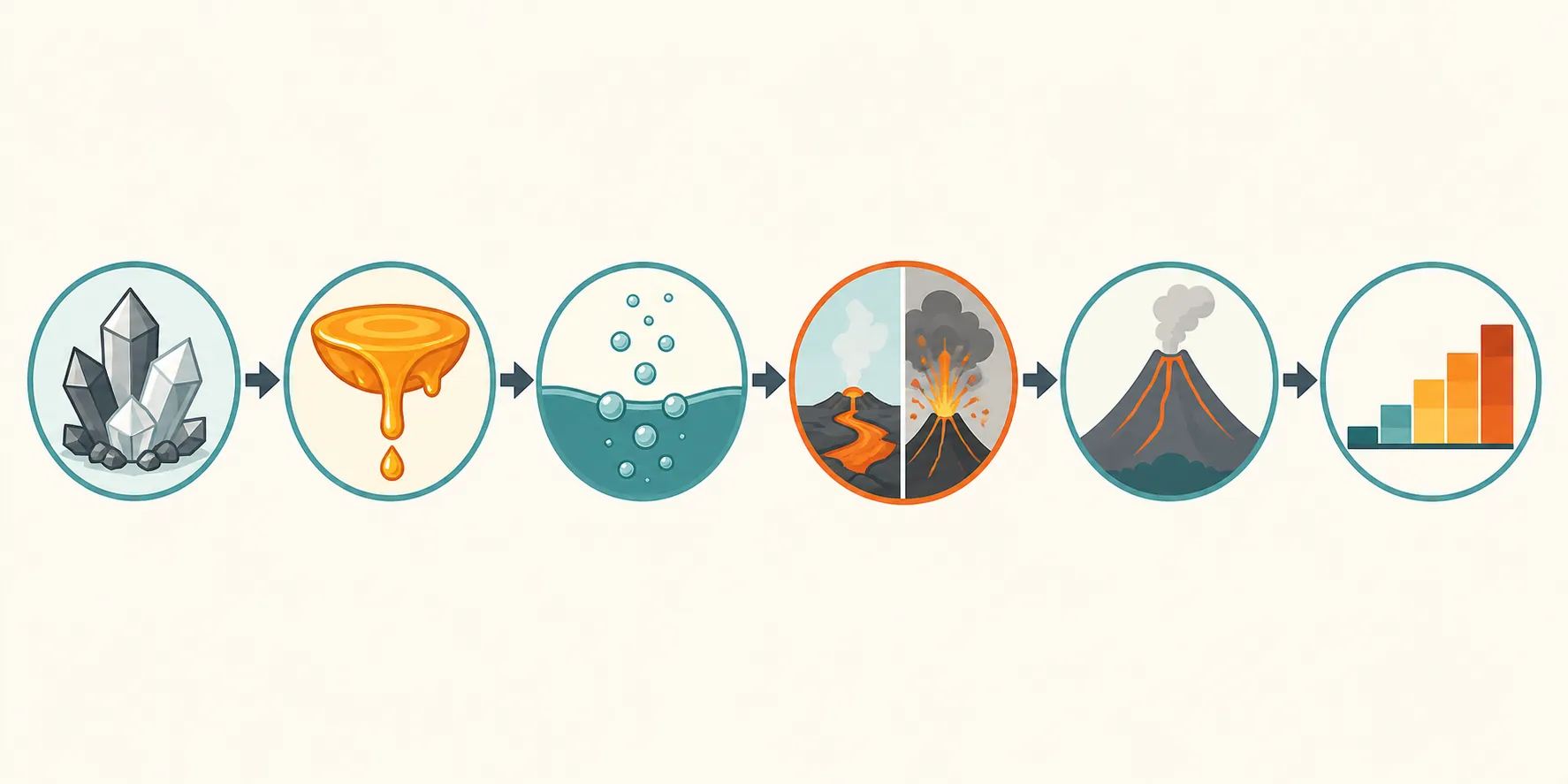
Geology exams keep reducing volcanic eruption questions to one causal chain: silica content sets magma viscosity, and viscosity plus dissolved gas decides whether a volcano erupts quietly or explosively. Master that chain and you can answer items on eruption styles, tephra size classes, and the VEI scale without memorizing isolated volcano facts.
- gre
- mcat
- asvab
- sat
- act
- digital-adaptive
- official-material
- section-strategy
- test-date-timeline
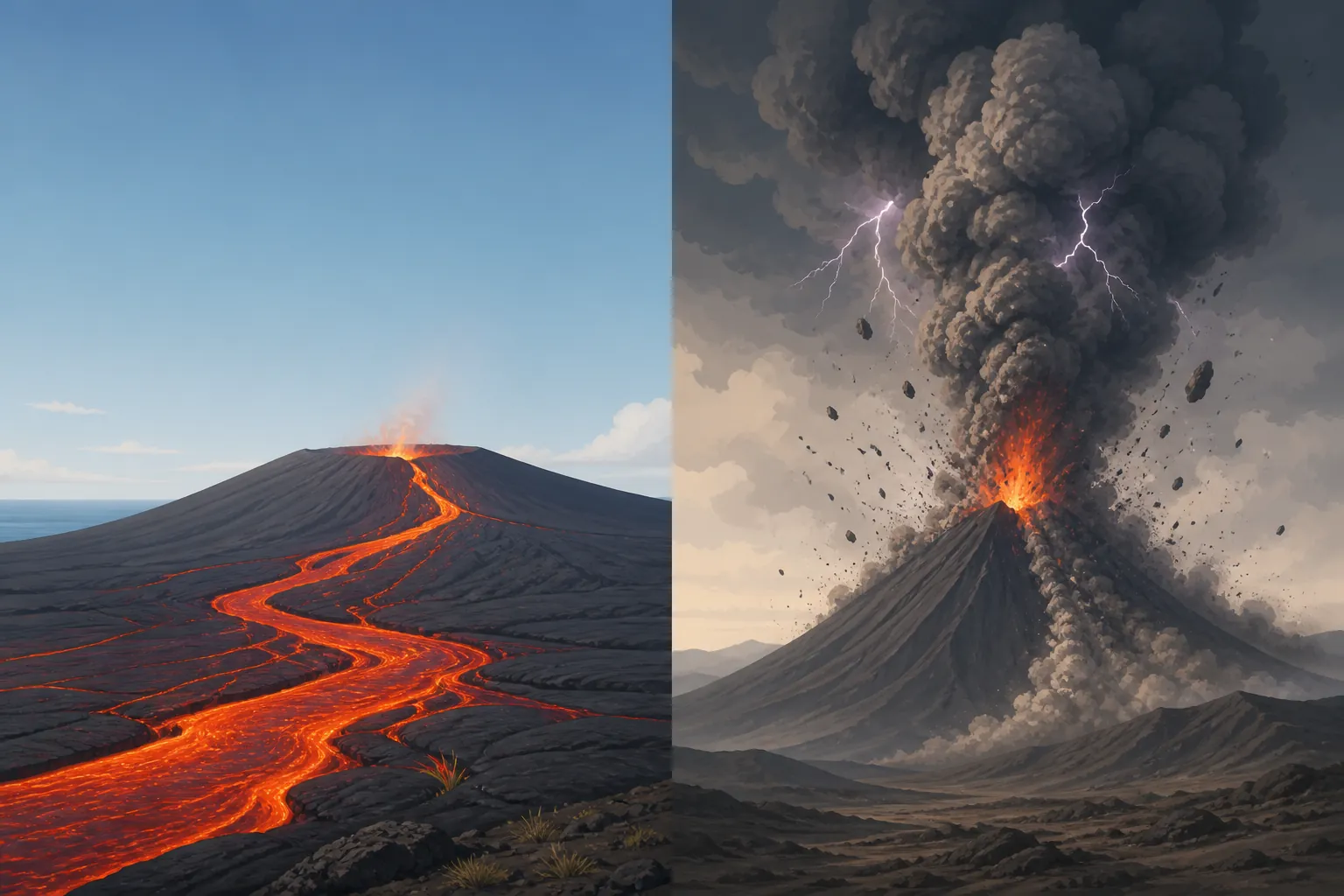
The exam question usually hides inside a simple contrast: one volcano sends out runny lava, another throws ash high into the atmosphere. The useful study move is to stop treating those as two separate facts. For intro geology, high-school earth science, ASVAB General Science, ACT Science earth/space-science passages, and similar exam settings, the conversion is usually this:
- Low silica magma → low viscosity → gas escapes more easily → effusive eruption → Hawaiian-style lava flows or fountains → low VEI.
- High silica magma → high viscosity → gas stays trapped longer → explosive eruption → Vulcanian, Pelean, or Plinian possibilities → higher VEI.
- Water added to the system → steam-driven or magma-water explosions → phreatic or phreatomagmatic branch, which should not be forced into the same pure silica ladder.
That is the core of a volcano eruption study guide for geology exams. The names matter, but they are not where the reasoning starts. A student who memorizes “Plinian” before understanding trapped gas has memorized the label at the expensive end of the chain and left the mechanism blank.
Start with magma type, because the rest of the question follows from it
Tulane’s volcano lecture notes give the exam-friendly comparison cleanly: basaltic magma has about 45–55 weight percent SiO2, a temperature of 1000–1200°C, low viscosity, and low gas content; andesitic magma has about 55–65 weight percent SiO2 and a temperature of 800–1000°C; rhyolitic magma has about 65–75 weight percent SiO2, a temperature of 650–800°C, high viscosity, and high gas content.[1]
| Magma type | SiO2 range | Temperature range | Exam conversion |
|---|---|---|---|
| Basaltic | 45–55 wt% | 1000–1200°C | Hot, low silica, low viscosity, gases escape more easily, commonly effusive |
| Andesitic | 55–65 wt% | 800–1000°C | Intermediate composition and temperature, intermediate viscosity, mixed behavior possible |
| Rhyolitic | 65–75 wt% | 650–800°C | Cooler, high silica, high viscosity, gases are more easily trapped, more explosive potential |
The table is not there so you can admire three rock words. It lets you process a question before the answer choices distract you. If the stem says basaltic, hot, low silica, or shield-volcano lava, move toward low viscosity and easier gas escape. If it says rhyolitic, cool, silica-rich, viscous, or dome-forming magma, move toward trapped gas and explosive behavior. Andesitic magma sits in the middle, which is why it often appears in questions that want you to notice intermediate composition rather than force every eruption into an extreme.
The viscosity numbers are worth keeping because they make the word “viscous” stop feeling decorative. Tulane gives basaltic lava as roughly 10,000 to 100,000 times more viscous than water, while rhyolitic magma is roughly 1 million to 100 million times more viscous than water.[1] That gap is large enough that a multiple-choice item does not need much storytelling. Once the magma composition is given, the eruption behavior is already leaning in one direction.
Viscosity matters because gas has to get out
Dissolved gas is the part students often remember only after they have already chosen an answer. Magma contains dissolved volatiles. As magma rises and pressure decreases, those gases can come out of solution. Tulane compares the process to opening a bottle of soda: release the pressure, and bubbles form as gas escapes from the liquid.[1]
In low-viscosity magma, bubbles can move and escape more easily. The eruption can still be hot, dangerous, and spectacular, but the exam category tends toward effusive behavior: lava flows, lava fountains, and relatively low explosivity. In high-viscosity magma, bubbles have more trouble escaping. Pressure can build until the magma fragments, producing ash, larger tephra, pyroclastic flows, or high eruption columns depending on the eruption style.
This is why “gas-rich” by itself is not enough. A gas-rich magma with low viscosity can let much of that gas escape. A gas-rich magma with high viscosity is the more exam-dangerous combination. The mechanism is not gas alone; it is gas plus the ability, or inability, of the magma to let that gas leave.
Convert the chain into eruption styles
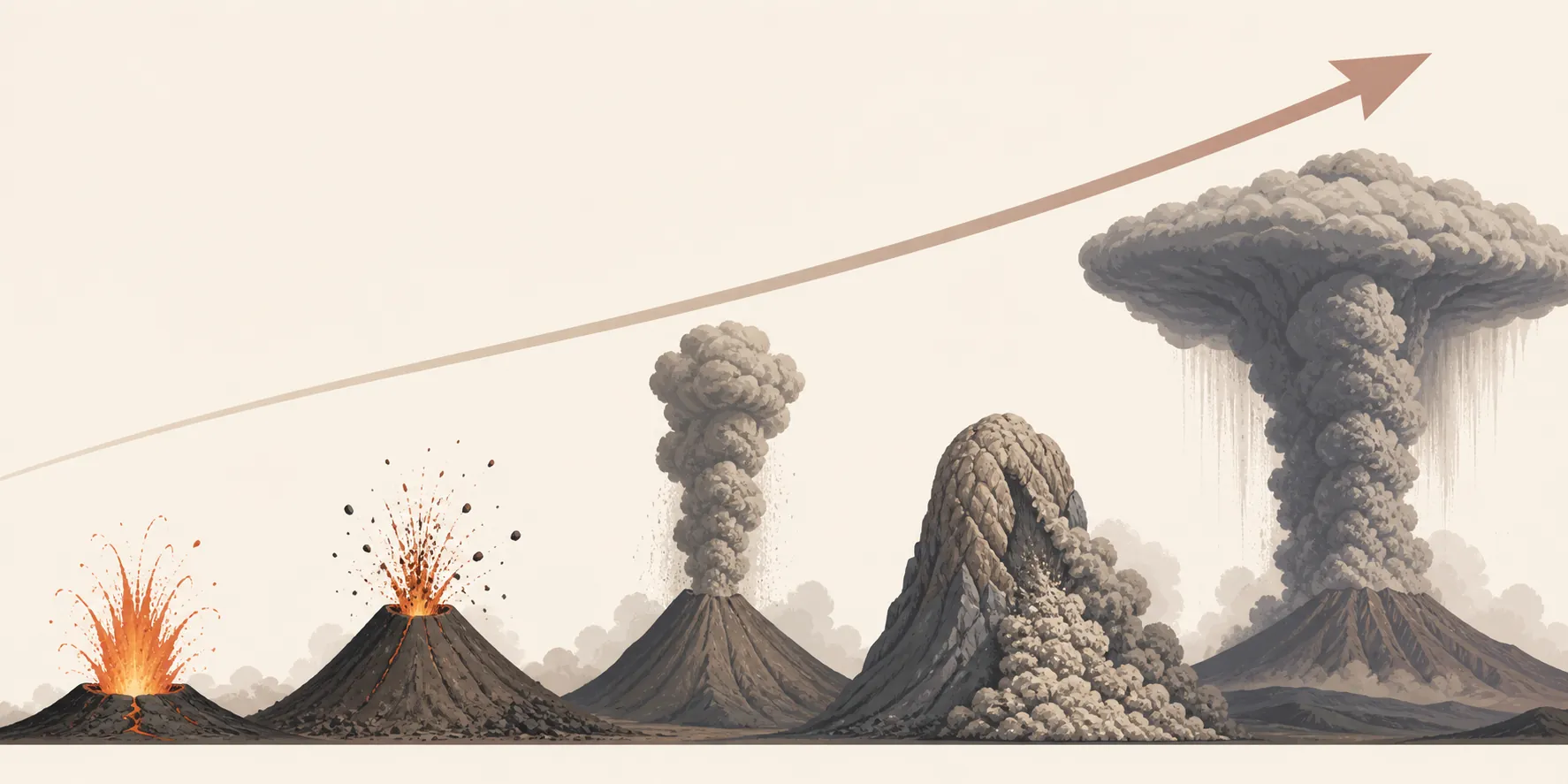
Eruption-style names become less annoying when they are arranged by behavior. The National Park Service describes Hawaiian, Strombolian, Vulcanian, Pelean, Plinian, phreatic, and phreatomagmatic eruption classifications; Tulane’s notes also connect eruption character to viscosity, gas behavior, and magma composition.[1][2]
| Style | What to recognize | How to reason on an exam |
|---|---|---|
| Hawaiian | Lava flows and fire fountains | Start with low-viscosity basaltic magma and relatively easy gas escape |
| Strombolian | Intermittent bursts, often associated with cinder-cone activity | Still on the mild-to-moderate side compared with sustained high ash columns |
| Vulcanian | Short, more explosive blasts with ash columns that can rise multiple kilometers | Move toward higher viscosity and more plugged or gas-pressurized behavior |
| Pelean | Lava dome growth and collapse, producing block-and-ash flows | Think viscous magma, unstable domes, and gravity-driven hot fragment flows |
| Plinian | Sustained, very high eruption columns; Tulane notes columns may reach about 45 km and ash may circle Earth in days | High explosivity: gas-rich, viscous magma and a major fragmentation problem |
| Phreatic | Steam-driven explosion without new magma necessarily being erupted | Use the water/steam branch rather than the silica-only chain |
| Phreatomagmatic | Explosion from interaction between magma and water | Again, water changes the mechanism; do not classify only by basaltic-to-rhyolitic composition |
The least-to-most-explosive sequence is useful, but it is still a study model. Real eruptions can shift behavior, combine processes, or refuse to sit politely in one labeled box. Intro courses usually test the clean version first because it checks whether you can connect composition, viscosity, gas, and eruption products. Treat the taxonomy as a decision procedure for exam questions, not as a complete volcanology model.
Tephra is a vocabulary checkpoint, not a separate chapter
Once an eruption becomes explosive enough to fragment material and throw it into the air, exams often switch vocabulary. Tephra is classified by particle size: ash is less than 2 mm, lapilli are 2–64 mm, and blocks and bombs are greater than 64 mm.[1][3]
The block-versus-bomb distinction is not size; both are larger than 64 mm. Blocks are solid when ejected, while bombs are ejected while still liquid or partly molten and then solidify during flight.[1][3] That one detail is a common way to separate two answer choices that otherwise look identical.
| Fragment term | Size | Extra exam clue |
|---|---|---|
| Ash | <2 mm | Fine volcanic particles; often linked with explosive fragmentation and ash columns |
| Lapilli | 2–64 mm | Pebble-sized volcanic fragments |
| Blocks | >64 mm | Solid when ejected |
| Bombs | >64 mm | Liquid or partly molten when ejected |
VEI is logarithmic, so one number is not one small step
The Volcanic Explosivity Index is a 0-to-8 scale used to describe explosive eruptions, and the National Park Service emphasizes that it is logarithmic, with each interval representing about a ten-fold increase.[4] This is the second place where students lose easy points: they read VEI like a normal rating scale. It is not.
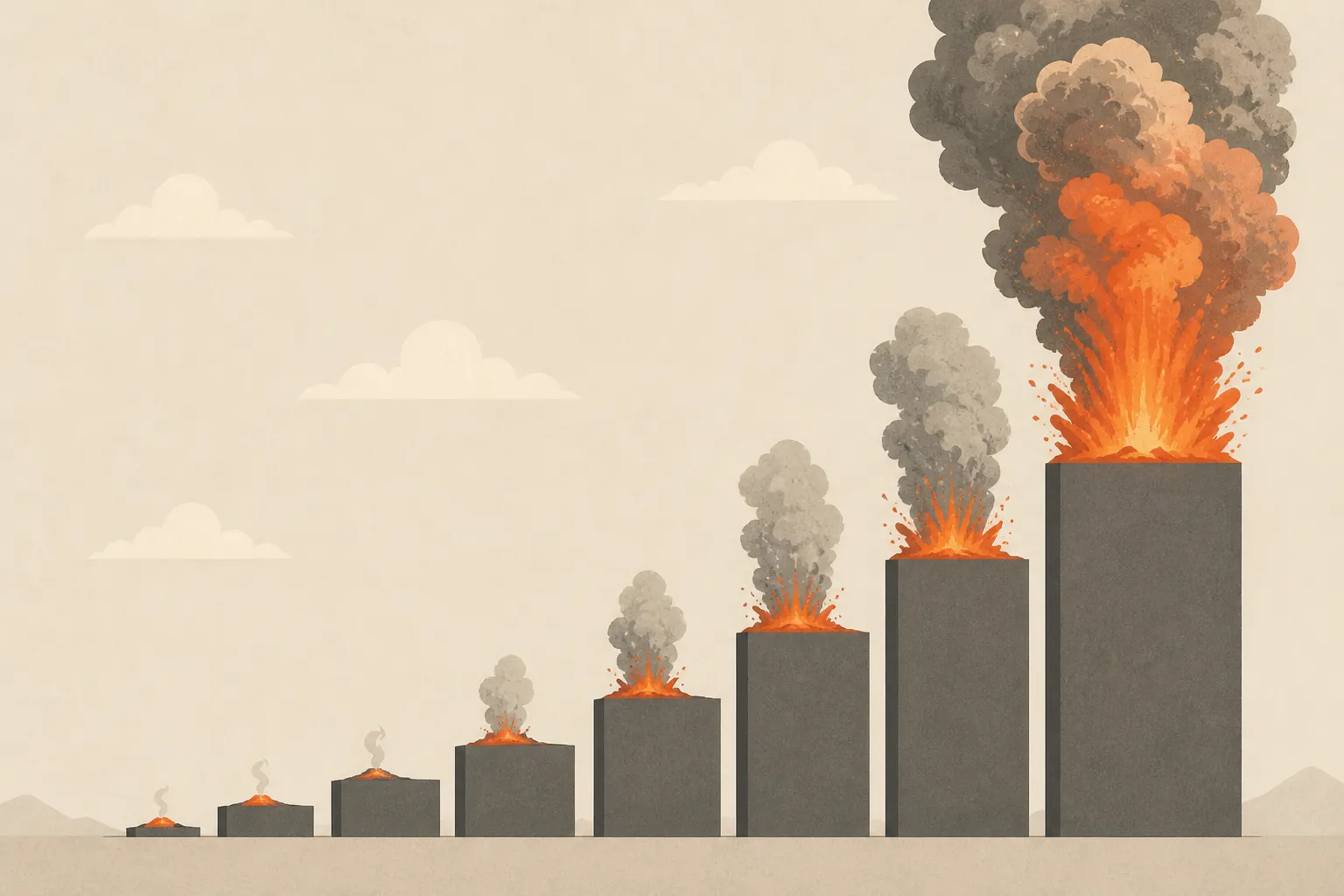
A move from VEI 2 to VEI 3 is not “one unit more” in the everyday sense. It is roughly an order-of-magnitude jump. A move from VEI 3 to VEI 5 is roughly two such jumps. The U.S. Geological Survey’s Mount St. Helens comparison page also uses the VEI framework and notes that VEI 5 events occur roughly once every two decades, with only 21 VEI 5 or larger eruptions since 1500.[5]
For studying, use the endpoints as anchors. Effusive Hawaiian activity sits at the low end of the scale. The largest “supervolcano” eruptions sit at VEI 8. Most classroom items do not need you to reconstruct the entire scale from memory; they need you to recognize that the VEI numbers are logarithmic and that explosivity reflects eruption volume, column height, and eruption behavior rather than how dramatic a sentence sounds.
How exam questions reuse the same chain
The University of Oklahoma volcano study guide and the quiz-style materials in Tulane and OpenGeology point toward the same kinds of tasks: know the magma types, connect viscosity and gas to eruption behavior, identify eruption products, and interpret VEI rather than reciting famous eruptions as isolated stories.[1][3][6] The exact wording will vary by instructor, textbook, and course level, so the safe way to practice is by converting any given clue back into the chain.
| If the question gives you... | Your first move | Likely answer direction |
|---|---|---|
| Basaltic magma, high temperature, low silica | Translate to low viscosity | Easier gas escape; more effusive behavior; Hawaiian-style clues become plausible |
| Rhyolitic magma, lower temperature, high silica | Translate to high viscosity | Gas trapping; fragmentation; explosive styles become more plausible |
| High viscosity plus abundant dissolved gas | Focus on pressure buildup | Explosive eruption rather than quiet lava flow |
| Fragments smaller than 2 mm | Use tephra size classes | Ash |
| Fragments larger than 64 mm, solid when ejected | Separate state from size | Block, not bomb |
| VEI increases by 2 intervals | Apply the logarithmic rule | Roughly a hundred-fold jump, not a two-point linear increase |
| Explosion driven by heated groundwater or magma-water interaction | Leave the pure silica ladder | Phreatic or phreatomagmatic, depending on whether new magma is involved |
Here is a hypothetical exam conversion, not a real course item: a stem says a volcano erupts low-silica magma at high temperature and produces broad lava flows rather than a sustained ash column. The answer is not found by remembering a famous volcano first. Low silica and high temperature point to basaltic magma; basaltic magma points to low viscosity; low viscosity lets gas escape more easily; the eruption is more likely effusive; Hawaiian-style behavior and a low VEI are the answer neighborhood.
Reverse the clues and the answer changes. If a hypothetical stem gives silica-rich magma, high viscosity, trapped gas, ash, and a high eruption column, you should not be shopping randomly among eruption names. You are already on the explosive side of the chain, where Vulcanian, Pelean, or Plinian choices become plausible depending on the specific clue: short ash blast, dome collapse with block-and-ash flow, or sustained towering column.
What to skip until the chain is automatic
It is tempting to study volcanoes as a parade of dramatic names, death tolls, and disaster summaries. Those can matter in a hazards unit, but they are not the best first pass for eruption-mechanism questions. Historical cases also bring source-specific number differences that are mostly irrelevant to the mechanism chain. For this exam task, the better order is composition, viscosity, gas, eruption behavior, style label, tephra, VEI.
Volcano type identification is also useful, especially once plate tectonics enters the unit. Subduction zones, stratovolcanoes, and intermediate-to-silicic magmas belong together in many intro courses. If that is the part giving you trouble, the plate-boundary reasoning in the San Andreas ASVAB geology guide is the nearby context to review. For broader earth/space-science exam practice, the meteor shower astronomy study guide and the 2026 solar eclipse ACT Science guide use the same kind of source-bounded exam framing.
Final self-check
- Can you turn basaltic into low silica, hotter magma, low viscosity, easier gas escape, effusive behavior, and low VEI without looking?
- Can you turn rhyolitic into high silica, cooler magma, high viscosity, trapped gas, explosive behavior, and possible Plinian-scale clues?
- Can you explain why dissolved gas causes more trouble in viscous magma than in runny magma?
- Can you place Hawaiian, Strombolian, Vulcanian, Pelean, and Plinian styles from less explosive to more explosive?
- Can you name ash, lapilli, blocks, and bombs from size clues, and separate blocks from bombs by whether they were solid or liquid when ejected?
- Can you remember that VEI runs from 0 to 8 and is logarithmic, with each interval representing about a ten-fold increase?
If those conversions are automatic, most intro-level eruption questions have already lost their disguise.
References
- Volcanoes, Magma, and Volcanic Eruptions — Tulane University
- Eruption Classifications — National Park Service
- 4 Igneous Processes and Volcanoes — OpenGeology
- Volcanic Explosivity Index — National Park Service
- MSH Comparisons With Other Eruptions — U.S. Geological Survey
- Volcanoes study guide — University of Oklahoma
Related exhibits & inventory
Verified outcomes
No verified outcomes on file for this exam yet
See Methodology for how outcome evidence is disclosed once logged.
Planners
No planner filed for this exam yet
A downloadable timeline template for this exam hasn't been published yet.
Tool verdicts
AI-tool cautions
No AI tools tested for this exam yet
No hands-on AI-accuracy logs have been filed for this exam.
Questions about this plan
Ask a question about a specific section, timeline, or citation in this plan — or flag something that needs correcting.
Comments
Join the discussion with an anonymous comment.