
ACT Exam Hub
How the 2026 Solar Eclipse Maps to ACT Science Concepts
The August 12, 2026 total solar eclipse is a live case study in the Earth/space science that ACT Science officially covers — even though most of the US will see only a partial phase. Learn the key phenomena behind the event, from umbra and penumbra to the Moon's orbital tilt and the corona, and which parts of the science could show up on test day.
- gre
- mcat
- asvab
- sat
- act
- digital-adaptive
- official-material
- section-strategy
- test-date-timeline
For a U.S. student, the August 12, 2026 solar eclipse starts with a small disappointment that is actually useful for ACT Science: the total eclipse is not coming to the United States. NASA’s path places totality across Greenland, Iceland, northern Russia, the Atlantic, Spain, and a corner of Portugal, while the northern U.S., most of Canada, much of Europe, and northwest Africa fall in the partial-eclipse zone. NASA also notes that totality lasts under two minutes for most viewers, while NationalEclipse.com gives the event’s maximum duration as 2 minutes 18 seconds. That difference is not a problem to memorize; it is exactly the kind of source-and-measurement detail a science passage can make you sort out under time pressure. [1][2]
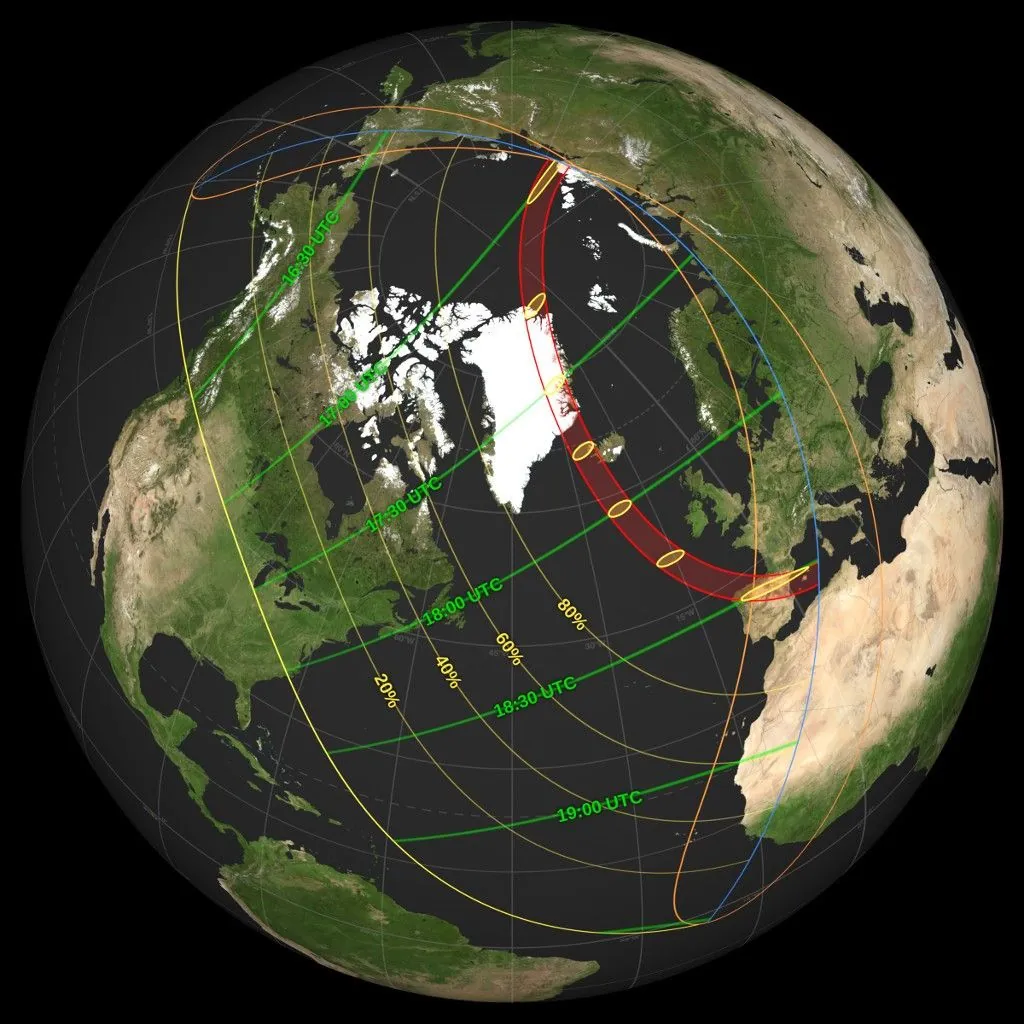
For ACT prep, that partial-eclipse table is the point. A student in Fairbanks, Anchorage, Boston, New York, Washington, D.C., or Detroit is not asking what totality feels like. That student is looking at a map and a table and deciding what the numbers mean.
| U.S. city | NASA listed partial coverage for August 12, 2026 |
|---|---|
| Fairbanks | 37% |
| Anchorage | 28% |
| Bangor | 24% |
| Boston | 16% |
| New York City | 9% |
| Washington, D.C. | 4% |
| Detroit | 3% |
Those percentages are not “almost total” scores. A 37% partial eclipse means the Moon covers part of the Sun from that location; it does not mean the sky behaves as if the viewer were 37% of the way to totality. That distinction matters because ACT Science questions often reward the student who keeps the measured variable separate from the tempting story.
What the map is really showing
A solar eclipse happens at new moon, when the Moon passes between Earth and the Sun. The Moon’s shadow has two useful parts: the umbra, the darker central shadow where the Sun is completely blocked, and the penumbra, the lighter outer shadow where only part of the Sun is blocked. If you are standing in the umbra, you are in the path of totality. If you are standing in the penumbra, you see a partial eclipse. [3]
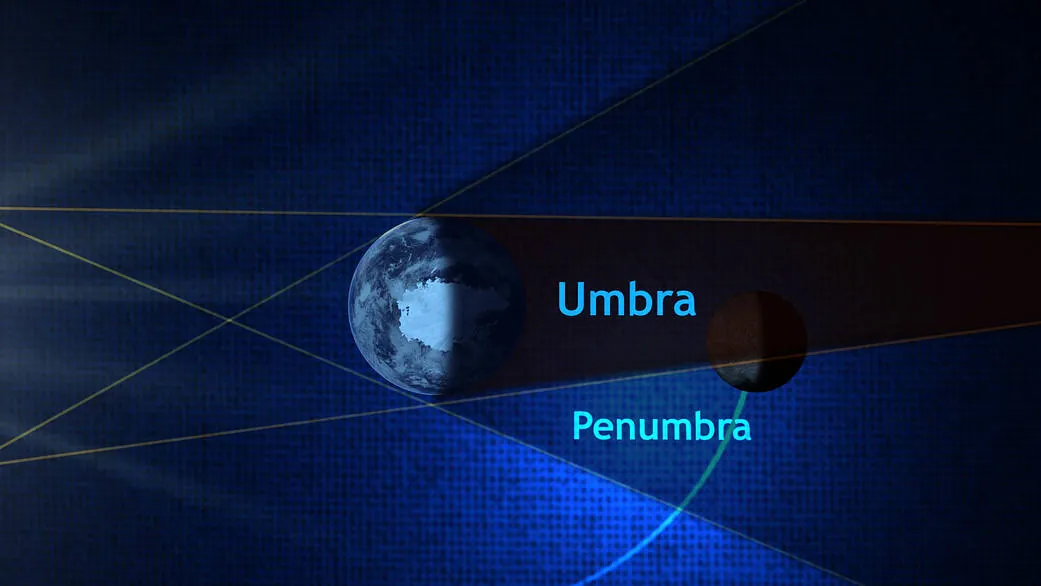
The 2026 map is a clean diagram disguised as a current event. The narrow track across Greenland, Iceland, the Atlantic, Spain, and part of Portugal is the umbra’s path. The much larger region that includes northern North America and much of Europe is the penumbra. That is why a student in Boston can be included in the event and still be nowhere near totality.
One common student mistake is to picture the Moon’s shadow as a giant blanket. The map argues against that. The umbra touches only a thin path on Earth’s surface; the penumbra spreads much more broadly. So the first ACT-style skill is not vocabulary. It is reading the map closely enough to see that two shadow regions produce two different viewing experiences.
Why there is not a solar eclipse every new moon
If a solar eclipse requires a new moon, it is reasonable to ask why the event does not happen every month. The missing piece is the Moon’s orbit. The Moon’s orbital plane is tilted by about 5° relative to Earth’s orbital plane, so most new moons pass a little above or below the Sun from our viewpoint instead of lining up closely enough to cast the right shadow on Earth. Eclipse seasons occur when the geometry is favorable; NASA’s eclipse periodicity material describes eclipse seasons as lasting about 34.5 days and occurring roughly twice a year. [4]
For test purposes, that explanation is more valuable than the date itself. It gives you a cause-and-effect chain: new moon is necessary, alignment is also necessary, and orbital tilt explains why the necessary alignment is not monthly. If a passage gives you a diagram of orbital planes, the best answer will probably come from matching geometry to observation, not from remembering a slogan about eclipses.
The apparent-size coincidence behind totality
Totality also depends on a visual coincidence: the Sun is roughly 400 times wider than the Moon, but it is also roughly 400 times farther from Earth, so the two objects can appear about the same size in the sky. When the alignment is right, the Moon can cover the Sun’s bright disk. [5]
That is why the corona becomes visible during totality. The corona is the Sun’s outer atmosphere, normally hidden by the glare of the bright solar disk. ESA gives the temperature contrast sharply: the corona reaches more than 1,000,000°C, while the Sun’s visible surface is about 4,500–6,000°C. [5]
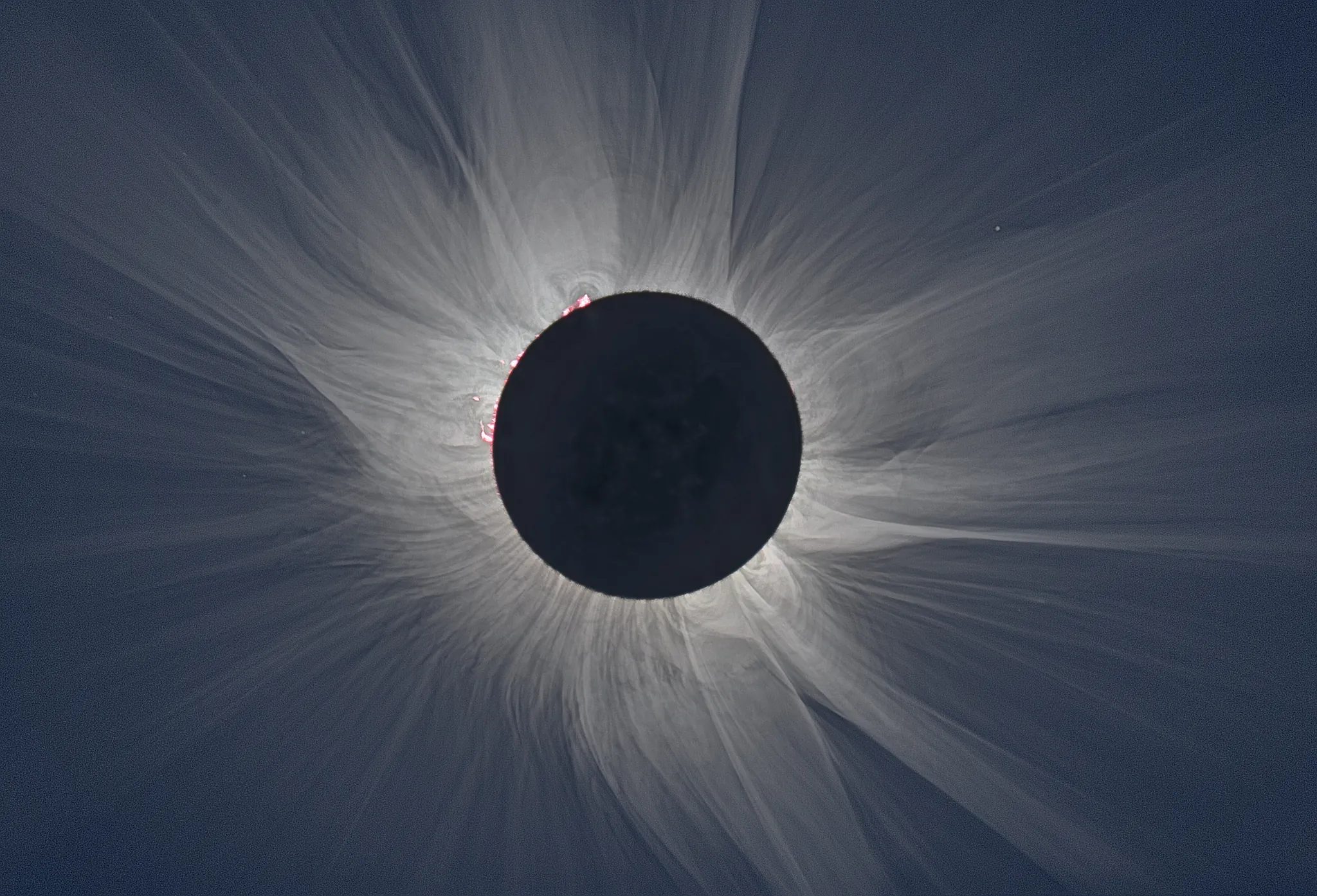
Students sometimes reverse the logic here. The corona is not visible because the Sun turns off, cools down, or changes suddenly during the eclipse. It becomes visible because the Moon blocks the bright photosphere from the viewer’s line of sight. The event changes what reaches your eyes, not what the Sun is.
Where this fits ACT Science
ACT’s official Science description includes Earth/space sciences such as geology, astronomy, and meteorology, and it says background knowledge from introductory science courses may be needed. That is the full strength of the claim here. ACT has not, based on the provided materials, announced an August 2026 eclipse passage. The useful point is narrower and better: the eclipse uses official ACT Science territory, and its public data look like the kinds of evidence students already have to interpret. [6]
| ACT Science task | How the 2026 eclipse can train it | What a careful student watches |
|---|---|---|
| Data Representation | Read a path map, city table, or duration comparison. | Which location is in the umbra, which is in the penumbra, and what the percentage actually measures. |
| Research Summaries | Follow a short explanation of new moon alignment, orbital tilt, and eclipse seasons. | Which condition is necessary, which condition is not sufficient by itself, and how the mechanism explains the observation. |
| Conflicting Viewpoints | Compare claims about duration, frequency, viewer estimates, or recurrence. | Whether two sources are measuring the same thing, using the same location, or making an estimate rather than a direct observation. |
A Data Representation version could give a simplified eclipse map and ask which city experiences totality, which city experiences a partial eclipse, or which direction the path crosses a region. A strong student would not need to be an astronomy fan. The student would need to read the legend, separate umbra from penumbra, and avoid assuming that every city inside the broad shaded area sees the same thing.
A Research Summaries version could describe one model in which solar eclipses happen whenever the Moon is new, then add evidence that the Moon’s orbit is tilted. The better explanation would account for both facts: eclipses require new moon, but new moon alone is not enough. The passage might never use the word “eclipse season” in the question stem; it could still ask for the role of orbital tilt in limiting when an eclipse can occur.
A Conflicting Viewpoints version would not have to make anyone wrong in a dramatic way. One source might emphasize that totality lasts under two minutes for most viewers, while another reports the event’s maximum duration as 2 minutes 18 seconds. Both statements can be compatible if they refer to different viewing locations or different summaries of the event. The test habit is to ask what each claim measures before choosing the answer that sounds most familiar. [1][2]
The same caution applies to viewer-count graphics, livestream listings, and same-location recurrence claims that circulate around major eclipses. Viewer counts are estimates, not head counts. Livestream links can change close to the event. Recurrence statements depend on how narrowly “same location” is defined. Those details can be interesting, but they are weaker test material than the official path, coverage table, shadow geometry, and ACT’s own stated science scope.
Four science traps to avoid
- Trap 1: Treating partial coverage as a mild version of totality. A partial eclipse and totality are separated by shadow region, not just by excitement level. The umbra gives totality; the penumbra gives partial coverage.
- Trap 2: Assuming a bigger partial percentage means the viewer is close to totality in a simple linear way. Fairbanks at 37% sees more coverage than Detroit at 3%, but neither location is in the path of totality.
- Trap 3: Saying eclipses happen whenever the Moon is new. New moon is required for a solar eclipse, but the Moon’s tilted orbit means the alignment usually misses.
- Trap 4: Explaining the corona as a change in the Sun. The corona is visible during totality because the Moon blocks the bright disk, allowing the faint outer atmosphere to be seen.
Those are not just astronomy corrections. They are test-reading corrections. Each one asks you to slow down just enough to identify the condition, the measurement, and the conclusion.
Viewing safely, especially from the partial-eclipse zone
For U.S. viewers, the safety rule is simple because there is no totality: do not look directly at the Sun without proper solar viewing protection. Use eclipse glasses or solar viewers that meet ISO 12312-2, not regular sunglasses. Do not look through a camera, telescope, binoculars, or other optical device while wearing eclipse glasses unless the equipment has the proper solar filter; concentrated sunlight can damage the filter and your eyes. Pinhole projection is a safe indirect option. [1]
The “only during totality” exception does not help most American students for this event. If your location is seeing only a partial eclipse, the Sun’s bright disk is never fully covered. That means the glasses stay on for direct viewing the entire time.
What to bank for test day
The August 12, 2026 eclipse is worth studying for ACT Science because it turns official Earth/space-science scope into readable evidence. The bankable pieces are the path map, the partial-coverage table, umbra versus penumbra, new moon alignment, the Moon’s roughly 5° orbital tilt, eclipse seasons, apparent Sun-Moon size, and the corona. You do not need to predict that ACT will test this exact eclipse. You need to practice the kind of reasoning the event makes visible.
A good next move is to take this same pattern back to the ACT exam hub: real science event first, test reasoning second. The Curiosity Mars polygon-features guide and the climate-change and wildfires study guide use the same approach: read the evidence, separate the claim from the measurement, and resist making the topic bigger than the passage supports.
References
- Total Solar Eclipse on August 12, 2026, NASA
- 2026 Total Solar Eclipse Overview for Iceland and Spain, NationalEclipse.com
- What Is a Solar Eclipse?, NASA Space Place
- Periodicity of Solar Eclipses, NASA GSFC Fred Espenak
- The science of solar eclipses, ESA
- Description of Science Test, ACT
Related exhibits & inventory
Verified outcomes
No verified outcomes on file for this exam yet
See Methodology for how outcome evidence is disclosed once logged.
Planners
No planner filed for this exam yet
A downloadable timeline template for this exam hasn't been published yet.
Tool verdicts
AI-tool cautions
No AI tools tested for this exam yet
No hands-on AI-accuracy logs have been filed for this exam.
Questions about this plan
Ask a question about a specific section, timeline, or citation in this plan — or flag something that needs correcting.
Comments
Join the discussion with an anonymous comment.