GRE, SAT, ACT, ASVAB Exam Hub
Turn NYT Strands Hints Into a Vocabulary-Building Drill
A no-spoiler protocol that turns NYT Strands' hint mechanic — one hint per three non-theme words — into a retrieval-practice vocabulary drill for GRE, SAT, ACT, and ASVAB prep: solve first, cash in hints only as a last resort, log each revealed word with its meaning, and treat daily hint pages as graduated clues, not answer dumps. Strands supports a high-frequency word list here; it doesn't replace one.
- gre
- mcat
- asvab
- sat
- act
- digital-adaptive
- official-material
- section-strategy
- test-date-timeline
You open a daily NYT Strands hints page because you want help, not because you want the whole grid handed to you. That choice matters. One click can preserve the useful part of the puzzle — retrieving a word from a theme, a few letters, and your own memory — while the next click can turn the same activity into answer recognition.
Evidence label: Limited / synthesis. Last reviewed: August 5, 2026. No study in the available evidence directly measures whether NYT Strands improves vocabulary retention for GRE, SAT, ACT, or ASVAB students. The practical claim here is narrower: the Strands hint loop can be used as a retrieval-practice warm-up if the solve attempt comes before the hint reveal. It should sit beside a high-frequency word list, not replace one.
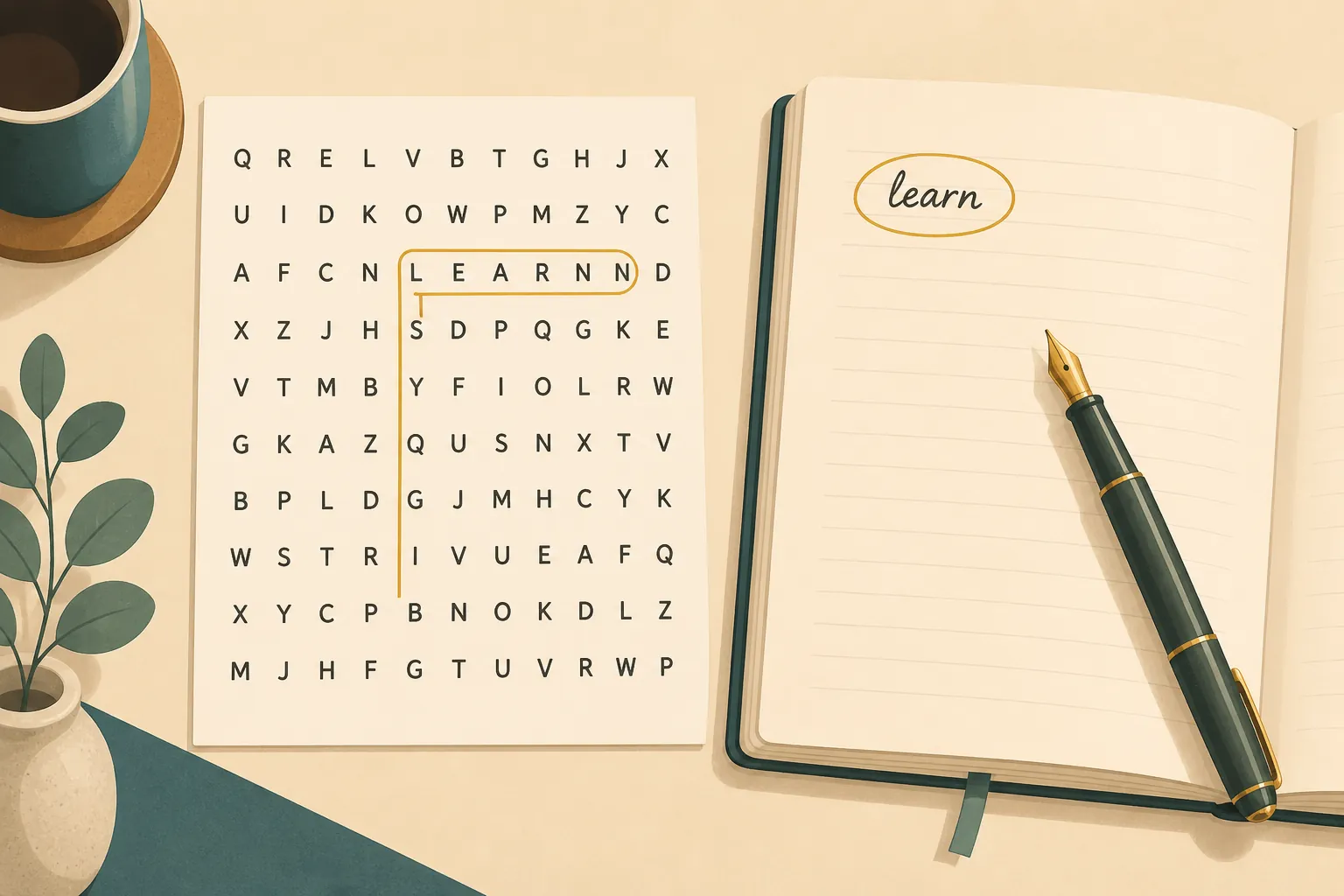
Why Strands hints can become useful — and why they often do not
Strands gives this method a real structure. The game uses a 6-by-8 letter grid, asks players to find theme words, allows optional hints, and awards one hint for every three valid non-theme words found. Its stats also include “Solved Without Hints,” and a Perfect score is reserved for finishing without using hints and without making mistakes, according to the NYT Help Center.[1]
That hint economy is the useful part for vocabulary work. It creates a delay between confusion and help. If you spend that delay actually trying to retrieve words — testing possible meanings, word families, alternate senses, and theme associations — the hint becomes feedback. If you go straight to the answer list, the hint becomes a spoiler.
Daily hint pages can support either habit. Tom’s Guide, for example, structures its Strands help as a ladder: the official theme, an unofficial hint, clue words, spangram start and end letters, and then the full answers. Its page for game #884 on August 4, 2026, shows that sequence clearly.[2] Read in order, that ladder can protect recall. Skimmed from the bottom up, it mostly bypasses it.
A little orientation is enough here: Strands is a themed word-search game from The New York Times. Each puzzle includes a spangram, a word or phrase that summarizes the theme and touches two opposite sides of the board.[3] The spangram is not just a prize word. For students, it is often the most useful clue because it forces a category decision: once you know the theme, you have to retrieve words that belong to it.
That is the difference between a vocabulary warm-up and a fake study session. Moving your eyes around a grid is not much of a study plan. Trying to summon a word before you reveal it is at least the beginning of one.
The no-spoiler Strands vocabulary protocol
Use this when you already planned to play Strands or check a hints page. It is not a replacement for your GRE verbal list, SAT vocabulary review, ACT reading work, or ASVAB Word Knowledge practice. It is a five-to-ten-minute retrieval drill attached to a habit you already have.
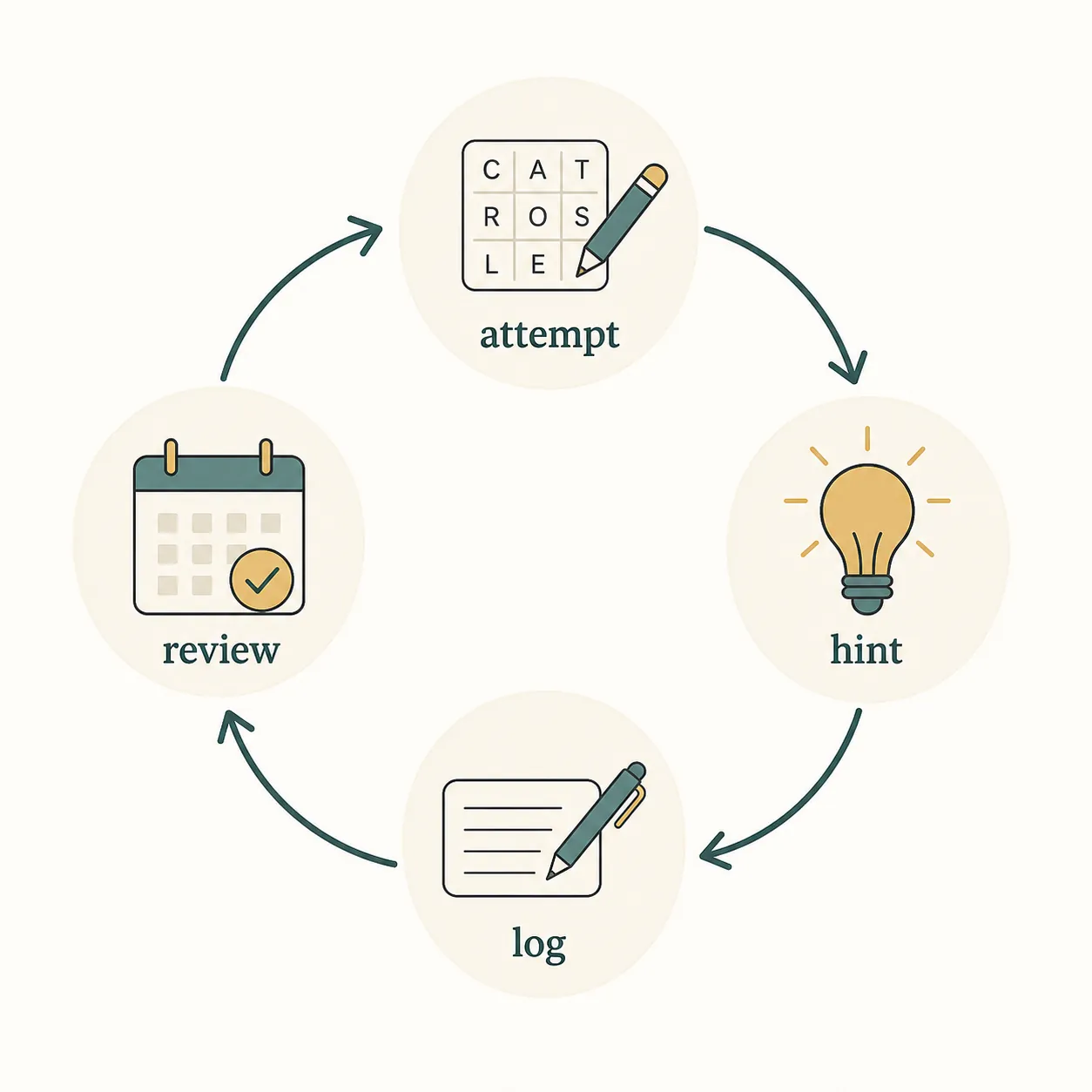
| Stage | What to do | What counts as vocabulary work |
|---|---|---|
| 1. Attempt | Start the puzzle without outside help. Use the theme, grid, word shapes, and any associations you can generate. | You are forcing recall before feedback. |
| 2. Delay the hint | Earn or resist hints. If you have an in-game hint available, do not cash it in until you have made a real attempt. | The delay keeps the puzzle from becoming answer recognition. |
| 3. Use graduated clues | On a hint page, read only the next level: theme, then nudge, then clue words, then spangram letters. Stop as soon as you can resume solving. | Each clue should narrow the search without finishing the retrieval for you. |
| 4. Log misses | Write down every revealed word you did not retrieve, plus a short definition or sentence. | The word becomes study material instead of a forgotten spoiler. |
| 5. Track clean solves | Record whether the puzzle was solved without hints. | The “Solved Without Hints” stat is the cleanest game-native metric for this drill. |
The first stage is where most of the learning value is won or lost. Before opening Tom’s Guide, CNET, Mashable, Lifehacker, or any other daily hints page, give the puzzle a real attempt. Not a ceremonial thirty seconds. Look at the theme. Try possible categories. Say a few likely words out loud or write them in the margin. If the theme is clothing, food, occupations, geography, idioms, or moods, generate your own list before the grid confirms anything.
Then use the in-game system with some restraint. NYT’s mechanic awards one hint after three non-theme words, which means even your wrong-path discoveries have a visible reward.[1] That can be helpful, but it can also make busywork feel like studying. A student who spends ten minutes harvesting random non-theme words just to fill the hint meter has not necessarily practiced the vocabulary that matters. The earned hint is useful only if it follows an honest retrieval attempt.
When you do use a hint, treat it as feedback, not rescue. Ask: What word was I supposed to know? Did I miss it because I did not know the word, did not recognize a secondary meaning, or did not infer the theme? Those are different misses. A word you have never seen belongs in your vocabulary log. A word you knew but failed to connect to the theme belongs in your retrieval-practice notes. A word you saw but ignored because of the grid path is mostly a puzzle-mechanics miss.
How to read daily Strands hint pages without ruining the drill
A good daily hints page is not the enemy. The problem is reading it in the wrong order. Tom’s Guide’s format is useful precisely because it separates lighter clues from full answers: official theme, extra hint, clue words, spangram start and end letters, and then the complete solution.[2] That gives you several stopping points.
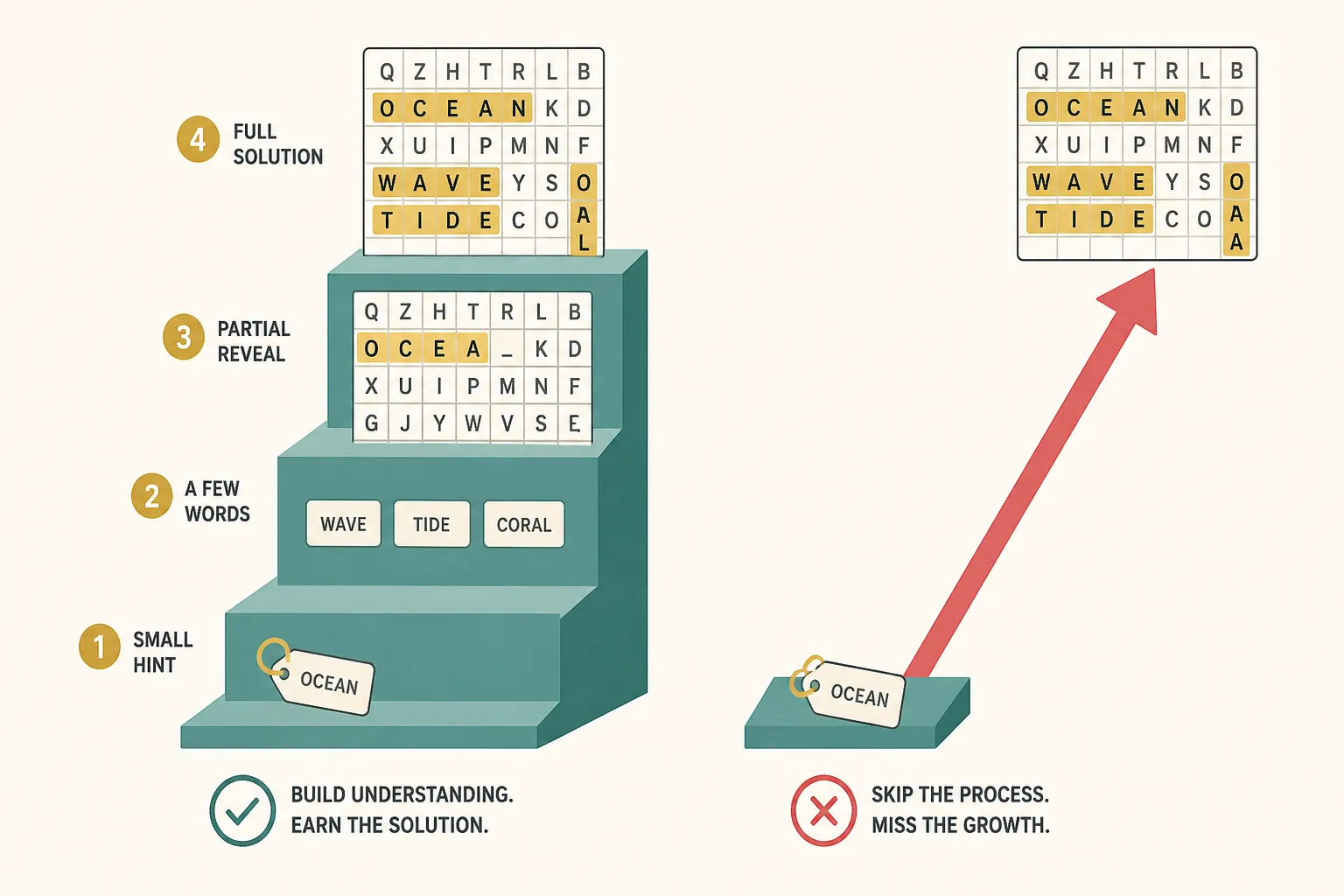
Use the lightest clue that gets you moving again
Start with the official theme only. If that is not enough, read the unofficial hint. If you still cannot move, look at the clue words. The clue words can be useful because they help you earn an in-game hint without revealing the theme answers themselves. After that, use spangram start and end letters only if you are genuinely stuck. Full answers come last, and only for logging.
The stopping rule is simple: the moment you can make another serious guess, leave the hint page. Do not keep reading “just to check.” Checking is recognition. Solving is retrieval.
Do not pre-read the answer list
Pre-reading the answer list feels efficient because the brain loves fluency. You see the word, it looks familiar, and you get the small satisfaction of thinking, “I knew that.” But for exam prep, that is the weaker habit. GRE, SAT, ACT, and ASVAB vocabulary tasks reward access under pressure: recognizing a word in context, selecting a meaning, eliminating a trap answer, or recalling a relationship quickly enough to keep moving.
If you reveal the full Strands answers before trying, you have changed the task. You are no longer asking your memory to produce anything. You are asking your eyes to confirm something already supplied.
Turn every spoiled word into a logged word
If a hint or answer reveal gives you a word you did not retrieve, write it down immediately. Keep the log small. A Strands vocabulary log should not become another place where words go to be admired and forgotten.
- Word: the revealed answer or clue word you failed to retrieve.
- Meaning: a short definition in your own words.
- Puzzle link: the theme or category that hid the word.
- Miss type: unknown word, known word but missed meaning, theme-inference miss, or grid-path miss.
- Review date: tomorrow, then later in the week.
For a full worked example of logging Strands words for GRE-style review, use the Frocks and Smocks Strands drill. Use that walkthrough for the logging mechanics; the concern here is protecting the retrieval loop before the logging step begins.
What to track: “Solved Without Hints” beats vanity notes
Strands already gives you a useful tracking metric: “Solved Without Hints.” NYT identifies it as one of the game’s stats, and it is cleaner than a self-invented feeling of “I learned a lot today.”[1]
Track three things only:
- Whether you solved without hints.
- How many words you logged.
- How many logged words you recalled correctly on review.
That is enough. A clean solve suggests the puzzle functioned as retrieval practice or theme inference. A hint-assisted solve is still fine if the revealed word becomes review material. A full-answer peek with no log is entertainment. There is nothing wrong with entertainment, but it should not be counted as vocabulary study.
Be careful with Perfect scores. They are satisfying, and NYT’s rules make them meaningful inside the game.[1] For exam prep, however, a Perfect score is less important than what happens to missed vocabulary after the puzzle. A perfect grid with no new words is a pleasant warm-up. A messy grid that sends two unfamiliar words into spaced review may be more useful.
The productivity trap inside the hint meter
Ian Bogost’s analysis of Strands in The Atlantic is useful here because it explains a feeling many players recognize: the progress bar toward hints can make wrong guesses feel productive and create a “sense of acceleration.” He also notes that newspaper games are built for daily control and delight, not for learning outcomes.[4]
That does not make Strands bad for students. It makes the boundaries important. The game is good at making you continue. It is good at rewarding pattern sense. It is good at giving you a small daily win. Those qualities can support a study routine, but they can also disguise procrastination as “verbal practice.”
The vocabulary value is not in racking up random non-theme words. It is in the moment before the reveal, when you try to retrieve a word from partial information, and in the moment after the reveal, when you decide whether that word deserves a definition and review slot.
This is also why broad claims about word games and vocabulary should be handled carefully. Edutopia’s classroom vocabulary-game guidance emphasizes recall, student explanation, and verbalizing connections in low-stakes settings as the retention mechanism.[5] That supports the part of this protocol where you retrieve, define, and explain a word. It does not prove that scanning a Strands grid, by itself, raises exam vocabulary scores.
Where this fits in GRE, SAT, ACT, and ASVAB prep
Use Strands as a daily verbal warm-up, not as the curriculum. The core curriculum is still exam-scoped review: a high-frequency vocabulary list, reading in context, answer-choice analysis, and scheduled recall. That is true whether you are working on GRE Verbal, SAT Reading and Writing, ACT reading passages, or ASVAB Word Knowledge.
If you want the broader verdict on whether Strands counts as vocabulary practice at all, start with the existing NYT Strands vocabulary-practice review. The short version for this protocol is stricter: Strands is useful when it creates retrieval and review. It is weak when it creates only exposure.
For students who like puzzle warm-ups, this method belongs in the same family as crossword vocabulary study and NYT Mini Crossword vocabulary practice: enjoyable, limited, and best used after the serious study plan is already in place.
A practical daily routine
Here is the version I would actually let a test-prep student keep:
- Open Strands before opening any hint page.
- Spend several minutes generating theme possibilities and testing words.
- If stuck, read only the next graduated clue on a hints page.
- Return to the puzzle immediately after the clue gives you a path forward.
- Use in-game hints only after a genuine attempt, not as the default next move.
- After the puzzle, log every revealed word you could not retrieve.
- Review those logged words later instead of trusting that seeing them once was enough.
- Record whether the solve was completed without hints.
The New York Times launched Strands in beta on March 4, 2024, with free-to-play access, and the game has since become part of the daily word-game routine for many players.[6] That routine is the opportunity. A daily habit does not have to become a full study block to be worth keeping. It only has to stop pretending that every solved grid is vocabulary growth.
For exam prep, the rule is plain: retrieve before you reveal, log what you missed, and review it later. If the hint page helps you do that, use it. If it hands you the answers before your memory has done any work, close it until the puzzle has earned the help.
References
- Strands, The New York Times Games Help
- Today’s Strands answer, Tom’s Guide
- NYT Strands, TechRadar
- Strands word-search game analysis, The Atlantic, March 2024
- Vocabulary games and content knowledge, Edutopia
- Strands, the New York Times’ new word search game, The New York Times, March 4, 2024
Related exhibits & inventory
Verified outcomes
No verified outcomes on file for this exam yet
See Methodology for how outcome evidence is disclosed once logged.
Planners
No planner filed for this exam yet
A downloadable timeline template for this exam hasn't been published yet.
Tool verdicts
AI-tool cautions
No AI tools tested for this exam yet
No hands-on AI-accuracy logs have been filed for this exam.
Questions about this plan
Ask a question about a specific section, timeline, or citation in this plan — or flag something that needs correcting.
Comments
Join the discussion with an anonymous comment.