
MCAT Exam Hub
How Perseverance's organic carbon tests MCAT evidence skills
The Perseverance rover's detection of complex organic carbon in Jezero Crater's mudstones illustrates the kind of scientific reasoning tested on the MCAT—separating observation from interpretation and evaluating evidence against alternative hypotheses—using a real astrobiology case that remains unresolved.
- gre
- mcat
- asvab
- sat
- act
- digital-adaptive
- official-material
- section-strategy
- test-date-timeline
Perseverance found complex organic carbon in Jezero Crater mudstones. That sentence is exciting, and it is also exactly where an MCAT passage would start taking points away from rushed readers. Organic means carbon-containing chemistry; it does not mean biological origin. At Bright Angel, the important result is not “Mars life found.” It is that the rover’s SHERLOC instrument detected spatially distributed macromolecular carbon in ancient river-valley mudstones, including hundreds of organic detections across four targets and detections only microns below the surface.[1]
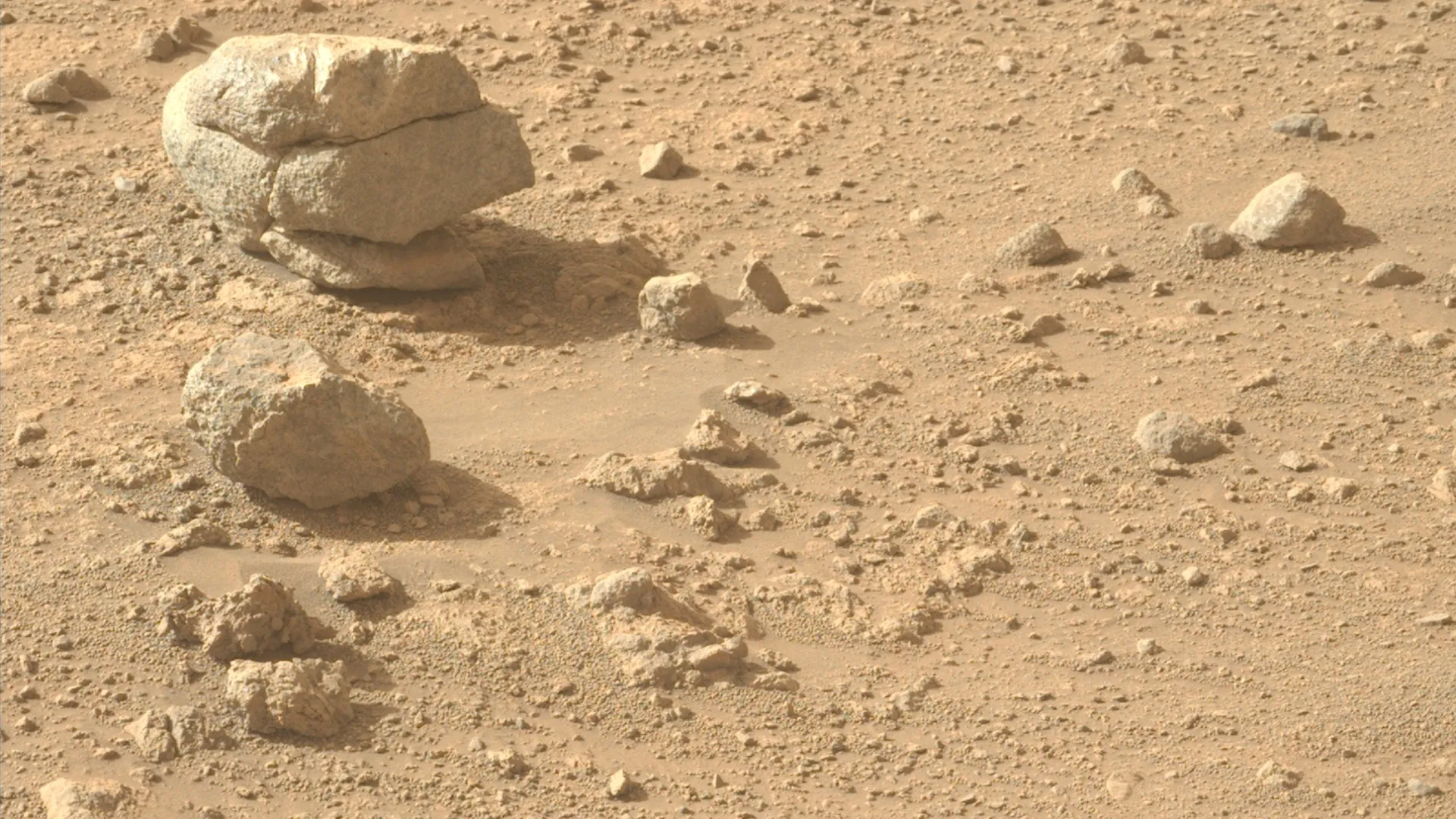
That is a real astrobiology discovery. It is also a clean lesson in evidence discipline: circle the verb detected, then ask what the instrument cannot detect. SHERLOC can identify spectral signatures consistent with complex organic matter. It cannot, by itself, decide whether that carbon came from water-driven chemistry, material delivered from space, or ancient biology.[1]
What Perseverance actually measured at Bright Angel
The Bright Angel formation matters because it is not a random rock with a faint carbon hint. The Science Advances paper reports macromolecular carbon, or MMC, in two mudstone targets, with hundreds of detections distributed across four targets in the formation.[1] Mudstone is already a tempting setting for astrobiology because fine-grained sediments can preserve chemical records. Still, the passage-level move is to separate the setting from the conclusion: a preservational environment can make a biosignature search more promising without making the signal biological.
The shallow preservation is one of the most striking details. The reported detections sit only microns below the Martian surface, which the authors describe as the shallowest organic detection on Mars and evidence that this organic matter has relative resistance to ultraviolet radiation and oxidation.[1] That does not mean the molecules are unchanged leftovers from cells. It means some organic carbon survived in a harsh surface environment where many organic compounds would be vulnerable.
| Observation | What it supports | What it does not prove |
|---|---|---|
| Macromolecular carbon detected in Bright Angel mudstones | Complex organic matter is present in ancient Jezero sediments | A biological source |
| Hundreds of detections across four targets | The signal is spatially distributed rather than a single isolated hit | That all detections share one origin |
| Organic matter preserved only microns below the surface | Some organics resisted near-surface degradation | That preservation required biology |
| Organic carbon occurs near redox-relevant minerals at Cheyava Falls | The local chemistry could have supported energy-yielding reactions | That microbes used those reactions |
The table is the MCAT version of slowing down. The left column is data. The middle column is reasonable interpretation. The right column is where overconfident answers usually live.
Why Cheyava Falls raised the stakes without closing the case
Bright Angel also contains Cheyava Falls, a roughly 1 m by 0.6 m arrowhead-shaped rock with “leopard spots” associated with vivianite, a hydrated iron phosphate, and greigite, an iron sulfide, at reaction fronts.[2] That mineral context matters because redox chemistry is not decorative in a life-detection argument. Redox gradients can provide energy sources, and energy availability is one reason a site becomes biologically interesting rather than merely chemically interesting.
Joel Hurowitz of Stony Brook, lead author of the Nature study, described the combination of organic carbon, oxidized iron, and sulfur as something that “could have been a rich source of energy for microbial metabolisms.”[2] The key word is could. It is not filler. It is the difference between an environment compatible with metabolism and evidence that metabolism occurred.
In a test passage, this is where answer choices often start to drift. One answer may say the minerals prove ancient microbial activity. Another may say the minerals are irrelevant because no cells were seen. Both miss the point. The mineral-organic association increases astrobiological interest because it puts carbon near chemistry that can matter for energy. It still leaves abiotic explanations alive.
The same facts still fit more than one origin story
The Bright Angel result supports a hypothesis set, not a single winning answer. The authors identify multiple possible origins for the macromolecular carbon, including abiotic aqueous chemistry, meteoritic infall, and ancient microbial activity.[1] Those options are not equally satisfying emotionally, but the instrument result does not get to choose among them just because one is more exciting.
- Abiotic aqueous chemistry: water-rock reactions could generate or alter organic matter without organisms.
- Meteoritic infall: organic carbon could arrive from outside Mars and later become preserved in sediment.
- Ancient microbial activity: biology could produce or modify organic molecules, but this remains a hypothesis rather than a demonstrated source.
This is the kind of ambiguity MCAT science passages use constantly. A graph, spectrum, or experimental result narrows the field of plausible explanations. It does not automatically identify mechanism. If a passage says an enzyme inhibitor decreased product formation, that supports involvement of the enzyme under the study conditions; it does not prove the entire pathway in a living organism works exactly that way. Bright Angel is the Mars version of the same reasoning habit.
The uncomfortable part is that “not proof of life” is not the same as “unimportant.” Complex organics in ancient mudstones, distributed across targets and preserved near the surface, are exactly the sort of evidence one would want before asking harder life-detection questions. The mistake is treating a promising upstream observation as if it were the downstream conclusion.
CoLD is a burden-of-proof scale, not a hype meter
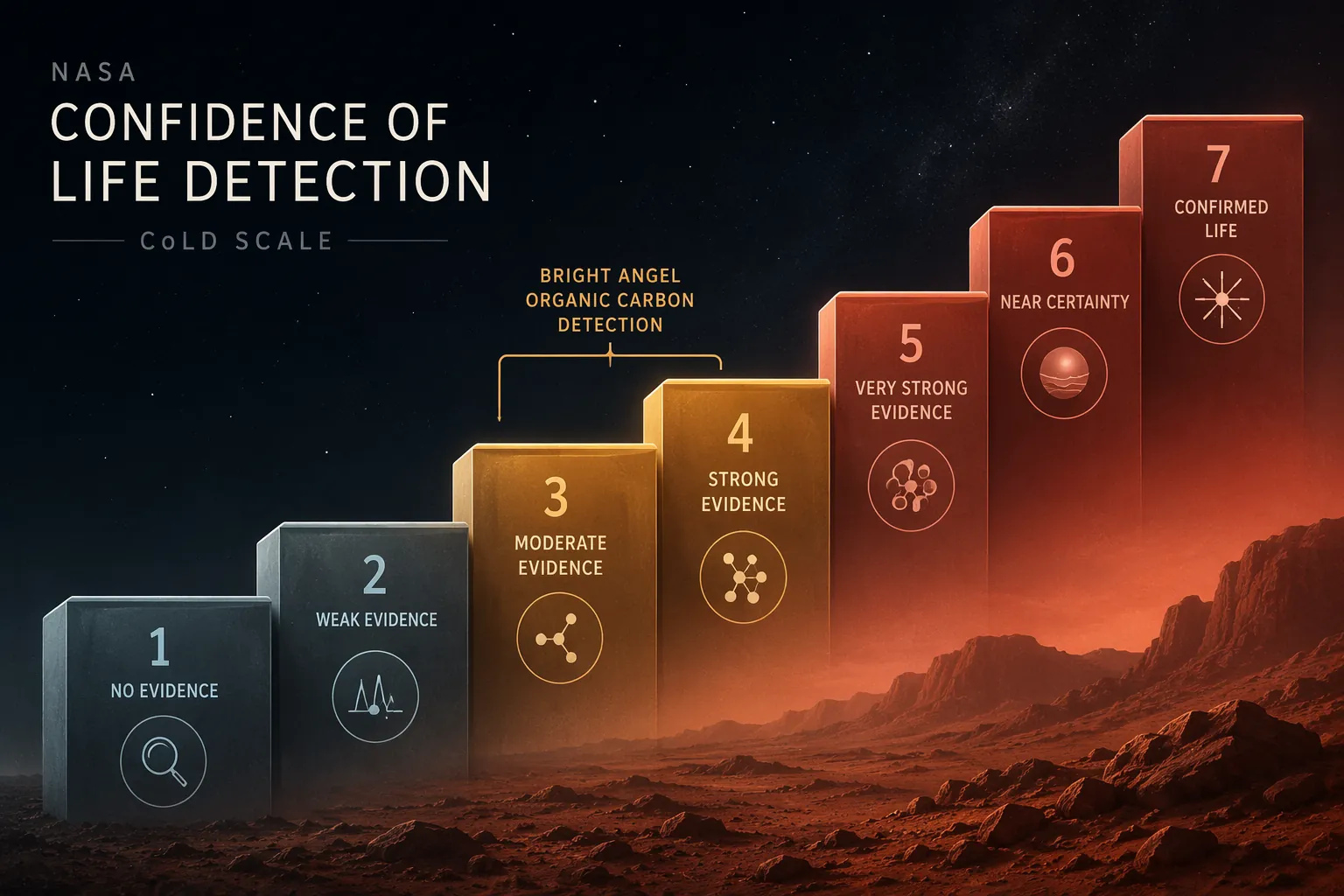
NASA’s Confidence of Life Detection scale, or CoLD, is useful here because it turns “How sure are we?” into a staged evidentiary problem. The framework has seven levels, moving from initial detection of a possible biosignature toward independent confirmation and exclusion of nonbiological explanations.[3][4] For Bright Angel, NASA’s public framing placed the case around Level 2–3: multiple independent detections of a potential biosignature, while abiotic alternatives remain plausible.[3]
Level 2–3 is not a consolation prize. It means the evidence has moved beyond a casual curiosity. But the classification also protects the claim from doing more work than it can do. Katie Stack Morgan, Perseverance project scientist, put the standard plainly in NASA’s release: “Astrobiological claims require extraordinary evidence.”[3]
Some scientists would keep the Bright Angel case closer to Level 2 because the rover has not provided isotope data or cellular structures, and because the present measurements cannot eliminate nonbiological chemistry.[5][6] That disagreement is not a failure of the scale. It is the point of the scale: confidence rises when different kinds of evidence converge and when alternatives are actively tested, not when one impressive observation is repeated more loudly.
The instrument caveat is part of the evidence, not a footnote
SHERLOC is powerful because its deep-ultraviolet Raman and fluorescence measurements can identify organic signatures on rock surfaces at fine spatial scales. It is limited because those spectra do not resolve whether the source was biological or abiotic.[5][6] For MCAT purposes, that is not trivia about a rover instrument. It defines the legal boundary of the inference.
There is also a specific measurement complication: a SHERLOC focus failure on sol 1024 introduced additional spectral uncertainty, which outside analyses noted as relevant to interpreting the data.[5][6] A careful reader should not inflate that into “the finding is invalid.” Nor should they wave it away because the story is more fun without it. Methodological uncertainty changes confidence; it does not automatically erase observation.
That distinction shows up on both the Biological and Biochemical Foundations section and CARS. In science passages, the limitation may affect mechanism, specificity, or generalizability. In CARS, the author may endorse a cautious interpretation while rejecting a stronger public-facing claim. The correct answer often preserves that tension instead of resolving it for comfort.
A brief comparison: Curiosity makes the pattern broader, not decisive
Curiosity’s Gale Crater findings are useful as a comparison because they show that organic chemistry is not confined to one Perseverance target. In 2026, reports from Gale Crater described organic molecules in clay-bearing sandstone more than 3,500 km from Jezero, including nitrogen-bearing ring structures. That convergence makes early Mars look more chemically interesting across more than one sedimentary setting.
It does not turn two sites into a planetary survey, and it does not solve the biotic-versus-abiotic problem. The comparison should be used the way a strong MCAT reader uses a secondary experiment: it can support a broader claim about organic availability, but it cannot supply the missing causal evidence for life at Bright Angel.
How to read this like an MCAT passage
If Bright Angel appeared as a passage, the test would not reward the student who memorized Mars mission names. It would reward the student who tracked claim strength. The first sentence might describe MMC detections. A later sentence might mention redox-active minerals. Another might quote a scientist saying the chemistry could have supported microbial metabolism. The wrong answer would combine those pieces into “Perseverance found evidence of ancient Martian microbes.”
A better answer would say the rover detected complex organic carbon in a geologic context relevant to habitability, but the origin remains unresolved because abiotic pathways remain plausible and the instrument cannot distinguish source. That sentence is less cinematic. It is also the one the evidence earns.
- When a passage says “detected,” do not convert it to “proved.”
- When a passage says “could,” preserve the uncertainty unless later evidence removes it.
- When a molecule is called “organic,” ask whether the author means carbon chemistry or biological origin.
- When multiple hypotheses remain, choose answers that keep the alternatives alive.
- When a framework ranks confidence, treat the rank as a claim about evidence burden, not as proof by label.
Mars Sample Return may eventually allow Earth-based laboratory tests that could push a case toward higher CoLD levels, but that is not a near-term rescue clause. Current discussions describe the timeline as delayed, with returned samples uncertain and potentially not arriving until the 2030s or later.[5][6] The present evidence has to stand where it stands.
That is why the Bright Angel discovery is such a good MCAT reasoning model. Complex organic carbon survived in ancient Martian mudstones near chemistry that could matter for metabolism. The finding remains unresolved because the same observations fit more than one origin story. It is strongest when read at its actual strength: important, incomplete, and bounded by alternative explanations.
References
- Spatially distributed complex organic matter detected in an ancient river valley in Jezero crater, Mars, Science Advances, June 24, 2026.
- Redox-driven mineral and organic associations in Jezero Crater, Mars, Nature, September 2025.
- NASA Says Mars Rover Discovered Potential Biosignature Last Year, NASA.
- Confidence of Life Detection Scale, Wikipedia.
- Mars discovery raises compelling questions: Life or chemistry?, SETI Institute.
- Mars rover finds organic carbon, but life remains uncertain, Chemical & Engineering News, June 2026.
Related exhibits & inventory
Verified outcomes
Planners
No planner filed for this exam yet
A downloadable timeline template for this exam hasn't been published yet.
Tool verdicts
Questions about this plan
Ask a question about a specific section, timeline, or citation in this plan — or flag something that needs correcting.
Comments
Join the discussion with an anonymous comment.