
ASVAB Exam Hub
Are Crossword Puzzles Worth It for Vocabulary Study?
Classroom studies link crossword puzzles to measurable gains on definition-recall tasks, but the evidence comes from EFL and medical courses, not US admissions tests. This evidence-graded review shows where crosswords can help and why they work best as a retrieval-practice layer inside a spaced-repetition plan, not as the plan itself.
- gre
- mcat
- asvab
- sat
- act
- digital-adaptive
- official-material
- section-strategy
- test-date-timeline
Last reviewed: August 1, 2026. Evidence label: moderate-to-limited evidence that crossword puzzles improve definition recall in classroom vocabulary settings; limited evidence that those gains transfer to standardized-exam vocabulary performance; no evidence that crossword puzzles alone are a complete vocabulary study plan.
That is the useful answer for crossword puzzles for vocabulary study: they can make you retrieve word meanings, and that matters. They do not automatically teach you to infer meaning from a sentence, schedule review across weeks, or handle the reading demands of the SAT and ACT. If you have three weeks left before a GRE, SAT, ACT, or ASVAB date, puzzle time has to earn its place next to spaced repetition, official practice, and actual reading-context work.
The strongest recent evidence says “yes,” but only for a narrow kind of learning
The most useful current study is Jamal, Liu, and Li’s 2026 medical-terminology study, because it is concrete enough to prevent both lazy dismissal and lazy hype. The study followed 211 students in a medical terminology course using classroom-based gamified crossword activities. After adjustment for covariates, students in the crossword group scored about 26 points higher on the total outcome than comparison students, with p < 0.001 and effect sizes above g = 1. The cleanest subscore was term-defining: adjusted scores were 66 versus 23 in favor of crossword users. The authors also made the boundary clear: the findings were associative, not causal, and crosswords alone were insufficient for more complex term-construction learning. [1]
That result is worth taking seriously. A crossword clue that asks for a term’s definition forces the learner to produce an answer rather than simply stare at a word list. For medical terminology, where many items can be tested as direct definition recall, the task and the assessment line up unusually well. That alignment is why the result is useful—and also why it should not be quietly converted into “crosswords raise verbal scores.”
Older classroom evidence points in the same general direction. Orawiwatnakul’s 2013 study of 68 first-year Thai students found significant pre/post vocabulary gains at p < 0.05 across proficiency groups after crossword puzzle use. This supports the modest claim that crosswords can help in structured vocabulary-learning classrooms. It does not show that a student doing printable SAT puzzles at home will improve on passage-based exam questions. [2]
Perception evidence is friendlier still, but it needs to be kept in its lane. In Patrick et al.’s 2018 medical-education study, 139 students had an average crossword solve rate of 52.69%, and 87.8% reported that the crosswords helped them remember terms. That tells us students often like the format and feel it helps. It is not the same thing as verified score improvement on an admissions test. [3]
| Claim | Evidence label | What that label means |
|---|---|---|
| Crosswords can improve definition recall in classroom vocabulary settings. | Moderate-to-limited | Supported by classroom studies, including a recent sizable medical-terminology study, but not by randomized test-prep trials. |
| Crosswords improve SAT, ACT, GRE, or ASVAB scores. | Limited | The available studies do not directly test these exams or full exam scores. |
| Crosswords are enjoyable and feel helpful to students. | Moderate | Student perception data is positive, but enjoyment and self-report are not the same as objective exam gains. |
| Crosswords alone are a complete vocabulary plan. | No evidence | The research does not show that puzzles replace spacing, context practice, or official exam questions. |
Be careful with “crosswords are proven” headlines
Some of the strongest-sounding crossword headlines come from a very different research world. Duke School of Medicine covered a randomized trial comparing crossword puzzles with computer games for older adults with mild cognitive impairment; the endpoint was memory loss, not vocabulary learning for students and not standardized-test performance. That study may matter for cognitive-aging questions. It should not be used as evidence that crossword puzzles raise GRE Verbal, SAT Reading and Writing, ACT Reading, or ASVAB Word Knowledge scores. [4]
This distinction is not academic nitpicking. A student deciding whether to spend tonight on a puzzle packet or on official practice questions needs to know what was actually measured. A trial about cognitive decline, a medical terminology class, an EFL vocabulary intervention, and a commercial SAT puzzle set are not interchangeable just because they all contain grids.
What crosswords actually do: retrieval without a built-in study system
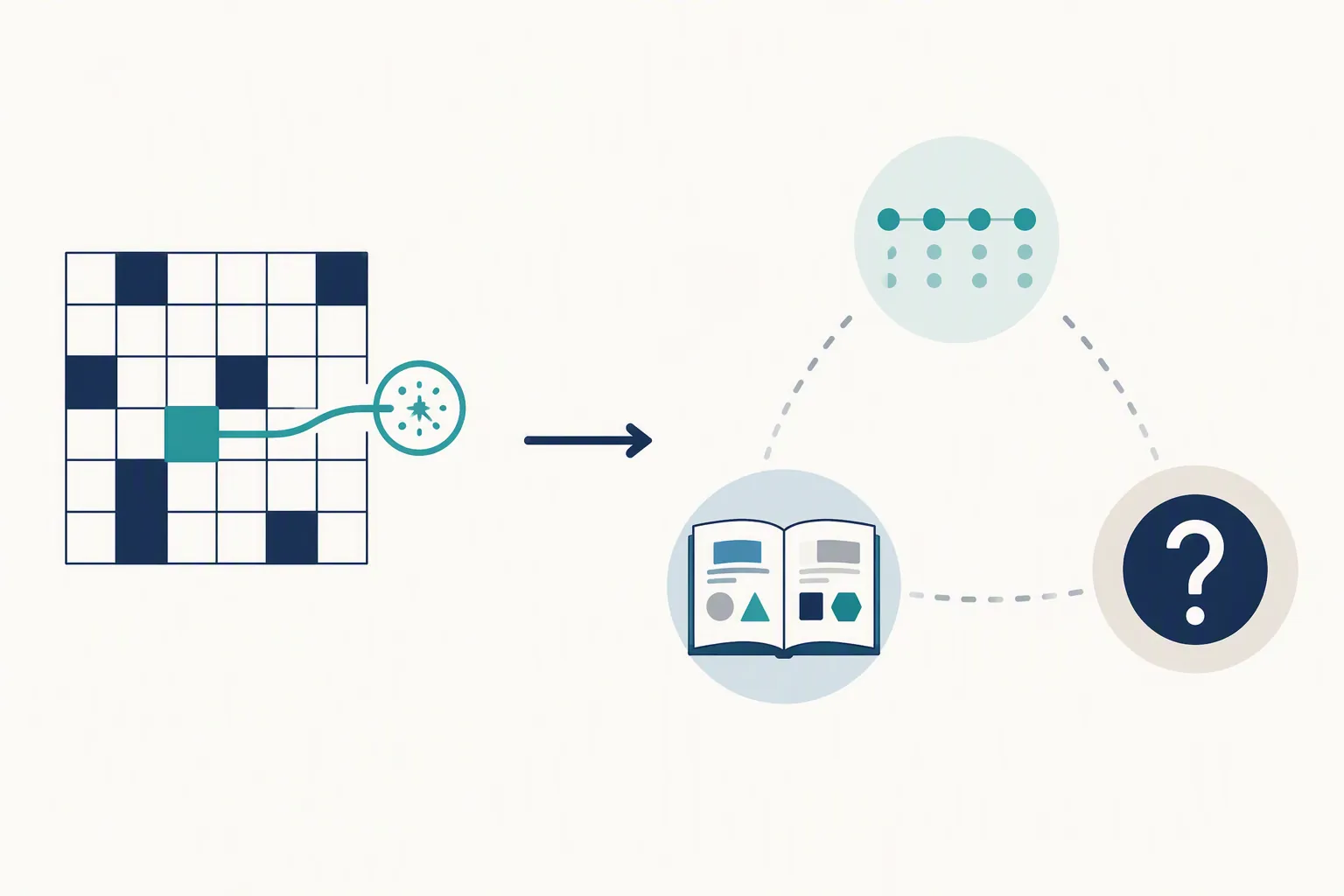
The educational case for crossword puzzles is retrieval practice. When the clue says “to make less severe” and you have to produce “mitigate,” you are doing something more useful than rereading the word mitigate with a highlighted definition beside it. You are reaching for the meaning from memory. That reach is the part worth preserving.
But a crossword does not, by itself, solve the scheduling problem. Spacing research on verbal recall supports distributing practice over time rather than massing it into one session. A puzzle can be one retrieval event inside that schedule, but the grid will not decide that the word should come back tomorrow, three days from now, and again next week. [5]
It also works best after first exposure. Retrieval practice is strongest when students have something real to retrieve: a meaning, an example, a contrast with a similar word, and ideally a sentence context. Guidance on retrieval practice and vocabulary instruction treats retrieval as part of instruction, not a substitute for learning the word in the first place. [6]
That gives crosswords a specific job: review. They can interrupt passive rereading. They can expose weak words quickly. They can make a learner notice, “I recognize this word, but I cannot produce the meaning.” That is useful feedback. It is not a curriculum.
Why the exam matters: ASVAB, GRE, SAT, and ACT do not ask vocabulary in the same way
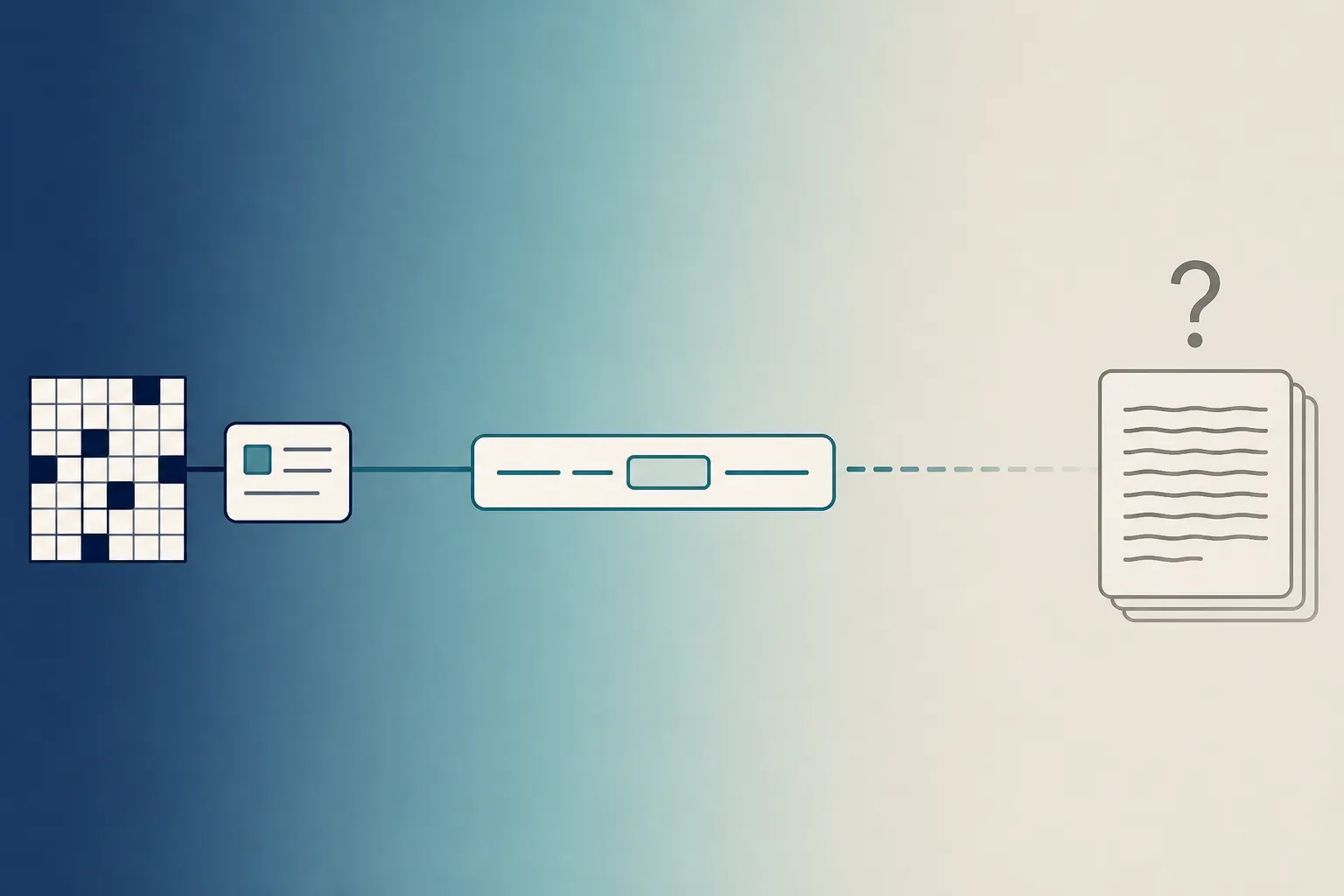
The following exam mapping is a synthesis from the mechanism and classroom evidence, not a direct research conclusion. The studies above did not enroll SAT, ACT, GRE, or ASVAB test-takers and then measure official-score changes. The safer question is: which exam tasks resemble the kind of retrieval that a vocabulary crossword actually trains?
| Exam task | How well a vocabulary crossword matches it | Practical judgment |
|---|---|---|
| ASVAB Word Knowledge-style synonym or definition recall | Closest match | A crossword clue that asks for a definition or synonym resembles this kind of direct vocabulary retrieval more than it resembles passage analysis. |
| GRE Text Completion or Sentence Equivalence preparation | Partial match | Knowing word meanings helps, but GRE items also require sentence logic, contrast signals, and fit among answer choices. |
| SAT and ACT vocabulary-in-context questions | Weakest match | These questions usually reward context inference and reading control, not merely producing a dictionary-style meaning from a clue. |
| Full verbal or reading scores | Not established | No cited classroom crossword study here demonstrates full standardized-exam score gains. |
This is where crossword hype becomes most expensive. If the exam task is direct recall, a definition-clue crossword can be a reasonable supplement. If the exam task is to determine how a familiar word functions inside a dense sentence or passage, the crossword is at best preparation for one ingredient: knowing a possible meaning. It does not train the whole act of reading the sentence, rejecting a tempting but context-wrong meaning, and choosing the meaning that fits the author’s logic.
GRE: useful for word familiarity, incomplete for sentence logic
For GRE verbal study, crossword puzzles can help you check whether a word has become retrievable. If you cannot produce “laconic” from “using few words,” that is a real weakness. But GRE-style verbal questions rarely stop at raw meaning. They ask you to track tone, contrast, support, and sentence structure. A crossword can sit before that practice, not replace it.
SAT and ACT: the transfer claim is thin
SAT and ACT vocabulary work is usually less about reciting a memorized definition and more about reading a word in context. A puzzle clue often narrows the target meaning for you. A passage does not. The passage may use a common word in an uncommon way, or it may require you to infer tone from the surrounding sentences. Classroom crossword gains on term-defining do not prove transfer to that task.
ASVAB: the best fit, still not a full plan
ASVAB Word Knowledge is the most natural fit for vocabulary-focused crosswords because synonym and definition recall are closer to what a clue demands. Even here, the practical limit remains: a random free puzzle set may not match your weakest words, may not repeat items on an effective schedule, and may not reflect the balance of your real practice results.
What to do with free printable vocab puzzles
Free puzzle libraries, SAT-themed crossword packets, downloadable GRE puzzles, and ASVAB clue sets can be useful materials. Treat them as dated snapshots of available practice, not as validated prep systems. A set may contain real vocabulary words and still fail the two questions that matter: Are these the words you need, and will you see them again on a schedule that makes forgetting less likely?
The best use is after first exposure. Learn the word from a reliable list, class material, or official-adjacent prep source. Put it into a spaced-repetition system. Then use a crossword as one review event, especially when you are tired of cards but still need retrieval. If the puzzle reveals missed words, those words go back into the spaced schedule; the completed grid is not the endpoint.
- Good use: reviewing words you have already studied and checking whether definitions or synonyms are retrievable.
- Weak use: discovering a large number of unfamiliar words for the first time inside a puzzle, then assuming the puzzle taught them.
- Bad use: replacing official practice, passage reading, and spaced review with a folder of printable grids because they feel productive.
A simple rule is enough: if the crossword causes a word to reappear at the right time and makes you retrieve its meaning, keep it. If it merely gives you a pleasant twenty minutes and a completed page, count it as recreation unless your practice data says otherwise.
Where this leaves the NYT Mini and other tiny daily puzzles
This broader review is about vocabulary-focused crosswords and the classroom evidence behind them. A tiny speed puzzle is a different case. If your real question is whether the NYT Mini counts as meaningful vocabulary practice, the narrower verdict is here: Does the NYT Mini Crossword Count as Vocabulary Practice? The short version is that a 5x5 speed puzzle has even less reason to be treated as exam vocabulary training.
Verdict
Crossword puzzles are worth using for vocabulary study when they are doing one job: making you retrieve meanings you have already learned. The classroom evidence supports that narrow use, especially for definition recall. It does not support a leap to SAT or ACT reading-context improvement, full GRE verbal gains, or a standalone vocabulary plan.
Use them as a low-cost review layer inside spaced repetition. Do not count them as your curriculum, your context-inference training, or your evidence-backed score strategy.
References
- Improving learning outcomes of medical terminology course through classroom-based gamified crossword puzzle activities, Frontiers in Medicine, 2026.
- The Use of Crossword Puzzles as a Vocabulary Learning Strategy, Electronic Journal of Research in Educational Psychology, 2013.
- Crossword puzzles: a self-learning tool in pharmacology, Journal of Advances in Medical Education & Professionalism, 2018.
- Study Shows Crossword Puzzles Beat Computer Games in Slowing Memory Loss, Duke School of Medicine.
- Distributed practice in verbal recall tasks: A review and quantitative synthesis, Psychological Bulletin, 2006.
- Retrieval practice and vocabulary instruction, Evidence Based Education.
Related exhibits & inventory
Verified outcomes
No verified outcomes on file for this exam yet
See Methodology for how outcome evidence is disclosed once logged.
Planners
No planner filed for this exam yet
A downloadable timeline template for this exam hasn't been published yet.
Tool verdicts
AI-tool cautions
No AI tools tested for this exam yet
No hands-on AI-accuracy logs have been filed for this exam.
Questions about this plan
Ask a question about a specific section, timeline, or citation in this plan — or flag something that needs correcting.
Comments
Join the discussion with an anonymous comment.