
SAT Exam Hub
Can NYT Connections Hints Count as SAT Vocabulary Practice?
Use NYT Connections hints as a low-stakes SAT and ACT vocabulary drill by treating each clue like a Words in Context context clue: predict the group in your own words, name the link, then reveal the color. The article explains why this predict-then-match loop transfers to test questions — and why it builds skill, not a word list.
- gre
- mcat
- asvab
- sat
- act
- digital-adaptive
- official-material
- section-strategy
- test-date-timeline
Yes, NYT Connections hints can count as vocabulary practice for SAT or ACT prep — if you use the hint as a context clue, not as an answer key. The useful move is to pause before revealing, predict the category in your own words, name the relationship among the words, and then check the color. That trains a test behavior. It does not replace official SAT or ACT vocabulary-in-context questions, and it does not prove you are learning the exact words that will appear on test day.
This is different from building your own study grid. If you want the custom-puzzle version, use the separate guide to turning NYT Connections into SAT vocabulary practice. This guide is for the student who already opens the official daily puzzle, checks hints, and wants that five-minute habit to do something more disciplined than produce a little guilt-free scrolling.
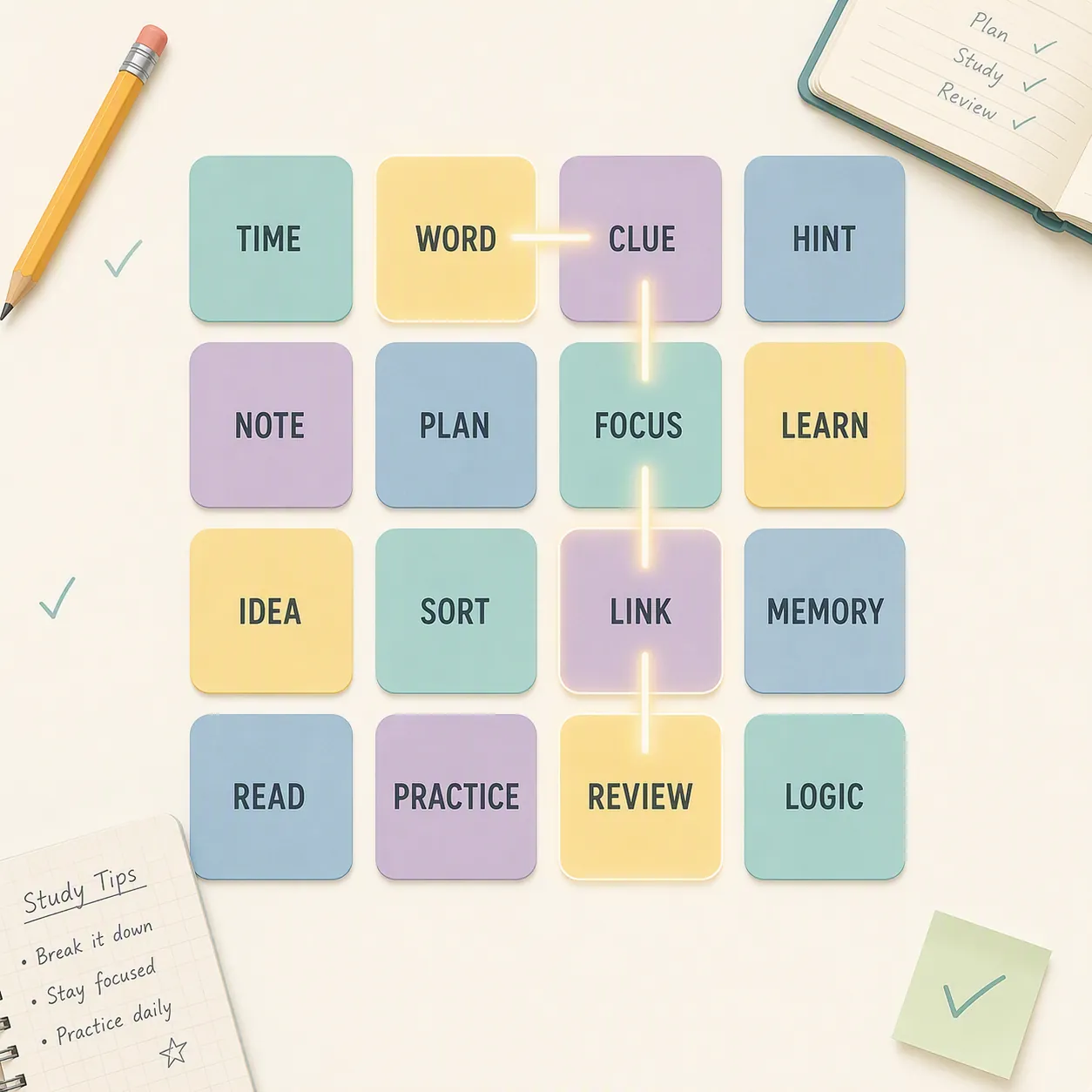
The part that can transfer: predict, then match
Good Words in Context work is not mainly a memory contest. PrepMaven’s SAT vocabulary strategy tells students to use context, predict the meaning in their own words, and then match that prediction to an answer choice instead of being pulled around by the choices first.[1] The Test Advantage’s digital SAT Words in Context guide gives a similar process and warns about the “common definition trap,” where a familiar meaning of a word looks safe but does not fit the sentence.[2]
That is the same discipline a Connections hint can rehearse. The hint gives you partial context. The grid gives you possible matches. Your job is not to admire the clue and reveal. Your job is to form a testable prediction before the game tells you whether you were right.
| In Words in Context | With Connections hints |
|---|---|
| Read the sentence or passage before looking too hard at the choices. | Look at the full grid before opening or using a hint. |
| Infer the role or meaning the word needs in that context. | Predict what kind of relationship the hinted group probably uses. |
| Put that prediction in your own words. | Say the category link out loud or write a quick label. |
| Compare your prediction to the answer choices. | Choose four words only after the relationship is named. |
| Reject choices that use a tempting but wrong meaning. | Use red herrings as practice for explaining why an obvious group is wrong. |
That table is the whole reason the habit is worth considering. If the student skips the prediction step, the transfer mostly disappears. Reading hints after the fact may be entertaining, but it does not force the same decision that an SAT or ACT vocabulary question forces.
A five-minute routine that makes the hint do actual work
Use this on the official daily puzzle, not as a hunt for “today’s answers.” The point is to keep the mental step that usually gets skipped: naming the relationship before the reveal.
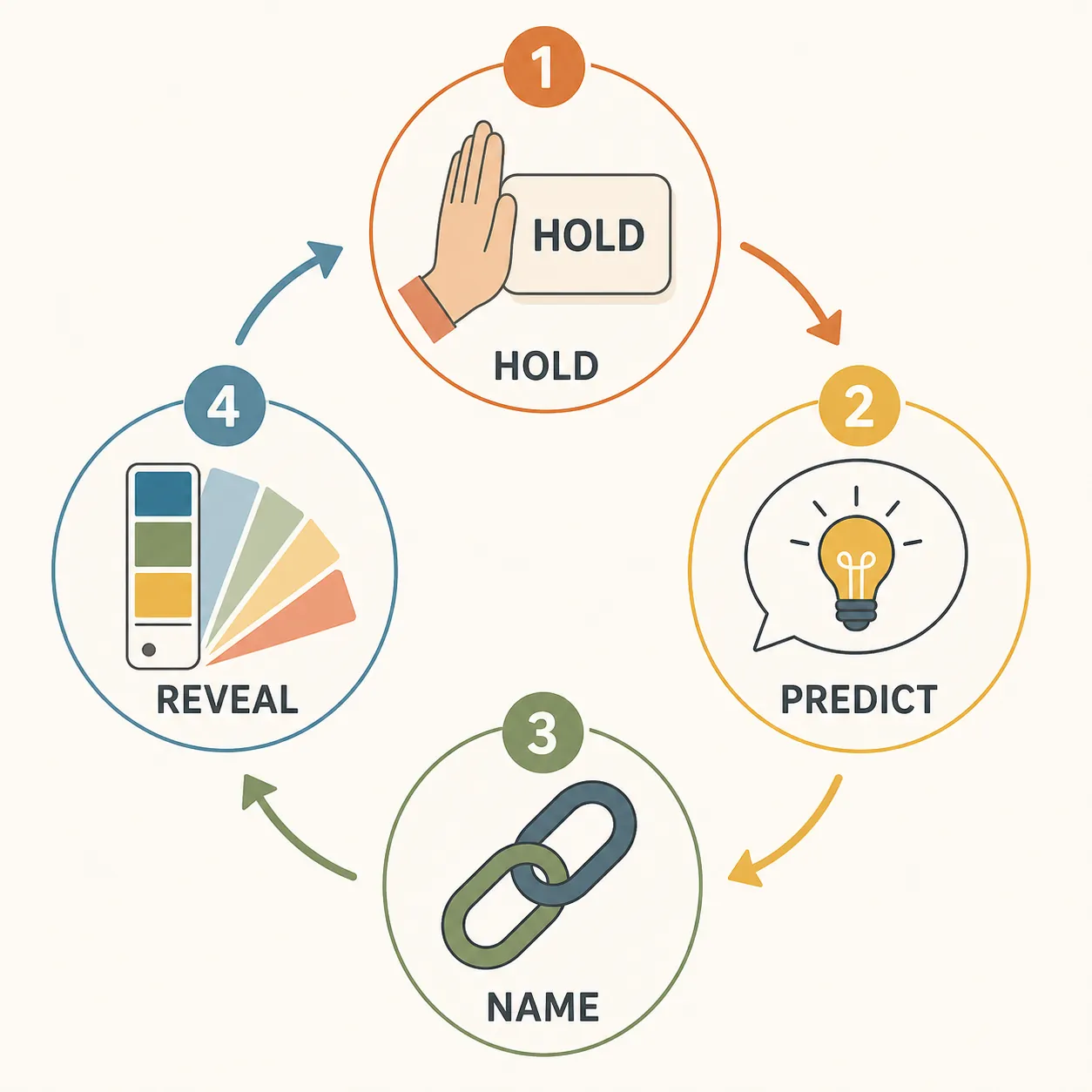
1. Hold the guess
Before selecting anything, make yourself wait. This is the smallest step and the easiest to fake. If you are already hovering over four tiles because they feel related, stop before you submit. On the SAT or ACT, the equivalent mistake is choosing the answer that sounds like the word’s most familiar meaning before checking whether the sentence actually supports it.
The New York Times’ own Connections tips describe categories as being based on the meaning or structure of words and present the color sequence as a difficulty signal, with purple often requiring the least obvious kind of connection.[3] That is enough to make the pause useful: you are not just collecting four related words; you are deciding what kind of relatedness the puzzle is asking you to recognize.
2. Predict the category in your own words
Do not reveal first and then reverse-engineer the answer. Before you check a hint, or after reading only the lightest hint you allow yourself, state the possible link in plain language. Not “blue maybe.” Not “these sound like they go together.” Say something like: “These could all be words that can follow the same adjective,” or “These might be terms with a second meaning in sports,” or “This looks like a group based on spelling rather than definition.”
The exact category does not have to be elegant. In fact, for test prep, elegance is not the goal. A rough prediction is enough if it can be checked. On a vocabulary-in-context question, a student may predict “the word has to mean something like reduce” before seeing the answer choices. In Connections, the parallel prediction is “the group has to be linked by usage, not topic.” Both moves keep the solver from becoming passive.
3. Name the link, not just the label
A category title can hide weak reasoning. If a hint makes you think the group is “music,” that is too broad to be useful. Name the actual link: instruments, music genres, words after “pop,” composers’ surnames, or phrases that contain musical terms. This is where the exercise starts to resemble an exam question instead of a guessing game.
For SAT and ACT work, this matters because Words in Context questions usually punish approximate thinking. A word may feel negative, formal, scientific, or emotional, but the question still asks which meaning fits the local context. A vague feeling is not enough. The student has to say what job the word is doing.
4. Reveal the color only after the prediction
Now check. If the group is right, ask whether your reason was right too. A correct submission with a sloppy explanation is not as useful as it feels. If the group is wrong, do not just move on. Write or say one sentence explaining what attracted you and what broke the pattern.
- “I grouped these by topic, but one word only fit by a different meaning.”
- “I used the most common definition, but the puzzle needed a phrase or secondary use.”
- “Three words shared a surface category, but the fourth was a decoy.”
- “The correct group was structural, not semantic.”
Those post-miss sentences are not busywork. They are distractor review. The student is practicing the same correction that should happen after missing an official Words in Context question: not “I didn’t know the word,” but “I accepted a meaning the surrounding evidence did not support.”
Why the red herrings are the useful part
The obvious-but-wrong group is not just the game being cute. Western News, drawing on cognitive scientist Penny Pexman’s explanation, describes how Connections can exploit semantic memory and priming: seeing related words can push solvers toward an attractive category even when the full grid requires a different relationship.[4] That is close to the feeling students get when an answer choice contains the familiar definition of a tested word but the sentence is asking for another meaning.
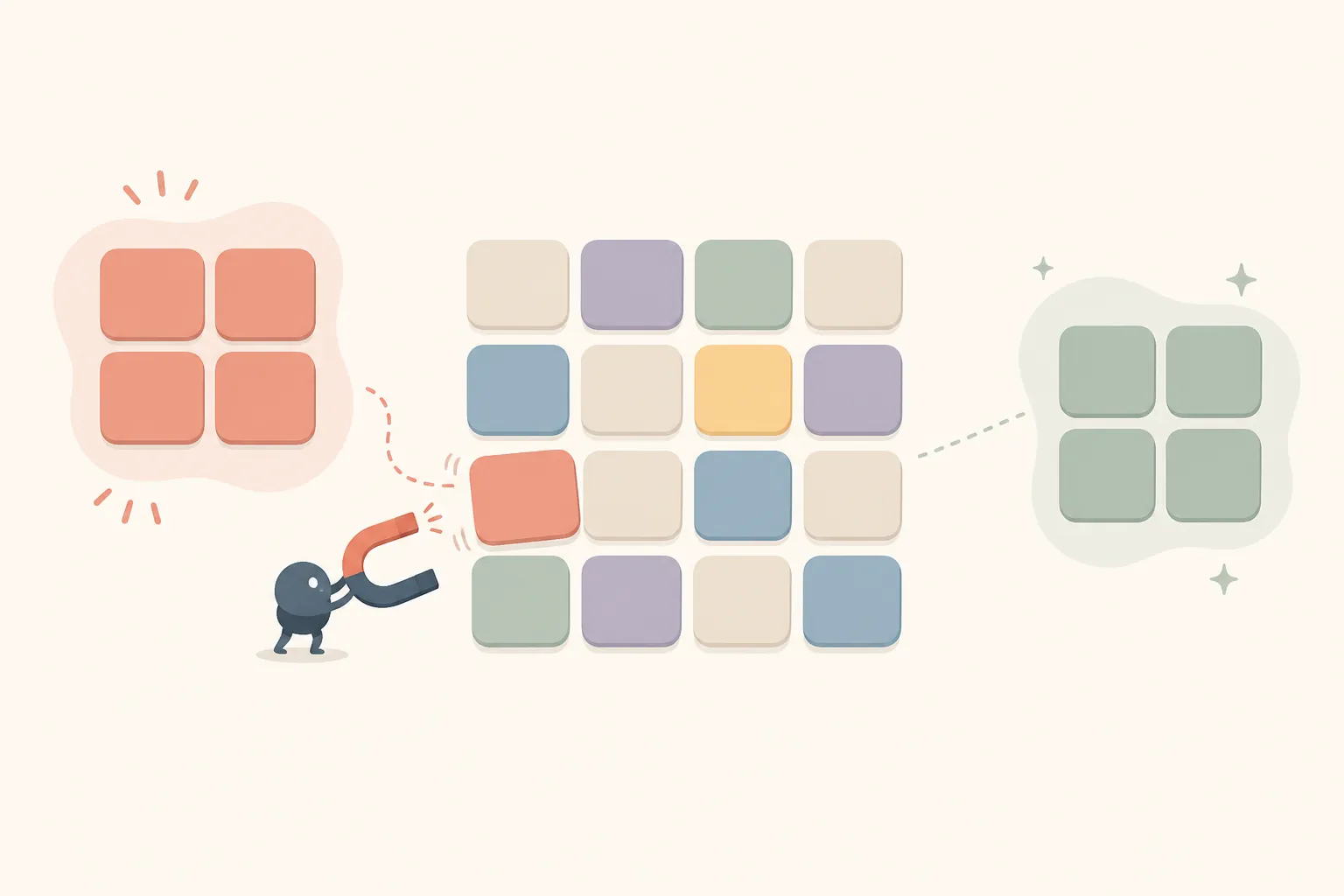
This is where Connections becomes more useful than a casual word list. A word list can tell a student that a word has several meanings. The puzzle makes the student feel the pull of the wrong one. That feeling is worth noticing, because many vocabulary misses are not blank stares. They are confident choices made too early.
The Test Advantage’s warning about the common definition trap belongs here: the wrong answer can be a real definition, just not the meaning required in context.[2] Connections red herrings can rehearse that restraint in a lower-stakes setting. The student learns to ask, “Does this relationship explain all four words?” before submitting. On a test, the version is, “Does this meaning fit the sentence, not just the word?”
What this does not prove about SAT or ACT vocabulary
There is no good reason to claim that Connections teaches “SAT words” directly. The available materials do not provide word-overlap data between Connections answers and SAT, ACT, or other exam vocabulary pools. The safe claim is narrower: the game can train a process that vocabulary-in-context questions also reward.
That boundary matters more when the test date is close. If you have two months or less, official SAT Reading and Writing or ACT English and Reading practice still has to carry the main load. Connections can warm up the habit of prediction and distractor resistance, but it cannot show you the exact question format, the scoring pressure, or the passage-level evidence the exam will require.
Even the number of SAT Words in Context questions is not something sources state identically. PrepMaven says students can see up to 10 vocabulary-in-context questions on the SAT, while The Test Advantage describes about two to four Words in Context questions per digital SAT.[1][2] That disagreement is a good reason not to turn this into a frequency argument. The practical point is simpler: these questions exist, students miss them, and the method for attacking them depends on prediction before matching.
The context-clue connection is the real justification
Context-clue instruction is not just handing students definitions in advance. Timothy Shanahan argues for teaching students to use context through questioning, prediction, and checking rather than treating vocabulary learning as simple pre-teaching of word meanings.[5] That is exactly the difference between useful Connections-hint practice and empty hint consumption.
A student who reads a hint and immediately reveals has learned the answer to a puzzle. A student who reads a hint, predicts the relationship, chooses a group, and explains the miss has practiced context use. The words on the grid are the material; the reasoning loop is the study skill.
If Words in Context is a recurring problem, pair this routine with more direct work from SAT Reading and Writing sample question types and with harder examples where a familiar word is used in an unfamiliar way, such as the patterns covered in hardest SAT question types. The puzzle routine is most useful when it prepares the brain for that official work, not when it replaces it.
A language-rich game is still not a curriculum
There is a fair reason students and tutors are tempted to use Connections this way. The New York Times Help Center says Connections uses words from the Oxford Dictionary and that categories are edited by the Games team.[6] The official tips also make clear that categories can rely on word meaning or word structure.[3] So yes, the game is language-rich enough to support a vocabulary warm-up.
But “language-rich” is not the same as “aligned to the SAT” or “aligned to the ACT.” The exam questions define the exam task. If a parent, tutor, or student wants to count Connections as study time, count it honestly: five minutes of context-clue and distractor-elimination practice before the real set begins.
The same boundary applies to other daily NYT game warm-ups. A Strands vocabulary routine or a Mini Crossword vocabulary routine can be useful when it is treated as a warm-up. It becomes a problem when it starts substituting for passage-based practice while still wearing the costume of test prep.
How tutors can use it without overselling it
For a tutoring session, the cleanest version is a short opening drill. Put the grid on screen, allow one hint if needed, and ask the student for a prediction before any guess. Then require one sentence of evidence: “What makes those four belong together, and why does the tempting fifth word not belong?”
- Use it before official SAT or ACT reading work, not after the student is already mentally done.
- Stop after one puzzle or one meaningful miss. The goal is precision, not completion.
- Ask for the relationship in the student’s own words before accepting the answer.
- Translate one wrong group into test language: “That was the common meaning. What did the evidence actually require?”
- Do not report it as vocabulary coverage. Report it as context-clue reasoning practice.
A limited self-tracked analysis of more than 100 Connections games found purple hardest to discern and noted the pull of obvious categories, but that is anecdotal evidence from one solver’s dataset, not population-level proof.[7] It is still useful as a familiar classroom observation: students often lose points not because nothing made sense, but because the first pattern made too much sense too soon.
Where it fits in an actual study plan
The best place for this habit is the first five minutes of a study block, especially on a night when the alternative is doing nothing. Open Connections. Withhold the guess. Use a hint only as a clue. Predict the relationship. Name the link. Reveal. Explain one tempting wrong path. Then move to official SAT or ACT questions.
For students who struggle with passage vocabulary more broadly, the same predict-and-check habit can carry into longer reading practice, including an unfamiliar-vocabulary SAT passage protocol. The difference is that official passages add sentence structure, tone, and surrounding claims. Connections can train the first restraint; the exam still requires the fuller read.
So the permission is narrow but real. If you predict before revealing and explain why the tempting group is wrong, NYT Connections hints can count as context-clue vocabulary practice. If you just read hints, reveal colors, and enjoy the answer, it is a game break. A perfectly fine game break — just not SAT or ACT prep.
References
- SAT Vocabulary Strategy: How to Approach Words in Context Questions, PrepMaven, https://prepmaven.com/blog/test-prep/sat-vocabulary-strategy/
- Digital SAT Words in Context: A Complete Strategy Guide, The Test Advantage, https://thetestadvantage.com/blog/digital-sat-words-in-context-a-complete-strategy-guide
- Connections Tips and Tricks, The New York Times, November 6, 2023, https://www.nytimes.com/2023/11/06/crosswords/connections-tips-and-tricks.html
- How to improve at Connections game, Western News, April 2024, https://news.westernu.ca/2024/04/improve-connections-game/
- How I Teach Students to Use Context in Vocabulary Learning, Shanahan on Literacy, https://www.shanahanonliteracy.com/blog/how-i-teach-students-to-use-context-in-vocabulary-learning
- Connections, New York Times Games Help Center, https://help.nytimes.com/360011158491-New-York-Times-Games/28525912587924-Connections
- Analyzing 100+ Games of NYT Connections, Medium, https://tristrumtuttle.medium.com/analyzing-100-games-of-nyt-connections-550848fee76d
Related exhibits & inventory
Verified outcomes
No verified outcomes on file for this exam yet
See Methodology for how outcome evidence is disclosed once logged.
Planners
No planner filed for this exam yet
A downloadable timeline template for this exam hasn't been published yet.
Tool verdicts
AI-tool cautions
No AI tools tested for this exam yet
No hands-on AI-accuracy logs have been filed for this exam.
Questions about this plan
Ask a question about a specific section, timeline, or citation in this plan — or flag something that needs correcting.
Comments
Join the discussion with an anonymous comment.