
SAT Exam Hub
How to Use the Ramayana as a SAT Study Guide for World Literature
Learn a repeatable protocol to decode unfamiliar world literature passages on the digital SAT using the Ramayana as a case study — no pre-reading of the epic required.
- gre
- mcat
- asvab
- sat
- act
- digital-adaptive
- official-material
- section-strategy
- test-date-timeline
The danger moment on a digital SAT literature question is often quiet. A strong reader sees a short passage, then one unfamiliar name: Rama, Sita, Ravana, maybe dharma. Suddenly the student who was comfortable with a fossil discovery passage or a political speech starts treating the paragraph as if it belongs to someone more cultured, better read, or secretly prepared.
That is the wrong problem to solve. A useful Ramayana study guide for exams is not a miniature humanities course. For SAT purposes, the better question is: what can you extract from a short passage fast enough to answer the one question attached to it?

On the digital SAT, literary fiction passages are short, commonly described as 25 to 150 words, and each passage is paired with a single question.[1] That format matters. You are not being asked to recognize an epic, summarize a tradition, or prove that you have read the source work. You are being asked to read a small piece of language under pressure.
College Board’s Reading and Writing section places these questions inside skill domains such as Information and Ideas and Craft and Structure, with question types including words in context, main idea, inference, and tone or perspective.[2] Those are ordinary SAT tasks. The names may be unfamiliar; the job is not.
Do Not Turn the Ramayana Into a Prediction
A caveat belongs near the front: no public official College Board SAT literary fiction passage featuring the Ramayana as the primary excerpt was found for this article. PrepScholar discusses the Ramayana in connection with a graph question comparing epic line counts, not as proof that a Ramayana fiction excerpt is waiting on a future test.[3]
So the Ramayana is not here as a forecast. It is here because it is a clean training case. It has a recognizable character triangle, a strong moral vocabulary, and enough unfamiliar names to trigger the exact panic that hurts students on world literature passages.
The epic itself is far larger than anything the SAT could meaningfully test in one paragraph. Traditionally attributed to Valmiki, the Ramayana is a Sanskrit epic often dated around 300 BCE, organized into seven kandas, and widely described as containing about 24,000 couplets.[4] That scale is interesting, but it is not the student’s burden during a timed Reading and Writing module.
The Four Moves That Matter on Test Day
PrepScholar’s general SAT reading framework—read the context line, skim for structure, annotate actively, then attack the question—is a useful ancestor for this method.[3] For world literature passages, it needs to become more specific. The student does not have time to become comfortable with every name. The student needs a sequence that makes unfamiliar material behave like an SAT passage again.
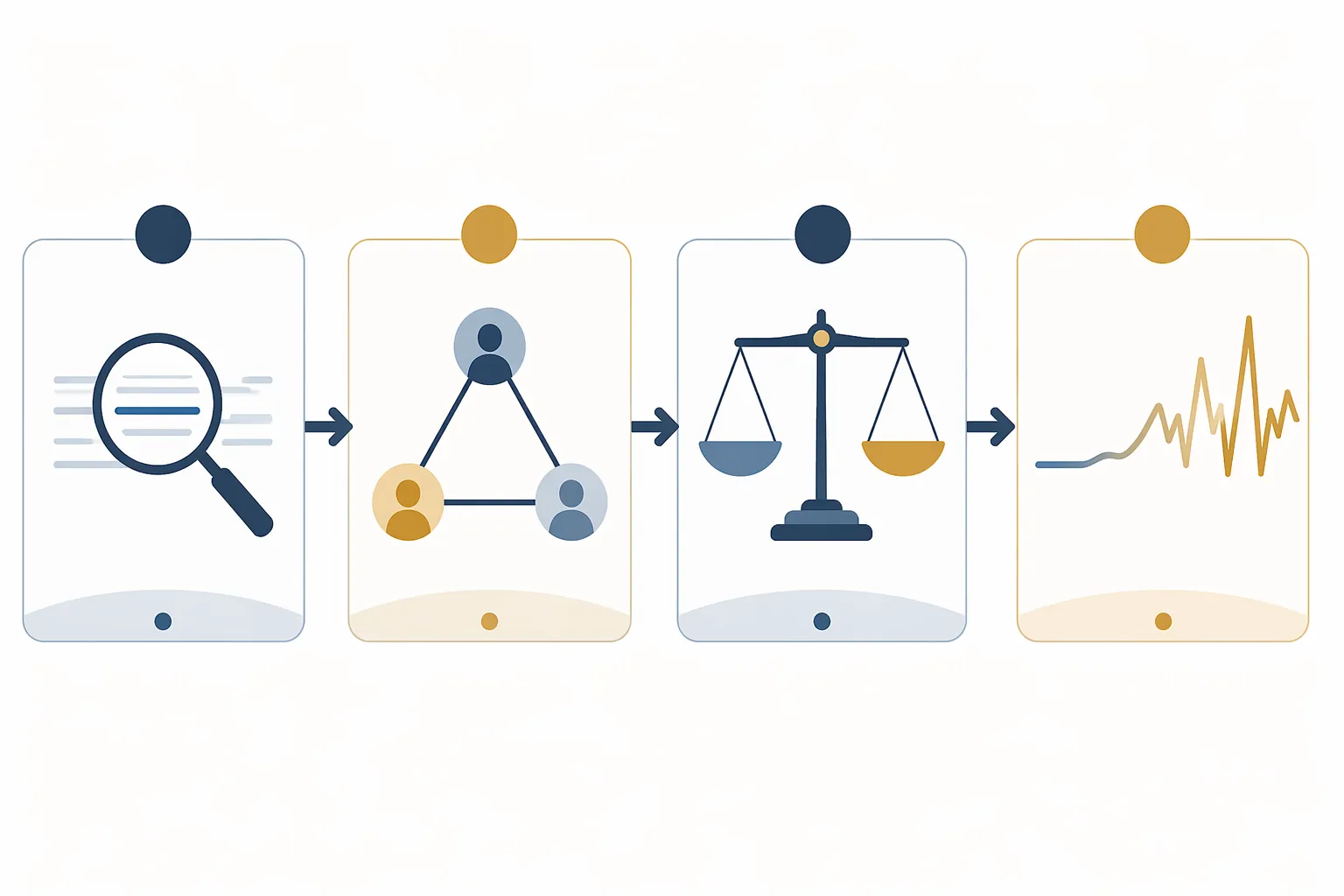
| Move | What You Are Looking For | SAT Question It Helps With |
|---|---|---|
| Mine the context line | Who is speaking, what situation is named, and what conflict is already visible | Main idea, inference, words in context |
| Map the character triangle | Who wants something, who is affected, and who blocks or helps | Inference, function, perspective |
| Identify the moral binary | What value system the passage treats as order, duty, loyalty, disorder, or violation | Theme, inference, tone |
| Track the tone shift | Whether the language moves toward admiration, grief, warning, irony, anger, or restraint | Tone, perspective, word choice |
This is not a College Board-endorsed formula. It is a practical adaptation of SAT reading strategy for a specific failure point: the moment when unfamiliar world literature makes a familiar question type feel foreign.
If you want a separate breakdown of how these question types appear across the digital SAT, StudyMethod’s SAT sample question guide is the better place to study that taxonomy. Here, the concern is narrower: what to do when the passage sounds like it came from a world epic and your brain tries to leave the room.
1. Mine the Context Line Before You Touch the Myth
The context line is the sentence or introductory note that tells you where the excerpt sits. On the digital SAT, this line may be brief, but it can keep you from inventing a problem. If it says a character has returned from exile, you do not need the whole exile story. You need to know that return, separation, duty, and recognition may be active pressures in the passage.
For a Ramayana-style excerpt, the context line might mention Rama, Sita, Ravana, a forest, a kingdom, an abduction, a battle, or a vow. Treat each of those as a local signal, not as a demand for background knowledge. The name Ravana does not need to make you think, “I never studied this.” It should make you ask, “Is this person blocking someone, threatening someone, tempting someone, or being judged by the narrator?”
This move protects you from the most expensive mistake: reading the first unfamiliar noun as evidence that the passage is above you. The SAT question still has to be answerable from the words provided.
2. Map the Character Triangle
The Ramayana gives you a convenient model because its central conflict can be flattened, for test purposes, into a triangle: Rama as hero or protagonist, Sita as the devoted wife and central figure affected by the conflict, and Ravana as antagonist and abductor. Hanuman and Lakshmana function as important allies in Rama’s cause.[4][5]
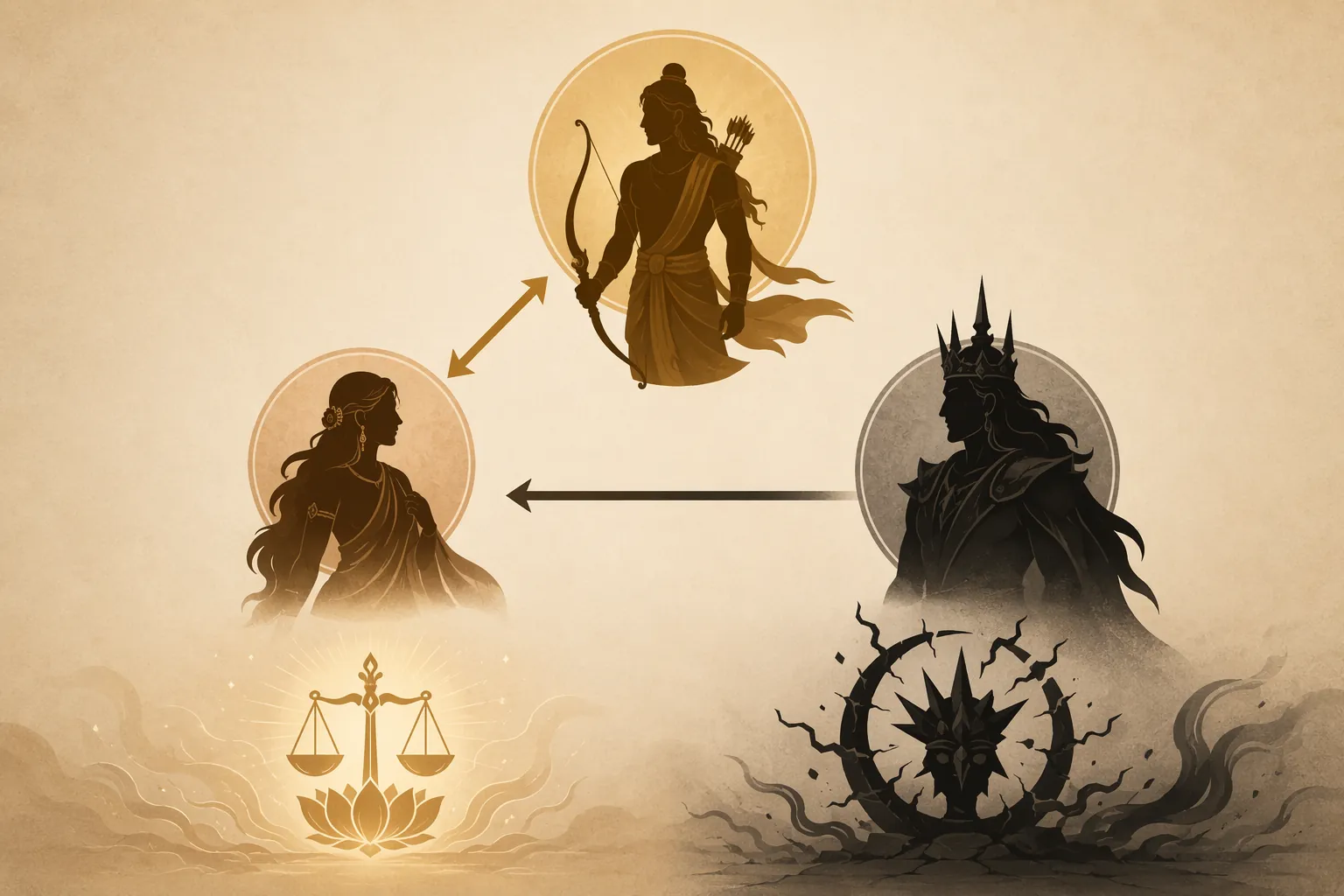
On a timed SAT passage, do not start with a family tree. Start with pressure:
- Who wants something?
- Who has been wronged, separated, tested, or protected?
- Who blocks the desired outcome?
- Who helps restore order?
That is enough to answer many inference questions. If a passage describes Rama pausing before battle, the relevant issue may be restraint, duty, grief, or resolve. If it describes Sita speaking in captivity, the issue may be loyalty, dignity, fear, or resistance. If it describes Ravana in elevated language, the question may ask whether the narrator admires his power while still condemning his actions. You do not need to know every episode to see the relationship pressure inside the paragraph.
A student who reads mostly science passages is used to tracking variables. This is the literature version: desire, obstacle, consequence. Replace “Who is this mythological person?” with “What role is this person playing in the sentence?”
3. Identify the Moral Binary Without Overstudying It
The Ramayana is often read through the contrast between dharma and adharma: duty, order, and righteousness set against disorder, wrongdoing, or violation.[4][5] For SAT reading, that contrast is useful because it tells you what the passage may treat as morally charged.
Do not turn dharma into a flashcard and stop there. The exam will not reward you for recognizing the word if you ignore how the passage uses it. A sentence may present duty as noble, painful, socially expected, personally costly, or politically convenient. Those are different tonal possibilities.
In a short excerpt, the moral binary usually appears through loaded language. Watch for words that praise steadiness, loyalty, restraint, honor, purity, obedience, justice, restoration, or sacrifice. Watch also for words that signal violation: arrogance, deception, seizure, exile, temptation, chaos, or shame. The exact vocabulary will depend on the translation or adaptation, but the test question can only use the evidence in front of you.
This move helps most with inference and tone questions. If the answer choice says a character is “indifferent,” but the passage frames that character as bearing a duty with visible emotional cost, “indifferent” is probably too flat. If an answer says the narrator “celebrates rebellion,” but the passage repeatedly associates the rebellion with disorder or harm, that answer is probably importing a modern reflex instead of reading the passage.
4. Track the Tone Shift, Not the Whole Plot
Tone questions are where unfamiliar world literature can feel slippery. Students often look for a label too early: reverent, mournful, critical, ironic. Better to ask what changes from the beginning of the excerpt to the end.
A passage may begin with ceremonial description and end with private grief. It may begin by praising a warrior’s strength and end by narrowing attention to the suffering that strength causes. It may begin in calm narration and end in accusation. These shifts are answerable without outside knowledge because they are built from diction, sentence movement, and contrast.
On test day, mark the emotional direction in plain words. Not “epic tone.” Not “ancient values.” Use ordinary labels: starts proud, ends worried; starts admiring, ends uneasy; starts formal, ends intimate; starts condemning, ends regretful. Those labels make answer choices easier to eliminate.
This is also where words-in-context questions become less mechanical. If a word like “grave,” “noble,” “bound,” or “fierce” appears in a literary sentence, the local tone tells you which meaning is active. The dictionary definition is only half the work; the sentence’s attitude chooses among the possibilities.
A Short Ramayana-Based Practice Walkthrough
Imagine a hypothetical SAT-style excerpt. It is not from an official test. It says that Rama, after long separation, looks toward the city where Sita has been held, while his allies wait for him to command the final assault. The language describes his anger as controlled rather than explosive, and it contrasts Ravana’s splendor with the disorder caused by his desire.
Before answering anything, run the four moves. The context line gives separation, captivity, and approaching conflict. The triangle is clear: Rama seeks restoration, Sita is the person whose abduction defines the wrong, Ravana blocks order, and the allies wait for action. The moral binary is not subtle: controlled duty is being weighed against destructive desire. The tone may be grave, restrained, and morally serious rather than merely excited about battle.
Now a possible inference question becomes less intimidating. If the question asks what the passage suggests about Rama’s anger, the best answer would probably avoid extremes. He is not careless, indifferent, or purely vengeful if the language emphasizes control and duty. He is angry, but the passage frames that anger as governed by a larger obligation.
A tone question would work the same way. An answer such as “lightly amused” would collapse under the moral weight of the scene. “Solemn and restrained” would have a better chance if the diction supports it. The point is not that you knew the Ramayana. The point is that you refused to let names replace evidence.
What to Memorize, and What to Ignore
There is a small amount of Ramayana background worth knowing because it reduces panic. Keep it compact.
| Name or Term | SAT-Useful Handle |
|---|---|
| Rama | Hero or protagonist; often associated with duty and rightful order |
| Sita | Central figure in the conflict; associated with loyalty, suffering, dignity, and separation |
| Ravana | Antagonist; abductor whose desire disrupts order |
| Hanuman | Ally and helper in Rama’s cause |
| Lakshmana | Rama’s brother and ally |
| Dharma | Duty, order, righteousness, or the value system the passage may invoke |
| Adharma | Disorder, wrongdoing, or violation of that value system |
That is the usable test-day layer. The seven kandas, the full sequence of episodes, and the epic’s literary and religious depth matter in a literature course. They are not the fastest route to a correct answer on a 25-to-150-word SAT passage.
There is also a risk in memorizing too much. If you walk into the exam convinced that Rama must always be presented one way, or that every passage involving duty must admire duty without complication, you may miss the actual tone. SAT passages are local. The correct answer is tied to the excerpt, not to your preferred summary of the source.
Why This Transfers to Other Epics
The point of using the Ramayana is not to make you a Ramayana specialist. It is to practice a pattern that travels. Gilgamesh, the Odyssey, the Iliad, the Mahabharata, and other epic traditions can all produce the same SAT problem: unfamiliar names attached to familiar reading tasks.
In another epic excerpt, the triangle may not be Rama, Sita, and Ravana. It may be a warrior, a king, and a defeated enemy; a traveler, a spouse, and a divine obstacle; a ruler, a friend, and a rival. The moral binary may not be called dharma and adharma. It may be honor versus shame, hospitality versus violation, loyalty versus betrayal, divine order versus human pride.
The labels change. The work does not. Mine the context line. Map the pressure among characters. Identify the value system. Track the tone shift. Then answer the question that was actually asked.
This is the same case-study-to-protocol approach StudyMethod uses in its guide to fossil discovery passages on the SAT and ACT. A fossil passage is not really about becoming a paleontologist. A Ramayana-style passage is not really about becoming an epic scholar. In both cases, the subject matter is the costume; the exam skill is underneath it.
The Compact Test-Day Routine
When a world literature passage appears, spend your first seconds preventing panic from becoming a reading strategy. Use this routine:
- Read the context line for situation, speaker, conflict, and relationship.
- Assign roles before meanings: seeker, blocker, harmed person, helper, judge, observer.
- Circle or mentally mark the value words that show what the passage approves, mourns, condemns, or questions.
- Name the tone movement in plain language before looking too long at the answer choices.
- Eliminate answers that require outside plot knowledge or ignore the sentence-level evidence.
If Rama, Sita, Ravana, or dharma ever does show up in a literary passage, you will have useful handles. If they never appear, the practice still helps. The digital SAT is not asking whether the passage belongs to your cultural comfort zone. It is asking whether you can extract the local signal from a short text and choose the answer that follows from it.
References
- How to Tackle SAT® Literary Fiction Passages (2026–2027), UWorld College Prep
- The Reading and Writing Section, College Board SAT Suite
- How to Read SAT Passages: 4 Easy Steps, PrepScholar
- Ramayana | Summary, Characters, Themes, & Facts, Britannica
- The Ramayana Study Guide, GradeSaver
Related exhibits & inventory
Verified outcomes
No verified outcomes on file for this exam yet
See Methodology for how outcome evidence is disclosed once logged.
Planners
No planner filed for this exam yet
A downloadable timeline template for this exam hasn't been published yet.
Tool verdicts
AI-tool cautions
No AI tools tested for this exam yet
No hands-on AI-accuracy logs have been filed for this exam.
Questions about this plan
Ask a question about a specific section, timeline, or citation in this plan — or flag something that needs correcting.
Comments
Join the discussion with an anonymous comment.