
GRE Exam Hub
The JWST Dyson Sphere Study as a Passage Analysis Blueprint
The July 2026 JWST Dyson sphere study follows a textbook hypothesis→test→revise arc that mirrors science passages on the GRE, MCAT, and ACT. This article dissects that structure, highlights key evidence signals and false-positive traps, and provides simulated question types with answer logic to help you answer main-idea, inference, and function questions faster.
- gre
- mcat
- asvab
- sat
- act
- digital-adaptive
- official-material
- section-strategy
- test-date-timeline
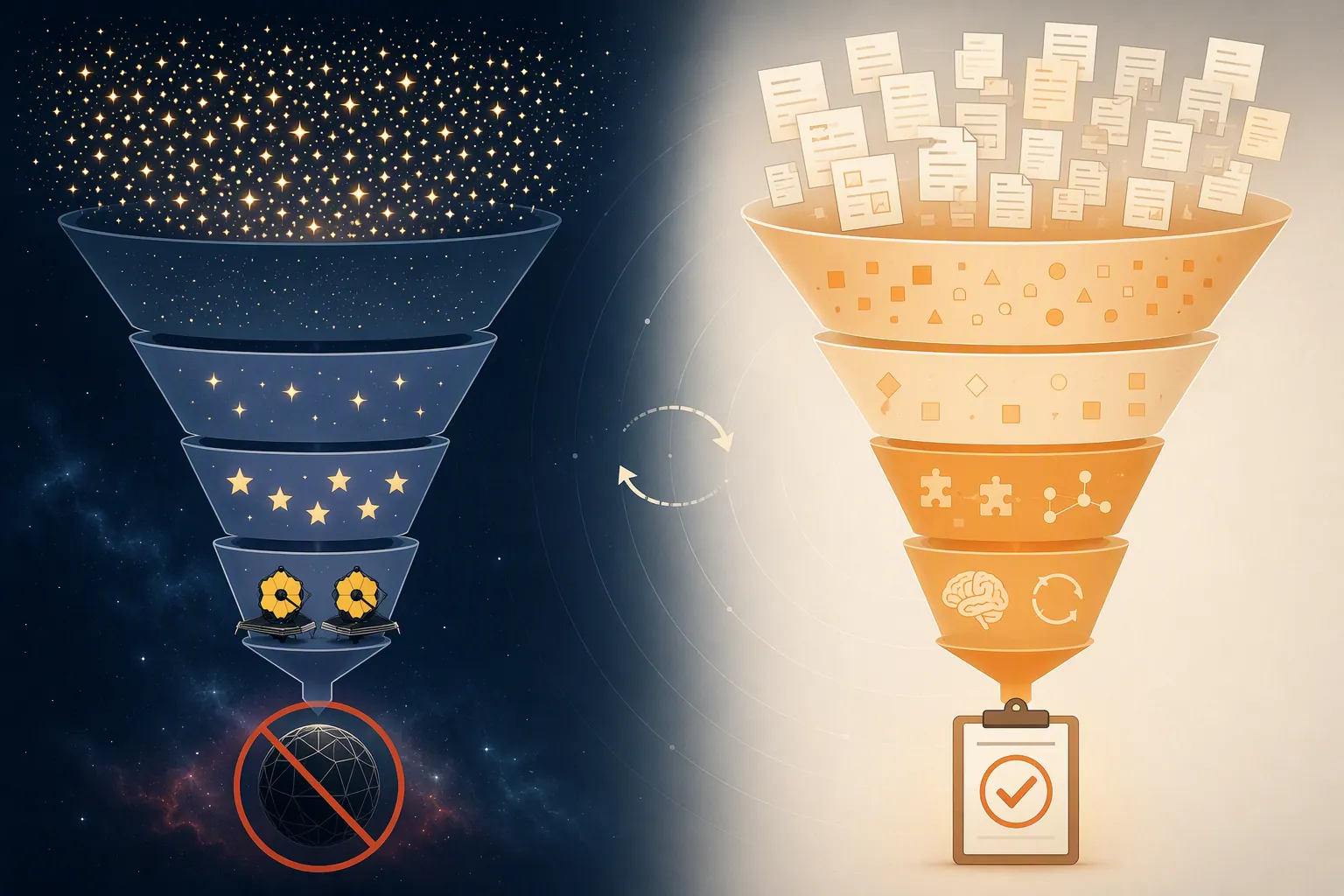
The useful part of the Dyson sphere JWST study is not the phrase “alien megastructure.” It is the narrowing sequence:
| Scientific move | What happens | Exam-passage job |
|---|---|---|
| Initial screen | Project Hephaistos starts from about 5 million stars, applies optical/near-infrared cuts and a WISE mid-infrared excess filter, and reports 7 candidates. | Sets up the hypothesis and the first selection method. |
| Sharper test | JWST/MIRI follows up 2 of the 7 candidates. | Introduces a better instrument and a more precise test. |
| Revision | Both observed candidates are ruled out as Dyson sphere candidates and interpreted as background galaxies. | Forces the reader to replace the exciting explanation with the better-supported one. |
| Boundary | The remaining 5 candidates have not yet been observed with JWST. | Blocks overbroad answer choices. |
That is already a passage map. A first screen finds objects that look unusual. A follow-up test asks whether the unusual signal comes from the target star or from something blended with it. The follow-up breaks the original interpretation for the two objects it examines. The correct conclusion is narrow: two candidates were rejected, not the whole search.
The July 2026 paper, Project Hephaistos - IV. James Webb Space Telescope Observations of Two Dyson Sphere Candidates, is a preprint submitted to arXiv on July 10, 2026, so it should not be treated as a peer-reviewed final settlement. It is still excellent exam practice because the logic is unusually clean: a hypothesis is generated by survey filters, then tested by higher-resolution imaging and spectroscopy, then revised when the measurements point somewhere else.[1]
Start With The Funnel, Not The Spectacle
A timed reader should underline the numbers before admiring the premise: 5 million stars, 7 candidates, 2 JWST follow-ups, 0 Dyson sphere confirmations among those 2. The passage is not mainly asking whether Dyson spheres are interesting. It is asking whether a candidate-selection method survives a more discriminating test.
The original Project Hephaistos selection used large survey catalogs to look for stars with anomalous infrared behavior. The general idea is simple enough for a test passage: if an advanced structure absorbed starlight and re-emitted waste heat, the object might look too bright in the mid-infrared relative to an ordinary star. But a mid-infrared excess is not a diagnosis. It is a flag.
That distinction is where many wrong answers live. “The object passed the infrared screen” does not mean “the object is probably artificial.” It means the object deserves a better look. On the GRE, MCAT, or ACT Science section, this is the difference between an answer that reports what the evidence shows and an answer that converts a preliminary filter into a conclusion.
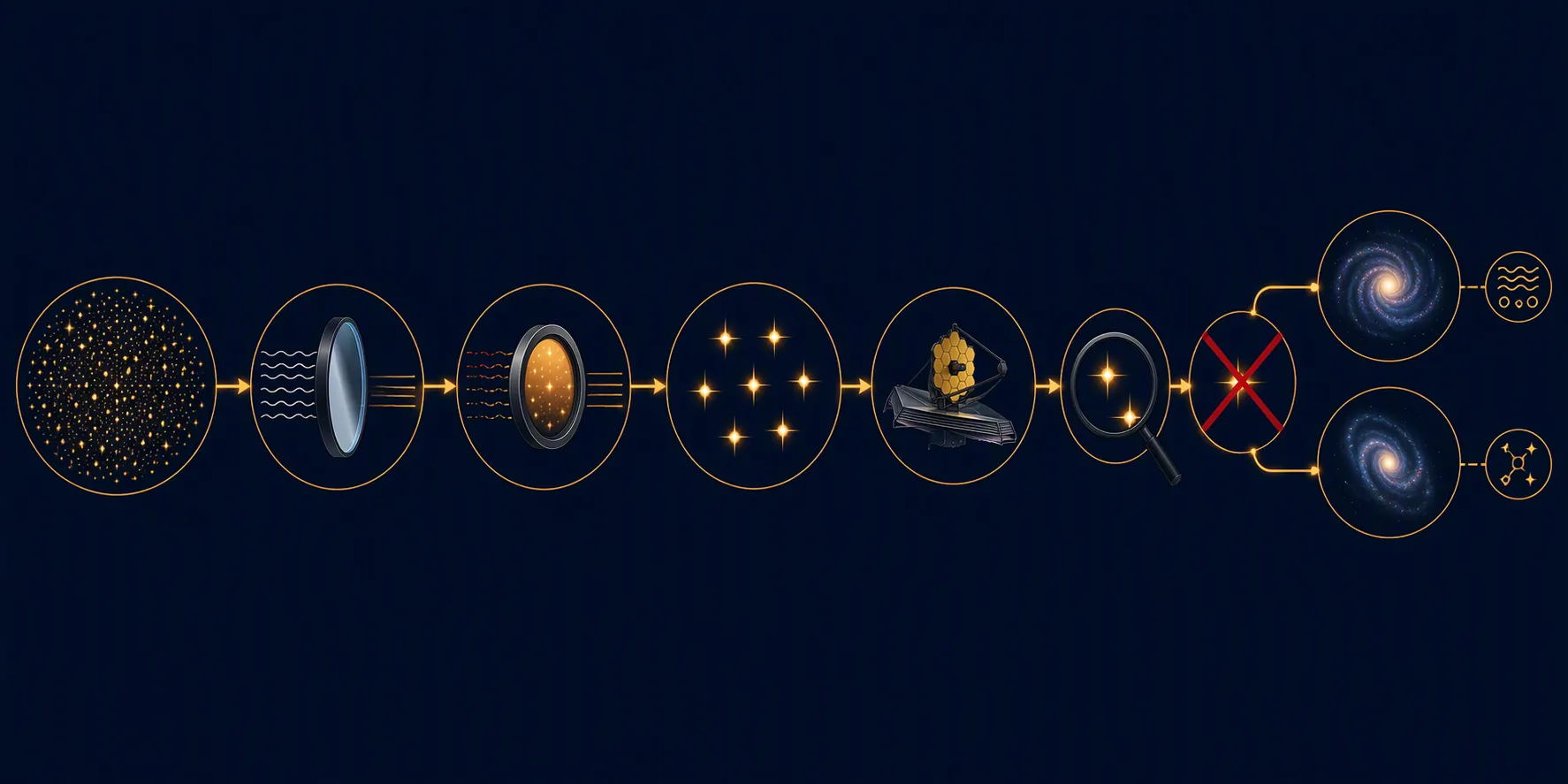
The JWST follow-up examined two candidates, labeled D and E in the study. For both, the key question was not “Can a Dyson sphere exist?” The key question was more operational: does the observed infrared emission line up with a single target star, or does JWST reveal a blended background source that explains the excess?
That operational question is exactly how a science passage earns its structure. The first method creates a possible explanation. The second method tests whether that explanation is still necessary. Once the second method finds a better explanation, the passage pivots from discovery to contamination.
The Evidence That Breaks The First Interpretation
The most exam-worthy evidence is the centroid shift. In the JWST/MIRI data, both candidates showed position changes between filters, including F560W and F1500W. A centroid shift means the apparent center of the light changes with wavelength. If one object were simply a star plus a surrounding Dyson sphere, the wavelength-dependent center should not behave like two blended sources taking turns dominating the image.[1]
Candidate D makes the point almost too neatly. The paper reports a separation of about 1 arcsecond between the M-dwarf and the mid-infrared source. The M-dwarf contributes roughly 80% of the flux in F560W, but only about 10% in F1000W. That is not decorative detail. It tells you why the object could pass an earlier screen and fail the sharper one: at shorter mid-infrared wavelengths, the star still matters; at longer mid-infrared wavelengths, the background source takes over.[1]
Under test conditions, those two numbers should light up immediately. They explain the mechanism of the false positive. The passage is not merely saying “JWST is better.” It is showing how better resolution and multi-filter measurements separate what the earlier survey blended together.
The spectroscopy then supplies a second line of pressure. Using mid-infrared spectral diagnostics, the study classifies candidate D as a class 2A obscured active galactic nucleus on the Spoon diagram and candidate E as a class 1C starburst galaxy. In plain passage terms: the emission has galaxy signatures, not the clean single-star-plus-waste-heat pattern the Dyson sphere interpretation would need.[1]
Candidate D is also identified as a Hot Dust-Obscured Galaxy, or Hot DOG, at approximately z = 0.9; candidate E is interpreted as a starburst galaxy at approximately z = 0.4. The labels are less important than the logical role they play. They are replacement explanations. They account for the infrared excess without requiring artificial megastructures.[1]
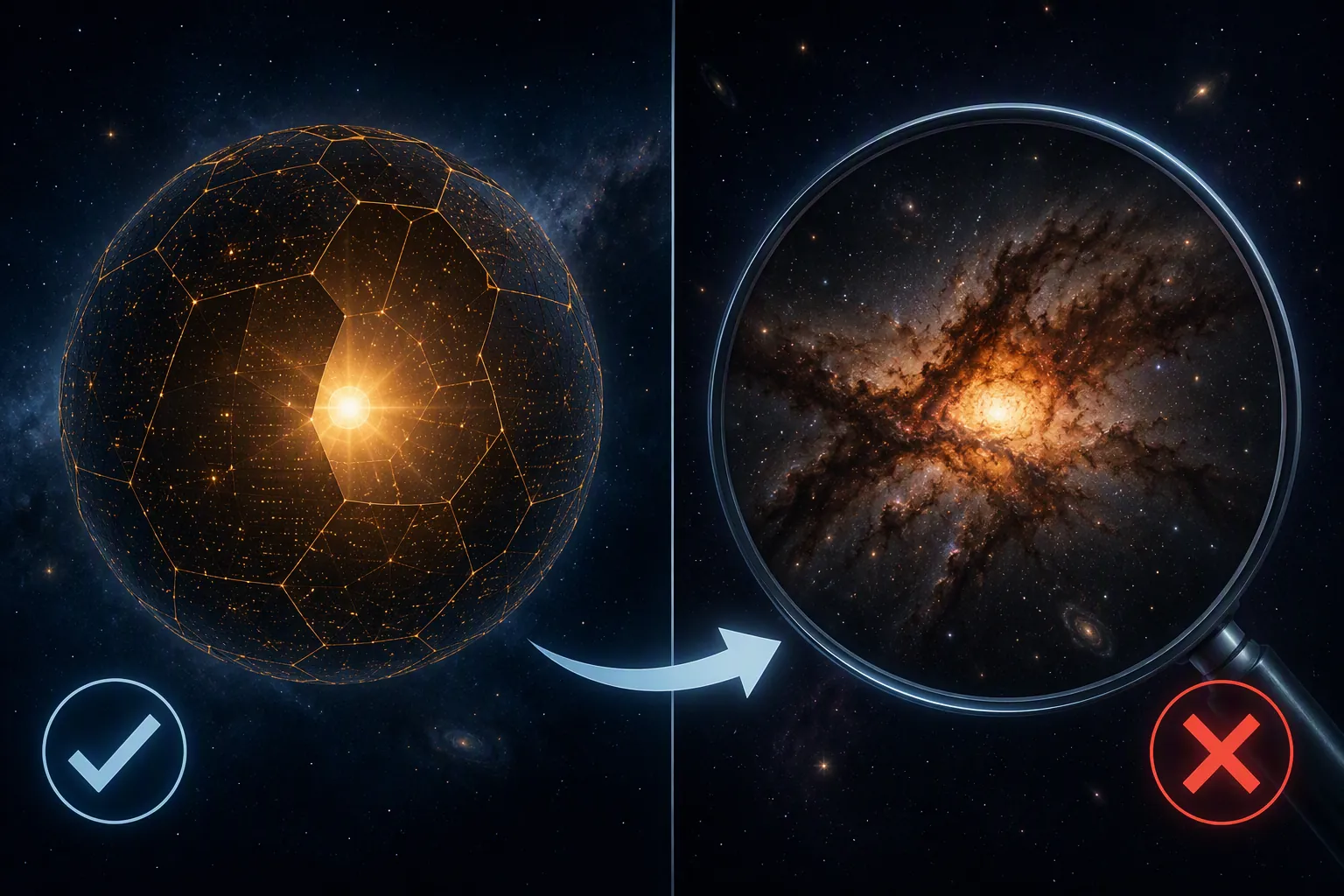
The Hot DOG detail is a beautiful wrong-answer trap. It is exotic enough to feel like confirmation of something extraordinary, but in the paper it does the opposite. It explains why the object looked strange in the first place. A strong reader does not reward the most colorful noun; a strong reader asks what job the noun performs in the argument.
Why The Blackbody Fits Matter
The study also tests whether the photometry can be fit as a single star plus a Dyson sphere-like blackbody component. The fits do not support that simple model for the observed candidates. The problem is not just that the objects are bright in the infrared; it is that their positions, wavelength-dependent flux patterns, spectra, and fitted emission behavior point away from one compact stellar system and toward blended background galaxies.[1]
IRAS upper limits also help constrain the interpretation. For the relevant candidates, the paper discusses upper limits below 0.5 Jy at 25 micrometers. In an exam passage, upper limits often appear because they restrict what an explanation is allowed to claim. They may not solve the puzzle alone, but they narrow the space in which a model can survive.[1]
| Evidence signal | What it shows | Likely question target |
|---|---|---|
| Centroid shift between filters | The apparent source position changes with wavelength, consistent with blended or multiple sources. | Which evidence most directly weakens the single-object interpretation? |
| Changing M-dwarf contribution | The star dominates one filter much more than another, while the infrared source dominates elsewhere. | Why did the candidate pass the first screen but fail the follow-up? |
| Spoon diagram classification | The spectra match galaxy categories: obscured AGN for D and starburst for E. | Which alternative explanation does the evidence support? |
| IRAS upper limits | The data restrict how bright the source can be at longer infrared wavelengths. | Why include a non-detection or upper bound? |
| Blackbody model mismatch | A simple single star plus Dyson sphere model does not fit the combined observations. | Which conclusion stays within the evidence? |
How This Becomes GRE, MCAT, And ACT Training
For GRE Verbal and MCAT CARS, the passage value lies in argument structure: preliminary claim, test, conflicting evidence, revised conclusion. For ACT Science, the value lies in reading figures and experimental logic: filters, measurements, classifications, and what each one rules out. The science content differs by exam, but the answer-choice traps are remarkably similar.
A main-idea question should reward the whole arc. The correct answer would not say that JWST disproved Dyson spheres. It would say that JWST observations of two candidates found evidence favoring background-galaxy explanations, illustrating how follow-up observations can eliminate false positives from an infrared-excess search.
An inference question should punish answers that outrun the sample. The paper examines two of the seven candidates. It rules out those two. It does not show that all seven candidates are galaxies, that all mid-infrared searches are unreliable, or that Dyson sphere searches are scientifically pointless. Those answers may feel temptingly decisive, but they are wider than the evidence.
A function question should ask why the paper spends time on false positives. The reason is not filler. False positives reveal which contaminants can survive early catalog filters. Once a background galaxy is shown to mimic the signal, future searches can refine selection methods, observation priorities, and follow-up strategies.
For a companion method on marking hypothesis, sample, method, result range, and limitation, use the Greenland shark research walkthrough. This article goes one layer deeper into answer-choice behavior: how the same evidence becomes a main-idea answer, an inference boundary, or a function clue. You can also compare this structure with the cabin air quality study-design example and the Perseverance organic carbon evidence lesson.
Simulated Questions With Answer Logic
Use these as structure drills, not astronomy drills. The goal is to practice what the passage allows you to say.
Main Idea
Question: Which statement best captures the main point of the study as presented in the passage?
- A. JWST observations confirmed that infrared-excess stars are strong evidence for Dyson spheres.
- B. JWST observations of two previously identified candidates found evidence that they are background galaxies rather than Dyson spheres.
- C. The discovery of Hot Dust-Obscured Galaxies proves that all Dyson sphere searches will produce false positives.
- D. The main purpose of the study was to describe the history of SETI and megastructure theory.
Best answer: B. It covers the full movement: prior candidates, JWST follow-up, and revised interpretation. A reverses the result. C generalizes from two cases to all searches. D mistakes the attention-grabbing premise for the paper’s actual work.
Inference
Question: Which inference is best supported by the passage?
- A. The five unobserved candidates are also background galaxies.
- B. Mid-infrared excess alone is insufficient to distinguish a Dyson sphere candidate from some background galaxies.
- C. JWST can determine the nature of every infrared-excess source without spectroscopy.
- D. Hot DOGs are the most common source of false positives in Dyson sphere searches.
Best answer: B. The two observed cases show that an object can pass a mid-infrared excess screen and later be explained by a background galaxy. A is possible but untested. C ignores the role of multiple measurements. D is too broad; the passage gives one important false-positive case, not a frequency ranking.
Function
Question: Why does the passage emphasize the changing flux contribution of the M-dwarf across filters?
- A. To show that the star becomes physically smaller at longer wavelengths.
- B. To explain how a blended background source can mimic an infrared-excess candidate in lower-resolution data.
- C. To prove that M-dwarfs cannot host planets or artificial structures.
- D. To argue that optical and near-infrared filters are more accurate than JWST/MIRI filters.
Best answer: B. The flux pattern explains the false positive mechanism. The point is not the star’s physical size, the habitability of M-dwarfs, or a ranking of instruments. It is a clue about blending.
Detail to Conclusion
Question: The centroid shift between F560W and F1500W most directly supports which conclusion?
- A. The mid-infrared emission likely does not come from a single object centered on the target star.
- B. The original catalog measurements were fabricated.
- C. The Dyson sphere hypothesis is impossible in principle.
- D. The object must be closer to Earth than the target star.
Best answer: A. A centroid shift is evidence about source location across wavelengths. It does not accuse the earlier surveys of error or fraud, and it does not settle the general existence of Dyson spheres.
The Portable Method
When a science passage gives you an exciting hypothesis, do not start by deciding whether you like it. Mark the chain:
- What was the original hypothesis or candidate explanation?
- What screen or method produced that explanation?
- What later test had better precision, a different measurement type, or a narrower target?
- Which specific evidence weakened the first interpretation?
- What revised explanation fits the evidence better?
- What conclusion would go beyond the sample?
For this study, the answers are compact: an infrared-excess search identified candidate stars; JWST/MIRI tested two of them; centroid shifts, filter-dependent flux changes, spectral classifications, IRAS upper limits, and blackbody-fit problems weakened the Dyson sphere interpretation; background galaxies explained the observations better; the other five candidates remain outside the JWST result.
That is why the study works so well as passage practice. The unexpected evidence is not noise. It is the engine of the passage. The strongest reader follows the revision, separates the evidence from the spectacle, and refuses the attractive answer that passed only the first screen.
References
- Project Hephaistos - IV. James Webb Space Telescope Observations of Two Dyson Sphere Candidates, arXiv, submitted July 10, 2026.
Related exhibits & inventory
Verified outcomes
Planners
No planner filed for this exam yet
A downloadable timeline template for this exam hasn't been published yet.
Tool verdicts
AI-tool cautions
No AI tools tested for this exam yet
No hands-on AI-accuracy logs have been filed for this exam.
Questions about this plan
Ask a question about a specific section, timeline, or citation in this plan — or flag something that needs correcting.
Comments
Join the discussion with an anonymous comment.