
MCAT Exam Hub
How Cabin Air Quality Research Builds Study Design Skills for Exams
Environmental health students can strengthen their MCAT and GRE study-design analysis skills by working through real cabin air quality improvement studies. This article explains how to use the methodology of published trials — including randomization, confounding control, and effect-size interpretation — as exam-relevant practice.
- gre
- mcat
- asvab
- sat
- act
- digital-adaptive
- official-material
- section-strategy
- test-date-timeline
The hard part of a timed science passage is rarely the vocabulary word sitting by itself. It is the moment when the passage says participants completed a randomized, double-blind, placebo-controlled, cross-over commuting protocol, then gives particle reductions, heart-rate variability, cortisol, and cognition results in the same few paragraphs. A student who knows the definition of randomization can still lose the question if they cannot tell what the design is doing.
That is why a cabin air quality improvement study for environmental health students can be better practice than another polished test-prep passage about “intervention A.” The setting is concrete: a car cabin, a filter condition, a commute, instruments measuring particles, and physiological outcomes changing during a short exposure window. The exam skill is not memorizing cabin pollution facts. It is learning to read a messy but controlled environmental health study quickly enough to answer what the design can support.

Start by Naming the Study Design
Mallach et al. give students a passage almost designed to test study-design recognition, except it is real. The Health Canada study enrolled 48 participants in a randomized, double-blind, placebo-controlled, cross-over trial conducted in Ottawa and surrounding areas. Participants completed a 90-minute commuting protocol under filtered and unfiltered cabin-air conditions, while the researchers measured in-vehicle particles and several acute physiological or cognitive outcomes.[1]
A strong reader should slow down at “cross-over.” In a parallel-group trial, one group might receive filtration and another might not. In a cross-over trial, each participant experiences more than one condition. That means each person can help serve as their own comparison, which can reduce some between-person variability. On an exam, that single design feature changes how you think about confounding: age, baseline fitness, commuting anxiety, and other stable participant characteristics are less likely to explain the difference between the filtered and unfiltered condition than they would be in a simple between-groups comparison.
It does not make the study magically immune to every problem. A cross-over design raises other questions: Was condition order randomized? Could the first exposure affect the second? Were participants and investigators kept from knowing which condition was active? The Mallach trial gives useful practice because those questions are not decorative. Randomization, blinding, placebo control, and repeated exposure conditions all matter to the interpretation.
| Passage Detail | What It Tests Under Exam Pressure |
|---|---|
| Randomized condition order | Whether exposure assignment is protected against systematic ordering bias |
| Double-blind and placebo-controlled filtration | Whether expectations about the filter could influence behavior, stress, or reporting |
| Cross-over structure | Whether participants can be compared against themselves rather than only against other people |
| 90-minute commuting protocol | Whether the outcomes are acute rather than evidence of long-term health effects |
| Ottawa and surrounding-area setting | Whether generalizability is limited by geography, climate, traffic patterns, or vehicle conditions |
The Exposure Result Is Not the Same as the Health Claim
The cleanest part of the Mallach trial is the exposure contrast. Cabin air filtration reduced in-vehicle ultrafine particles by 28% with a 95% confidence interval of 19% to 36%, PM2.5 by 30% with a 95% confidence interval of 20% to 39%, and black carbon by 32% with a 95% confidence interval of 24% to 39%.[1] Those are not vague “air quality improved” claims. They are measured reductions in specified pollutants under the study’s commuting conditions.
For exam purposes, the confidence intervals are doing more than decorating the percentages. They tell the reader that the estimated reductions are not single magic numbers. The interval around ultrafine particles, for example, still sits on the reduction side across the reported range. A question could ask which conclusion is best supported, and the disciplined answer would be that filtration reduced measured in-vehicle particle exposures during the protocol, not that it prevents chronic cardiovascular disease in commuters.
The instruments also help, as long as they do not become trivia. The study used DustTrak for PM2.5, DiSCmini for ultrafine particles, and microAeth for black carbon.[1] A good exam question could ask why using pollutant-specific instruments improves measurement validity. A poor reader might treat the instrument names as details to memorize. The better move is to ask what each measurement makes possible: separating particulate size fractions and black carbon exposure rather than collapsing everything into a generic “pollution” variable.
Then Separate Acute Associations from Broad Health Conclusions
After the exposure result, the passage gets more exam-like. Reduced exposure in the Mallach trial was associated with increased parasympathetic heart-rate variability modulation within 45 minutes of exposure.[1] That sentence contains several traps. The outcome is physiological, the timing is short, and the result is tied to an acute commuting window. It is not a direct measure of disease incidence, long-term autonomic function, or all-day cardiovascular risk.
The measurement method matters here, too. Heart-rate variability was assessed using Holter ECG.[1] In an MCAT-style passage, that may connect to autonomic regulation. In a GRE-style argument task, it may connect to whether the evidence is sufficient for a broad policy claim. Either way, the move is the same: identify the measured outcome before accepting the conclusion someone wants to draw from it.
Cortisol makes the caution even more obvious. The study reported sex-dependent cortisol responses: men showed increased cortisol in the filtered condition compared with the unfiltered condition, while women showed the opposite pattern.[1] That is exactly the kind of result students often try to force into a simple story because they expect every passage to reward a clean intervention-benefit conclusion. It should instead trigger restraint. The authors note that these unexpected effects require replication and may reflect psychological factors or baseline stress differences rather than a direct physiological mechanism.
The exam question hiding inside that cortisol finding is not “Which sex benefited?” It is more likely “Which interpretation is most justified?” or “Which limitation weakens the proposed mechanism?” The safest answer would acknowledge the interaction-like pattern without turning it into a general biological law.
Cognitive Outcomes Are Useful Because They Are Awkward
Mallach et al. also measured cognition using the CANTAB battery and reported measurable cognitive effects, including a 19% increase in multitasking switching costs per interquartile-range increase in ultrafine particles and a 5% increase in reaction latency.[1] These findings are useful for exam preparation partly because they are not the obvious endpoint students expect in an air-filtration trial.
The right response is not to dismiss the outcome because it is unusual. It is to ask whether the outcome was measured consistently, whether the effect size is practically meaningful, whether the time window matches the conclusion, and whether the result has been replicated. The study supports practice interpreting acute changes in task performance during a commute-related exposure period. It does not, by itself, establish how filtration changes academic performance, driving safety, or long-term cognitive health in daily commuters.
A Systematic Review Asks a Different Kind of Question
Once students can read a controlled trial, the next challenge is not “more of the same.” Rawat and Kumar’s systematic review shifts the evidence type. Instead of asking what happened to 48 participants under a controlled commuting protocol, the review aggregates school-based intervention evidence across more than 50 studies.[2] That makes it valuable for GRE-style reasoning because the reader has to evaluate how evidence is gathered, compared, and weakened by heterogeneity.
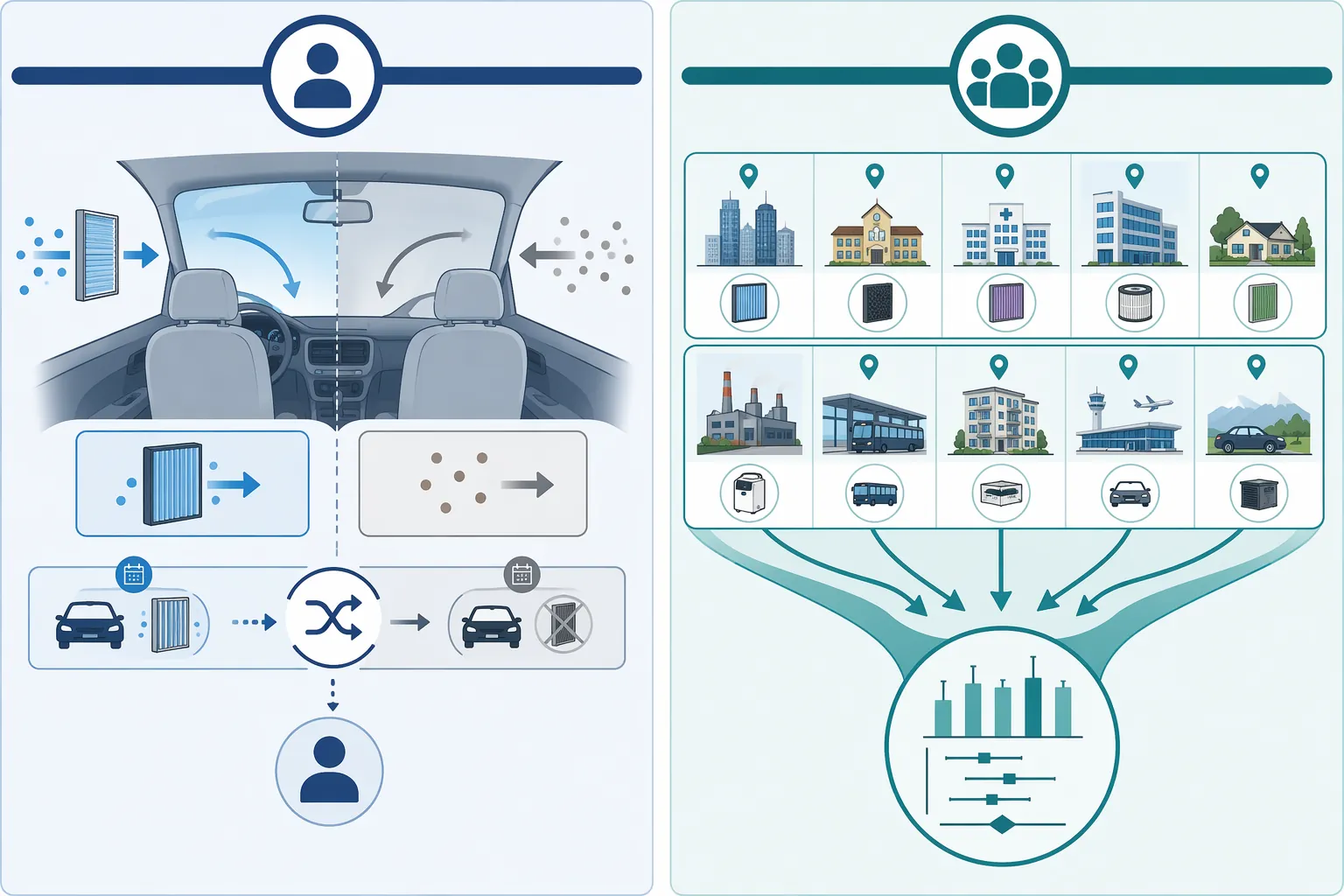
The review reports intervention-efficiency estimates that look temptingly straightforward: air purifiers removed 57% of PM2.5 with a range of 18% to 76% and 34% of PM10 with a range of 6% to 73%; HVAC systems with high-efficiency filters removed up to 97% of black carbon; green barriers reduced PM10 by up to 60%; and clean fuel policies reduced school bus in-cabin PM2.5 by up to 62% and tailpipe emissions by 94%.[2]
Those numbers are not interchangeable with the Mallach trial’s confidence intervals. A range across reviewed studies often reflects differences in setting, intervention type, baseline pollution, duration, population, measurement strategy, and implementation quality. Rawat and Kumar note high heterogeneity across the school studies, which limits how precisely a pooled or generalized effect can be stated.[2] That is not a flaw to skip over. It is the lesson.
| Evidence Type | Best-Supported Question | Main Exam Trap |
|---|---|---|
| Mallach et al. randomized cross-over trial | Did filtration reduce measured in-vehicle exposures and relate to acute physiological or cognitive outcomes under this protocol? | Overgeneralizing acute, location-specific findings into long-term health claims |
| Rawat & Kumar systematic review | What do multiple school-based intervention studies suggest across different settings and intervention types? | Treating heterogeneous ranges as if they came from one uniform experiment |
This comparison is where students can sharpen a skill that test-prep drills often flatten. A single controlled trial may have stronger internal control but narrower conditions. A systematic review may cover more settings but inherit the inconsistency of the studies it includes. Neither automatically outranks the other for every question. The design has to match the claim.
A Smaller Contrast: Within-Subjects Design and an Unusual Endpoint
Arikrishnan et al. provide a useful side example because the design and outcome differ again. In a within-subjects study with 92 participants, TVOC levels were reduced from about 1000 ppb to about 280 ppb, and the reduction was associated with an 11.5% improvement in creative potential measured with the Serious Brick Play method.[3]
This is not the article’s main load-bearing study, but it is a good practice passage for unusual endpoints. Students may be comfortable with blood pressure or pollutant concentration and less comfortable with “creative potential.” That discomfort is useful. The question is not whether the outcome sounds familiar. The question is how it was measured, whether the within-subjects comparison helps control participant differences, and how cautiously the result should be generalized.
How This Becomes an Exam Question
A real study becomes exam practice when the student stops reading for topic familiarity and starts reading for argumentative structure. In the Mallach trial, the topic is cabin filtration. The tested reasoning is design identification, variable classification, measurement validity, effect-size interpretation, and limits on inference.
- Independent variable: filtered versus unfiltered cabin-air condition.
- Exposure outcomes: ultrafine particles, PM2.5, and black carbon measured inside the vehicle.
- Physiological outcomes: heart-rate variability measured with Holter ECG and cortisol measured with Salivette swabs and ELISA.
- Cognitive outcomes: CANTAB measures such as multitasking switching costs and reaction latency.
- Validity limits: Ottawa-area setting, single 90-minute protocol, acute outcomes, and uncertain generalizability.
From there, the likely exam questions almost write themselves. If a question asks why the cross-over design matters, the answer points to within-person comparison. If it asks why blinding matters, the answer points to expectations and behavior under filtered versus placebo conditions. If it asks what conclusion is too strong, the answer is any claim that leaps from acute HRV, cortisol, or reaction-time findings to long-term commuting health.
For GRE analytical writing, the same studies train a slightly different muscle. A prompt might present a city official claiming that in-vehicle filtration will broadly improve commuter health because one controlled study reduced pollutant exposure. The critique should not say the study is useless. It should say the evidence is promising for measured short-term exposure reduction under the tested conditions, but the argument would need longer follow-up, broader settings, different vehicle types, and clearer links to health outcomes before supporting the larger claim.
What to Practice When Reading the Passage
Students do not need to memorize every instrument or pollutant range before an exam. They need a repeatable way to keep the passage from becoming a wall of methods. A useful first pass is brutally practical: identify the design, identify what changed, identify what was measured, and identify the narrowest conclusion the data support.
- Label the design before reading the results: randomized trial, cross-over trial, within-subjects study, or systematic review.
- Separate exposure outcomes from health or performance outcomes.
- Check whether the comparison is between people, within the same people, or across heterogeneous studies.
- Treat confidence intervals, ranges, and subgroup patterns as evidence about uncertainty, not as extra decoration.
- Write the conclusion at the same scale as the design: acute, local, measured, and conditional when the study is acute, local, measured, and conditional.
The final step is to notice when the passage gives you a result that resists a tidy answer. Sex-dependent cortisol findings, heterogeneous review ranges, and creative-potential outcomes are not distractions from exam reasoning. They are where the reasoning happens. A student who can stay calm there is doing more than learning about cabin air; they are learning how scientific evidence behaves when it is no longer simplified for them.
Real cabin air quality studies do not replace official MCAT, GRE, or licensing-exam preparation. They make a sharper supplement for students who already know the vocabulary but need practice turning dense environmental health methods into transferable decisions: what kind of study is this, what changed, what was measured, what can be inferred, and where does the claim go too far.
References
- Mallach et al. 2023, Health Canada, 2023.
- Rawat & Kumar 2023, Science of the Total Environment, 2023.
- Arikrishnan et al. 2023, Scientific Reports, 2023.
Related exhibits & inventory
Verified outcomes
Planners
No planner filed for this exam yet
A downloadable timeline template for this exam hasn't been published yet.
Tool verdicts
Questions about this plan
Ask a question about a specific section, timeline, or citation in this plan — or flag something that needs correcting.
Comments
Join the discussion with an anonymous comment.