
GRE, MCAT, ASVAB, SAT, ACT Exam Hub
Willpower for Studying Is a System, Not a Muscle
The muscle-training story behind most willpower advice is only half-supported: the ego-depletion effect that anchors it failed a 23-lab replication. The evidence that holds up — routines, situational strategies, and if-then plans — points to building a study system rather than gritting harder, and maps directly onto a fixed exam timeline.
- gre
- mcat
- asvab
- sat
- act
- digital-adaptive
- official-material
- section-strategy
- test-date-timeline
Most advice on how to build willpower for studying starts with the same picture: willpower is a muscle. Use it, tire it out, train it, strengthen it. The story became persuasive because it matched a familiar student day. You resist your phone in the morning, sit through class, make decisions all afternoon, and by evening the practice test looks impossible. Early ego-depletion studies seemed to give that feeling a clean explanation. In one classic setup, people who had resisted cookies and eaten radishes persisted for roughly 8 minutes on an unsolvable puzzle, while those allowed to eat cookies persisted for about 19 minutes.[1]
For test prep, that explanation sounds almost too useful. If willpower gets drained, then a bad study night is not a mystery. You used up the tank. If willpower can be trained, then the solution is obvious too: practice resisting things until the tank gets bigger.
The problem is that a fixed exam date does not leave much room for a comforting theory that only half-survives the evidence. If your GRE, MCAT, ASVAB, SAT, or ACT date is already on the calendar, the practical question is narrower: what actually makes studying happen on ordinary days and bad ones?

The muscle story got weaker where students needed it to be strongest
The key break in the old story came from a large preregistered multilab replication published in 2016. Across 23 labs and 2,141 participants, the ego-depletion effect was essentially absent: d = 0.04, with a 95% confidence interval from −0.07 to 0.15.[2] That does not prove students have infinite self-control. It does mean the clean “use willpower, drain willpower, fail later” account should not be treated as a dependable foundation for study advice.
The training version is also modest. A 2017 meta-analysis of 33 self-control training studies found a small overall effect, g = 0.30, and after bias correction that estimate dropped into the 0.13 to 0.24 range.[3] That is not nothing. It is also not a strong reason for an exam student to spend the next month doing generic self-control drills and hoping the benefit transfers cleanly to timed reading passages, math sets, vocabulary review, or chemistry practice.
This is where a lot of popular advice goes stale. It keeps repeating the muscle metaphor because the metaphor is simple, not because it tells you what to do at 7:45 p.m. when your notebook is closed, your phone is open, and your next task is vague. A student in that situation does not need to be told to have a stronger character. They need fewer decisions between “I should study” and the first real question on the page.
What the better-supported answer looks like
The useful answer to “how to build willpower for studying” is not to imagine a bigger inner reservoir. It is to build a study system that asks less of in-the-moment resistance. The strongest pieces are routines, situational strategies, and if-then plans. Temptation bundling can help in selected cases, but it deserves a smaller, more cautious role.
| Lever | What it changes | Evidence label | Best use in exam prep |
|---|---|---|---|
| Routine | Turns studying into a repeated cue-action pattern | Strong practical fit: high self-control students were more likely to do the same thing in the same place at the same time across six experiments.[4] | Daily or near-daily study blocks, review sessions, practice-set starts |
| Situational strategy | Changes the environment before temptation is active | Supported as a self-control framework: select, modify, or avoid situations instead of relying only on resistance.[5] | Phone placement, study location, app blockers, desk setup, leaving the house |
| If-then plan | Links a predictable obstacle to a specific response | Implementation intentions showed d = .65 across 94 studies in a major review.[6] | Bad weeks, fatigue, schedule disruptions, missed sessions |
| Temptation bundling | Pairs a desired activity with a less desired but valuable one | Promising but uneven: an early field study found a large effect that decayed, while a larger later experiment found smaller effects.[7][8] | Low-cognitive review, flashcards, warm-up tasks, not deep work that needs full attention |
Start with the exam date, not with your mood
A student with a real test date should not begin by asking, “How motivated can I become?” Start with the date, then work backward. The exam decides the calendar pressure. The diagnostic or first practice test decides the weak areas. The remaining weeks decide how often studying must happen. Only after that does willpower enter the picture, and by then its job should be smaller.
A useful exam plan has three layers: the total work required, the weekly distribution, and the default study session. The last layer is where many students lose the day. They may have a reasonable calendar and still fail at the first step because the session begins with a decision pile: What should I study? Where is the book? Which app has the questions? Should I review notes or do practice? Is this even the right thing?
That pile feels like lack of discipline from the inside. From the outside, it often looks like missing setup. If you need a plan-first architecture, anchor the calendar to the test date before you try to fix your personality. The same logic shows up in a test-date-centered study plan and in fixed-window examples such as a 12-week MCAT study plan: consistency is easier to judge when the deadline is doing the organizing.
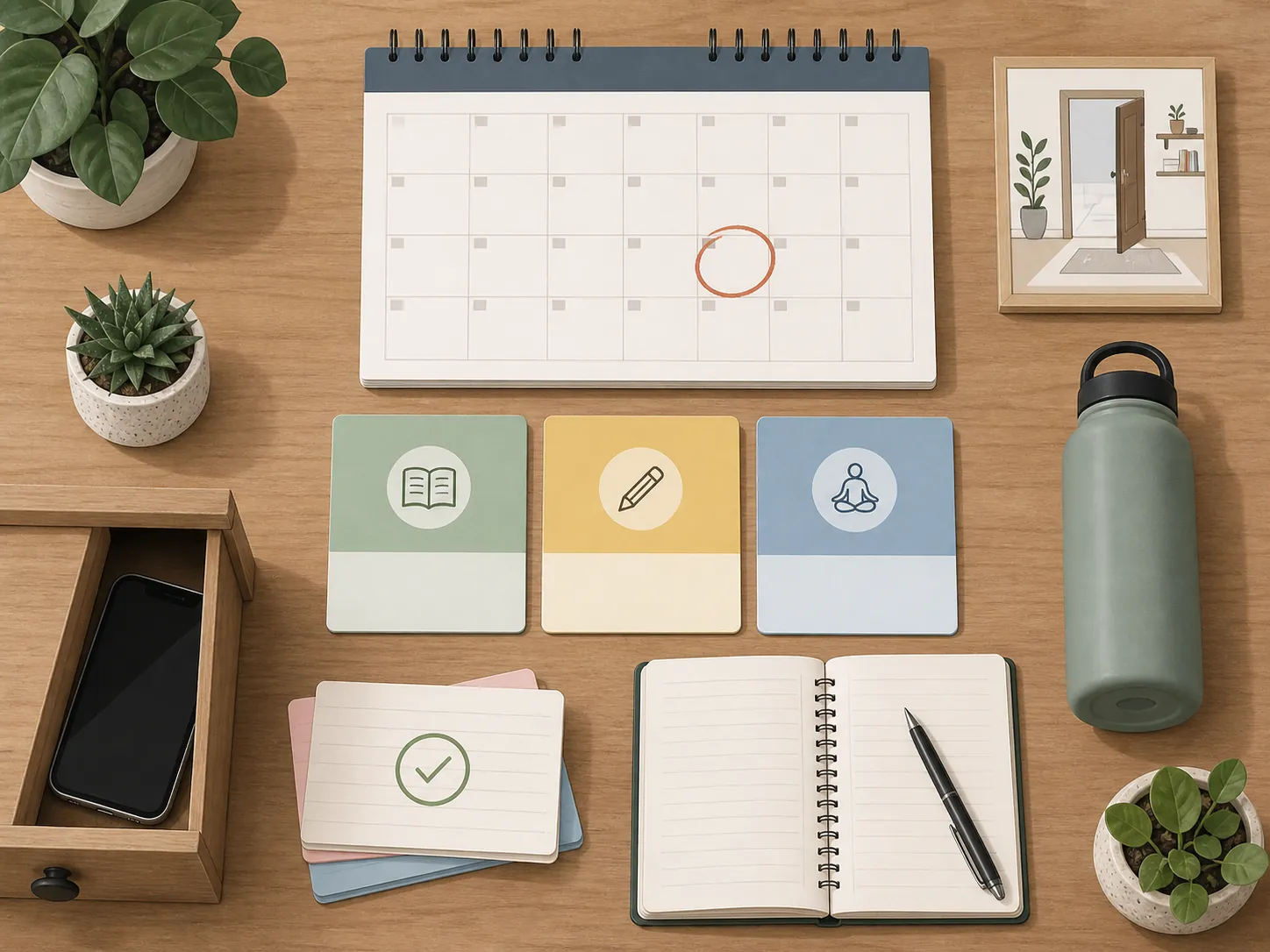
Routine is the main tool because it removes the first negotiation
Routines deserve the most attention because they solve the most common study failure: the session never starts. Galla and Duckworth’s work is useful here because it does not romanticize heroic resistance. Across six experiments, students with higher self-control were more likely to have routines: they did the same thing in the same place at the same time, rather than constantly fighting temptation in the moment.[4]
For studying, a routine is not “I will work hard every night.” That is a hope wearing a planner cover. A routine specifies the cue, the place, the first action, and the stopping rule. It should be boring enough that you can do it while mildly annoyed.
- Cue: after dinner, after school, after work, after the commute, or after a set alarm.
- Place: one default location, not a fresh debate each day.
- First action: open the exact question set, flashcard deck, passage, formula sheet, or error log.
- Stopping rule: finish the assigned block, review missed items, and write the next starting point.
The first action matters more than students expect. “Study biology” is too wide. “Open the last missed-question log and redo the starred enzyme questions” is narrow enough to start. “Work on math” invites bargaining. “Complete the next mixed set and mark every guessed answer” gives the session a door handle.
There should also be a bad-day version. Not because bad days are noble, and not because every day must become productive. The point is to keep the routine from becoming all-or-nothing. A full session might include practice, review, and error logging. A reduced session might be opening the notebook, correcting a small set of missed problems, and writing tomorrow’s first task. A minimum session might be reviewing a short deck or organizing the next practice block. The reduced version protects the study rhythm without pretending that a rough Tuesday is the same as a free Saturday.
If mental health or energy swings are part of the pattern, the routine needs tiers rather than guilt. A deeper walkthrough of that approach is in building a study routine that survives bad mental health days. The important move is the same: decide the fallback before you need it.
Change the room before the room starts arguing with you
Situational strategies are the unglamorous part of self-control, which is why they are often better than slogans. Duckworth, Gendler, and Gross describe self-control strategies that work by selecting or modifying situations, directing attention, changing appraisals, or managing responses.[5] For studying, the first two are often the cleanest: choose the study situation, then alter it so the desired action is closer and the distraction is farther away.
The phone is the obvious example because it turns “study” into dozens of tiny refusals. If it sits beside the notebook, every notification, lock-screen glance, and reflexive pickup becomes another self-control event. Moving it to another room, putting it in a drawer, using an app blocker, or studying somewhere that makes scrolling awkward does not make you a better person. It makes the next bad choice less available.
If phone proximity is the recurring failure point, it is worth treating that as a design problem rather than a moral diagnosis. The behavioral checklist in screen time, focus, and grades is a better companion to exam prep than another promise to “be stronger tomorrow.”
Environment design can be small. Put the book open before dinner. Leave the practice test printed or bookmarked. Keep scratch paper, calculator, charger, water, and answer explanations in the same place. Make the first five minutes require no searching. If the home desk keeps failing, the better strategy may be a library, empty classroom, café, or kitchen table at a predictable hour. The winning environment is not the prettiest one; it is the one where the first study action happens with the least negotiation.
If-then plans are for obstacles you can already predict
Implementation intentions are simple enough to sound unimpressive: if situation X occurs, then I will do response Y. The evidence is stronger than the phrasing. Gollwitzer and Sheeran’s review reported an effect size of d = .65 across 94 studies.[6] The value is that the plan moves a decision out of the hot moment. You are not trying to invent a response while tired, irritated, late, or tempted.
For test prep, the best if-then plans are not motivational. They are mechanical. They name the predictable failure point and the next physical action.
- If I miss my normal study block, then I will do the reduced block before bed and write the next full session on tomorrow’s plan.
- If I sit down and do not know what to study, then I will open the error log and redo the oldest missed items first.
- If I reach for my phone during a practice set, then I will put it outside the room until the set is reviewed.
- If I score badly on a practice block, then I will mark the question type, write the reason for each miss, and stop myself from changing the whole plan that night.
- If a work shift, family obligation, or commute disrupts the usual time, then I will use the backup location and the smallest preassigned task.
The plans should be written before the week starts. A vague obstacle like “I might get busy” is too foggy. A real obstacle sounds like “I get home late on Wednesdays,” “I scroll after dinner,” “I avoid reviewing wrong answers,” or “I panic after a low practice score.” The more familiar the failure mode, the less shameful it needs to be. Predictable problems should get procedures.
Temptation bundling can help, but do not let it dilute the work
Temptation bundling pairs something you want with something you tend to avoid. The classic example is allowing an enjoyable audiobook only at the gym. The evidence is interesting but not as stable as a listicle headline would make it sound. In an early field study, temptation bundling produced a 51% increase in gym visits during the intervention, but the effect decayed after the intervention ended.[7] A larger later experiment with 6,792 participants found smaller effects, in the 10% to 14% range, that persisted up to 17 weeks.[8]
For studying, that means bundling is worth using only where the reward does not compete with the task. A favorite drink with flashcards is plausible. A specific playlist for copying formulas or organizing notes may be fine if lyrics do not interfere. A café pastry tied to Saturday review can work if the café does not become the main event. A TV show beside dense reading passages is not temptation bundling; it is divided attention with better branding.
Use bundling for friction, not for comprehension. It can help you arrive at the desk, begin a warm-up, or repeat a dull review task. It should not be asked to carry a full practice exam or a difficult reasoning set.
What to stop counting as a study plan
Some common advice is harmless in a greeting-card way and weak as an exam system. “Stay positive” may make the page feel nicer. It does not tell you what to do when you miss two days. “Just be disciplined” names the desired outcome, then leaves you alone with the same setup that failed last week. “Push through” may work occasionally, especially near a deadline, but it is too expensive to be the daily operating model.
Rest, exercise, food, and stress management matter, but they are not magic replacements for task design. A well-rested student can still avoid a vague plan. A tired student may still complete a reduced routine if the next action is obvious. The point is not to deny effort. It is to stop making effort compensate for every missing cue, every bad environment, every undefined task, and every predictable interruption.
Self-control still matters for academic outcomes. Duckworth and Seligman’s work with eighth-grade students found that self-discipline outpredicted IQ for academic performance.[9] But that finding should not be flattened into “try harder tonight.” One reason disciplined students succeed is that they are more likely to have structures that make the right behavior repeatable.
Build the system around the week you actually have
A fixed-date study system does not need to be elaborate. It needs to answer the questions that usually get dumped onto willpower at the worst possible moment.
| Question | System answer |
|---|---|
| When do I study? | Use a repeated cue tied to the weekly calendar, with a backup block for predictable disruptions. |
| Where do I study? | Choose one default location and one backup location; remove or distance the main distraction before starting. |
| What do I do first? | Write the first task at the end of the previous session, so the next session begins with action instead of planning. |
| What happens on a bad day? | Use a reduced routine that preserves contact with the material without pretending the day is normal. |
| What happens when I fail? | Run the if-then plan, update the setup, and return to the next scheduled block instead of rewriting your identity. |
This is less dramatic than the muscle story, but it is kinder to the student who has to study after work, after school, after a bad score, or after a week that did not cooperate. The goal is not to feel powerful every time you sit down. It is to make the first useful action easier to take than the first avoidant one.
So if the question is how to build willpower for studying, the best answer is: stop trying to build a reservoir you can spend later. Build routines that start without a debate. Build environments that remove the obvious traps. Build if-then plans for the problems your week keeps repeating. Use small rewards where they help and keep them away from work that needs full attention. With an exam date on the calendar, that system is a better bet than gritting harder and calling the next failed evening a character flaw.
References
- What you need to know about willpower: The psychological science of self-control — APA
- A multilab preregistered replication of the ego-depletion effect — Hagger et al. — 2016
- Does Self-Control Training Improve Self-Control? A Meta-Analysis — PubMed — 2017
- Harnessing willpower to meet educational goals — APA
- Situational Strategies for Self-Control — PubMed — 2016
- Implementation Intentions — National Cancer Institute
- An Evaluation of Temptation Bundling — NBER — 2014
- Teaching temptation bundling to boost exercise: A field experiment — IDEAS/RePEc — 2020
- Self-Control May Lie at the Heart of Student Success — APS Observer
Related exhibits & inventory
Verified outcomes
No verified outcomes on file for this exam yet
See Methodology for how outcome evidence is disclosed once logged.
Planners
No planner filed for this exam yet
A downloadable timeline template for this exam hasn't been published yet.
Tool verdicts
AI-tool cautions
No AI tools tested for this exam yet
No hands-on AI-accuracy logs have been filed for this exam.
Questions about this plan
Ask a question about a specific section, timeline, or citation in this plan — or flag something that needs correcting.
Comments
Join the discussion with an anonymous comment.