
SAT Exam Hub
Does Screen Time Actually Hurt Student Focus and Grades?
The evidence on screen time and grades is weaker and more behavior-specific than viral prep-forum posts suggest. Each claim is scored by study design, sample, and effect size — from small real effects of media multitasking and phone proximity to null results for total screen hours — giving test-takers a behavioral checklist, not a panic-driven screen budget.
- gre
- mcat
- asvab
- sat
- act
- digital-adaptive
- official-material
- section-strategy
- test-date-timeline
The short answer is that total screen time is a weak and inconsistent predictor of student grades. The more useful risks are narrower: watching or gaming passively, switching between media while studying, keeping a phone within reach, using the internet to replace retrieval, and allowing screens to displace sleep. Those behaviors can damage a practice session even when a daily screen-time total looks reasonable.
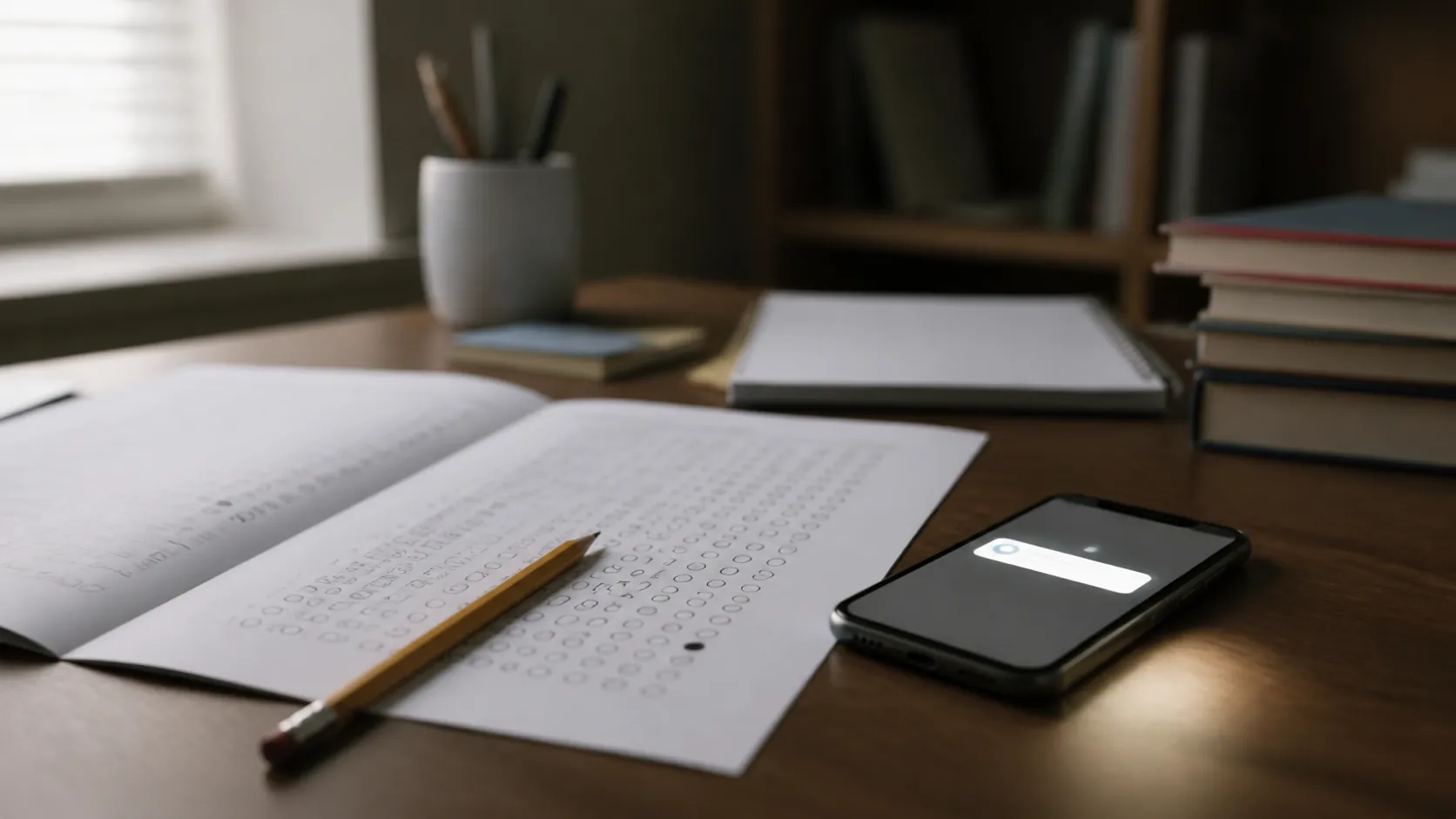
That distinction matters in the final month before the SAT, ACT, GRE, MCAT, or ASVAB. A student does not need a moral verdict on phones. They need to know which change is most likely to protect the next timed practice block and whether the evidence is strong enough to justify making it.
The Evidence at a Glance
The research does not support turning an arbitrary number of daily screen hours into a universal grade prediction. It does support treating particular study conditions as potential performance problems.
| Claim | What the study measured | Evidence label |
|---|---|---|
| More total screen media time predicts lower grades | A 2019 meta-analysis of 58 cross-sectional studies and 480,479 participants aged 4–18 found no significant overall association between total screen media time and academic performance. | High confidence that the blanket claim is unsupported |
| Television viewing and video games are associated with weaker academic performance | The same meta-analysis found negative associations for television viewing, with effect sizes from −0.19 to −0.25, and video games, with an effect size of −0.15 for composite academic performance. | Moderate confidence; associations are not proof of cause |
| Each extra screen hour causes a fixed loss in grades | A 2025 prospective cohort of Ontario elementary-school children found 9–10% lower odds of reaching a higher achievement level for each additional daily hour, depending on grade and subject. | Moderate confidence for that child cohort; limited transfer to teenagers |
| A nearby phone can reduce available attention | In a study of about 800 participants, people whose phones were in another room outperformed those whose phones were on the desk, even when the phones were silent or switched off. | Moderate confidence for a proximity effect |
| Phone surrender improves learning during class | A quasi-experiment across four college classes found that surrendering phones increased course comprehension, with d = 0.56. | Moderate confidence; small college quasi-experiment |
| School phone bans reliably raise test scores | Studies report different results: an England analysis found gains, while a 2026 national lockable-pouch study found average effects close to zero. | Limited confidence; evidence is contested |
| Looking up homework answers predicts weaker exam performance | A Rutgers study of 2,433 students in 11 lecture courses linked internet answer-sourcing with a half- to full-letter lower exam grade. | Moderate confidence for answer substitution, not screen time |
The strongest broad counterweight is the 2019 JAMA Pediatrics meta-analysis. It combined 58 cross-sectional studies involving 480,479 participants aged 4 to 18 and found that television viewing and video games were negatively associated with academic performance, but total screen media time was not significantly associated with performance overall. The reported associations were modest: effect sizes ranged from −0.19 to −0.25 for television viewing and were −0.15 for video games on composite academic performance.[1]
That null result is not evidence that every use of a screen is harmless. It means the single variable “hours on screens” combines activities with different demands and consequences. A digital flashcard session, a streamed lecture, a game, background television, and an interrupted practice test all count toward the same total while creating very different study conditions.
Why the Age Group Changes the Answer
A newer longitudinal study gives the concern more substance without turning it into a teenage rule. Li and colleagues followed children in Ontario and analyzed standardized achievement-test outcomes for approximately 3,322 grade 3 students and 2,084 grade 6 students. Each additional daily hour of screen time was associated with 9–10% lower odds of reaching a higher achievement level in grade 3 reading and mathematics and grade 6 mathematics.[2]
The important qualifications are built into that finding. Screen exposure was measured when the children were roughly 5.5 to 7.5 years old, and the result describes odds of reaching an achievement level, not a fixed percentage loss in grades. It is also an association, not a randomized demonstration that removing one hour would produce a defined score increase. The study earns a Moderate label for its design and outcome, but the number should not be transferred to a teenager preparing for the SAT or ACT, or to a college student preparing for the GRE or MCAT.
Other findings make an hourly threshold look even less defensible. An eight-year Finnish cohort of 260 teenagers reported that more childhood screen time was associated with better adolescent cognitive processing. The authors cautioned that the result was associative rather than causal.[3] This does not overturn the studies linking specific media behaviors with weaker performance. It does show why “every additional hour harms attention” is too broad a summary of the literature.
The Study-Session Mechanism Is More Actionable
For exam preparation, the clearest intervention is often not reducing entertainment across the entire day. It is removing interruption from the period when a student must encode, retrieve, and review information.
Ward and colleagues studied about 800 participants and found that participants with their phones in another room performed better on cognitive tasks than participants with phones on the desk. The difference remained even when the phone was silent or switched off.[4] The study does not establish a universal score penalty for every phone on every desk. It does provide a plausible, testable mechanism: part of the student's attention may remain available for the possibility of checking the device.

A classroom quasi-experiment points in the same direction. Huey and Giguere studied 106 students across four college classes. Students who surrendered their phones at the front of the room showed higher course comprehension, with d = 0.56, as well as lower in-class anxiety and higher mindfulness.[5] This is not a study of SAT or MCAT scores, and it is not a measure of total daily screen time. It is evidence that changing phone access during instruction can affect the quality of attention in that setting.
The practical translation is straightforward: a timed practice section should be treated as a single-application task. Put the phone outside the room when possible. Otherwise use focus mode or do-not-disturb, close unrelated tabs, and keep the session long enough to produce a meaningful block of retrieval practice. A digital setup is useful when it removes friction; it becomes counterproductive when the same device is also the notification center, answer key, messaging app, and entertainment feed.
Answer Lookup Is Not the Same as Screen Time
One of the most commonly misclassified findings concerns internet answer-sourcing. In a Rutgers study of 2,433 students across 11 lecture courses from 2008 to 2017, students who sourced homework answers from the internet were associated with exam grades that were a half to a full letter lower. The share of students scoring lower on exams than on homework also rose from 14% in 2008 to 55% in 2017.[6]
Those results concern answer substitution and homework integrity, not the number of hours spent looking at a screen. A student who uses a digital question bank, checks an explanation after committing to an answer, and records the error is doing a different activity from a student who searches for an answer before attempting the problem. Both may occupy the same number of screen minutes.
Phone Bans Have Not Settled the Grade Question
School phone bans are useful evidence about access, but they do not produce one clean answer about achievement. Beland and Murphy's England difference-in-differences analysis reported that bans raised 16-year-olds' scores by 6.4% of a standard deviation, approximately equivalent to five school days, with effects twice as large for low achievers.[7]
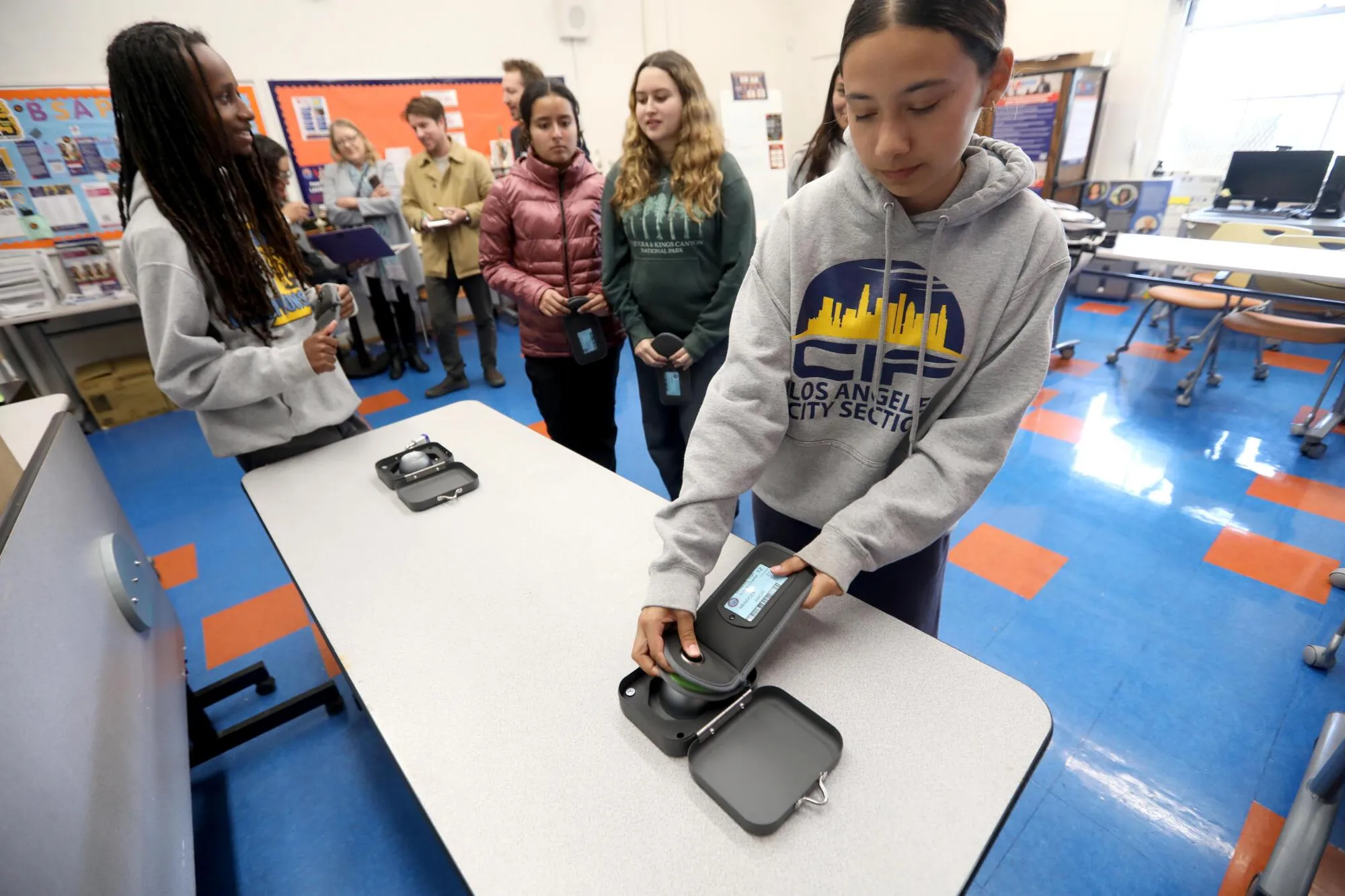
A 2026 National Bureau of Economic Research working paper examining lockable Yondr pouches found a different pattern: average test-score effects were consistently close to zero, with modest positive effects in high schools, especially in mathematics, and small negative effects in middle schools.[8] The University of Michigan Youth Policy Lab analysis also cautions against treating cellphone bans as a settled academic-achievement intervention.[9]
The responsible conclusion is limited. Removing phones can change classroom access and may improve attention in some contexts, but a ban is not interchangeable with a guaranteed grade increase. Differences in enforcement, school age, baseline phone use, teaching conditions, and study design can all affect the result. For an individual test-taker, the evidence is strong enough to justify trying a phone-free practice block and too weak to justify a universal policy sermon.
What to Change Before the Exam
The American Academy of Pediatrics' evidence-aligned guidance points toward controllable conditions: use do-not-disturb or focus modes during study, work in timed blocks with short breaks, and keep screens out of the bedtime routine.[10] These steps do not require claiming that screens are inherently damaging. They address the points at which screen use can interrupt practice, replace retrieval, or reduce sleep.
- Put the phone outside the room during timed practice, full-length tests, and focused review.
- Turn on focus mode or do-not-disturb before opening a digital question bank or practice platform.
- Use one study application at a time; separate the question interface from messaging, social feeds, and entertainment.
- Attempt homework and practice questions before searching for explanations or answers.
- Keep screens out of the bedtime routine when sleep is part of the score plan.
- Review the effect by checking completed practice, error patterns, and sleep rather than by chasing a universal daily screen-hour limit.
For a targeted plan, connect these conditions to the exam rather than treating them as a separate technology project. The SAT score-gap method and guides to SAT practice questions or Bluebook mistakes can help identify where digital practice is costing points. The same principle applies to a 12-week MCAT plan or an ASVAB subtest-priority plan: protect the work that produces score information, then adjust the condition that is interfering with it.
References
- Screen Time and Academic Performance: A Meta-Analysis of Studies on Children and Adolescents — JAMA Pediatrics, 2019
- Screen Time and Standardized Academic Achievement Tests in Elementary School — JAMA Network Open, October 2025
- Finnish PANIC study report on childhood screen time and adolescent cognitive processing — ScienceDaily, August 2026
- Brain Drain: The Mere Presence of One's Own Smartphone Reduces Available Cognitive Capacity — Journal of the Association for Consumer Research, 2017
- The Effects of Cell Phone Use on Student Learning and Classroom Engagement — Innovative Higher Education, 2022
- Smartphones Are Lowering Students' Grades, Study Finds — Rutgers University
- Banning mobile phones in schools can improve students' academic performance. This is how we know — The Conversation
- The Effects of School Phone Bans: National Evidence from Lockable Pouches — National Bureau of Economic Research, 2026
- Do Student Cellphone Bans Improve Academic Achievement? — University of Michigan Youth Policy Lab, 2026
- Effects of Screen Time on Academic Performance and Mental Health — American Academy of Pediatrics Center of Excellence
Related exhibits & inventory
Verified outcomes
No verified outcomes on file for this exam yet
See Methodology for how outcome evidence is disclosed once logged.
Planners
No planner filed for this exam yet
A downloadable timeline template for this exam hasn't been published yet.
Tool verdicts
AI-tool cautions
No AI tools tested for this exam yet
No hands-on AI-accuracy logs have been filed for this exam.
Questions about this plan
Ask a question about a specific section, timeline, or citation in this plan — or flag something that needs correcting.
Comments
Join the discussion with an anonymous comment.