
Comparison
Flash Flood Preparation Tips Every College Student Needs
College students face unique challenges during flash floods, from dorm living to protecting coursework. This guide provides a student-tailored plan covering before, during, and after a flood, including a dorm-friendly emergency kit under $50.
Verdict panel
- Compared
- not specified
- Target exam
- not specified
- Best for
- not specified
- Pricing last reviewed
- pricing currency unconfirmed
Most flash flood preparation tips sound like they were written for someone with a garage, a basement, a car trunk, and a utility closet. That is not how college life works. A student may have one shelf, half a mini-fridge, a backpack, a laptop that holds a semester of work, and a roommate who is also trying to figure out whether the campus alert is serious.
That mismatch matters because flash floods are not a slow household inconvenience. In the U.S., floods caused 145 deaths in 2024, above the 30-year average of 127, and flash floods are described as the nation’s top storm-related cause of death by the National Weather Service data cited by PBS NewsHour.[1] In July 2025, Texas flash floods killed more than 100 people, and NPR reported water rising 26 feet in 45 minutes in one area — the kind of speed that leaves no room for “I’ll check later.”[2]
So the useful version of flash flood preparation tips for students is not “buy a giant survival kit.” It is a small system: know whether your dorm or apartment sits in a flood-prone area, get alerts you will actually notice, keep your phone alive, protect the documents and coursework you cannot quickly replace, and know what to do in the four places students actually get stuck — dorms, classrooms, cars, and the walk between buildings.
If you want a shorter overview first, start with How to Prepare for Flash Flooding as a Student. This guide goes deeper: before, during, and after, with dorm and rental constraints treated as the starting point rather than an afterthought.

Start With The Places You Actually Use
A student flood plan should begin with locations, not gear. Write down the places where a flash flood could catch you on a normal week: your dorm or apartment, the building where you have your longest class or lab, the library or studio where you stay late, the parking lot, the bus stop, and the lowest walking route you use when it rains.
Then check risk before the storm exists. Use FEMA’s flood risk tools or your local emergency management site to see whether your residence and usual routes are near mapped flood zones, streams, drainage channels, low-water crossings, or underpasses. This does not predict every flash flood; heavy rain can overwhelm streets outside mapped flood zones. It does tell you which routes deserve suspicion before you are tired, late, and trying to make a quick decision.
For campus systems, do three boring things once: enroll in campus emergency alerts, confirm your phone number and email are current, and turn on weather emergency alerts on your phone. Ready.gov’s campus guidance emphasizes that students, faculty, and staff should know how they will receive emergency information and what plans apply where they live and study.[3] The best alert is the one that reaches you when your phone is on silent in a lecture hall or charging across the room.
If you live off campus, add your city or county alerts too. Campus alerts may cover university property well and still say very little about the road between your apartment and campus. A commuter should treat city alerts as part of the school day, not as separate adult paperwork to deal with later.
Make A Tiny Communication Plan Before Everyone Panics
A communication plan does not need to be elaborate. It needs to answer one question: if cell service is spotty, your roommate is gone, and your parent is calling repeatedly, who is the single person everyone checks in with?
- Pick one out-of-state contact who is less likely to be affected by the same storm.
- Text that person your dorm or apartment address, roommate name if appropriate, and campus emergency contact number.
- Agree on a short check-in message such as “safe in library” or “leaving by north route.”
- Share the plan with your roommate, partner, or closest campus friend.
- Save the contact offline on paper inside your kit, because a dead phone turns a memorized number into a luxury.
This is especially important for first-year students and graduate students who moved far from home. Parents may not know the campus geography. Roommates may not know your family. Professors may only see that you missed class. A simple contact chain keeps the first hour from becoming twelve separate people making twelve separate guesses.
Protect The Semester, Not Just The Snacks
A flooded laptop is not just a damaged device. For many students it is the only copy of a thesis chapter, lab data notes, financial aid forms, internship materials, immigration documents, or the group project no one else has organized. Saint Leo University’s student emergency checklist includes backing up important documents and saving academic work so a device problem does not become an academic crisis.[4]
Set up automatic cloud backup for the folders that actually matter: current papers, lab notes, lecture notes, application materials, scanned IDs, insurance information, and financial aid documents. If your school provides cloud storage, use it. If you already use a personal account, check that files are syncing rather than only sitting on your desktop. The test is simple: open your files from your phone or another computer. If you cannot reach them there, they are not really backed up.
For paper documents, you do not need a filing cabinet. Use one zip-top bag or slim folder for copies of your student ID, driver’s license or state ID, health insurance card, renters insurance information if you have it, lease or housing contact information, medication list, and emergency contacts. Cal OES recommends college students include copies of identification and insurance, cash, a contact list, hygiene products, medicine, a phone charger, a flashlight, and first-aid supplies in a go-bag.[5]
Put that folder where you would grab it during a fire drill: backpack pocket, kit bin, or desk drawer near the door. Not under three storage tubs. Not behind the laundry basket you only move when life is already going badly.
Build The Under-$50 Dorm Kit That Will Actually Fit
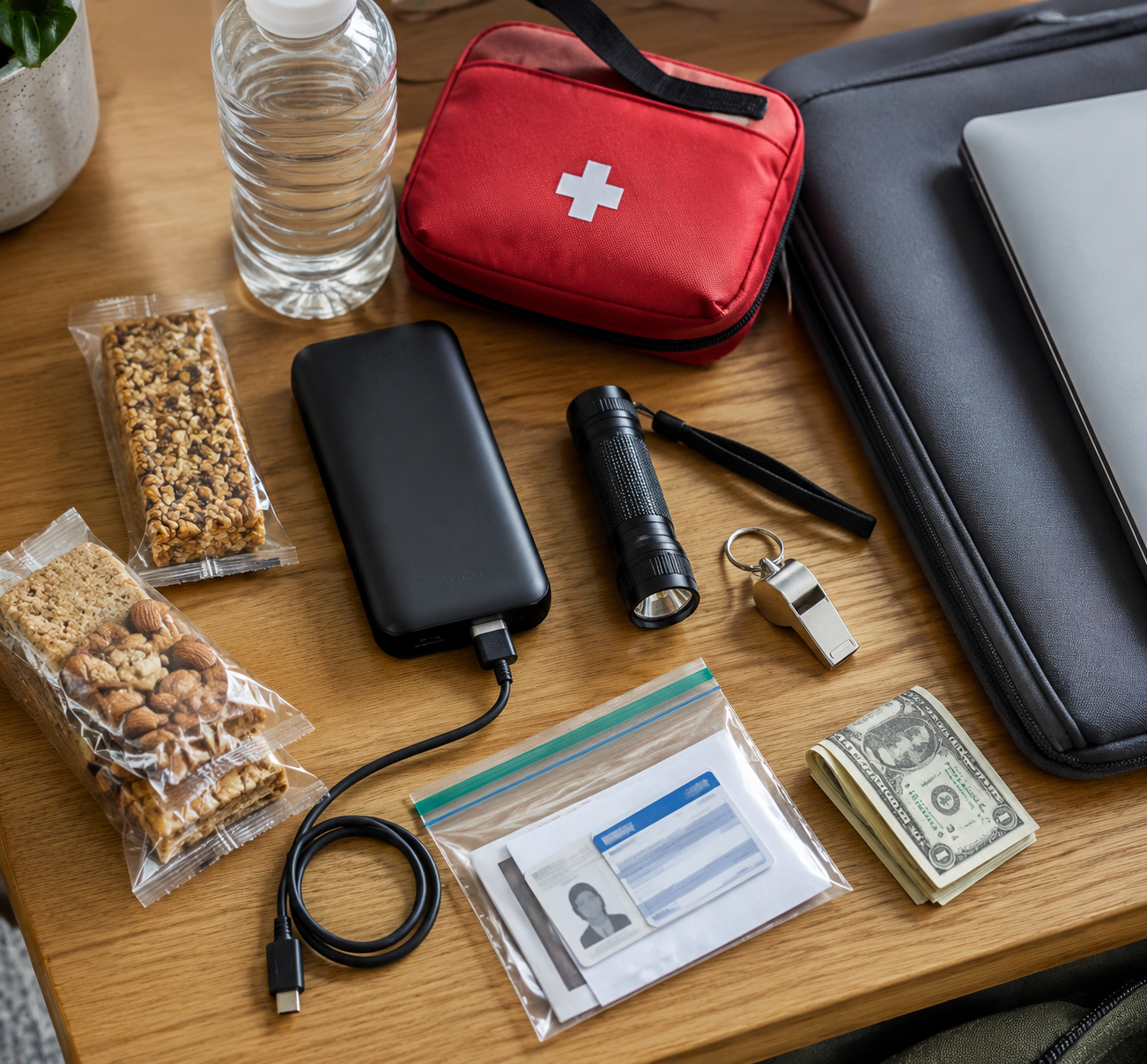
A student kit has to survive contact with reality: shared rooms, no spare closet, limited money, and no desire to explain a bunker-sized container to a roommate. Syracuse University’s emergency dorm kit list includes practical items such as a flashlight, extra batteries, whistle, first-aid kit, cash, prescription medications, non-perishable food, water, and a change of clothes.[6] That is the right scale.
Aim for one backpack or one small clear plastic bin. If you can only spend a little at a time, buy the phone-related items first. The Survival Mom’s college emergency kit breakdown notes that a portable power bank capable of charging a phone two to three times can cost under $30, and for students that may be the highest-value item in the kit.[7] A working phone is your alert system, map, flashlight backup, contact list, campus email, insurance camera, and ride coordination tool.
| Priority | What To Pack | Why It Matters For Students |
|---|---|---|
| First | Portable power bank and charging cable | Keeps alerts, maps, calls, campus email, and document access available when power is out. |
| First | Flashlight or headlamp, plus batteries if needed | Safer than using a phone light for everything and draining the battery. |
| First | Whistle | Helps signal for attention if you are trapped, injured, or hard to see. |
| First | Prescription medications and basic first-aid items | Covers immediate health needs if you cannot return to your room quickly. |
| First | Copies of ID, insurance, emergency contacts, and a little cash | Useful if your wallet, phone, or internet access is unavailable. |
| Next | Shelf-stable snacks and water | Helps if dining halls close, vending machines are down, or you shelter in place. |
| Next | Hygiene items, menstrual products if needed, and a small towel | Easy to forget, hard to improvise during displacement. |
| Next | Change of socks, underwear, and shirt | Dry clothes matter after exposure to rain or contaminated water. |
| Next | Large zip-top bags or a dry bag | Protects documents, medication, cables, and small electronics. |
Water is the awkward item because dorm rooms are small and heavy supplies are annoying. Keep what you can reasonably store without making the kit impossible to move. If your campus allows it, a few bottles in the kit plus a refillable bottle you actually use every day is better than a perfect supply you never bought because the advice sounded unrealistic.
Do not overbuild the kit at the expense of the basics. A cheap whistle, charged power bank, ID copy, medication, and flashlight beat a long shopping list that stays in a browser tab. If you share a room, tell your roommate where the kit is. If you live with housemates off campus, put shared items somewhere boring and obvious, not in the one person’s closet who leaves for the weekend.
When A Flash Flood Watch Or Warning Hits
A watch means conditions could produce flooding. A warning means flooding is happening or expected soon. The difference matters, but students do not need to become amateur meteorologists. When a warning arrives, stop treating the storm as background noise. Check your location, your route, your phone battery, and whether you need to move to higher ground.
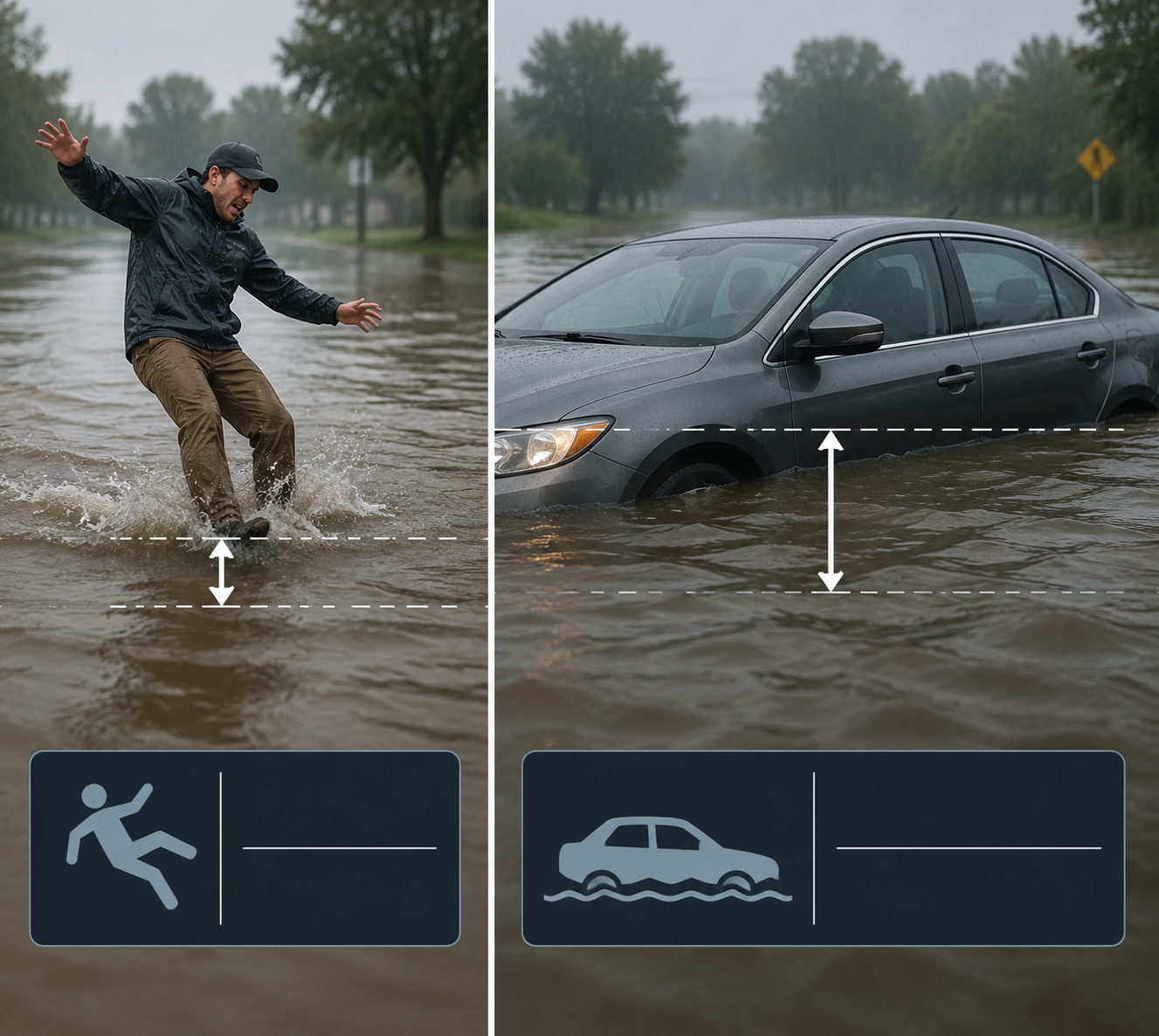
Ready.gov’s flood guidance uses the National Weather Service phrase “Turn Around, Don’t Drown” for a reason: people underestimate water depth, especially at night, in parking lots, near underpasses, and on familiar roads.[8] The Red Cross warns that six inches of fast-moving water can knock a person over, and 12 inches of moving water can carry away many vehicles.[9] Those two numbers should be louder in your head than your schedule.
If You Are In A Dorm Or Campus Apartment
Stay out of basements, ground-floor laundry rooms, underground parking, and low interior corridors if water is entering the building. Move up, not out into moving water. Take your phone, shoes, keys or ID card, medication, power bank, and document folder if they are within reach. If they are not within reach, do not turn a safe exit into a scavenger hunt.
- Follow campus housing instructions and alarms first.
- Avoid elevators if flooding or power failure is possible.
- Keep roommates informed with short texts rather than long calls.
- Do not go downstairs to move a car, retrieve laundry, or check a storage area while water is rising.
- If water is entering outlets, appliances, or power strips, move away and report it to housing or emergency staff.
Dorms add one complication: students wait for permission because the building feels managed by someone else. That is usually appropriate for coordinated evacuations, but it should not make you passive about obvious danger. If water is rising inside the building, call campus police, residence life emergency staff, or 911 according to your campus instructions. A resident assistant is helpful; an RA is not floodwater control.
If You Are In Class, Lab, Studio, Or The Library
Do not assume class ending means it is safe to leave. A professor may not know what the parking lot looks like, and the person at the front of the room may be receiving the same delayed alert as everyone else. Check official campus alerts and local warnings before walking out into heavy rain.
If the building is safe, staying put may be better than crossing campus. Move away from low entrances, glass doors facing fast-moving water, and basement rooms. In labs or studios, follow staff instructions for securing hazards only if it can be done quickly and safely. A lab notebook can be replaced more easily than a person who tried to protect a lab notebook.
Send one practical message to your contact: where you are, whether you are staying or moving, and whether your phone battery is low. If you have group project teammates waiting somewhere else, tell them the same thing. Flash floods are a bad time for ten “where are you??” messages draining the same battery.
If You Are Driving Or About To Drive
This is where the advice needs to be blunt. More than half of flash flood deaths happen when vehicles are driven into floodwater, according to National Weather Service data cited by PBS NewsHour.[1] A familiar road does not make water shallow. A large vehicle does not make moving water harmless. Being late to an exam, shift, lab, or clinical placement does not change physics.
- Do not drive through water covering the road.
- Do not follow another car through water just because it made it across.
- Do not drive around barricades.
- Do not park in low lots, creek-side lots, or underpasses during a warning if you can safely avoid them before flooding starts.
- If the route is flooded, turn around and tell the person waiting for you that floodwater blocked the road.
If water is rising around your car and you cannot safely drive away, get out early if the water is still low and not fast-moving. If the car is being swept or water is entering, experts interviewed by Northeastern University after the July 2025 Texas floods advised unbuckling, opening or breaking a window, and getting onto the roof before calling 911 if possible.[10] NPR’s safety guidance also emphasizes escaping through a window if doors will not open against water pressure.[2]
A small car escape tool on a keychain is useful if you drive often, but it is not a permission slip to take flooded roads. The better student plan is less dramatic: check warnings before leaving, choose higher routes, delay the trip, and send the awkward message early. “I am not driving through floodwater” is a complete explanation.
If You Are Walking Between Buildings
Walking is not automatically safer than driving. Six inches of fast-moving water can knock a person down.[9] On a campus, that water may hide curbs, open drains, uneven pavement, broken glass, or electrical hazards. The most dangerous route may be the one you take every day without noticing the dip near the road.
- Turn around if water is moving across the sidewalk, street, bridge, or parking lot.
- Avoid underpasses, drainage channels, creek paths, and low shortcuts.
- Enter the nearest safe building instead of trying to reach your preferred building.
- Keep shoes on; bare feet and floodwater are a bad combination.
- If you are with a group, do not let the most impatient person choose the route.
The social pressure is real. Students do not want to look dramatic for refusing to cross a flooded walkway. Refuse anyway. If someone needs a reason, use the number: six inches can knock you over. That is not anxiety; that is the safety threshold.
After The Water Recedes
The end of heavy rain is not the same as the end of danger. Wait for an all-clear from campus, local officials, housing staff, or emergency responders before returning to a flooded room, apartment, parking lot, or road. Ready.gov warns people to avoid walking, swimming, or driving through floodwater and to stay off bridges over fast-moving water.[8]
Treat floodwater as contaminated. The CDC warns that floodwater can contain sewage, chemicals, sharp objects, downed power lines, and other hazards.[11] Do not wade back into a room to rescue a rug, box fan, or textbook. If you had contact with floodwater, wash with soap and clean water as soon as possible, and seek medical advice for injuries, exposed wounds, or medication concerns.
Document Damage Before You Clean
If your dorm room or apartment was affected, take photos and videos before moving damaged items, as long as it is safe to enter. Photograph the room from the doorway, water lines on walls or furniture, damaged electronics, textbooks, clothing, bedding, and any standing water. Save receipts for emergency purchases.
Dorm residents should report damage through residence life, housing, or the campus emergency system. Off-campus renters should contact the landlord or property manager and, if they have renters insurance, the insurer. Do not assume the landlord’s policy covers your laptop, clothing, or personal items. Students often learn that distinction at the worst possible time.
Watch for mold after water damage, especially in carpet, drywall, mattresses, upholstered furniture, closets, and anything stored under a bed. Report musty smells, damp walls, or recurring moisture instead of trying to solve a building problem with one fan. In a dorm, persistent moisture is a housing issue. In a rental, it is a landlord communication issue and possibly an insurance documentation issue.
Tell Professors What Was Affected
If a flood damaged your laptop, notes, books, art supplies, lab materials, uniform, transportation, or living space, contact professors early. The message does not need to be emotional or long. State what happened, what course materials were affected, what you can still access, and when you expect to know more.
Subject: Flood-related access issue for [Course Name]

Hi Professor [Name],

I was affected by the flooding on [day]. My [laptop/notes/books/housing/transportation] was damaged or inaccessible, and I may need extra time for [assignment/exam/lab work]. I am documenting the damage and working on access to my files now. I will update you by [date/time].

Thank you,
[Name]
If your campus has a dean of students office, student support office, graduate program coordinator, or case manager, contact them too. They can often help verify emergency circumstances across multiple classes so you do not have to retell the same story five times while dealing with housing and insurance.
Replace The Kit Items You Used
After the immediate cleanup, reset the small system. Recharge the power bank. Replace wet first-aid supplies, food, medication reserves, batteries, paper copies, and contaminated clothing. Update your contact list if people changed numbers during the mess. Back up any new photos, claim documents, and academic files created during recovery.
Use campus mental health resources if the event was frightening, especially if you were trapped, evacuated, separated from friends, or watched housing become unsafe. A flash flood can be over quickly and still leave students jumpy every time rain hits the window. That is not a character flaw. It is a reason to use the support services your fees already help fund.
The Student Version Is Smaller, But It Has To Be Sharper
A student does not need a homeowner-style flood setup to be better prepared. The useful version fits in the life you actually have: one small kit, alerts that reach you, a route you will not take during flooding, a phone that can stay charged, documents you can access, medication you can grab, and coursework that will not disappear with one soaked laptop.
If you are building a broader student emergency plan, pair this with earthquake prep for dorm and rental living or review what a Red Flag Warning means for college students. The details change by hazard. The student problem is the same: protect the few systems you actually depend on before campus life gets disrupted.
References
- Why flash floods are the nation’s top storm-related cause of death, PBS NewsHour
- Flash flood safety tips: What to know, NPR, July 2025
- Campus, Ready.gov
- 7 Key Things for a College Student’s Emergency Preparedness Checklist, Saint Leo University
- College Student Emergency Preparedness, Cal OES, January 2024
- Emergency Dorm Kits, Syracuse University DPS
- College Emergency Kit, The Survival Mom
- Floods, Ready.gov
- Flood Safety, American Red Cross
- How to survive a flash flood like the Texas flood disaster, Northeastern University, July 2025
- Preparing for Floods, CDC
Back to the exam this applies to
Target exam not specified — see all exam hubs.
Comments
Join the discussion with an anonymous comment.