
Three Ways Claude Can Tank Your Exam Prep
Accuracy Warning — Claude
Known failure modes: factual errors, difficulty miscalibration, and cognitive offloading. Always verify Claude-generated content against official exam sources.
- Accuracy:
- Moderate
- Tested:
- Explaining official answers, drafting practice questions, and building flashcards for exam prep
- Last tested:
- 2026-08-01
If you searched for “i tested claude ai for exam prep does it work,” the useful answer is this: Claude can work as an exam-prep coach, explainer, planner, and drill assistant. It should not be your question bank, your scoring authority, or the final source of truth for exam rules.
The danger is not that Claude sounds confused. The danger is that it often sounds prepared. A fluent explanation, a clean multiple-choice stem, or a confident answer key can make a student feel as if the work is getting done while the wrong skill is being trained. With three weeks until a test date, that is not a cute AI limitation. It is time lost, false confidence gained, and bad practice that may have to be unlearned.

The cleanest verdict is conditional: generate with Claude, verify against official or otherwise authoritative sources, then do the retrieval yourself. Skip either of the last two steps and Claude can quietly turn into exactly the kind of study shortcut that lowers the value of your practice.
The first two failure modes: AI questions can be wrong or miscalibrated
The strongest evidence here is not a Claude-specific GRE, MCAT, SAT, ACT, or ASVAB score study. That study does not currently exist in the published evidence base. The best available warning comes from adjacent research on AI-generated multiple-choice questions, and it is useful precisely because it separates surface polish from exam usefulness.
In a peer-reviewed cohort study of AI-generated multiple-choice questions for a high-stakes medical licensing exam, researchers compared ChatGPT-4o-generated items with human-authored items. This was ChatGPT-4o, not Claude, and it was a medical licensing context, not a commercial admissions test. Still, it is one of the clearest published looks at what can go wrong when a large language model is used as a question writer rather than as a helper around verified material. [1]
| What the study compared | AI-generated items | Human-authored items | Why a test-taker should care |
|---|---|---|---|
| Factual inaccuracies | 6% | 4% | A small-looking error rate is still expensive when the student treats every item as training data. [1] |
| Inappropriate difficulty | 14% | 1% | Difficulty mismatch can make practice feel productive while it is not calibrated to the exam. [1] |
| Cognitive level | Predominantly Remember and Understand: 47% and 37% | More items reached Apply and Analyse | Recall-heavy practice can miss the reasoning behavior a real exam may reward. [1] |
That difficulty result is the one that should make students slow down. A wrong fact is irritating, but at least it can sometimes be caught by checking the answer explanation. Difficulty miscalibration is harder to see from the inside. A student can answer a set of AI-generated questions, score well, and believe the content is under control. If those items are easier than the real exam, or if they test recognition instead of transfer, the score is not evidence of readiness.
The cognitive-level split matters for the same reason. “Remember” and “Understand” items are not useless; early review often starts there. But a student preparing for a reasoning-heavy exam cannot live there. The failure is not that AI asks simple questions. The failure is that simple questions can wear the costume of legitimate test prep.

This is where “just prompt better” becomes thin advice. Prompting can improve the shape of an item, but it does not turn an unverified generated question into official practice. If Claude writes five math items in the style of an exam, the student still has to ask: Is the concept tested? Is the difficulty right? Is there exactly one defensible answer? Is the explanation using the reasoning the exam expects? If nobody checks those questions against real material, the student becomes the quality-control department.
The SAT example: structural errors hide better than typos
SAT prep makes the problem concrete because the exam is not just a pile of topics. It has modules, adaptive sequencing, item-writing conventions, answer-choice constraints, and specific mechanics that casual “SAT-style” content can miss.
Jason Robinovitz’s critique of AI SAT prep documents several of those failures: AI-generated SAT materials that mishandle module ordering, questions with more than one valid answer, confident misstatements about exam mechanics, and math explanations that reach an answer without sound conceptual reasoning. [2]
Those are not all equally visible to a student. A typo announces itself. A question with two valid answers may only become obvious after an expert reviews it. A math solution that lands on the right letter for the wrong reason is worse still, because it rewards the student for copying a move that may fail on the next item. The answer key looks reassuring while the underlying method is leaking.
This is why AI-generated exam questions should be treated as drafts, not practice. A draft can be useful. It can expose a topic, create a warm-up, or give a tutor something to revise. But once a student starts using unreviewed AI items as if they carry the authority of the College Board, ETS, AAMC, ACT, or the official ASVAB program, the tool has crossed into a role it has not earned.
The third failure mode: Claude can remove the friction that builds the skill
Students do not always use AI as a coach. Anthropic’s own Education Report found that about 47% of student-AI interactions fell into “Direct” patterns, meaning answer-seeking uses rather than collaborative or reflective ones. [3]
That number does not prove students are lazy, and it does not prove Claude lowers exam scores. It does show why offloading is not a fringe worry. If nearly half of observed student interactions are direct answer-seeking patterns, then a real exam-prep workflow has to assume that many users will be tempted to let the model finish the thinking.
The skill-formation evidence is also adjacent, not exam-specific, but it points in the same direction. In a randomized Anthropic study reported by EdTech Innovation Hub, developers learning an unfamiliar Python library with AI assistance scored about 17% lower on conceptual understanding and debugging than peers who learned without AI assistance, with no significant time savings; delegation-style use produced the weakest skills. [4]
That was a software-learning task, not GRE Quant, MCAT Chem/Phys, SAT Reading and Writing, ACT Science, or ASVAB Arithmetic Reasoning. The responsible inference is narrower: when learners delegate early, they may complete the task without forming the skill underneath. That is exactly the pattern exam prep cannot afford.
Claude is especially good at making this feel harmless. Ask it to explain an official answer, and it can slow the wording down. Ask it to compare two solution paths, and it can be patient. Ask it to quiz you, and it can keep going long after a human tutor would be tired. Those are strengths. They become liabilities when the student stops producing the answer before seeing the model’s version.
What Claude is actually good for in exam prep
Claude earns its place beside official materials when it stays in the coach role. It can turn a dense explanation into plainer language. It can ask a student to justify each step. It can help turn missed questions into an error log. It can rewrite messy notes into flashcard prompts. It can create a study plan from a test date, weak areas, and available hours.
Anthropic’s own Claude for Education launch describes a Learning Mode meant to guide students through questions rather than simply hand over answers. [5] That philosophy is the right one for exam prep, but the product intent does not remove the student’s responsibility to structure the session. A model can be designed to coach and still be prompted into doing the work.
For a hands-on feature walk-through, use the companion article I Tested Anthropic Claude for Exam Prep. The practical verdict here is narrower and stricter: Claude is useful when it improves the work around official practice, not when it replaces official practice.
The safe workflow: generate, verify, retrieve
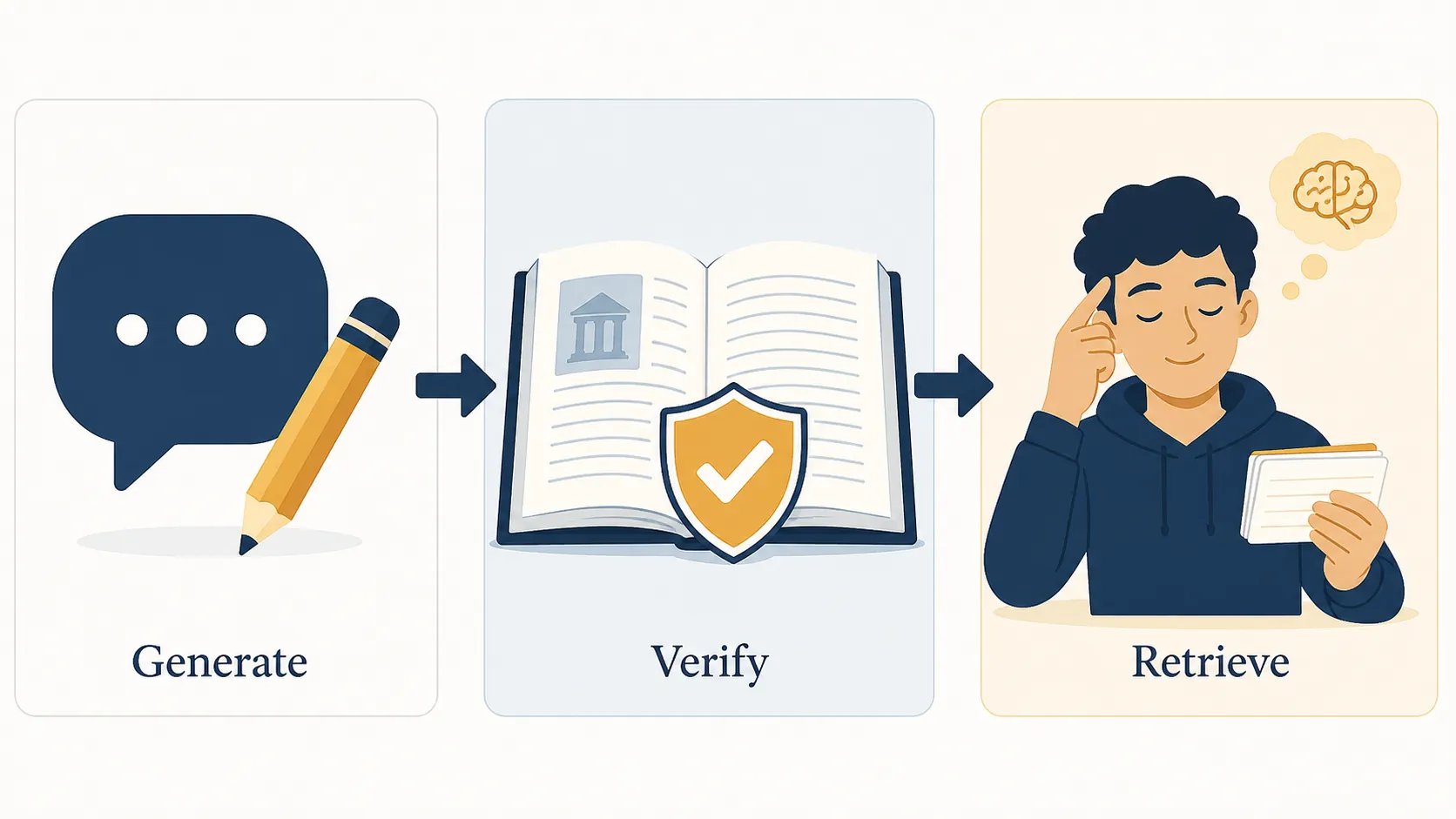
The workaround is not expensive. It is stricter than ordinary AI advice, and that is the point.
| Step | What Claude can do | What you must not outsource |
|---|---|---|
| Generate | Draft explanations, drills, Socratic prompts, study schedules, error-log categories, and flashcard stems. | Do not assume generated facts, scoring rules, timing rules, answer keys, or practice questions are valid. |
| Verify | Help you compare a draft against a pasted official explanation or a source excerpt. | Do not let Claude be the final judge of what the exam tests or what answer is correct. |
| Retrieve | Quiz you after you have created a verified deck or after you have attempted official questions. | Do not let Claude show the answer before you have produced your own reasoning. |
Generate: use Claude for drafts, not authority
Good uses sound like this: “Explain why the official answer is C in simpler language.” “Turn my missed-question notes into five retrieval prompts.” “Ask me one question at a time about this passage, but do not tell me the answer until I commit.” “Make a two-week schedule that alternates official Quant practice with review.”
Weak uses sound like this: “Write me a full SAT practice module.” “Make an MCAT section and score me.” “Generate 100 ASVAB questions with answer explanations.” The output may be useful as raw material, but it should not become the thing that tells you whether you are ready.
Verify: compare anything consequential with official sources
Verification is not glamorous. It is opening the official guide, the exam maker’s practice portal, the scoring documentation, or a trusted published explanation and checking the claim. For GRE, MCAT, SAT, ACT, and ASVAB prep, that means the official practice ecosystem should remain the spine of the study plan. Claude can sit next to it; it should not sit above it.
The parts that always need verification are the ones students most want to automate: question format, timing, scoring, adaptive structure, allowed tools, answer keys, and concept coverage. If Claude says an exam section works a certain way, check the official source. If Claude writes a question, check whether the item has one correct answer and whether the explanation uses valid reasoning. If Claude estimates a score, treat that as informal feedback unless it is tied to an official scoring method.
Retrieve: make yourself answer before Claude explains
This is the step students most often skip because Claude makes skipping it feel efficient. Do not ask for the polished explanation first. Attempt the official question. Write or say your reasoning. Predict the answer. Only then ask Claude to compare your reasoning with the official explanation.
A better prompt is not “Teach me this topic.” A better prompt is: “I chose B. Here is my reasoning. The official answer is D. Do not solve it from scratch yet. Identify the exact step where my reasoning stopped matching the official explanation, then ask me a follow-up question.” That keeps the labor where it belongs: with the student.
A brief note on Claude plans and cost
Last reviewed: August 1, 2026. Claude plan names, limits, and pricing are volatile, so do not build an exam plan around a specific limit without checking the current pricing page and plan documentation. [6][7]
For most students, the more important budget question is not whether a paid AI plan is nicer. It is whether paid access is being used to deepen official practice or to generate more unverified material. More volume is not automatically better prep.
Where the safety and integrity lines sit
This article is about exam-prep quality: accuracy, difficulty, and skill formation. Privacy, academic-integrity, and broader study-safety questions need their own boundaries. For that, use Is Claude AI Safe for Studying? Three Separate Verdicts. If your concern is where AI help becomes substitution or cheating, read Can Students Use ChatGPT for Exam Prep Without Cheating? alongside your school or testing program’s rules.
So, does Claude work for exam prep?
Yes, if it is kept in the coach role. Use it to explain official answers, pressure-test your reasoning, organize mistakes, build retrieval prompts, and keep a study session moving.
No, if it becomes the source of truth. Do not use Claude as your primary practice-question factory. Do not let it invent exam mechanics. Do not let it score your readiness without official anchors. Do not let it answer before you retrieve.
The next action is exam-specific: work through official GRE, MCAT, SAT, ACT, or ASVAB practice first; use Claude only to explain, organize, and quiz around that material; then check your performance against the exam maker’s standards. That is less exciting than “AI replaces prep,” but it is the workflow that protects the part that matters: the score.
References
- Quality of AI-generated multiple-choice questions for a high-stakes medical licensing examination: a cohort study, BMC Medical Education / PubMed Central
- The Illusion of AI SAT Prep, Jason Robinovitz
- Anthropic Education Report: How University Students Use Claude, Anthropic
- Anthropic Study Finds AI Use Can Weaken Skill Development in Early Learning Tasks, EdTech Innovation Hub
- Introducing Claude for Education, Anthropic
- Claude pricing, Claude
- Choose a Claude plan, Anthropic Support
Authoritative source
For the authoritative version of this contentHow to Read the '1 in 4 NFL Players CTE' Study
Report an error in this tool's output
Found something this tool got wrong beyond what's documented above? Report it so the accuracy log stays current.
Comments
Join the discussion with an anonymous comment.