
Perplexity AI Tested for Student Research
Accuracy Warning — Perplexity AI
More than one in three answers wrong in independent testing; a real citation may not support the AI claim. Open sources before relying.
- Accuracy:
- Moderate
- Tested:
- Student research for exam prep: official score policies, prep timelines, and section strategy
- Last tested:
- 2026-08-25
A student checking whether an MCAT date leaves enough time for score release, or whether a GRE score policy affects an application deadline, does not need an answer that sounds researched. They need to know whether the source behind the answer actually says the thing the AI claims it says. That is where Perplexity AI is useful, and also where it becomes risky: it is strong at surfacing candidate sources, but weak enough at verification that every important citation still has to be opened.
Evidence label: Moderate for Perplexity as a source-discovery tool; Limited for trusting its generated answers without source checking. Last reviewed: August 25, 2026. Tested use case: student research for exam prep and admissions-adjacent decisions, especially official score policies, prep timelines, and section-strategy claims. Accuracy warning: no exam-specific primary study of Perplexity for GRE, MCAT, SAT, ACT, or ASVAB research was available in the research set, so the risk judgment here combines independent citation studies, deep-research reliability work, and an exam-scoped verification workflow.

The citation problem starts before exam prep
The most useful calibration point is not a vendor benchmark. In March 2025, the Tow Center for Digital Journalism compared eight AI search engines on 1,600 news-citation queries. Perplexity led the group on citation coverage, but still answered 37% of the queries incorrectly; Grok 3 was wrong on 94% of the same task set.[1] That finding should be read narrowly: it tested news-citation retrieval, not GRE registration rules or MCAT study planning. Still, it is exactly the kind of failure that matters for student research, because it shows that a citation-heavy answer engine can look well sourced while attaching the wrong claim to the wrong support.
A later EBU/BBC report reached a similar warning from a different angle: roughly a third of Perplexity responses carried a significant issue.[2] The exact task design differs from the Tow Center test, so the figures should not be blended into one universal Perplexity error rate. They do, however, point in the same practical direction: citation presence and citation faithfulness are not the same thing.
That distinction matters more for test-takers than for casual search. A wrong restaurant summary wastes a few minutes. A wrong interpretation of an official score-reporting rule can change when someone registers, whether they send scores, or how they sequence a study calendar. The damage usually comes after the answer has already shaped a plan.
The harder failure mode is not the cartoon hallucination where the AI invents a source nobody can find. It is the confident sentence attached to a real-looking URL that opens to a legitimate page, except the page does not support the claim. That kind of source mismatch is also central to allegations in the Dow Jones / New York Post lawsuit against Perplexity, which accuses the company of citing real URLs while attributing fabricated claims to them.[3] A lawsuit allegation is not the same as an independent accuracy rate, but the pattern it describes is the exact pattern students need to guard against.
Deep-research tools do not remove the need to check. A synthesis of academic and practitioner evaluations summarized the upper range of source faithfulness for leading deep-research systems at roughly 80% at best, with reliability varying by task and evaluation method.[4] Practitioner reviews of Perplexity’s citation behavior likewise treat citations as inspectable leads rather than proof.[5][6] For exam research, that ceiling is not comforting. A tool that is right most of the time can still be unsafe for the one deadline or policy detail a student actually acts on.
How I tested Perplexity for student research
The field test used exam-scoped prompts a real student might ask when they are trying to make a decision, not trivia prompts designed to catch the model being silly. The prompts fell into three groups: official score policies, prep timelines, and section-strategy claims. For each answer, the citation check asked four questions.
- Is the cited source official for the decision at hand, such as ETS, AAMC, College Board, ACT, or a Department of Defense source for ASVAB-related questions?
- Does the cited page actually state the same claim Perplexity made?
- Did Perplexity add an interpretation, deadline implication, exception, or strategy recommendation that the source itself does not support?
- Could a student safely act on the AI sentence without reading anything else?
That last question is intentionally strict. For student research, a source-discovery tool gets credit when it quickly finds the right official page. It does not get credit for making an official-sounding inference that the page itself does not make.
| Test area | What counted as a pass | What counted as a warning |
|---|---|---|
| Official score policy | Perplexity surfaced the official source and kept the answer aligned with that source. | The answer cited an official page but added timing, eligibility, or reporting implications not stated there. |
| Prep timeline | The answer labeled guidance as planning advice and tied official claims only to official material. | The answer turned a general prep suggestion into a hard schedule without evidence. |
| Section strategy | The answer distinguished official test format from unofficial strategy advice. | The answer cited official format pages as if they proved a prep tactic. |
| Eligibility or administrative detail | The answer sent the student to the controlling official source for the rule. | The answer summarized a rule confidently when exceptions or current policy needed direct confirmation. |
Score policies: the source has to control the decision
For official score policies, Perplexity’s main value was speed. It was often good at getting close to the right kind of source: the official testing organization, a policy page, or a help-center page that a student might otherwise reach only after several searches. That is a real advantage over a general chatbot answer with no source trail.
The problem appears when the answer compresses policy language into a decision rule. A source may explain that scores are reportable in a certain way, that an account contains certain options, or that a testing program has a score-release process. Perplexity may then produce a more actionable sentence: register by this point, expect this sequence, use this option for that admissions scenario. The official page may support part of the sentence while not supporting the conclusion a student would actually rely on.
The safe test is simple: if the claim affects registration, score sending, retesting, cancellation, accommodation timing, eligibility, or application planning, the cited source must be official and must say the same thing in its own language. A Perplexity paragraph that points to ETS, AAMC, College Board, ACT, or a DoD-related source is not done being researched. It has only identified the page that now needs to be read.
Prep timelines: useful synthesis, weak authority
Prep-timeline prompts are where Perplexity can feel most helpful. Ask for a study plan and it can quickly produce a workable outline, surface official exam pages, and mix them with prep-oriented explanations. That is fine as a brainstorming layer. It becomes less fine when a suggested timeline is presented as if it follows from official evidence.
Official sources can verify what the exam covers, how registration works, what score reports mean, and what policies govern a test. They usually do not prove that a particular student needs a particular number of weeks to improve by a particular amount. When Perplexity cites an official page beside a prep-calendar recommendation, the citation may support the exam format but not the schedule. That is a partial pass at best.
The better way to use it is to split the answer into two columns. Put official facts on one side: test length, content areas, registration rules, score-release information, permitted materials, retest limits if applicable. Put planning advice on the other side: study blocks, review cycles, practice-test spacing, section order. Only the first column can be verified against official sources. The second column should be treated as coaching advice, not policy.
Section strategy: format evidence is not strategy evidence
Section-strategy claims are a common place for citation laundering. A student asks how to handle SAT Reading and Writing, MCAT passages, GRE Quant timing, ACT pacing, or ASVAB subtests. Perplexity may cite official pages that describe the exam structure, then produce a strategy recommendation that sounds evidence-backed because the source sits underneath it.
That is not enough. An official page describing section format can support claims about what appears on the test. It does not automatically support claims about whether to skim first, whether to skip aggressively, whether to memorize a formula list before drilling, or how to allocate minutes across item types. Those may be reasonable strategies, but they need to be labeled as strategy advice rather than official policy.
This is where a student should be especially suspicious of polished synthesis. Perplexity’s answer may be educationally useful and still overclaim what the citation proves. The verification question is not “does the source seem relevant?” It is “does the source support this exact sentence?”
A practical scoring rubric for Perplexity answers
For student research, I would not score Perplexity on whether the first answer feels complete. I would score it on claim support. This is the rubric I used while checking exam-related answers.
| Score | Meaning | Student action |
|---|---|---|
| 5 | Official source directly supports the load-bearing claim, and Perplexity does not add unsupported implications. | Safe to use after opening and confirming the source. |
| 4 | Official source supports the main fact, but Perplexity’s wording is broader than the source. | Use the source wording, not the AI wording. |
| 3 | Source is relevant but indirect; the answer mixes verified facts with advice or inference. | Separate facts from recommendations before acting. |
| 2 | Citation is real but does not support the claim a student would rely on. | Do not use the AI claim; continue searching official sources. |
| 1 | Source is unofficial, outdated for the decision, inaccessible, or mismatched to the claim. | Treat the answer as unverified. |
| 0 | No usable citation for the load-bearing claim. | Ignore the claim for planning purposes. |
Most student mistakes happen in the middle of that scale. The answer is not absurd. The link is not fake. The page is adjacent to the topic. But the sentence a student wants to act on is one step beyond what the source proves.
What Perplexity does well
Perplexity deserves credit for making the source trail visible. In student research, that is not cosmetic. A student who starts with a general search engine may have to sort through prep-company pages, outdated forum posts, scraped snippets, and unofficial summaries before finding the controlling source. Perplexity can shorten that search path.
Its best use is as a source scout. Ask it to find the official page for a policy. Ask it to identify whether the controlling organization is ETS, AAMC, College Board, ACT, or a Department of Defense source. Ask it to show where the claim comes from. Then open the sources and read the relevant section yourself.
That workflow is faster than pretending AI is useless. It is also safer than pretending the citation badge has done the checking. If you are comparing tools, the same standard should apply to other AI study assistants as well; our tested-format reviews of ChatGPT for exam study and Mistral Vibe for exam prep use the same basic distinction between helpful drafting and verified exam facts.
Where vendor claims fit
Perplexity’s own Deep Research announcement claims 21.1% on Humanity’s Last Exam, 93.9% on SimpleQA, and completion of most tasks in under 3 minutes.[7] Those are vendor-reported figures. They may help describe what Perplexity says its product can do, but they should not be treated as independent proof that it is reliable for exam-policy research.
A third-party hands-on review of Perplexity Deep Research in 2026 scored it 4–5 out of 5 on 7 of 9 research tasks across academic, policy, legal, and technical areas, while giving weaker 2–3 out of 5 scores for investment and business-data tasks requiring niche databases.[8] That is encouraging for broad research assistance, but it still is not an exam-specific validation study. Aaron Tay’s academic deep-research discussion is useful here because it treats these tools as aids for mapping and scoping research, not as replacements for reading the underlying literature or source documents.[9]
Product details are also unstable. Learn Mode, Education Pro, pricing, quotas, model availability, and search modes can change, so any tactical advice about features should be checked against Perplexity’s current product pages before relying on it. As of this review date, those details are less important than the verification habit: open the source.
The workflow I would actually use before a deadline
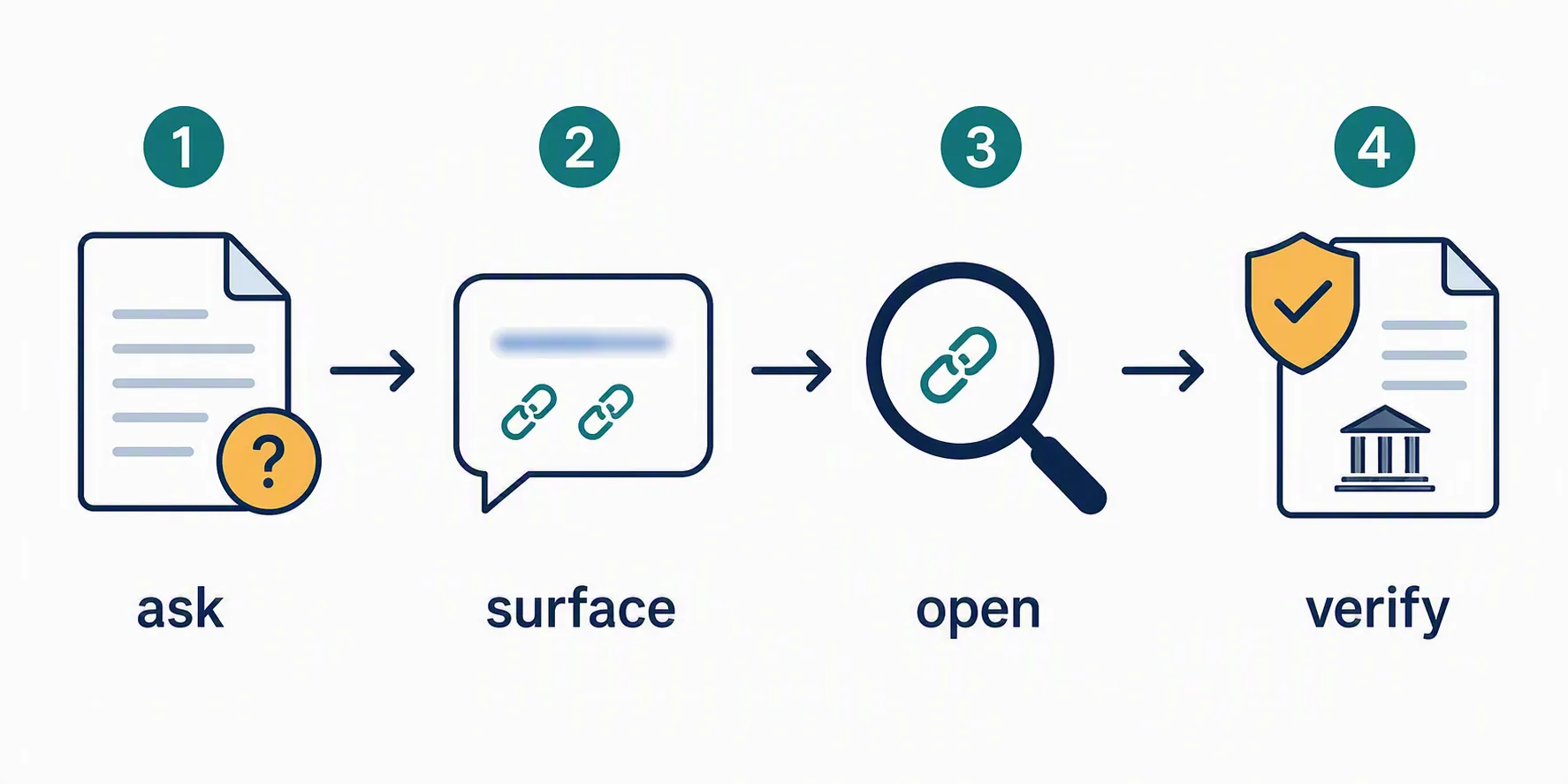
For a deadline-driven test-taker, the safest Perplexity workflow is short and repetitive.
- Ask Perplexity for the official source, not just the answer. Example: “Find the official source for this score-reporting policy and quote the relevant section.”
- Open every citation attached to a load-bearing claim.
- Check whether the source is official for the decision. A prep-company page may explain, but it usually does not control policy.
- Compare the AI sentence with the source sentence. If Perplexity adds a deadline implication, exception, or strategy conclusion, mark that part as unverified.
- Save the official link and the exact wording you will rely on. Do not save only the AI answer.
For more general source-checking habits, the same principle appears in our guide to checking citation generators and sources and in the broader review of AI study-tool hallucination rates. The habit is not complicated. It is just inconvenient enough that students skip it when the AI answer looks clean.
Verdict: use Perplexity for discovery, not verification
Perplexity AI is one of the better tools for the first stage of student research. It can help a GRE, MCAT, SAT, ACT, or ASVAB student find likely sources faster, especially when the alternative is wading through forum shorthand and old prep-blog summaries. That is worth using.
The independent evidence does not support using it as the final authority. Perplexity led an eight-engine citation-coverage test and still got 37% of 1,600 news-citation queries wrong.[1] Other evaluations point to significant issue rates and source-faithfulness limits that are too high for unverified exam decisions.[2][4]
The boundary is simple: Perplexity can shorten the path to ETS, AAMC, College Board, ACT, or DoD sources. The final answer belongs to the opened official source, not to the AI summary or the citation badge beside it.
References
- AI Search Has a Citation Problem, Tow Center for Digital Journalism, March 2025.
- EBU/BBC report, EBU/BBC, October 2025.
- Dow Jones / New York Post lawsuit against Perplexity, Dow Jones / New York Post.
- AI Hallucination Rates and Benchmarks, Suprmind.
- Perplexity AI Review: Citations, Future AGI.
- Perplexity AI for Academic Research: How Reliable Are the Sources, Data Studios.
- Introducing Perplexity Deep Research, Perplexity.
- Perplexity Deep Research Review 2026: 9 Real-World Tests, Second Talent.
- What Academic Deep Research Is Really For, Aaron Tay.
Authoritative source
For the authoritative version of this contentHow to Read the '1 in 4 NFL Players CTE' Study
Report an error in this tool's output
Found something this tool got wrong beyond what's documented above? Report it so the accuracy log stays current.
Comments
Join the discussion with an anonymous comment.