Mistral Vibe Tested for Exam Prep
Accuracy Warning — Mistral Vibe
Answer accuracy was inconsistent, especially on multi-step and numeric-entry math; verify against the official answer key.
- Accuracy:
- Moderate
- Tested:
- Digitizing official PDFs, re-explaining missed questions, drafting flashcards, and solving exam questions
- Last tested:
- 2026-08-03
Mistral Vibe, formerly Le Chat, is useful for exam prep when the job is support: digitizing official PDFs, turning messy notes into reviewable text, re-explaining a concept after you have already checked the official answer, or drafting flashcards you will verify. In our hands-on trial against official GRE, MCAT, SAT, ACT, and ASVAB questions, it was not reliable enough to use as an answer key, scoring system, or replacement for official practice.
Last reviewed: August 3, 2026. Evidence label: first-party hands-on tool trial, not a universal benchmark. The trial tested exam-prep jobs a student would actually delegate to an AI assistant: reading source material, extracting questions from documents, explaining missed items, generating review cards, checking steps, and answering questions. The answer-generation results were the part that carried the most risk, especially on multi-step quantitative work and numeric-entry formats.

One naming note before the evidence: Mistral’s assistant was called Le Chat until the May 2026 rebrand to Vibe, so older reviews and search results may still use the former name.[1] This article uses the current name, Mistral Vibe.
| Prep job | Hands-on verdict | Safe use |
|---|---|---|
| Digitizing official PDFs and notes | Strongest use case | Use it to convert material into clean text, formulas, summaries, and draft cards |
| Re-explaining missed questions | Useful with verification | Ask for a second explanation only after checking the official key |
| Drafting flashcards and review sheets | Useful as a first draft | Keep, edit, or delete cards against official material |
| Solving questions from scratch | Too inconsistent | Do not treat generated answers as correct without the official answer |
| Scoring practice tests | Unsafe | Use official scoring guides and exam-platform reports |
| Replacing official practice | Unsafe | Use official questions first; use Vibe after the attempt |
How we tested Mistral Vibe for exam prep
The test set was built around official exam material because that is where prep tools either help or waste time. GRE prompts came from ETS POWERPREP materials; SAT questions came from College Board’s SAT Practice Test #10 PDF; ASVAB items came from official ASVAB sample questions; and the trial also included official MCAT and ACT practice material in the same workflow.[2][3][4]
We did not count a polished explanation as success by itself. For answer tasks, success meant the final answer matched the official key and the reasoning did not hide a serious error. For workflow tasks, success meant Vibe reduced study friction without becoming the source of truth: a readable extraction, a useful concept explanation, a flashcard draft that could be checked, or a step-by-step rewrite that made a missed solution easier to review.
This matters because a student with a test date does not just need an AI that sounds helpful. They need to know which parts can be delegated without corrupting the study record. A wrong generated answer copied into Anki is worse than no card at all. A fluent explanation of the wrong ASVAB mechanical-comprehension choice can train the wrong instinct. A week spent on AI-generated SAT-style material is a week not spent on official College Board questions.
So the trial was intentionally conservative. Mistral Vibe was allowed to help with reading, formatting, explanation, and review production. It was not given credit for acting confident. When it guessed, over-explained a mistaken path, or produced an answer that needed outside correction, the result was treated as a risk, even if the language around it was smooth.
Where Vibe actually helped: documents, formulas, and review materials
The strongest reason to consider Mistral Vibe for exam prep is not that it can chat about test strategy. It is that Mistral’s OCR work is genuinely relevant to the ugly middle of studying: old PDFs, scanned worksheets, handwritten notes, formulas, tables, and half-legible scratch work.
Mistral says OCR 4 can read handwriting, rebuild formulas as LaTeX, support 170 languages, and score 85.20 on OlmOCRBench, with roughly 72% human-preference win rates.[5] Those are vendor-published results, not an independent exam-prep outcome study. Still, they line up with the part of our trial where Vibe was most useful: turning official and student-created material into something a learner can review, search, and restructure.
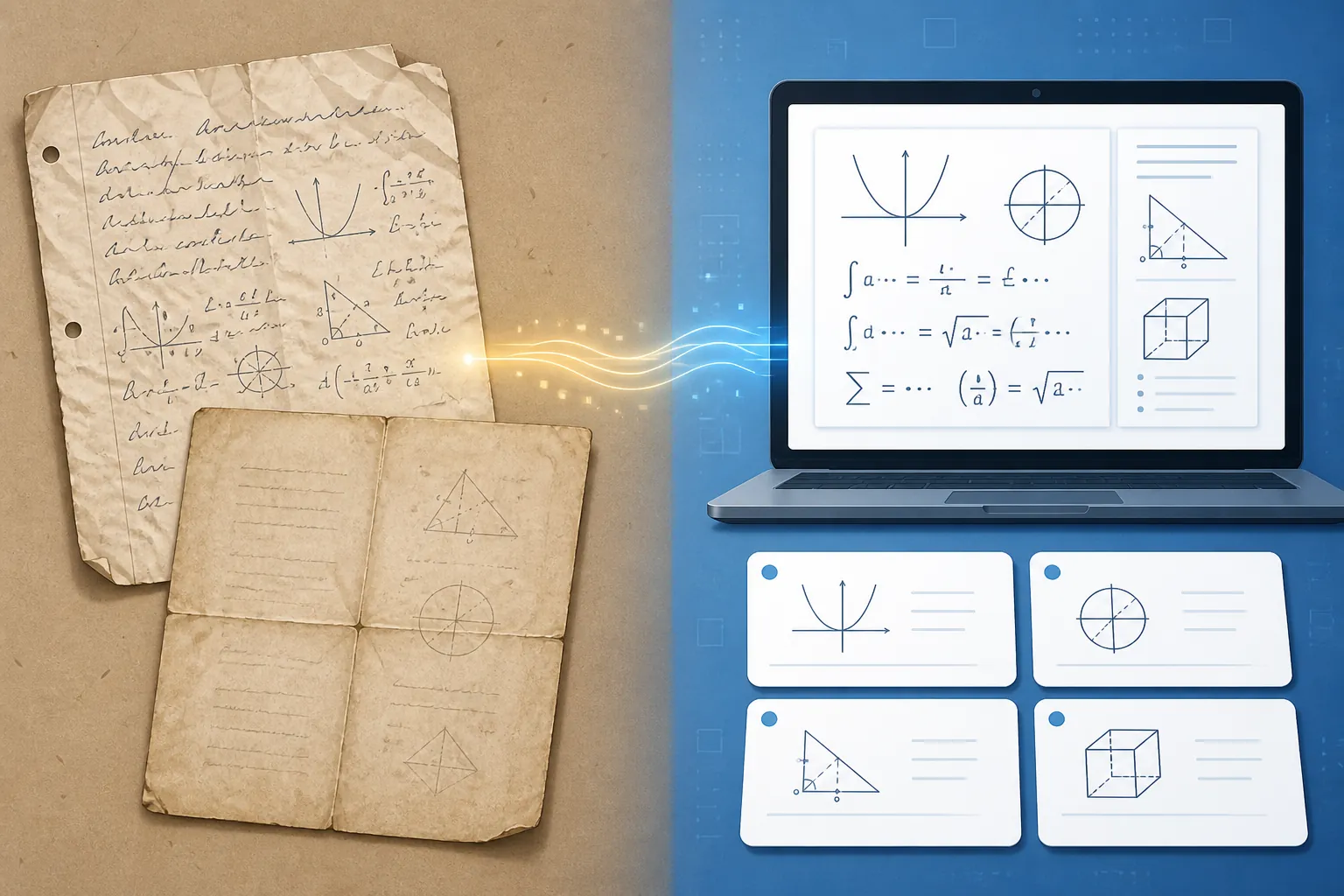
For SAT and GRE math review, the useful pattern was simple: give Vibe official material or your own missed-problem notes, ask it to extract the problem cleanly, then ask for a concept label and a short review card. It was better at producing a usable study artifact than at being trusted as the judge of the final answer.
Formula handling was also more valuable than generic tutoring. When a student has a page of algebra, geometry, or physics notes, the time sink is often not understanding every symbol; it is getting the page into a form that can be searched, corrected, and reused. Vibe’s ability to preserve mathematical structure made it a better document assistant than many chatbots that flatten equations into mush.
For MCAT-style science review, the safest use was after the official attempt. Feed in the passage topic, the missed concept, and the official explanation, then ask Vibe to rewrite the idea at a different level: one version for quick recall, one for mechanism, one for a flashcard. That produced useful study material without asking the model to decide what the exam maker meant.
For ASVAB prep, the same boundary mattered. Vibe was helpful for turning official sample-question topics into review prompts, especially vocabulary, arithmetic reasoning concepts, and mechanical-comprehension explanations. It was much less safe when asked to act like the scoring authority or to generate a full substitute practice set.
The flashcard workflow that held up best
The best workflow was not “ask Vibe to teach the exam.” It was narrower:
- Complete an official question first.
- Check the answer against the official key or explanation.
- Paste the missed question, your wrong approach, and the official explanation into Vibe.
- Ask for one concept label, one corrected explanation, and two or three flashcard drafts.
- Edit the cards before saving them.
That sequence keeps the exam maker in charge of correctness and lets Vibe do the clerical and explanatory work. It also prevents a common failure: letting an AI produce both the question and the answer, then studying its private version of the test.
Where it became risky: answer generation and multi-step math
The weak point was not that Vibe could never solve an exam question. It often could. The problem was that the student cannot tell quickly enough when it has crossed from solving into improvising. On high-stakes prep, that distinction is expensive.
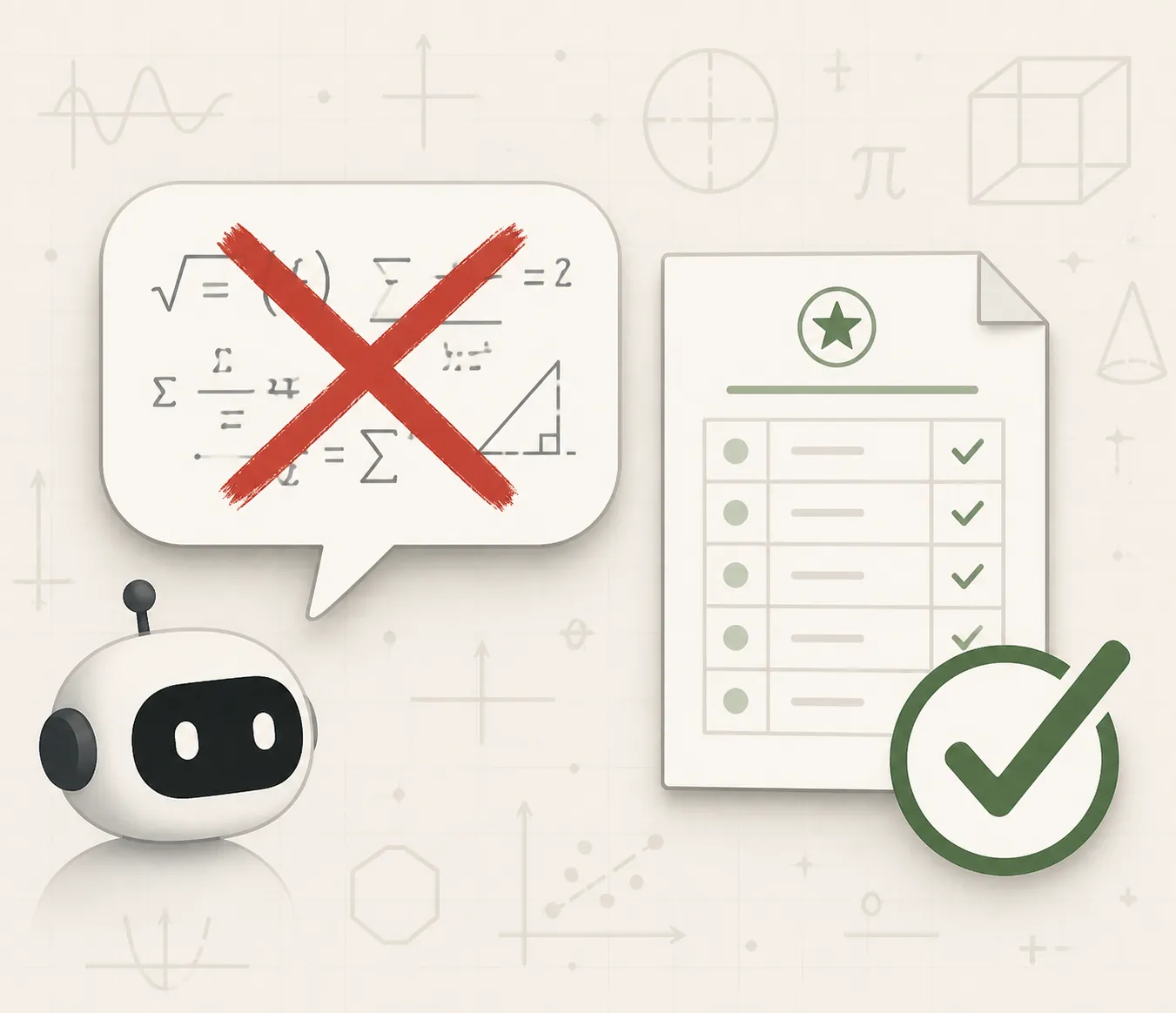
The riskiest cases were multi-step quantitative questions, especially when the answer format did not give the model a set of choices to compare. Numeric-entry math is exactly where an AI assistant has to carry the whole chain: parse the prompt, select the method, perform the computation, avoid arithmetic drift, and land on the final value without a multiple-choice safety net.
That pattern is not unique to Mistral. EstBook, an independent benchmark of 10,576 real SAT, GRE, GMAT, TOEFL, and IELTS questions, concluded that frontier LLMs were “inadequate” as standardized-test assistants and were weakest on numeric-entry and multimodal math.[6] EstBook did not test Mistral models, so it should not be read as a Mistral Vibe score. It is still useful context for why numeric-entry and visual math items deserved special suspicion in this trial.
Mistral’s own math history points in the same direction, though with a different caveat. In 2024, Mistral reported that Mathstral 7B scored 56.6% on MATH and 63.47% on MMLU, and said it evaluated the model using GRE Math Subject Test problems curated by Professor Paul Bourdon.[7] That is a documented Mistral-to-GRE connection, but it is not a current Vibe benchmark and not a promise about the consumer assistant a student opens today.
The practical consequence is straightforward. If Vibe gives a GRE quantitative explanation, an SAT math solution, an ACT math shortcut, or an ASVAB arithmetic-reasoning answer, the student still needs the official answer key. If the model’s explanation disagrees with the key, the key wins. If the key is unavailable, the result should be treated as unverified, not as “probably right because it sounds mathematical.”
Exam-by-exam notes from the trial
The exam differences mattered less than the task differences. Vibe’s safest role was similar across tests: clean up source material, explain a missed concept, and make review assets. Its least safe role was also consistent: generate answers or score performance without an official reference.
| Exam | Where Vibe was useful | Where we would not rely on it |
|---|---|---|
| GRE | Rewriting quantitative explanations, extracting PDF material, labeling missed concepts | Numeric-entry answers, multi-step quantitative reasoning, unofficial scoring |
| SAT | Turning official practice-test misses into flashcards and short concept reviews | Replacing College Board practice, generating a private practice set and treating it as equivalent |
| ACT | Reviewing missed math and science concepts after checking official explanations | Timing strategy or section scoring based only on AI-generated analysis |
| MCAT | Rephrasing science mechanisms and passage concepts after official review | Inferring the test maker’s intended answer without the official explanation |
| ASVAB | Creating vocabulary, arithmetic, and mechanical-comprehension review prompts | Treating generated questions as official-like or using Vibe as a score predictor |
For SAT students, the safest route is still to build the week around official College Board material, then use Vibe to process the misses. If you need a fuller exam-first plan, start with the SAT exam prep guide or the SAT study tools guide before adding another AI assistant.
For ASVAB applicants, the risk is slightly different. The ASVAB covers a wider range of practical knowledge areas, so a fluent explanation can feel especially reassuring. Use Vibe to restate concepts and make drills from official topics, but keep the official sample questions and scoring information at the center. The ASVAB exam prep guide is the better place to decide what to study next.
Why “more practice” can still backfire
A chatbot can make studying feel more productive because it removes pauses. It answers immediately, writes another explanation, and generates another set of questions. That speed is useful when the input is official material and the output is checked. It is dangerous when the student starts measuring effort by how many AI-produced items they completed.
A July 2024 University of Pennsylvania SSRN preprint reported that ChatGPT-enabled students in a Turkey high-school math study solved 48% more practice problems but scored 17% worse on a follow-up test; the chatbot answered math correctly only about half the time.[8] That study was not peer-reviewed at the time described, was about ChatGPT rather than Mistral, and should not be stretched into a universal rule. It is still a useful warning: practice volume is not the same as learning if the feedback loop is contaminated.
There is also a broader confident-wrong-output problem. NewsGuard reported that Le Chat repeated state-sponsored disinformation in roughly 60% of leading prompts in a news-related test.[9] That was not an exam-prep test, and it does not prove Vibe will answer your GRE or MCAT question incorrectly. It does show why a polished answer from a chatbot should not be confused with verification.
For more on how we separate tool claims from learning evidence, see Are AI Study Tools Actually Tested for Learning? The short version for this trial: a tool can be good at producing explanations and still be unsafe as the final authority.
Pricing and plan limits, reviewed August 2026
As of the August 2026 pricing snapshot, Mistral listed a Free tier, Pro at $14.99 per month, Team at $24.99 per user per month, and an Education plan at $5.99 per month for verified students, limited to a maximum of 12 months and first-time Vibe/Le Chat users.[10] Pricing can change, so check the official page before making a decision.
The free tier may be too narrow for a serious exam-prep evaluation. TechRadar’s Vibe review noted an approximately 25-message-per-day free limit and described No Telemetry Mode on Pro as a differentiator.[11] The Decoder also observed that Pro limits were published as opaque multiples of the free plan rather than plain caps.[1] For a student, the practical issue is not only monthly price. It is whether you can test the exact workflow you care about before relying on it during a timed prep cycle.
If you are paying mainly for OCR-heavy work, document conversion, and repeated review-material generation, Vibe has a clearer case. If you are paying because you hope it will become a cheaper tutor and answer key, the trial does not support that use.
A safer way to put Mistral Vibe into a prep stack
The safest rule is sequence-based: official practice first, Vibe second, verification always. Do not begin with AI-generated practice and then hope it maps back to the real test. Begin with ETS, AAMC, College Board, ACT, or ASVAB material, attempt the question under realistic conditions, check the official result, and only then bring in Vibe to help turn the miss into study material.
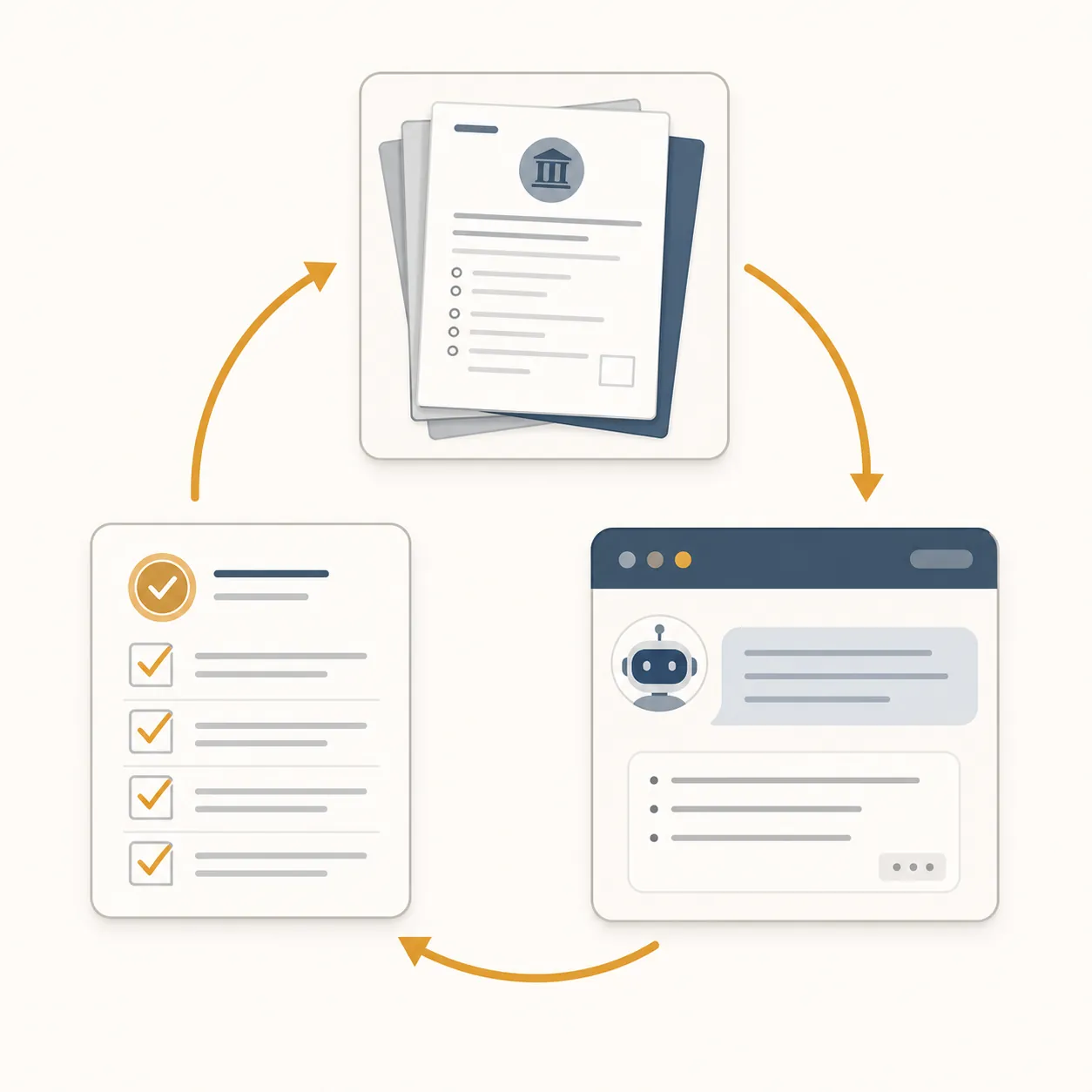
A useful instruction is specific about the boundary: “Here is the official question, my wrong answer, and the official explanation. Do not change the answer. Explain why my reasoning failed, name the concept, and draft three flashcards I can verify.” That wording keeps Vibe from becoming the judge and makes it work as a reviewer.
For comparison across tools, read the sibling hands-on trials: I Tested ChatGPT as an Exam Study Assistant and I Tested Grok Voice Think Fast 2.0 for Language Learning. If your concern is the ethical line rather than the accuracy line, use Can Students Use ChatGPT for Exam Prep Without Cheating? as the boundary-setting piece.
Mistral Vibe earns a place in an exam-prep workflow when it is downstream from official material. Feed it missed questions, notes, PDFs, and official explanations. Let it clean, rewrite, organize, and draft. Verify every answer against the official key.
References
- Mistral rebrands Le Chat as Vibe, betting its chatbot’s future is as a full-blown work agent, The Decoder.
- POWERPREP Practice Tests, ETS.
- SAT Practice Test #10 Digital, College Board.
- Sample Questions, Official ASVAB.
- Introducing Mistral OCR 4, Mistral AI.
- EstBook: A Benchmark for Evaluating Large Language Models on Standardized Test Tasks, arXiv.
- Mathstral, Mistral AI.
- Kids who got help from ChatGPT did worse on tests, The Hechinger Report, July 2024.
- Mistral’s Le Chat spreads Iran war disinformation in 60 percent of leading prompts, The Decoder.
- Pricing, Mistral AI.
- Mistral Vibe review, TechRadar.
Authoritative source
For the authoritative version of this contentHow to Read the '1 in 4 NFL Players CTE' Study
Report an error in this tool's output
Found something this tool got wrong beyond what's documented above? Report it so the accuracy log stays current.
Comments
Join the discussion with an anonymous comment.