DeepSeek AI Tested for Exam Prep — What the Scores Show
Accuracy Warning — DeepSeek AI
Not an answer authority: accuracy drops on multi-answer and case-analysis items, hallucination risk is higher than rival models, and DeepSeek has not been directly tested on GRE/MCAT/SAT/ACT/ASVAB — verify every output against official prep materials.
- Accuracy:
- Moderate
- Tested:
- Answering medical board-style and licensing exam questions plus math-reasoning benchmarks
- Last tested:
- 2026-08-01
Last reviewed: August 1, 2026. For anyone looking up DeepSeek AI tested for exam prep, the honest evidence label is narrow but useful: there are published exam-question tests for DeepSeek-V3 and DeepSeek-R1, including peer-reviewed medical-board, licensing, and in-service question sets. There is not, as of this review date, a peer-reviewed study testing DeepSeek directly on GRE, MCAT, SAT, ACT, or ASVAB questions. So the exam-by-exam verdict below is reasoned inference from tested formats, not a source-proven GRE/MCAT/SAT/ACT/ASVAB score report.
That distinction matters. DeepSeek has cleared hard exam-style questions at rates high enough to take seriously. It has also failed in exactly the places where students are most likely to overtrust it: multi-answer items, case-analysis questions, landmark-study reasoning, and confident explanations that still need checking.
The published exam-question evidence
The strongest available evidence is not a viral prompt or a one-off screenshot. It is a set of versioned studies where researchers fed real or sample exam-style questions to a named DeepSeek model and recorded performance. Those details carry the weight here; every later recommendation depends on what these rows actually tested.
| Study / question set | DeepSeek model and timing | Sample size | Source type | Key result | What it can and cannot justify |
|---|---|---|---|---|---|
| Radiology board-style questions | DeepSeek-V3; tested April 1–7, 2025 | 161 questions / 207 items | Peer-reviewed article in Medical Education Online | DeepSeek-V3 scored 72.0% overall versus ChatGPT-3.5 at 55.6%. Format split: 87.1% single-choice, 55.7% multiple-choice, 68.0% case-analysis. [1] | Strong evidence that DeepSeek-V3 was useful on this medical exam-question set; strong warning that item format changed reliability. |
| USMLE sample items | DeepSeek-R1; study published 2026 | 243 sample items | Peer-reviewed article in Scientific Reports | DeepSeek-R1 scored 92.59% versus ChatGPT at 90.26%. Fleiss’ Kappa was 0.96 for DeepSeek-R1 and 0.93 for ChatGPT; both models hallucinated on some items. [2] | Supports high performance on short licensing-style medical questions; does not prove safety on nonmedical exams or passage-heavy items. |
| Radiation oncology in-service questions | DeepSeek-R1; pricing snapshot February 2025 | 600 questions | Peer-reviewed article in Advances in Radiation Oncology | DeepSeek-R1 scored 84.0% overall, but 74.2% on landmark-trial questions versus ChatGPT o1 at 93.5%. The same study reported about $1.56 in DeepSeek cost versus $37.96 for ChatGPT o1, with DeepSeek taking about 59 seconds per question versus 10 seconds. [3] | Good evidence for low-cost specialist exam practice; the landmark-trial gap warns against trusting it as final authority on evidence-heavy rationales. |
| EPSITE pediatric surgery questions | DeepSeek-R1; study published 2025 | Not specified in available source details | Peer-reviewed article in Pediatric Surgery International | DeepSeek-R1 scored 85.0%, compared with 60.1% for human trainees and 55.4% for Microsoft Copilot. [4] | Supports strong specialist recall and question-answering performance; treat it as source-specific evidence rather than a portable benchmark. |
| Hallucination benchmark | DeepSeek-R1 and DeepSeek-V3; Vectara HHEM 2.1 methodology | Benchmark-specific; not an exam-question set | Vendor benchmark analysis, with separate news coverage | Vectara reported hallucination rates of 14.3% for DeepSeek-R1, 3.9% for DeepSeek-V3, and 2.4% for GPT-o1 under its HHEM 2.1 method. [5] | Useful warning about answer verification; not a direct measure of exam accuracy. |
| Math and reasoning benchmark context | DeepSeek-R1 and later R1-0528; early 2025 and May 2025 snapshots | Benchmark-dependent | Benchmark analysis and official model-update notes | DeepSeek-R1 was reported at 79.8% Pass@1 on AIME 2024 and 97.3% on MATH-500; DeepSeek’s May 2025 R1-0528 update reported AIME 2025 rising from 70.0% to 87.5% and claimed reduced hallucination. [6][7][8][9] | Shows quantitative promise and version drift; does not replace direct testing on GRE, SAT, ACT, MCAT, or ASVAB items. |
| Independent KOG reasoning test | DeepSeek compared with other AI tools; 2025 article | 6 KOG test items | Independent media/research commentary | DeepSeek scored 5.5/6, while Claude and o1-mini scored 6/6. [10] | A small reasoning check, useful as context only; too small to drive an exam-prep verdict. |
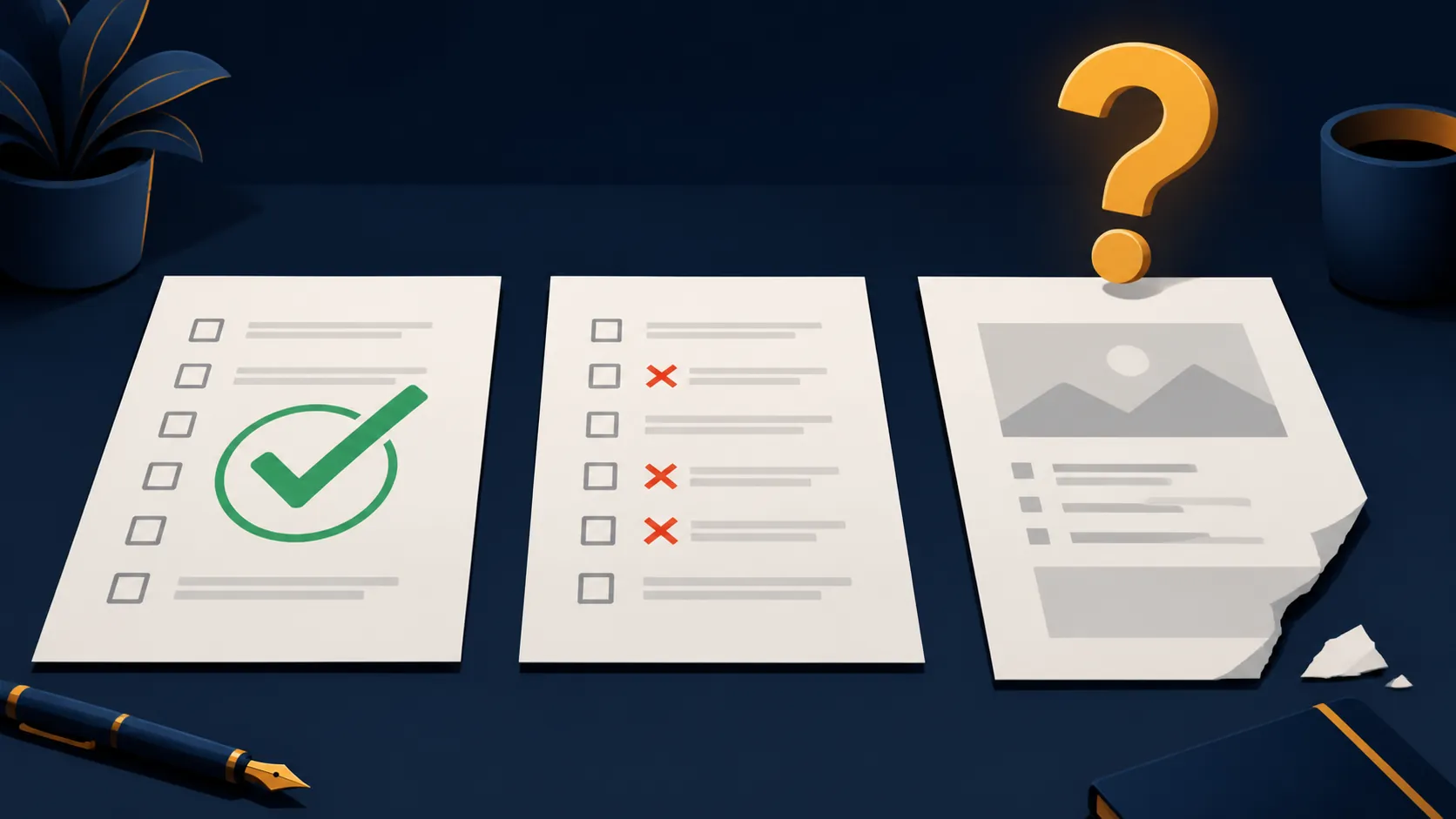
The headline scores are good. The format split is the warning.
The radiology study is the cleanest place to see the problem. A 72.0% overall score from DeepSeek-V3 against ChatGPT-3.5’s 55.6% makes DeepSeek look like a serious exam tool, not a toy. Then the item formats separate: 87.1% on single-choice questions, 55.7% on multiple-choice questions, and 68.0% on case-analysis questions. [1]
That is the difference between a useful study partner and a dangerous answer key. Single-choice items often reward recognition, recall, and one clean decision. Multi-answer and case items ask the model to keep several conditions active at once, reject tempting partial truths, and notice when two or three facts must all be true together. A student using DeepSeek for “what does this term mean?” is assigning a different job than a student asking it to adjudicate a passage, a multi-select trap, or a clinical-style scenario with exceptions.
The same pattern shows up less neatly, but still visibly, in the other studies. DeepSeek-R1’s 92.59% on USMLE sample items is impressive, especially with high agreement across repeated runs. But the study still observed hallucinations on some items. [2] In radiation oncology, the 84.0% overall score looks strong until landmark-trial questions are separated out: DeepSeek-R1 scored 74.2% there, while ChatGPT o1 scored 93.5%. [3] Landmark-trial questions are not just “remember the fact” questions. They test whether the answer can be tied to named evidence, treatment context, and a specific conclusion.
For exam prep, that makes the safe task boundary fairly clear. DeepSeek maps best to short, checkable work: vocabulary drilling, definition checks, formula recall, basic science review, fact flashcards, short-answer self-quizzing, and alternate explanations of a concept you can verify in an official source. It becomes less safe as the item asks for layered reasoning, multiple correct options, passage interpretation, data-table judgment, or a rationale where one missed condition changes the answer.
What this means for GRE, MCAT, SAT, ACT, and ASVAB
The following roles are inference from the medical-question and math-benchmark evidence above. They are not direct DeepSeek score reports for these exams. The useful question is not “Can DeepSeek answer hard things?” It can. The useful question is whether a student can safely give it a specific job inside a study plan.
| Exam | Best DeepSeek role | Use with caution | Do not assign it this job |
|---|---|---|---|
| GRE | Quant formula review, concept drills, vocabulary checks, and generating extra practice prompts after official or trusted questions are exhausted. | Quant explanations for multi-step word problems, especially if the model skips a condition or gives a shortcut without verifying constraints. | Final authority on GRE quant rationales or official-answer disputes. |
| MCAT | Basic science recall, amino acid / equation / pathway review, Anki-style self-quizzing, and asking for a second explanation of a concept already covered in a trusted MCAT source. | Passage-based science reasoning, CARS rationales, experimental design questions, and any item that depends on interpreting the passage rather than recalling outside content. | Replacement for AAMC materials, full-length review, or final answer explanations. |
| SAT | Grammar-rule review, algebra refreshers, vocabulary-in-context practice, and generating similar practice questions from a skill label. | Reading and Writing rationales where two answer choices are close and the evidence line matters. | Answer key for official SAT practice tests. |
| ACT | Math skill drills, grammar rules, punctuation review, and science-section vocabulary or graph-reading warmups. | ACT Science and Reading explanations when timing, comparison, or passage details drive the answer. | Final judge of why an official ACT answer is right or wrong. |
| ASVAB | Word Knowledge, Arithmetic Reasoning warmups, formula review, mechanical/electrical concept checks, and short recall quizzes. | Word problems with several quantities, mechanical scenarios with hidden assumptions, and electronics explanations that need diagram-level precision. | Replacement for official ASVAB practice or MOS-targeted score planning. |
GRE: useful for drills, not trusted for final quant logic
The GRE is where DeepSeek’s math promise is most tempting. Reported performance on AIME 2024 and MATH-500 suggests that DeepSeek-R1 can handle serious quantitative work in benchmark settings. [6][7] The R1-0528 update also matters because DeepSeek reported a jump on AIME 2025 from 70.0% to 87.5%, which is a reminder that model version changes can alter math behavior quickly. [8][9]
For GRE prep, that supports using DeepSeek to review formulas, ask for alternate explanations, generate extra algebra or probability drills, and test whether you can explain a method back. It does not support treating DeepSeek as the last word on a GRE Quant explanation. GRE word problems often punish one overlooked constraint. If DeepSeek gives a clean-looking solution, the student still has to check whether every condition in the question was used.
MCAT: strongest for content review, weakest where passages do the work
The MCAT is closer to the medical studies in subject matter, but that does not make the transfer automatic. USMLE sample items and radiation oncology in-service questions are not MCAT CARS passages, AAMC experimental-design items, or psychology/sociology questions written in MCAT style. DeepSeek-R1’s 92.59% on USMLE sample items and 84.0% on radiation oncology in-service questions justify interest, not blind transfer. [2][3]
The safer MCAT job is content reinforcement: “Quiz me on Michaelis-Menten terms,” “Give me five conceptual questions on fluids,” “Explain why oxidation state changes here,” or “Make me distinguish competitive from noncompetitive inhibition.” The unsafe job is letting DeepSeek settle a passage-based rationale without checking AAMC logic. The radiation oncology landmark-trial weakness is a fair warning: when the question depends on a specific evidence context, a strong overall model can still underperform. [3]
If you are building toward a high MCAT score, DeepSeek belongs beside a structured plan and official practice, not above them. For sequencing content review, full-lengths, and AAMC work, use it only as a support layer around a plan such as the site’s 12-week MCAT study plan.
SAT and ACT: good for skill labels, risky for close reading rationales
For SAT and ACT prep, the radiology format split is more relevant than the medical subject matter. Single-choice performance was strong; multiple-choice and case-analysis performance fell sharply. [1] SAT Reading and Writing and ACT English often look like simple single-choice items, but the hard questions are not pure recall. They depend on evidence, tone, sentence function, punctuation context, or why one almost-right answer is still wrong.
DeepSeek can be useful when the task is bounded: explain comma splices, generate five subject-verb agreement drills, review linear equations, or produce a short quiz on function notation. It is less trustworthy when asked to decide between two close reading answers without a verified official rationale. A model can sound especially convincing while misreading the exact sentence that controls the answer.
ASVAB: practical for recall and warmups, not enough for score-critical decisions
ASVAB prep is a better fit for DeepSeek when the student needs rapid, checkable review: Word Knowledge definitions, arithmetic operations, mechanical comprehension vocabulary, electronics basics, or formula reminders. Those tasks resemble the fact-recall and short-question strengths visible in the medical studies.
The risk appears in Arithmetic Reasoning word problems and mechanical scenarios. If a problem requires tracking units, hidden assumptions, diagram relationships, or several quantities at once, DeepSeek’s answer should be treated as a draft explanation. ASVAB scores can affect job qualification paths, so “the AI sounded sure” is not a good enough verification method.
Hallucination is not the whole story, but it changes the job description
The right conclusion is not that DeepSeek is bad. The score evidence is too strong for that. The better conclusion is that DeepSeek can be accurate enough to help and still unstable enough to require verification.
Vectara’s HHEM 2.1 benchmark reported a 14.3% hallucination rate for DeepSeek-R1, compared with 3.9% for DeepSeek-V3 and 2.4% for GPT-o1. [5] That is not an exam score, and hallucination rates change by task and method. Still, it lines up with what the exam-question studies make visible: strong performance does not eliminate fabricated or unsupported reasoning.
In practical study terms, hallucination means the student should separate three activities that often get blurred together:
- Generating practice: usually safe if the output is treated as extra drilling, not official-style scoring.
- Explaining a concept: useful when the student checks the explanation against a textbook, official guide, course notes, or trusted prep source.
- Deciding the correct answer: risky when the question is official, passage-based, multi-step, multi-answer, or tied to a target score.
Cost and speed: cheap help is still not free verification
Cost is one of DeepSeek’s real advantages. In the radiation oncology study, the 600-question run cost about $1.56 with DeepSeek-R1 versus $37.96 with ChatGPT o1, using a February 2025 pricing snapshot. DeepSeek was slower in that same comparison, taking about 59 seconds per question versus 10 seconds. [3]
For a student, low cost makes DeepSeek attractive for repetition: more quizzes, more rephrased explanations, more “test me again on this weak area.” The slower per-question time is annoying, but not fatal for review. The real cost is verification time. If a wrong explanation teaches a false shortcut two weeks before test day, the cheap answer was expensive.
Version drift: the model name is not enough
DeepSeek results should be read with version labels attached. The strongest exam-question studies above involve DeepSeek-V3 and DeepSeek-R1. DeepSeek’s May 2025 R1-0528 update reported better AIME 2025 performance and claimed reduced hallucination. [8][9] That is good news for quantitative users, but it also proves the point: a score from one model build should not be casually transferred to another.
The same caution applies in reverse. A weak result on one old benchmark does not automatically condemn a newer model. A strong result on R1 does not automatically certify V4 Flash. If you want the site’s hands-on study trial of the newer model, use the companion article, I Tested DeepSeek V4 Flash for Studying. This article is the peer-reviewed-evidence companion for V3/R1 exam-question performance.
One access note before you build around it
Some students may not be allowed to use DeepSeek on school devices or networks. The University at Buffalo announced a DeepSeek ban affecting university devices and networks in 2026, George Mason University issued a DeepSeek ban notice for university devices and networks, and several governments have restricted or banned DeepSeek use in official contexts. [11][12][13] That is a gating issue, not the main accuracy story. If your school, employer, testing program, or device policy blocks it, pick another AI study backup rather than trying to route around the rule.
For continuity planning when an AI tool goes down or becomes unavailable, the site’s AI study backup plan is more useful than building a one-tool study system.
The safest DeepSeek role in an exam plan
DeepSeek earns a place as a verify-everything drill partner. That role is useful enough to matter and limited enough to keep a student from outsourcing judgment.
- Use it to generate extra practice prompts after official material has taught you the question style.
- Use it to quiz recall: formulas, definitions, vocabulary, basic science, grammar rules, and mechanical concepts.
- Use it to ask for a second explanation when a trusted source already gives the correct answer.
- Use it to stress-test weak concepts by asking for common traps, counterexamples, and “why not the other answer?” practice.
- Do not use it as the final rationale writer for official questions.
- Do not let it replace official GRE, MCAT, SAT, ACT, or ASVAB practice.
- Do not let it decide that an official answer key is wrong unless you verify through an official explanation or a trusted human instructor.
If you are comparing AI tools rather than only judging DeepSeek, the site’s Claude tested article and Claude vs ChatGPT exam-prep comparison give useful contrast. The boundary stays the same: AI tools sit beside official materials, never above them.
The earned verdict is versioned and conditional: DeepSeek is strong enough to use, risky enough to verify, and not directly tested enough on GRE, MCAT, SAT, ACT, or ASVAB to deserve an exam-authority label.
References
- Performance of DeepSeek-V3 on radiology board-style examination questions — Medical Education Online, 2025.
- DeepSeek-R1 versus ChatGPT on USMLE sample items — Scientific Reports, 2026.
- Large language model performance on radiation oncology in-service examination questions — Advances in Radiation Oncology.
- DeepSeek-R1 and Microsoft Copilot performance on pediatric surgery in-training examination questions — Pediatric Surgery International, 2025.
- DeepSeek-R1 hallucinates more than DeepSeek-V3 — Vectara.
- DeepSeek-R1: Incentivizing Reasoning Capability in LLMs via Reinforcement Learning — Galileo.
- DeepSeek: A Breakthrough in AI for Math and Everything Else — Math Scholar, February 2025.
- DeepSeek API Docs: Updates — DeepSeek API Docs.
- DeepSeek-R1-0528 — Hugging Face, May 2025.
- Putting DeepSeek to the test: how its performance compares against other AI tools — The Conversation.
- DeepSeek ban — University at Buffalo, 2026.
- DeepSeek AI ban on university devices and networks — George Mason University.
- Which countries have banned DeepSeek and why? — Al Jazeera, February 6, 2025.
Authoritative source
No specific exam hub matched
Browse the exam hubs directory for the authoritative plan on any of the five exams.
Report an error in this tool's output
Found something this tool got wrong beyond what's documented above? Report it so the accuracy log stays current.
Comments
Join the discussion with an anonymous comment.