
Best Noise-Cancelling Headphones for Studying and Focus
Learn how noise-cancelling headphones improve concentration through two science-backed mechanisms, plus evidence-based recommendations for the best models to buy in 2026.
Best for: reading, problem-solving, memorization
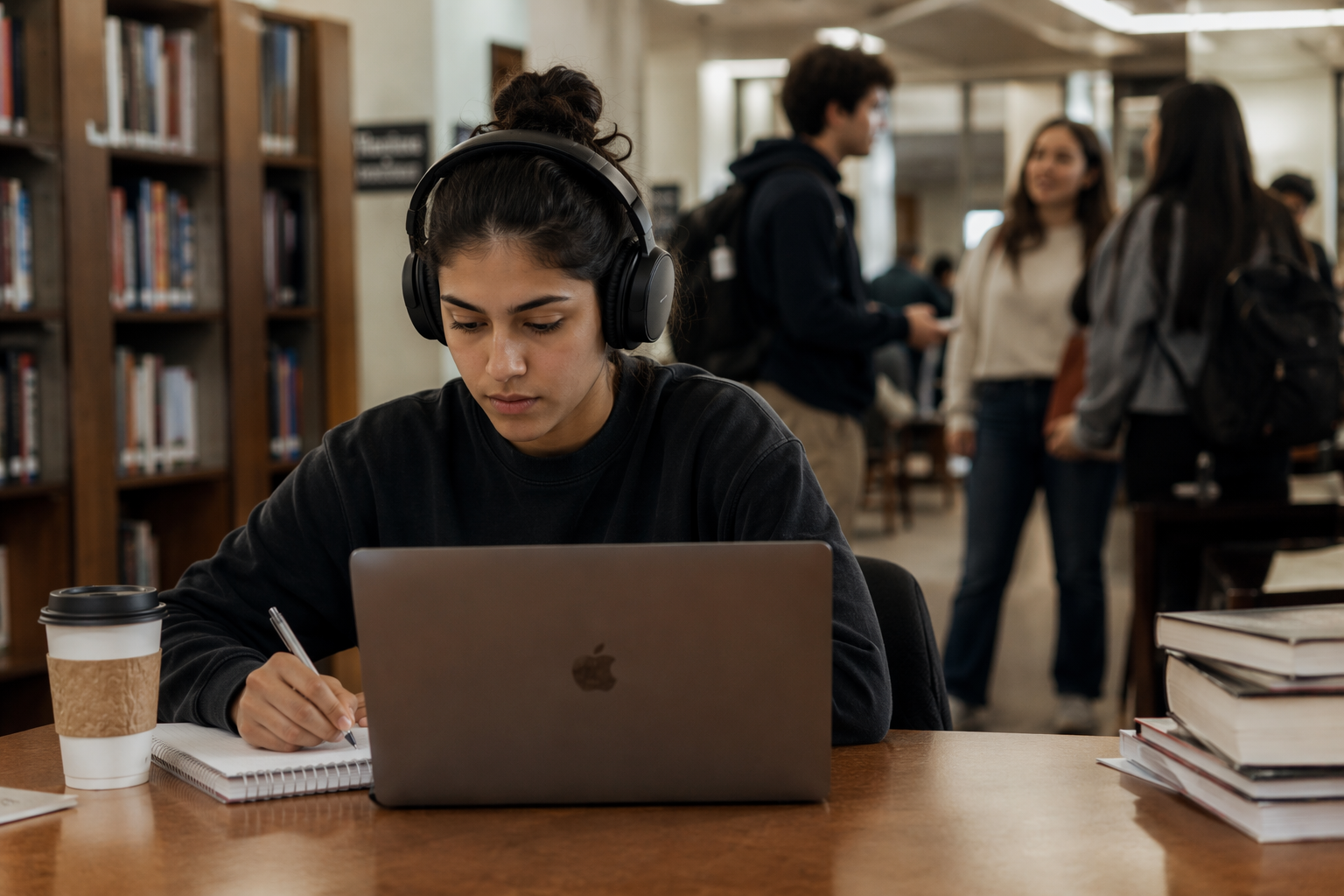
Noise-cancelling headphones can help with studying, but not because they magically create discipline. They help when they do two fairly specific jobs: reduce the speech and environmental noise that keeps stealing working memory, and let you choose a predictable sound environment for the task in front of you. That difference matters if you are deciding whether the best headphones for studying and concentration are worth paying for, especially when one purchase has to cover the library, a shared apartment, a bus ride, and the hour before an exam.
The strongest evidence is not that headphones make every student more productive in every setting. It is narrower and more useful: in noisy open-plan conditions, active noise cancellation reduced distracting background speech and improved working memory and serial-recall performance in a controlled study published in Frontiers in Built Environment in 2022.[1] That is exactly the kind of cognitive work students use when solving multi-step problems, holding a definition in mind while applying it, or testing themselves instead of rereading notes.
What headphones can actually change
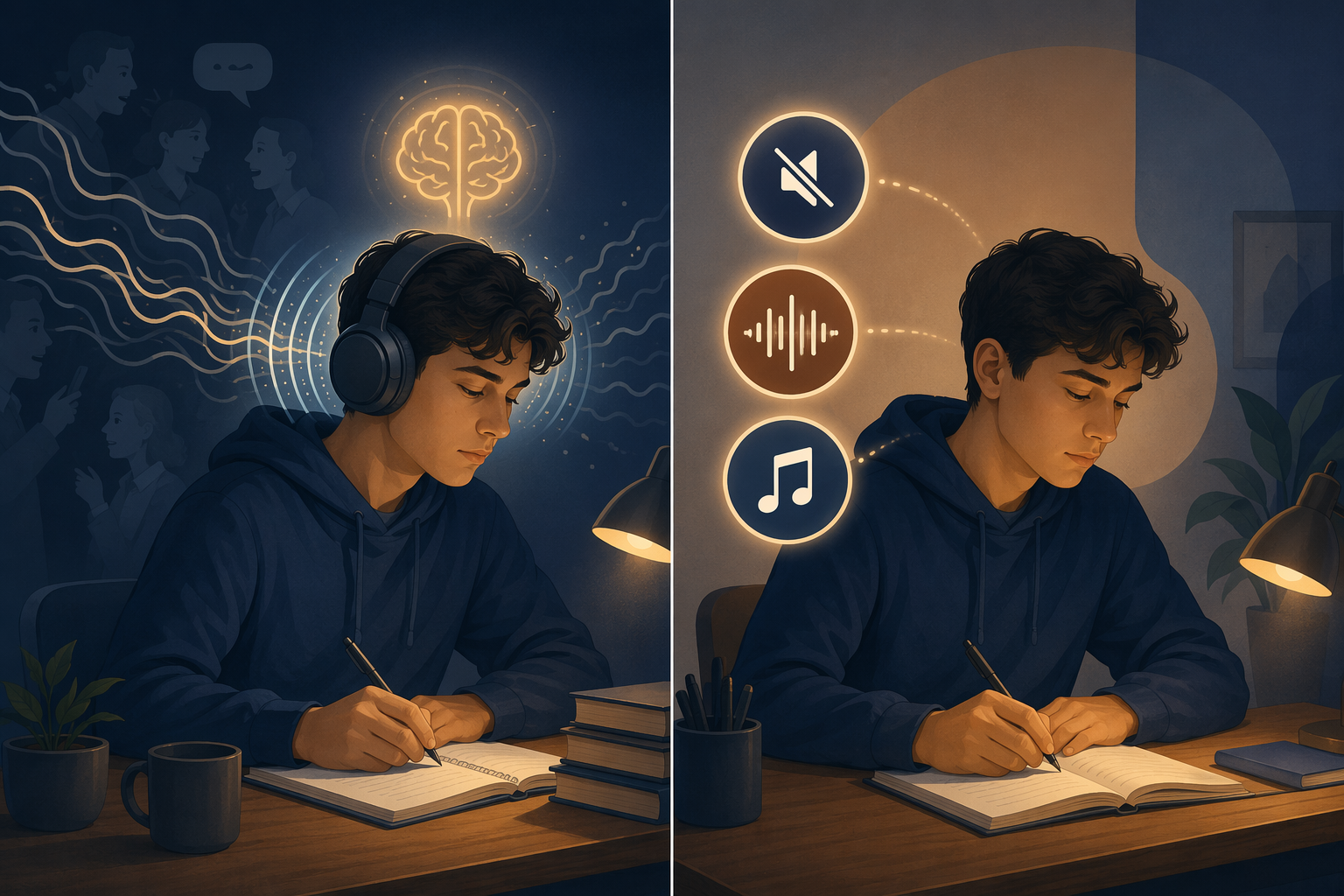
There are two separate mechanisms here, and mixing them up leads to bad buying advice.
| Mechanism | What changes | Why it matters for studying |
|---|---|---|
| Noise reduction | ANC lowers incoming environmental sound, especially steady low-frequency noise and some background speech | Fewer interruptions compete with working memory during reading, problem solving, and recall |
| Audio control | You choose silence, brown noise, or low-tempo instrumental music instead of whatever the room is doing | The sound environment becomes predictable, so you can match it to the difficulty of the task |
The first mechanism is about subtraction. The second is about replacement. A good study setup may use both, but they are not the same thing. Strong ANC can make a cafe less chaotic even if you play nothing. Brown noise can mask a roommate’s keyboard even on modest headphones. Instrumental music can keep a long review session from feeling endless, but it can also make a difficult proof or dense reading assignment harder if it starts competing for attention.
That is why a headphone recommendation for students should start with behavior, not brand status. The question is whether the headphones protect the kind of attention your work requires. If they make the room quieter but clamp too hard, run out of battery, or make every playlist sound dramatic enough to become its own event, they are not doing the study job well.
Noise cancellation is most useful when the problem is speech
Students usually complain about “noise,” but the most annoying version is often intelligible speech: two people talking beside the group-room wall, a roommate on a call, someone explaining an assignment at the next table. Speech is hard to ignore because the brain keeps checking whether it contains information. In the Frontiers study, ANC reduced distracting background speech and was linked with better working memory and serial recall in open-plan settings.[1]
That does not prove headphones will raise a grade. It does support a more modest and more practical claim: reducing unwanted speech can preserve mental bandwidth during tasks that require holding and manipulating information. If you are using retrieval practice instead of rereading notes, that bandwidth matters. Self-testing asks you to pull an answer from memory, compare it with feedback, and correct the gap. A half-heard conversation can break that chain.
Measured ANC also keeps the purchase conversation honest. Wirecutter’s 2026 testing reported average cancellation of 26.2 dB for the Sony WH-1000XM6 and 22.0 dB for the budget Soundcore Space One in the airplane band.[2] The important part is not just that Sony measured higher. It is that a sub-$100 model crossed a level of ANC performance that can be serious enough for study use, depending on the student and the environment.[2]
There is a comfort caveat. Some people feel pressure, dizziness, or the odd “eardrum suck” sensation with strong ANC. If that happens, more cancellation is not automatically better. A slightly weaker ANC setting that you can wear for two hours beats a flagship mode you keep removing every 15 minutes.
Controlled audio is different from “study music”
Once the room is under control, the next decision is what, if anything, to play. National University’s 2026 discussion of music and studying points to 60–70 BPM music as a range associated with helping students study longer and retain more information.[3] That is useful, but it should not be treated like a universal productivity spell. It is a controlled audio option, best tested against the kind of work you actually do.
For repetitive or moderately demanding work, low-tempo instrumental music can make a session easier to sustain. For dense reading, proofs, foreign-language memorization, or exam-style recall, silence or steady noise may work better because there is less musical structure to process. Lyrics are especially risky when the task already depends on language.
Brown noise deserves separate treatment because it is not trying to entertain you. Cleveland Clinic describes brown noise as a bass-heavy sound that may help focus and relaxation by masking higher-frequency distractions.[4] Health.com also reports clinical psychologist commentary that noise-cancelling headphones may help some people with ADHD focus by blocking distracting background sounds.[5] Both points are promising for students who are easily pulled toward small noises, but they still describe possibilities, not guaranteed results.
- Use silence or ANC-only mode for hard reading, practice exams, proofs, and recall-heavy work.
- Use brown noise when background chatter, typing, dishes, traffic, or HVAC noise keeps grabbing attention.
- Use low-tempo instrumental music for longer review blocks, flashcard cleanup, planning, and lower-stakes assignments.
- Avoid new playlists during demanding work; novelty is still a distraction even when the track has no lyrics.
The study-first buying criteria
For studying, the spec sheet is only useful when it predicts fewer broken sessions. Codec support, luxury materials, brand history, and microphone comparisons matter less than four things: ANC strength, low-distraction sound, battery life, and transparency mode.
Strong ANC, but not at any cost
A useful target is ANC that performs around the low-20s dB range or better in measured testing, because that is where budget and flagship models both start looking relevant for loud study environments. Wirecutter’s 26.2 dB Sony WH-1000XM6 measurement and 22.0 dB Soundcore Space One measurement make the range concrete rather than emotional.[2] If your worst study setting is a commuter train or a dorm lounge, prioritize ANC. If your main setting is already a quiet library, comfort may matter more.
Neutral or balanced sound
A study headphone should disappear. Heavy bass can make brown noise feel boomy and tiring. Sharp treble can make instrumental playlists feel more active than intended. A neutral or balanced tuning is boring in the best way: it lets you hear the focus sound you chose without turning it into the main event.
Battery that survives the day you actually have
For students, 30+ hours is a sensible floor because charging discipline gets worse during heavy weeks. SoundGuys publishes battery testing across noise-cancelling models, which is more useful than relying only on manufacturer claims when comparing real-world endurance.[6] Budget roundups also track long-lasting under-$100 options, which matters if your headphones need to survive campus, commuting, and evening study without becoming another device to babysit.[7]
Transparency mode you will actually use
Transparency mode is not a luxury feature when you study around other people. It lets you hear a librarian, a roommate, a train announcement, or a tutor without fully removing the headphones and losing the session. A clumsy transparency mode turns shared spaces into a choice between isolation and constant interruption. A good one makes headphones less socially awkward and more practical.
Best noise-cancelling headphones for studying in 2026
Prices change quickly, so treat this section as Q3 2026 guidance rather than permanent pricing. Price positioning was checked as of 2026-07-18. The recommendations below use the evidence-backed criteria first, then match models to student scenarios.
| Student scenario | Best fit | Why it makes sense |
|---|---|---|
| Loud dorms, commuting, shared apartments | Sony WH-1000XM6 | Highest cited ANC measurement here, strong all-around study tool if the price is manageable |
| Budget students who still need real ANC | Soundcore Space One | Measured ANC close enough to be credible for studying while staying in the under-$100 class |
| Long study days and work sessions | Models with independently tested 30+ hour battery life | Battery reliability matters more than small sound-quality differences during exam weeks |
| Students with sensory sensitivity or ADHD-related distractibility | Comfortable ANC headphones paired with brown noise or ANC-only mode | The setup can mask or reduce distracting background sound, but needs personal testing |
Sony WH-1000XM6: best if your environment is truly noisy
The Sony WH-1000XM6 is the clean recommendation for students who need maximum noise reduction and can afford it. Wirecutter measured its average cancellation at 26.2 dB in the airplane band, the strongest figure in the data used here.[2] That matters if your normal study location includes transit rumble, loud HVAC, hall noise, or people talking nearby.
The case against it is simple: not every student needs to pay flagship money to get a useful study setup. If you mainly study in a quiet room and only need help with occasional chatter, the XM6 may be more headphone than your problem requires. Also test the ANC feel before committing if you are prone to pressure discomfort.
Soundcore Space One: best budget study pick
The Soundcore Space One is the model that makes the 2026 market more interesting for students. Wirecutter reported 22.0 dB average cancellation for it in the airplane band, and it sits in the under-$100 budget range.[2] That combination challenges the old assumption that only premium headphones are serious enough for concentration.
This is the better choice if your budget is tight and your goal is practical control, not owning the most powerful ANC on the shelf. It is also a good reminder that the best headphones for studying and concentration are not always the most expensive headphones. They are the ones that reduce enough noise for your actual study locations and remain comfortable enough to stay on.
Battery-first picks: best for long campus days
Some students need the highest ANC. Others need headphones that are still alive after class, work, dinner, and a late library block. SoundGuys’ battery testing is useful here because real-world playback time can differ from idealized manufacturer numbers.[6] If two models are close enough on ANC and comfort, choose the one with more reliable tested endurance.
This is especially true if your study system depends on Pomodoro blocks, recorded lectures, brown noise, or lo-fi playlists. The headphones are not just an accessory at that point; they are part of the routine. If you are building a broader setup, a focused app stack can help keep the audio choice tied to timed work instead of turning it into playlist browsing. See Best Study Apps 2026: Build a Smarter 3–4 App Stack for that side of the workflow.
For ADHD or sensory sensitivity: prioritize comfort and repeatability
For students with ADHD or sensory sensitivity, the goal is not to find the loudest masking sound or the most intense ANC setting. It is to find a repeatable setup that lowers the number of unpredictable inputs. Cleveland Clinic’s brown-noise explanation and Health.com’s ADHD-focused discussion both support the idea that reducing or masking distracting background sound may help some people focus.[4][5]
The practical test is personal. Try ANC-only, brown noise, and low-volume instrumental music on the same type of task before deciding. If accountability also affects whether the headphones become a real study habit, pairing them with a check-in system or study partner can help; the Study Buddy App Landscape is a useful next stop for that problem.
How to test your focus setup before trusting it
A study headphone setup should earn its place in your routine. The easiest way to test it is not a perfect experiment, but it is better than guessing from vibes after one productive afternoon.
- Pick one task type: problem set, textbook reading, flashcards, writing, or practice questions.
- Use the same session length each time, such as one 25-minute Pomodoro block or one 45-minute deep-work block.
- Test ANC-only, brown noise, and low-tempo instrumental music on separate blocks.
- After each block, record output rather than mood: pages understood, problems completed, flashcards recalled, or paragraphs drafted.
- Note fatigue, pressure discomfort, and how often you removed the headphones.
The output measure keeps the setup honest. A playlist that feels amazing but slows your recall is not your recall playlist. Brown noise that feels boring but helps you finish practice problems may be doing exactly what it should. If you use Pomodoro timers, focus blockers, or spaced-repetition tools, keep them stable during the test so the audio is the main variable. For a broader study-tool setup, see Best Study Tools for College Students in 2026 or How to Build a Cohesive Online Learning Toolkit in 2026.
A simple pattern usually emerges after a few sessions. Hard verbal work often wants silence or brown noise. Longer review blocks may tolerate quiet instrumental music. Commutes and shared kitchens benefit most from ANC because the original environment is the problem. Group-adjacent study spaces need transparency mode because you still have to function around people.
What not to overbuy
Do not pay extra for features that do not change your study sessions. High-end codecs are nice if you care about audio fidelity, but they are rarely the reason you finish a chemistry set. Premium case materials do not reduce a roommate’s call. A famous brand does not matter if the clamp pressure makes you take the headphones off.
Do pay for the parts that remove friction: ANC strong enough for your worst regular environment, sound that does not fight the task, tested battery life that covers long days, and transparency mode that lets you stay polite and aware.
So, do noise-cancelling headphones actually help you study? They can, when the problem is auditory distraction and when you use them to create a controlled sound environment rather than a permanent soundtrack. The best study headphones combine sufficiently strong ANC, low-distraction sound, enough battery, and an audio setting you have tested against your own work.
References
- The effect of active noise-cancelling headphones on cognitive performance in noisy open-plan office environments, Frontiers in Built Environment, 2022
- Best Noise-Cancelling Headphones, Wirecutter, 2026
- Can Music Help You Study and Focus?, National University, 2026
- Brown Noise May Help You Focus and Relax, Cleveland Clinic
- Can Noise-Canceling Headphones Help People with ADHD Focus?, Health.com
- Best noise canceling headphones for work, SoundGuys, 2026
- 13 Best Headphones under $100, HeadphonesAddict
Apply This Method
Related Methods
- How to Use Retrieval Practice as a Study Method: A Weekly Schedule That Actually Works
Knowing about retrieval practice and spaced repetition separately isn't enough — this guide shows high school and college students how to combine them into a concrete weekly schedule, including which retrieval format to use for each content type, how to build spaced intervals into existing study time, and how to avoid the common mistakes that break the system.
- Digital vs. Paper Flashcards: What the 2025 Research Actually Says
A 2025 peer-reviewed study in Cogent Education shows digital flashcards produce statistically significant gains in learning and retention over paper. This article examines the full evidence base so students, educators, and self-directed learners can make an informed choice.
- How to Use Past Papers for Exam Revision: A Phased Timeline Approach
Learn when to start using past papers during your revision and how to progress from open-book practice to full timed mocks. This phased approach transforms past papers from a final panic check into a structured learning tool throughout your study cycle.
Comments
Join the discussion with an anonymous comment.