
Why the World Cup Is Played Every Four Years
This article explains why the FIFA World Cup follows a four-year cycle instead of a shorter schedule. It covers the historical origins in the ancient Olympiad, the multi-year qualification process for over 200 teams, host nation preparation timelines, player welfare concerns, and the economic logic of keeping the tournament scarce and prestigious.
Updated:
The short explanation is this: the World Cup is held every four years because football inherited a four-year international rhythm from the Olympic tradition, and that rhythm later became useful. It gives FIFA and the confederations enough time to qualify more than 200 national teams, gives hosts enough time to prepare stadiums and cities, leaves space in an already crowded football calendar, and preserves the rarity that makes the tournament valuable.
So the answer is not simply “tradition,” although tradition matters. It is also not that four years is a magical law of sport. The modern World Cup calendar is an institutional compromise: long enough to stage a global tournament properly, short enough that each generation of players still gets more than one realistic chance.
The four-year rhythm came from the Olympics
The word “Olympiad” originally referred to a four-year period connected to the ancient Greek Olympic Games, traditionally dated from 776 BCE. When the modern Olympic Games were revived in 1896, they also used a four-year cycle, turning that rhythm into the normal calendar for major international sport.[1]
Football’s World Cup grew out of that environment. The first FIFA World Cup was held in Uruguay in 1930, placed between the 1928 and 1932 Olympic Games rather than directly competing with them.[2] FIFA also pushed to separate elite international football from the Olympic program; football was excluded from the 1932 Los Angeles Olympics, a decision that helped the new World Cup stand on its own.[2]
That origin explains why four years was the starting point. It does not, by itself, explain why the schedule survived after the World Cup became far bigger than the event FIFA launched in 1930. The stronger explanation appears when you follow the tournament backward from the final match to the first qualifier.
The World Cup is not one month of football
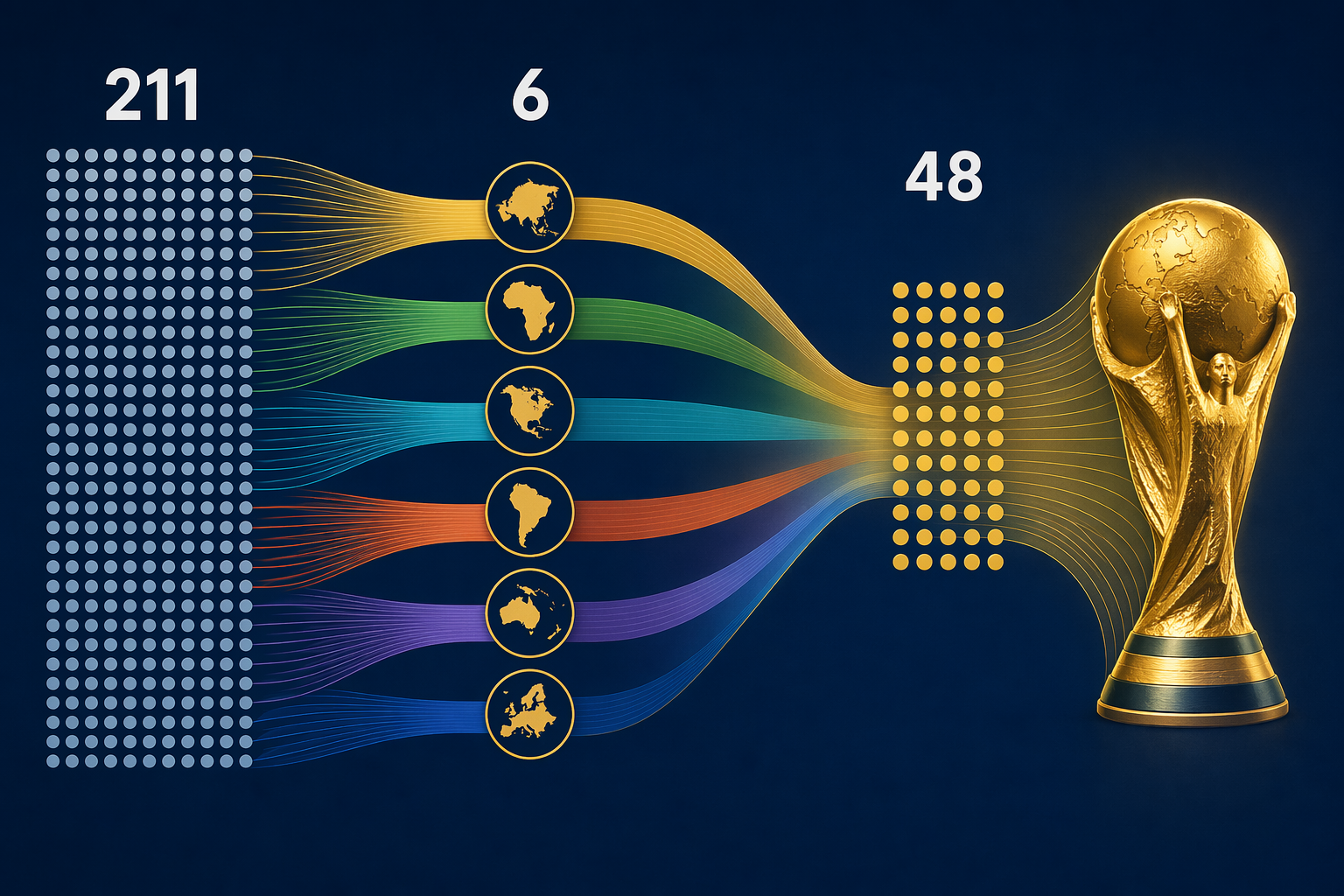
The televised tournament that most fans watch is the final stage. The competition system underneath it is much larger: more than 200 national teams compete through six continental confederations, and the qualification process usually stretches across roughly three years.[2][3]
That scale changes the question. If the World Cup were held every year, the world would not simply repeat the same four-week festival more often. It would have to keep restarting qualification while clubs, continental tournaments, domestic leagues, international breaks, and player recovery periods are already fighting for calendar space.
| Part of the system | What the four-year cycle makes room for |
|---|---|
| National teams | Multiple qualifying windows across confederations instead of one rushed selection period |
| Confederations | Regional formats that can fit geography, travel, and competitive balance |
| Host nations | Stadium, transport, accommodation, security, and city coordination |
| Players | Space between World Cups and the club seasons that employ them |
| Broadcasters and sponsors | A rare event with a long commercial runway |
Qualification also cannot be reduced to a single global knockout bracket without changing what the World Cup is. A national team in South America does not face the same travel pattern, opponent pool, or confederation structure as one in Asia, Africa, Europe, North America, or Oceania. The six-confederation model lets regions run competitions suited to their own membership, then feed teams into the final tournament.[2]
In 2026, the final field expanded to 48 teams.[2] Expansion made the finals more inclusive, but it did not remove the calendar problem. More teams at the end still require a qualification system at the beginning, and the larger final tournament adds matches rather than subtracting obligations.
Hosts need years, not months
A World Cup host is not only providing stadiums. It is coordinating transport, accommodation, training sites, broadcast facilities, policing, fan movement, visa and border procedures, volunteer systems, commercial zones, and city operations. The tournament looks like a sports event on television because a large civic project has already been running behind it.
Qatar is the clearest recent example of how much preparation can be involved. For the 2022 World Cup, Qatar built seven of its eight tournament stadiums from scratch over a 12-year preparation period.[3][4] That is an unusually construction-heavy case, not a template every host follows, but it shows why a short cycle would put real pressure on the host selection and delivery process.
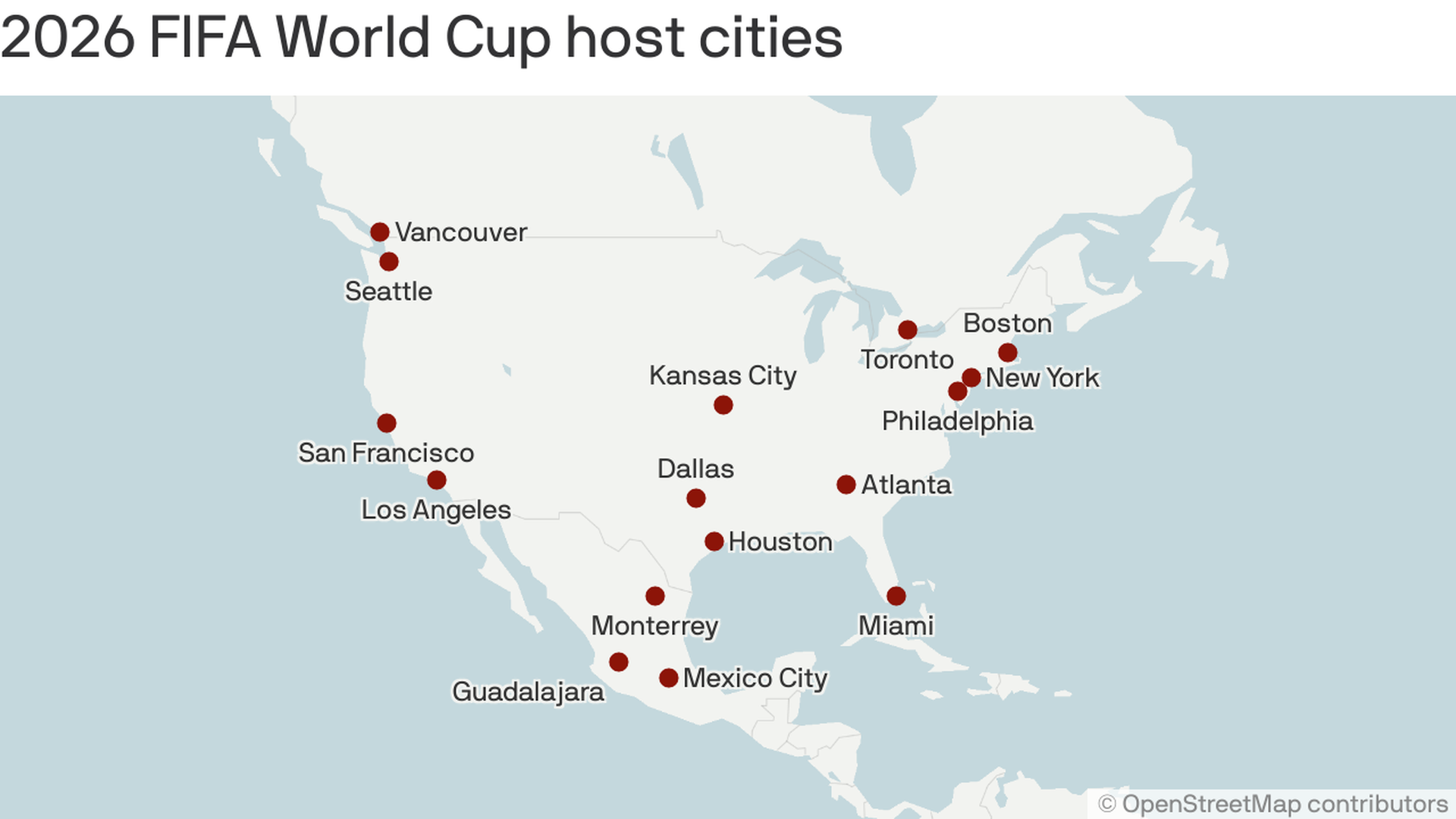
The 2026 World Cup used a different model: it was staged across 16 cities in three countries, the United States, Canada, and Mexico, with 104 matches.[2] That reduced some pressure because many venues and city systems already existed, but it added another kind of complexity. A three-country tournament needed cross-border coordination, long-distance travel planning, consistent tournament standards, and scheduling that worked across a continent.
This is where a four-year cycle becomes practical rather than ceremonial. Hosts need a long runway before the tournament, and FIFA needs enough time to inspect, adjust, schedule, sell, staff, and coordinate. A faster cycle would either narrow the range of possible hosts to places already prepared or increase the risk that cities are asked to deliver too much too quickly.
Players already live inside a crowded calendar
The World Cup is a national-team competition, but most elite players spend most of their working year with clubs. They move through domestic leagues, domestic cups, continental club competitions, preseason travel, international breaks, and national-team tournaments. Adding more World Cups would not create new bodies or new weeks of recovery.
That concern became central during the debate over a biennial World Cup. In 2021, a Saudi-led proposal pushed the idea of holding the men’s World Cup every two years. FIFA reported that more than 75% of its 211 member associations supported studying the change, while UEFA, CONMEBOL, leading managers including Jürgen Klopp, and player unions strongly opposed it.[2][4]
The opposition was not only sentimental attachment to the old calendar. A biennial World Cup would compress qualification, international tournaments, club seasons, and recovery into a tighter loop. UEFA president Aleksander Čeferin said in March 2022 that the proposal was “off the table,” a sign that the political resistance from powerful football institutions had become difficult to overcome.[2]
This is also why “just make it every two years” is less simple than it sounds. The event can be repeated more often on paper. In practice, the weeks have to come from somewhere: fewer qualifiers, shorter rest, disrupted club competitions, fewer other international tournaments, or a heavier load on the same athletes.
Scarcity is part of the tournament’s value
The World Cup is valuable partly because it is rare. A player may get only a few chances in a career. A host city may wait decades. A national team’s qualifying campaign can define an entire generation. Scarcity does not explain the calendar alone, but it helps explain why the calendar has been hard to change.
The audience figures are enormous, though they should be read carefully because the largest numbers come from FIFA’s own reporting as cited by secondary sources. The 2022 final was reported to have drawn about 1.5 billion viewers, and the tournament as a whole was reported to have reached roughly 5 billion people.[2][5]
FIFA also had a financial argument for more frequent tournaments. During the biennial debate, FIFA’s feasibility study projected an additional $4.4 billion in revenue from a two-year cycle.[3][4] That figure is a projection, not guaranteed money, and it does not settle the calendar question by itself. More events can mean more inventory to sell, but they can also dilute the attention that makes the inventory so valuable.
For students, this is a useful distinction: popularity is not the same as a reason to increase frequency. A final watched by a huge audience proves demand. It does not prove that the same demand would survive unchanged if the event became routine.
Why not annually or every two years?
An annual World Cup would collide most severely with qualification and the club calendar. There would be little time to finish one tournament, restart qualifying, prepare the next host operation, and let players return to normal club competition. It would likely stop feeling like the summit of international football and start functioning like a permanent calendar burden.
A biennial World Cup is more plausible, which is why it has been seriously discussed. But the 2021 debate showed the trade-off. The possible gain was more frequent global events and projected revenue. The cost was pressure on qualification, existing continental championships, player workload, club competitions, and the tournament’s rarity.[2][3][4]
The current four-year cycle survives because it balances those pressures better than the alternatives. It is long enough for qualification and hosting, familiar enough for broadcasters and federations, and rare enough to make each edition feel like a global deadline rather than another recurring fixture.
The best explanation to remember is compact: the World Cup happens every four years because tradition started the rhythm, logistics made it durable, and scarcity keeps it powerful. That does not make the cycle unchangeable. It means changing it would require rebuilding much more than the date on the calendar.
References
- Why is the World Cup every four years? — Britannica.
- FIFA World Cup — Wikipedia.
- Why Is the FIFA World Cup Held Every Four Years? — Goal.com US.
- Why is the FIFA World Cup played every four years? — Sporting News.
- World Cup History: The Soccer Tournament From 1930 to 2026 — HISTORY.
Comments
Join the discussion with an anonymous comment.