
Why the Strait of Hormuz Conflict Matters to You
A clear student-friendly breakdown of the Strait of Hormuz: what it is, why a 21-mile waterway carries 20% of the world's oil, how the 2026 crisis made history, and why it affects gas prices and inflation everywhere.
Updated:
When gas prices jump, the first explanation often sounds far away: Iran, oil tankers, the Persian Gulf, the Strait of Hormuz. For a student trying to connect a headline to a family budget, the useful question is simpler: how can one narrow stretch of water affect the price of a commute, a delivery fee, or groceries?
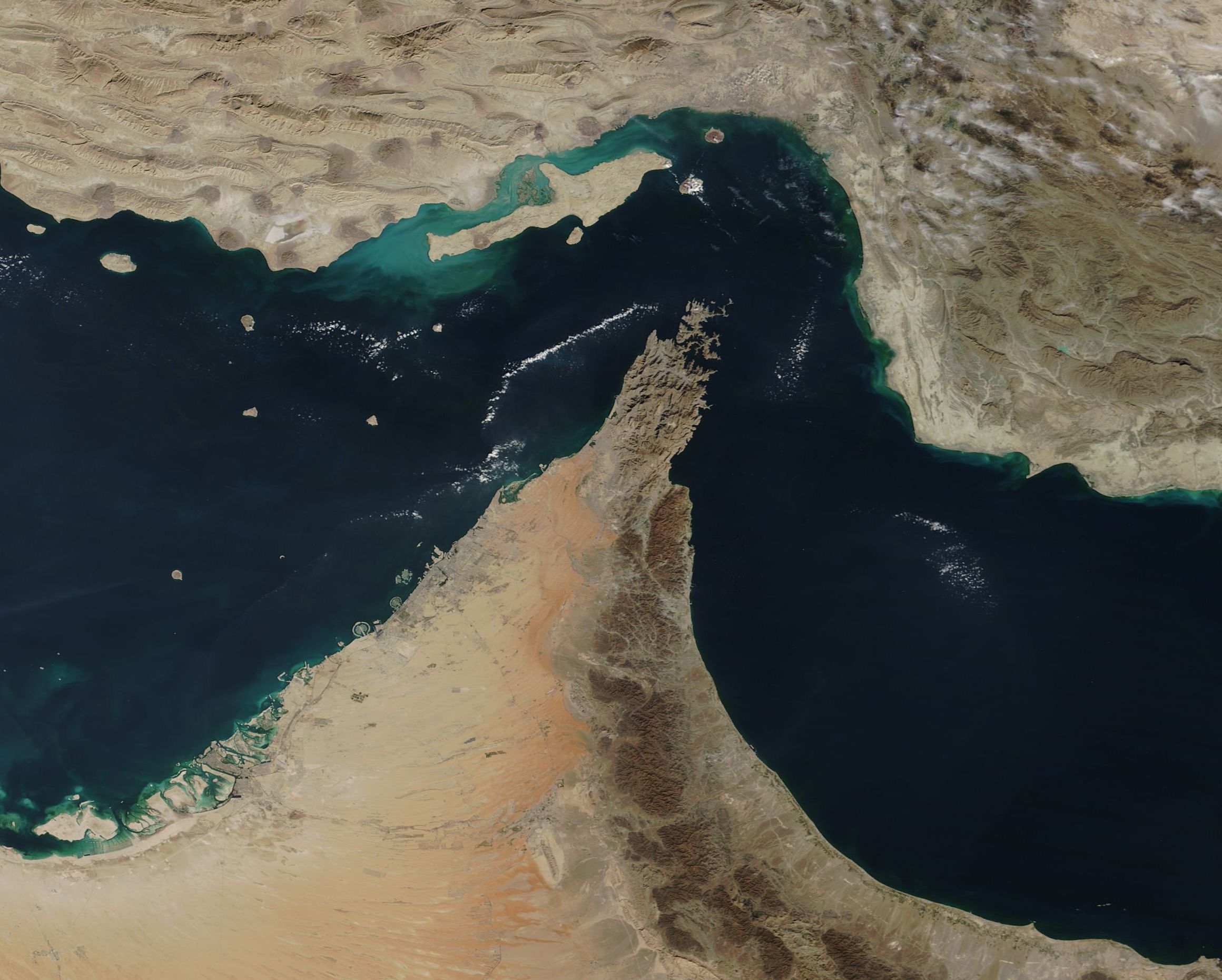
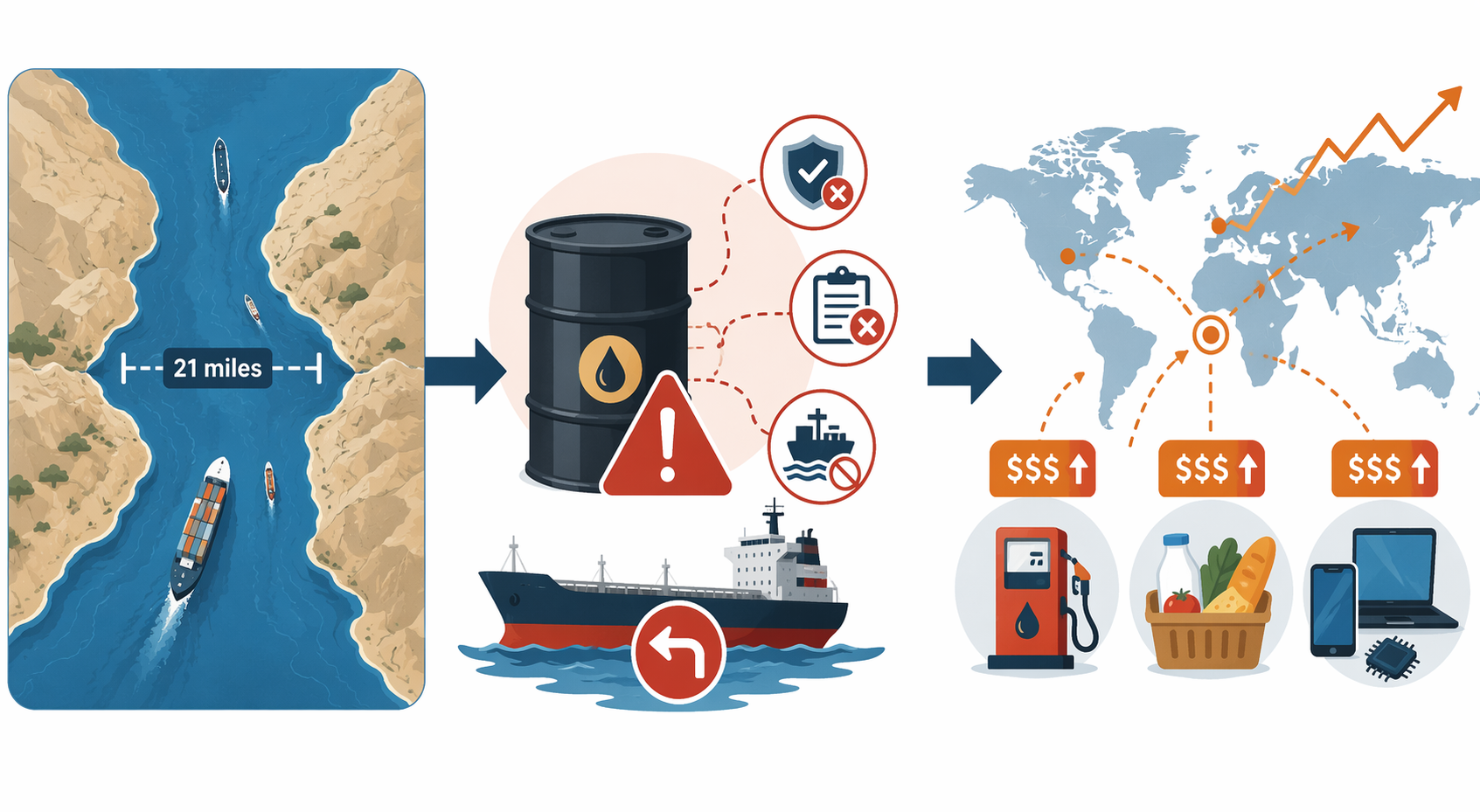
To explain the Strait of Hormuz clearly, start with the map. The strait is the narrow sea passage between Iran to the north and Oman and the United Arab Emirates to the south. It connects the Persian Gulf, where major oil-exporting countries load tankers, to the Gulf of Oman and then the wider Indian Ocean. At its narrowest point, it is only 21 miles wide, and the actual shipping lanes are much narrower: two miles for inbound traffic and two miles for outbound traffic, separated by a buffer zone.[1]
That geography gives the strait its power. Ships leaving the Persian Gulf cannot choose a wide-open ocean route instead. They have to pass through this narrow exit. Britannica describes the strait as linking the Persian Gulf with the Gulf of Oman and the Arabian Sea, which is why it matters not just locally but globally.[2]
Why 21 Miles Can Matter So Much
On an ordinary map, 21 miles may not look dramatic. In class, it is roughly the distance a commuter might drive from a suburb to a campus. On an energy map, it is a chokepoint: a place where a huge flow of goods is squeezed through a small space.
The scale is the part students should not skip. Roughly 20 million barrels of oil per day move through the Strait of Hormuz, about one-fifth of global daily oil consumption.[3] The route also matters for liquefied natural gas and, according to reporting summarized by The Conversation, a significant share of globally traded fertilizers.[4] That means the strait is tied not only to gasoline but also to electricity, shipping costs, and food production.
The important word is not just “oil.” It is “flow.” Oil is valuable only after it can be moved from where it is produced to where refineries, power systems, factories, trucks, and consumers need it. A field in the Gulf, a tanker at anchor, and a driver at a gas station are parts of the same chain. The strait is one of the places where that chain narrows.
The Chain From Chokepoint to Pump Price
The connection from the Strait of Hormuz to everyday prices is not mysterious, but it has several steps. Missing any one of them makes the news harder to understand.
| Step | What Happens |
|---|---|
| 1. Geography | A narrow strait carries a large share of daily oil flows. |
| 2. Conflict risk | Missiles, drones, mines, speedboats, or threats make ships and insurers recalculate the danger. |
| 3. Shipping response | Tankers slow, wait, reroute where possible, or refuse to sail. |
| 4. Market response | Traders expect less oil to arrive on time, so global oil prices rise. |
| 5. Consumer impact | Higher oil and transport costs show up in gasoline, delivery, groceries, electronics, and inflation. |
The biggest mistake is to imagine that a country can ignore the problem just because it produces oil of its own. Oil is a global commodity. A barrel does not have to come directly from the Persian Gulf to be priced in a market shaped by Persian Gulf risk. In a WBUR interview, maritime historian Sal Mercogliano explained this fungibility point: a disruption in one major supply route affects prices broadly, including in countries with domestic production.[7]
That is why a student in the United States can feel the effects of a conflict near Iran even though the United States is a major oil producer. If global buyers are suddenly competing for fewer reliable shipments, prices adjust everywhere. The price at the pump reflects crude oil markets, refining, taxes, distribution, and local competition, but the crude oil piece is large enough that a shock in a chokepoint can travel quickly into family budgets.
What “Closure” Means in 2026
As of July 19, 2026, the Strait of Hormuz crisis is still a fast-moving story. Any sentence about its current status may need updating. Still, one point is already useful for students: a chokepoint does not have to be blocked by a wall of ships to become functionally closed.
The 2026 disruption followed U.S.-Israeli strikes on Iran and Iranian threats that made the passage too risky for many commercial operators. CNBC reported that the strait was effectively closed not by a simple physical blockade, but by asymmetric threats such as missiles, drones, and speedboats. Within days, shipping traffic reportedly fell by 90% to 95%.[5]
That distinction matters. A tanker crew does not need to see a chain stretched across the water before deciding the trip is unsafe. An insurer does not need a permanent closure before refusing coverage or raising rates beyond what a voyage can bear. A shipping company does not need every vessel attacked before pausing departures. In maritime trade, risk itself can close a route.
This is also why headlines can be confusing. One article may say the strait is “open” because water is still physically navigable. Another may say it is “closed” because tankers are not moving at normal levels. For students, the better question is: are ships actually willing and able to use the route at normal volume?
Why Pipelines Cannot Simply Replace the Strait
Whenever a chokepoint appears in the news, someone asks the reasonable map question: can the oil just go another way? Some of it can. Not enough of it can.
Reuters identifies two major alternatives: Saudi Arabia’s East-West pipeline, with a capacity of about 7 million barrels per day, and the UAE’s Habshan-Fujairah pipeline, with a capacity of about 1.8 million barrels per day. Together, they cover less than half of the roughly 20 million barrels per day that normally pass through Hormuz.[6]
That is the practical reason the 20% figure matters. If there were many spare routes with enough capacity, the strait would still be important but less dangerous. The problem is not only that the waterway is narrow. The problem is that the alternatives are narrower in a different way: they cannot carry the same volume.
What Makes 2026 Historically Unusual
The Persian Gulf has seen tanker attacks before. During the Tanker War of the 1980s, 411 ships were attacked and 55 sank, yet the Strait of Hormuz was not fully closed.[8] That history is useful because it prevents two bad readings at once: pretending the region has never seen danger before, or assuming danger always produces the same result.
The 2026 crisis stands out because of the reported collapse in shipping traffic and the way risk moved through the system. If crews will not sail, if insurers will not insure, and if companies cannot justify the voyage, the effect can resemble closure even without a permanent physical barrier.
There have also been reports of an attempted Iranian “Persian Gulf Strait Authority” toll system, including possible charges of up to $2 million for very large crude carriers. Because that measure was reported as uncertain and may have been propaganda or short-lived, it should not be treated as a stable new rule. The safer lesson is narrower: in a crisis, states and armed actors may try to use geography not only to stop movement, but also to pressure, tax, or intimidate it.
How the Price Shock Reaches Students
The first visible effect is usually gasoline. If crude oil prices rise, gasoline often follows, though not always instantly and not by the same amount in every city. A student who drives to class, shares a family car, rides in a delivery-based household, or depends on relatives commuting to work may notice the change before they understand the headline.
The next effects are less obvious. Diesel moves trucks. Jet fuel moves air cargo and passengers. Ships carry manufactured goods. Natural gas and fertilizer affect food systems. When energy costs rise, businesses often face higher costs to produce, refrigerate, package, ship, and restock goods. Those costs do not land evenly, but they can spread widely.
- Gas: commuting, school drop-offs, part-time jobs, and family travel become more expensive.
- Groceries: fuel and fertilizer costs can raise pressure on food prices.
- Electronics: shipping and supply-chain costs can affect imported parts and finished products.
- Inflation: energy is built into many other prices, so a shock can make broader inflation harder to control.
Governments also react. The International Energy Agency’s reported 2026 release of 400 million barrels from strategic reserves was meant to calm markets by adding emergency supply. That kind of action can reduce panic, but it does not erase the geography. A reserve release buys time; it does not turn the Strait of Hormuz into a wider waterway or create new pipeline capacity overnight.[3]
How to Read the Next Headline
For a class discussion, the best move is to slow the headline down into map, movement, market, and household cost. First, locate the strait. Second, ask what normally moves through it. Third, ask whether ships are still moving at normal levels, not only whether the water is technically open. Fourth, ask what price changed and who has to absorb it.
Be careful with claims that sound too settled. The crisis is ongoing as of July 19, 2026. A shipping statistic, military claim, or price spike may be accurate for one week and outdated the next. The strongest conclusions are the structural ones: the strait is narrow, the oil flow is large, the substitutes are limited, and risk can change shipping behavior before a full physical blockade appears.
That is why the Strait of Hormuz matters to people who may never see it. Some places on the map are not just places. They are chokepoints where geography, risk, and global prices meet.
References
- Strait of Hormuz is the world's most important oil transit chokepoint, U.S. Energy Information Administration.
- Strait of Hormuz, Britannica.
- From chokepoint to crisis: The Strait of Hormuz and global oil markets, Brookings.
- What is the Strait of Hormuz and why is it so important for global shipping?, The Conversation.
- Strait of Hormuz crisis: U.S.-Iran-Israel war hits shipping, trade and oil, CNBC.
- The global chokepoint in the Strait of Hormuz, Reuters.
- History of the Strait of Hormuz and oil, WBUR On Point.
- Iran-Iraq tanker war redux? Why the Strait of Hormuz crisis is different, Al Jazeera.
Comments
Join the discussion with an anonymous comment.