
Remember Brazil's Five World Cup Wins
A structured reference covering Brazil's five World Cup titles with key facts, scores, star players, and a memorable year-gap pattern — designed for students studying sports history or general knowledge quizzes.
Updated:
To study Brazil’s World Cup wins, start with the complete answer before adding any story: Brazil won the men’s FIFA World Cup in 1958, 1962, 1970, 1994, and 2002. That gives Brazil five titles, more than any other national team; Germany and Italy are the next closest with four each.[1][2]
Brazil’s Five World Cup Titles at a Glance
This is the table worth copying into a quiz notebook. It keeps the tested facts together: year, host, final opponent, score, and the one detail that makes the title easier to separate from the others.
| Year | Host | Final opponent | Final score | Study hook |
|---|---|---|---|---|
| 1958 | Sweden | Sweden | Brazil 5–2 Sweden | Pelé, age 17, scored twice in the final and Brazil won its first title.[1][3] |
| 1962 | Chile | Czechoslovakia | Brazil 3–1 Czechoslovakia | Brazil defended the title; Garrincha became the main memory anchor after Pelé was injured earlier in the tournament.[1][4] |
| 1970 | Mexico | Italy | Brazil 4–1 Italy | Brazil won all six matches in the tournament, a clean study hook for the team often treated as the classic Brazil side.[1][4] |
| 1994 | United States | Italy | Brazil 0–0 Italy; Brazil won 3–2 on penalties | Romário led a tighter, lower-scoring title run, and the final was decided by penalties.[1][4] |
| 2002 | South Korea and Japan | Germany | Brazil 2–0 Germany | Ronaldo scored both goals in the final, a simple redemption hook after Brazil’s 1998 final loss.[1][5] |
The 4-8-24-8 Pattern
The easiest way to keep the five years in order is to rehearse the gaps between them: 1958 to 1962 is 4 years, 1962 to 1970 is 8 years, 1970 to 1994 is 24 years, and 1994 to 2002 is 8 years. That gives the pattern 4-8-24-8. It is not an official FIFA category or a historical theory; it is just a clean memory aid built from the title years.
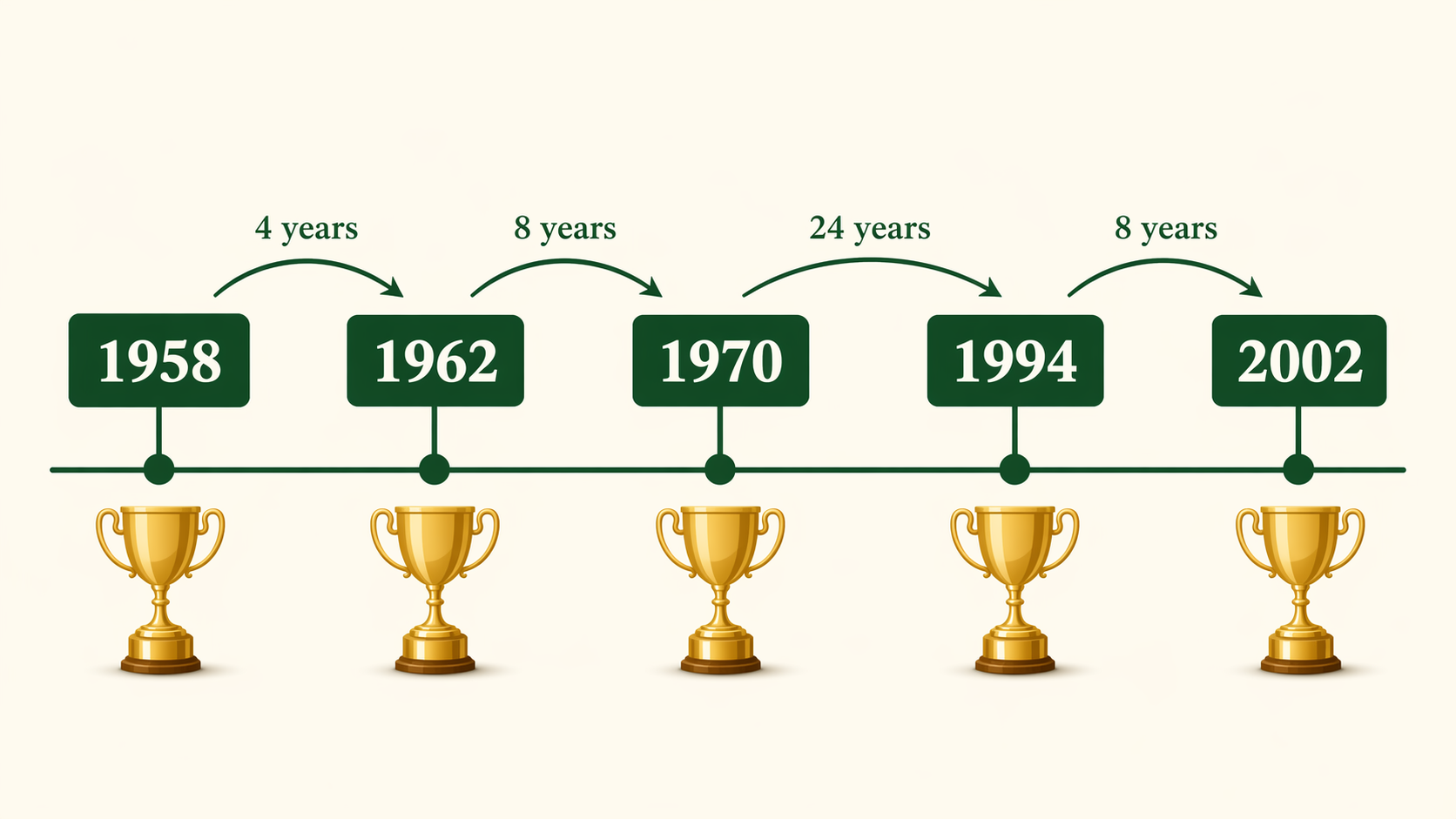
A useful rehearsal line is: first two close together, one more after eight, long wait, then one more after eight. In symbols, it looks like this:
1958 --4--> 1962 --8--> 1970 --24--> 1994 --8--> 2002The 24-year gap is the important warning label. Students often remember Brazil as a constant World Cup power and then accidentally place another title somewhere between 1970 and 1994. There was no Brazil World Cup win in 1974, 1978, 1982, 1986, or 1990. The next championship after Mexico 1970 was United States 1994.[1]
Five Title Signatures to Keep the Years Separate
1958: First Title, Sweden, Pelé at 17
The 1958 title is the origin point: Brazil’s first World Cup win, played in Sweden, finished with a 5–2 victory over host nation Sweden in the final. The flashcard detail is Pelé. He was 17 and scored twice in the final, which also makes this title the easiest one to attach to a player-age memory.[3]
For quiz purposes, do not overcomplicate this one. Write: 1958, Sweden, beat Sweden 5–2, Pelé age 17. If a question asks why 1958 matters beyond the trophy, the answer is that it began Brazil’s World Cup-winning era and introduced Pelé on the championship stage.
1962: Back-to-Back Defense in Chile
The 1962 title is best remembered as the repeat. Brazil won again four years after 1958, this time in Chile, beating Czechoslovakia 3–1 in the final.[1] The clean contrast is that 1958 is Pelé’s emergence, while 1962 is Brazil proving the first title was not a one-off.
Garrincha is the player hook for 1962. Pelé was injured earlier in the tournament, and Garrincha became the name most students should attach to Brazil’s title defense.[4] If the year 1962 appears in a matching question, think: Chile, Czechoslovakia, 3–1, back-to-back, Garrincha.
1970: Mexico and the Six-Win Team
The 1970 title is the one most likely to attract grand descriptions, but the study facts are simple: host Mexico, final opponent Italy, final score Brazil 4–1 Italy.[1] Brazil won all six matches in the tournament, which is the neat statistical hook to write next to the year.[4]
This is also the third title, so it completes Brazil’s first championship cluster: 1958, 1962, 1970. After that comes the long 24-year gap. If you remember only one structural point about 1970, make it this: it closes the early run and comes before the long wait.
1994: The Long Wait Ends in the United States
The 1994 title is the one that breaks the drought. Brazil had not won the World Cup since 1970, then won in the United States by beating Italy in a final officially recorded as 0–0 after extra time, with Brazil winning 3–2 on penalties.[1]
Romário is the name to attach to this campaign. The hook is not a huge final score or a teenage breakout; it is a tighter title run ending in a penalty shootout. That makes 1994 easy to distinguish from 1970, even though both finals were against Italy: 1970 was 4–1 in Mexico, 1994 was penalties in the United States.[1][4]
2002: Ronaldo’s Final and Brazil’s Fifth Star
The 2002 title is the fifth and, so far, Brazil’s most recent World Cup win. The tournament was hosted by South Korea and Japan, and Brazil beat Germany 2–0 in the final.[1][5]
Ronaldo scored both goals in that final.[5] That matters for memory because Brazil had lost the 1998 final before returning to win in 2002, giving the tournament a clear redemption label. On a flashcard, write: 2002, South Korea/Japan, Germany, 2–0, Ronaldo two goals.
Quick Comparison: Do Not Mix These Pairs
A lot of mistakes come from mixing years that share a surface feature. Brazil played Italy in both the 1970 and 1994 finals, and Brazil’s first two wins sit close together. Use the comparison instead of trying to memorize each title in isolation.
| Easy mix-up | How to separate them |
|---|---|
| 1958 vs. 1962 | 1958 is the first title in Sweden with Pelé at 17; 1962 is the title defense in Chile with Garrincha as the main hook. |
| 1970 vs. 1994 | Both finals were against Italy, but 1970 was a 4–1 win in Mexico; 1994 was 0–0 and then a penalty shootout in the United States. |
| 1994 vs. 2002 | 1994 ends the 24-year wait; 2002 gives Brazil its fifth title with Ronaldo scoring twice against Germany. |
Brazil’s Wider World Cup Record, Kept Brief
The five titles are the main study target, but two record-context facts are worth keeping nearby. Brazil has appeared in every men’s World Cup from 1930 through 2026, a run of 23 consecutive tournaments.[4][6] Brazil also reached three consecutive World Cup finals in 1994, 1998, and 2002, winning the first and third of those appearances.[4]
The 2026 note should stay in its proper place. Brazil’s listed 2026 finish was a Round of 16 exit to Norway, but that is context for Brazil’s all-tournament record, not an addition to the wins list.[6] For this article’s study purpose, the championship sequence still stops at 2002.
A Flashcard Version
- 1958 — Sweden — beat Sweden 5–2 — first title — Pelé age 17.
- 1962 — Chile — beat Czechoslovakia 3–1 — back-to-back title — Garrincha.
- 1970 — Mexico — beat Italy 4–1 — won all six matches.
- 1994 — United States — beat Italy on penalties after 0–0 — Romário — long wait ends.
- 2002 — South Korea/Japan — beat Germany 2–0 — Ronaldo scored both goals — fifth title.
Then add the gap line: 4-8-24-8. The full memory package is five wins, five signatures, and one gap pattern: 1958 Pelé, 1962 Garrincha, 1970 six wins, 1994 Romário and penalties, 2002 Ronaldo.
References
- FIFA World Cup winners list, Olympics.com
- What Country Has Won the Most World Cups?, Britannica
- 1958 FIFA World Cup Final, Wikipedia
- Brazil at the FIFA World Cup, Wikipedia
- 2002 FIFA World Cup Final, Wikipedia
- Brazil World Cup History, Heavy.com
Comments
Join the discussion with an anonymous comment.