
What Causes Dirty Rain? A Science Explanation for Students
Every raindrop forms around a microscopic speck of dust or salt. This article explains what causes 'dirty rain' and why, in a sense, all rain is technically a little dirty — a surprising science lesson for middle school students.
Updated:
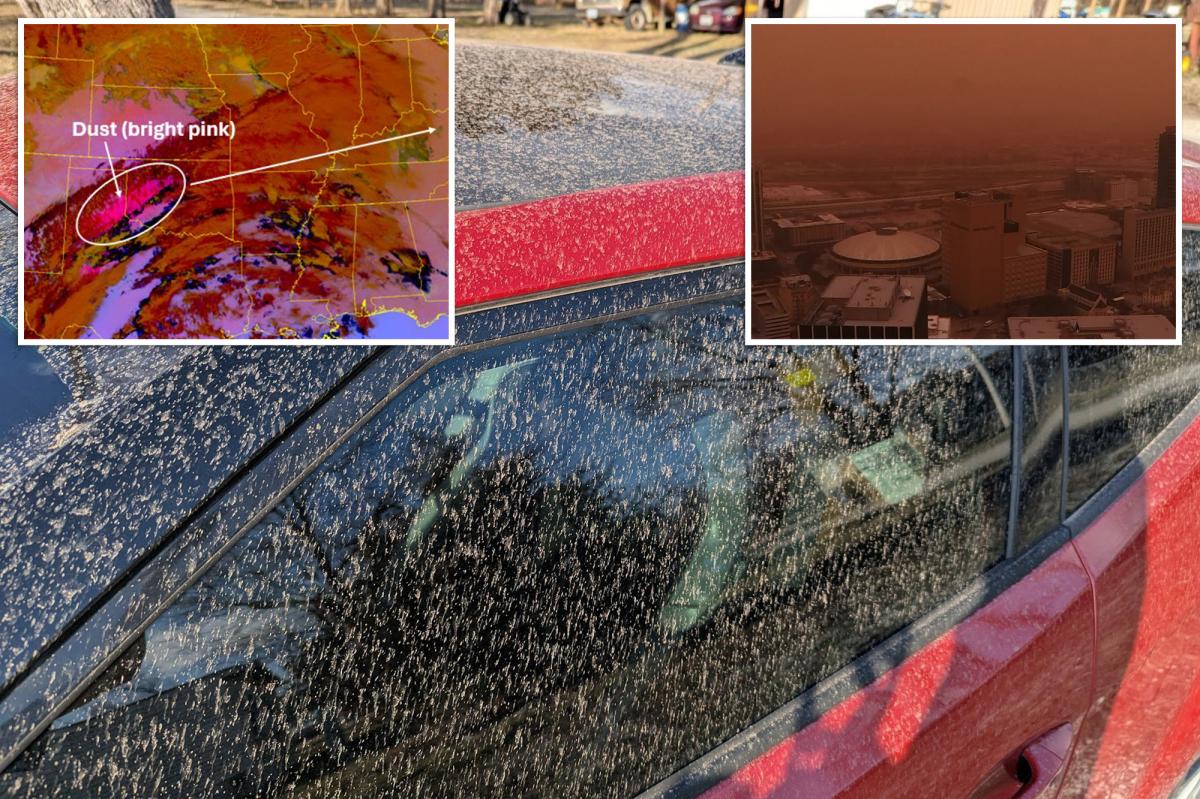
A car windshield after a strange rainstorm can look like someone flicked muddy paint across it. The spots dry tan or brown. The sidewalk may have a dusty film. A windowsill that was clean yesterday suddenly has little rings of grit. It is a fair question to ask: what got into the rain?
The short answer is that “dirty rain” is not a separate kind of rain. It is ordinary rain carrying enough visible dust, soil, ash, or soot to leave residue behind. The more surprising answer is that every normal raindrop begins with a tiny solid particle anyway. Rain can look clean because the starting speck is extremely small. Dirty rain happens when there are many more visible particles riding along.
The tiny speck that starts a raindrop
Water vapor in the air does not usually turn into cloud droplets by itself. It needs a surface to collect on, the way steam in a bathroom collects on a mirror. In the atmosphere, that surface is often a microscopic bit of dust, sea salt, smoke, or another particle. Scientists call it a cloud condensation nucleus. UCAR’s student explanation of raindrop formation describes this basic step: water vapor condenses onto tiny particles in the air to make cloud droplets.[1]
That means a raindrop is not pure water from the first moment of its life. It begins as water gathered around a speck. That is not a pollution alarm by itself; it is cloud physics. Without these tiny particles, cloud droplets and raindrops would not form in the usual way at ordinary atmospheric temperatures.[1]
After the first droplet forms, more water can join it. Cloud droplets bump into one another, merge, and grow. When a drop becomes heavy enough, it falls. On the way down, it can also sweep up more particles from the air below the cloud. So dirty rain has two chances to pick up material: first while cloud droplets form, and later while raindrops fall through dusty or smoky air.
Why the dirt usually disappears
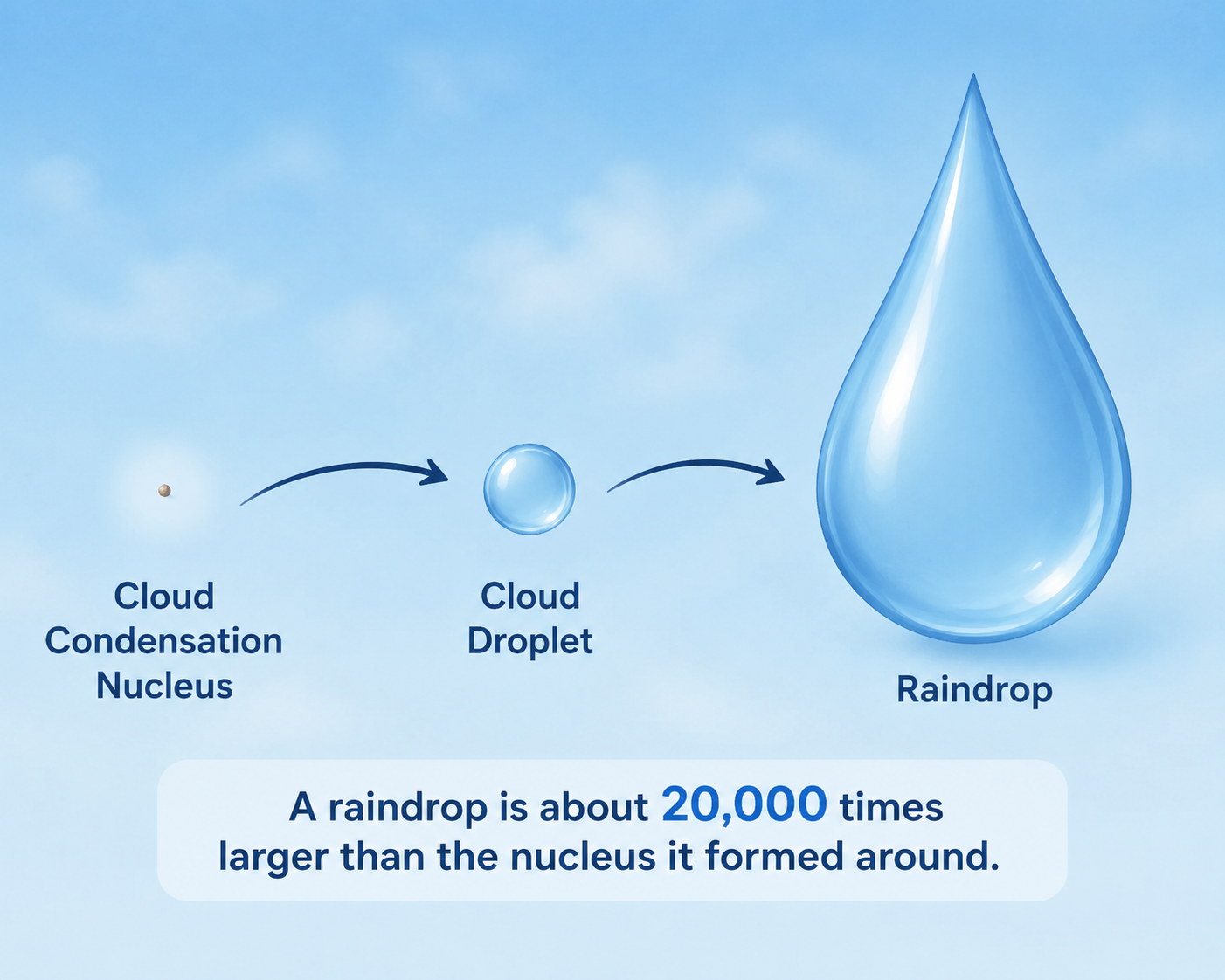
The reason most rain looks clean is scale. A typical cloud condensation nucleus is about 0.0001 millimeter across. A cloud droplet is about 0.02 millimeter across. A full raindrop is about 2 millimeters across.[2] In diameter, that raindrop is about 20,000 times larger than the tiny nucleus it began around.
| Object | About how wide it is | What to notice |
|---|---|---|
| Condensation nucleus | 0.0001 mm | The starting speck is microscopic. |
| Cloud droplet | 0.02 mm | Water has condensed around the speck. |
| Raindrop | 2 mm | The final drop is vastly larger than the original particle. |
That size difference matters. If one tiny particle is trapped inside one much larger drop, your eye will not see it. You see a clear drop of water, not the speck that helped start it. In a classroom model, it would be like hiding a grain of dust inside a large bead of clear gel. The dust is there, but it does not make the whole bead look brown.
Air is never perfectly particle-free. A National Weather Service cloud development training page says even the cleanest natural air contains about 1,000 dust particles per cubic meter.[3] That sounds like a lot until you remember how tiny these particles are and how much air fits into one cubic meter. Normal particle levels can help clouds form without leaving mud-colored rings on cars.
When ordinary rain starts leaving spots
Dirty rain needs a heavier passenger load. The National Weather Service describes dirty rain as rain that catches particles suspended in the air, then leaves visible residue on cars, windows, and sidewalks after the water evaporates.[4] The water goes away. The dust, soil, ash, or soot stays behind.
A useful way to picture it is a wet paper towel wiped across a dusty desk. The paper towel is not a special kind of towel because it picked up dust; it just passed through a dusty place. A raindrop falling through dusty air can do something similar. If the air contains only a small amount of fine material, the result may be invisible. If the air contains enough suspended particles, the dried drops leave marks.
- Dust can come from dry soil lifted by wind.
- Salt particles can come from ocean spray.
- Smoke and ash can come from fires.
- Soot can come from combustion sources.
Those particles do not all mean the same thing for health, chemistry, or visibility. For the basic dirty-rain question, the key point is simpler: there is enough solid material in the air for raindrops to collect it and leave it where they land.
A real path: dust from the Plains to Midwest windshields
The March 2025 Midwest dirty rain event is a good example because the path was not mysterious. The National Weather Service office in La Crosse explained that strong southwest winds picked up dry soil from Texas and Oklahoma, carried that dust into a storm system over Kansas, and then the storm dropped dirty rain across places including Missouri, Illinois, and Kentucky.[5]
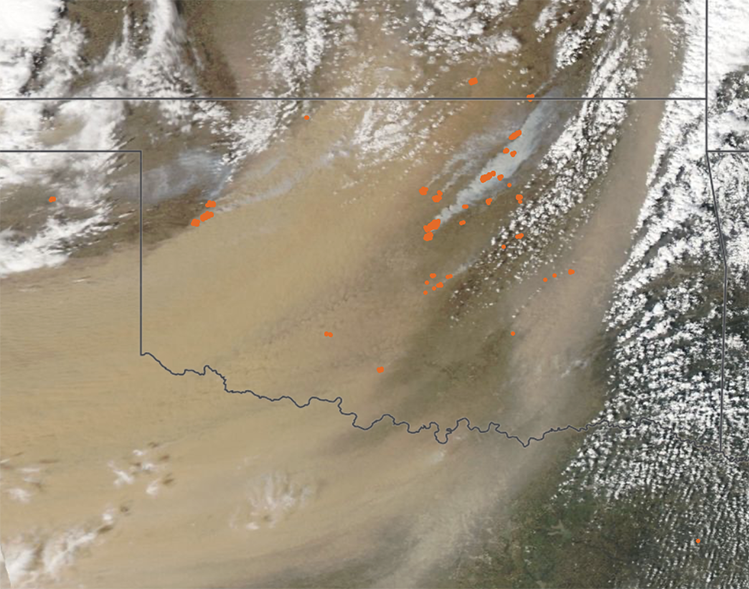
That event had the whole chain students need to see. First, dry soil was available at the ground. Then wind lifted it. Then moving air carried the dust away from its source. Then raindrops inside a storm system captured the dust and brought it down. The muddy spots at the end were not the beginning of the story; they were the last clue.
This also explains why dirty rain can surprise people far from the original dust source. The dust does not need to come from the street outside your house. It can travel with moving air before a storm washes it out. In February 2026, a dirty rain event was also reported in Indiana and Ohio, another reminder that the pattern is not limited to one storm or one state.[6]
Dirty rain is not the same thing as acid rain
Dirty rain and acid rain sound as if they belong in the same box, but they describe different problems. Dirty rain is about visible particles, such as dust, soil, ash, or soot, being carried down by raindrops. Acid rain is about rain or other wet deposition becoming more acidic because sulfur dioxide and nitrogen oxides react in the atmosphere to form acids.[7]
So a brown spot on a windshield does not automatically mean “acid rain.” It means particles were present and the rain carried them down. To know whether rain is acidic, scientists would need to measure its chemistry, especially its pH. The stain alone does not answer that question.
The clean-looking drop and the muddy windshield
The useful answer to “what causes dirty rain?” is not that rain suddenly becomes a strange substance. Every raindrop starts around a microscopic particle. Most of the time, that particle is so small, and the total particle load is so low, that the rain looks clean. Dirty rain happens when the air contains enough visible dust, ash, soot, or soil for falling raindrops to collect it and leave residue after the water evaporates.
The speck starts the droplet. The droplet grows into a raindrop. The raindrop falls through air that may contain more particles. If there are only tiny amounts, the sidewalk looks rinsed. If there are many, the same process can leave a muddy windshield.
References
- Making Raindrops With Mindy, UCAR Center for Science Education, https://scied.ucar.edu/kids/clouds-raindrops/making-raindrops
- Cloud condensation nuclei, Wikipedia, https://en.wikipedia.org/wiki/Cloud_condensation_nuclei
- Cloud Development, National Weather Service, https://weather.gov/source/zhu/ZHU_Training_Page/clouds/cloud_development/clouds.htm
- Is there such a thing as 'dirty rain'?, Fox Weather, https://www.foxweather.com/learn/what-is-dirty-rain
- What's with the DIRTY RAIN falling?, National Weather Service La Crosse, https://www.weather.gov/arx/DirtyRain_March152025
- What is 'dirty rain'?, WANE 15, https://www.wane.com/weather/what-is-dirty-rain/
- What is Acid Rain?, U.S. Environmental Protection Agency, https://www.epa.gov/acidrain/what-acid-rain
Comments
Join the discussion with an anonymous comment.