
Why Tactical Victory Failed to Win the 2026 US-Iran War
This analysis examines how the 2026 US-Israeli air campaign achieved unprecedented tactical success against Iran yet failed to secure strategic victory, revealing the growing gap between military dominance and political control in modern conflict.
Updated:
The hardest part of a serious analysis of the 2026 US-Iran military strikes is not proving that the air campaign was tactically extraordinary. On the available evidence, that part is almost too easy. The US-Israeli coalition struck more than 11,000 targets, killed Iran’s Supreme Leader Ali Khamenei and hundreds of senior commanders in the first week, and drove Iran’s ballistic missile launch rate from about 480 missiles per day to about 40 within ten days, a 92% reduction.[1]
Those are not marginal battlefield effects. They describe a campaign that shattered command layers, compressed decision time, and degraded systems that Iranian planners had spent years trying to harden. A student who writes that the opening phase displayed operational competence is not wrong. The analytical mistake begins when that sentence becomes the conclusion.
The better question is what kind of control that destruction bought. If a campaign can decapitate a state’s senior leadership, suppress missile fire by more than nine-tenths, and still leave the war politically unsettled, then the case is not a simple story about weak air power. It is a study in conversion failure: battlefield effects did not reliably convert into nuclear rollback, missile disarmament, economic security, domestic consent, or war termination.
The Tactical Case Was Stronger Than Many Critics Admit
A disciplined assessment starts by giving the campaign its due. The Modern War Institute’s account emphasizes not just the number of targets hit but the breadth of systems disrupted: leadership, missile forces, air defenses, command networks, and enabling infrastructure.[1] The Council on Foreign Relations similarly treated the strikes as militarily consequential while separating that judgment from broader claims about lasting strategic success.[2]
This distinction matters in a classroom because it prevents two lazy answers. One is triumphal: the enemy suffered more, therefore victory. The other is dismissive: the war did not end, therefore the strikes failed. Neither is adequate. Military effects can be real and still insufficient. A bridge can be down, a launcher destroyed, a commander dead, and the opponent’s political strategy still alive.
CSIS framed the central problem as one of victory conditions rather than scorekeeping: who was winning depended on which objective was being measured — nuclear degradation, regime behavior, missile threat reduction, alliance reassurance, escalation control, or domestic sustainability.[3] That is the right starting point. A campaign can win one contest and lose leverage in another.
The Nuclear Question Did Not Stay Settled
The nuclear program was the most politically convenient measure of success because it promised a clean before-and-after story. If the strikes had decisively destroyed Iran’s nuclear infrastructure, then other costs might have been easier for Washington and its allies to defend. But the public intelligence picture did not remain clean.
AP reported that a Defense Intelligence Agency assessment judged the US strikes to have set Iran’s nuclear program back by only three to six months, and that the assessment carried low confidence.[4] NBC News later reported that a new US assessment found only one of three Iranian nuclear sites had been fully destroyed, while also noting that CIA Director John Ratcliffe publicly contradicted the narrower damage estimate.[5]
That disagreement should not be overread. A low-confidence intelligence estimate is not a verdict, and public statements from senior officials are not a substitute for full battle-damage assessment. But the dispute is enough to weaken the strongest version of the nuclear-success narrative. The lesson is modest but important: when the strategic objective is durable nuclear rollback, destroyed facilities matter less than the adversary’s retained knowledge, dispersed assets, reconstruction capacity, and willingness to accept further risk.
Missile Suppression Was Not Missile Control
The 92% reduction in ballistic missile launch rates is one of the most impressive figures in the war. It shows that the coalition could find, strike, disrupt, and intimidate parts of Iran’s missile apparatus at scale. It also shows why rate-based metrics can seduce analysts. A falling launch rate looks like control until one asks what survived.
Modern War Institute’s analysis notes that Iran still retained about 70% of its prewar mobile launchers and missile stockpile.[1] That survivability changes the meaning of suppression. Iran could fire far less often and still preserve coercive options. It could husband missiles, shift to drones and proxies, exploit geography, and wait for moments when a smaller number of projectiles could produce disproportionate political or economic effects.
This is the difference between reducing an adversary’s tempo and governing its choices. Air power sharply limited what Iran could do in the open, on schedule, and at scale. It did not eliminate Iran’s ability to choose targets across a wider system.
Iran Moved the War Sideways
The key adaptation was horizontal escalation. Rather than answering only where the coalition was strongest, Iran widened the battlefield. Modern War Institute describes Iranian attacks across 11 countries and territories: Israel, the United Arab Emirates, Saudi Arabia, Kuwait, Bahrain, Qatar, Oman, Jordan, Iraq, Azerbaijan, and Cyprus.[1]
The distribution mattered. According to the same analysis, 44% of Iranian projectiles targeted the UAE and 24% targeted Kuwait, and 17 US military installations were damaged.[1] That pattern was not just retaliation. It was a way of pressuring basing networks, energy logistics, Gulf partners, and the political assumptions behind coalition operations.
This is where the war becomes more useful as an analytical case study than as a debate over who looked stronger on television. The coalition dominated the vertical battlespace over Iran. Iran tried to make the relevant battlespace regional, economic, and infrastructural. The shift did not erase the damage Iran suffered. It changed the arena in which that damage had to produce political compliance.
The Hidden Systems Became the Real Target Set
The most revealing part of the war was not another crater photo or another briefing slide. It was the pressure on systems that militaries depend on but do not fully control: cloud infrastructure, interceptor inventories, insurance markets, shipping behavior, Gulf energy routes, and domestic prices.
Modern War Institute’s “hidden systems” framing is valuable because it pushes the analysis beyond platforms. The report highlights AWS cloud targeting as part of the conflict’s digital-infrastructure dimension and emphasizes that modern campaigns depend on commercial and logistical systems whose disruption can have strategic effects even when they are not conventional military centers of gravity.[1]
That is a different problem from destroying a radar. A radar has a location, a function, and a replacement timeline. A cloud dependency, shipping corridor, fuel-price shock, or interceptor stockpile connects military operations to civilian markets and political patience. These systems are vulnerable, but not governable in the same way a target complex is governable.
Hormuz Turned Tactical Damage Into Economic Leverage
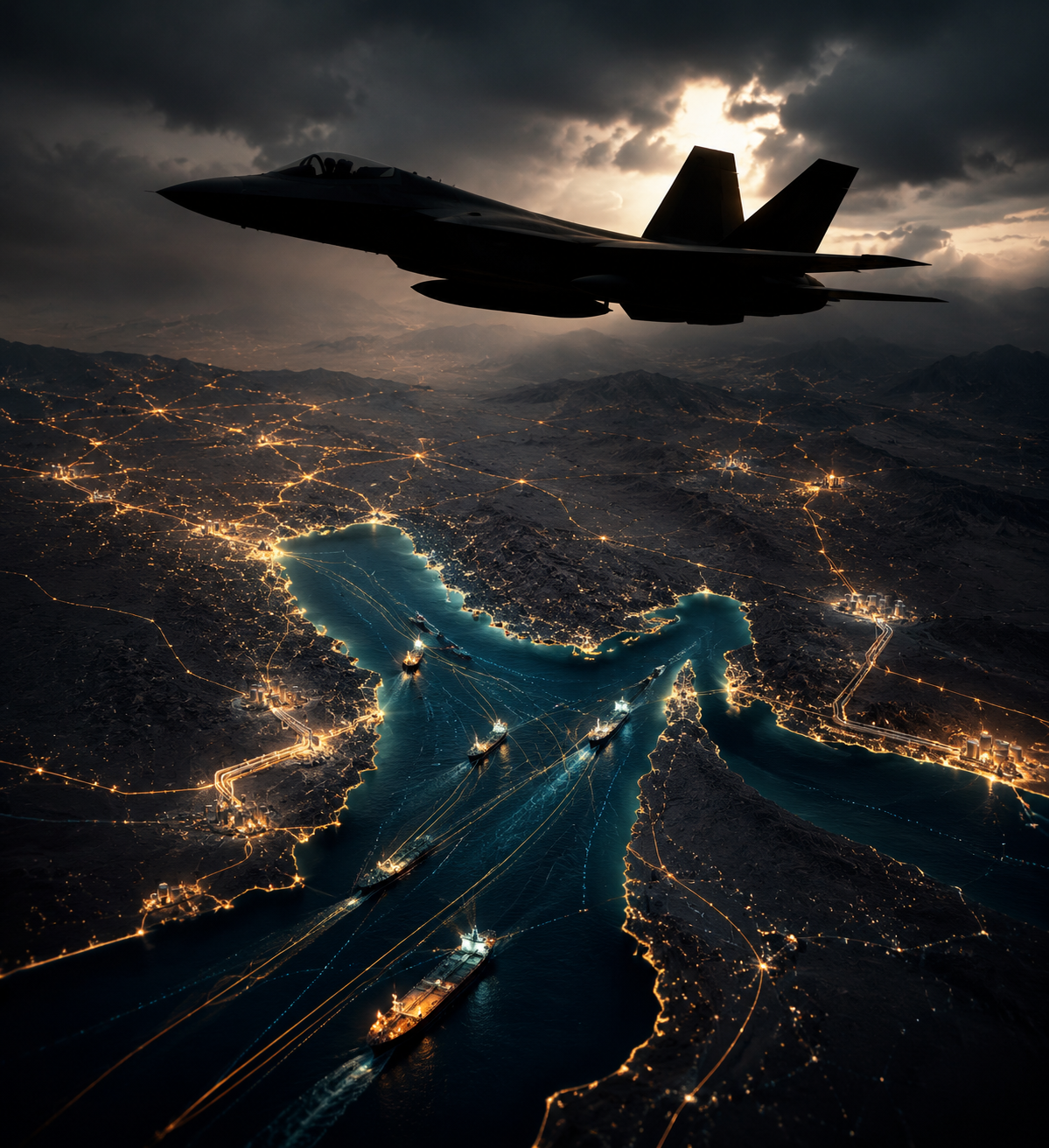
The Strait of Hormuz was the sharpest example. Within weeks, tanker transits through the strait collapsed by 92%, crude oil outbound trade dropped by 95%, and LNG movement fell by 99%.[1] These are not just maritime statistics. They show how Iran could suffer severe military punishment while making the continuation of punishment costly for others.
A chokepoint is not a bunker. It cannot be permanently neutralized by a successful strike package. Ships, insurers, energy firms, naval escorts, Gulf governments, and consumers all become part of the coercive field. When traffic collapses, the effect is transmitted through prices, inventories, contracts, and public anger rather than through a front line.
The paradox was brutal. Iran suffered an estimated $40 billion to $50 billion in economic damage, yet price surges gave it an estimated $25 million per day in additional oil revenue.[1] That does not mean Iran was economically winning. It means the costs of escalation were not confined to the state being bombed. The energy system redistributed pain.
The Interceptor Exchange Was Politically Expensive
The cost asymmetry made the problem worse. Modern War Institute reports that a roughly $50,000 Shahed drone could require a $4 million Patriot interceptor or a $12 million THAAD interceptor.[1] The point is not that defenders should refuse to intercept. If the target is a base, port, refinery, or populated area, interception may be necessary. The point is that successful defense can still be strategically draining.
In undergraduate essays, attrition is often treated as a body count or platform count. Here, attrition also meant magazine depth, replenishment schedules, industrial capacity, and fiscal tolerance. A defender can win each individual interception and still dislike the war more after every exchange.
The Home Front Became Part of the Balance Sheet
The economic pressure traveled back into US politics. Available figures show US gas prices crossing $4 per gallon, a 6% producer price index surge, and a 3.8% consumer price index increase during the war. Brookings reported that 58% of the American public opposed the war by May 2026, up from 48% in March, and that 86% gave a negative assessment of cost-of-living conditions.[6]
Those figures do not prove that inflation alone caused opposition to the war. They do show that the conflict’s political sustainability was being evaluated in grocery aisles and gas stations as well as in situation rooms. For coercion, that matters. A strategy that depends on time must ask whose time is more politically affordable.
| Domain | Tactical or operational result | Strategic complication |
|---|---|---|
| Leadership and command | Khamenei and hundreds of senior commanders killed in the first week | Shock did not produce a settled coercive outcome |
| Missile campaign | Launch rates fell from about 480 per day to about 40 within ten days | Iran retained about 70% of mobile launchers and missile stockpile |
| Regional escalation | Coalition degraded Iranian systems inside Iran | Iran struck across 11 countries and territories |
| Energy chokepoint | Air dominance remained overwhelming | Hormuz traffic collapse transmitted costs through global markets |
| Domestic politics | US forces demonstrated reach and precision | Public opposition and cost-of-living pressure narrowed political tolerance |
Costs and Casualties Clarify the Stakes, Not the Winner
The human and fiscal costs are important, but they should be handled carefully because the available figures vary by source and method. Wikipedia’s war summary, used here as a factual anchor rather than as the main analytical source, lists 3,684 total documented deaths attributed to HRANA, including more than 3,503 Iranian dead, 16 to 19 US service members killed, and 40 Israeli soldiers killed.[7]
Cost estimates also diverge. The Center for International Policy estimated $72 billion in US war costs, while Wikipedia listed $113.3 billion as of June 2026.[7] Those numbers should not be blended into a false precision. They are better read as a range indicating that the war was expensive enough to become part of the strategic contest itself.
Casualty and cost data can tell us what was paid. They do not, by themselves, tell us what was bought. That is why the central test remains political: did the campaign produce the conditions it needed to produce?
The War-Termination Problem Was Never Solved
War termination is where battlefield success receives its most unforgiving exam. The Islamabad Memorandum of June 17, 2026, did not resolve control of the Strait of Hormuz, and the ceasefire collapsed on July 8, 2026.[7][8] As of July 20, 2026, the conflict is best treated as a no-war, no-peace condition rather than as a completed war with a stable settlement.[8]
That matters because coercion is not measured at the moment of maximum shock. It is measured when the opponent decides whether to comply, resist, stall, disperse, or move the fight elsewhere. The coalition produced shock. Iran absorbed shock and shifted pressure into Hormuz, regional basing networks, drones, missiles, and economic systems.
The unresolved Hormuz question was especially damaging to any claim of strategic victory. If the war’s continuation threatened global energy flows, and its ceasefire did not settle the chokepoint, then the political problem survived the military campaign. A damaged Iran could still pose a system-level risk.
What Students Should Learn From the Case
The 2026 war is useful for students of international relations and security studies because it punishes single-metric analysis. If the metric is target destruction, the coalition looks dominant. If the metric is missile-launch suppression, it looks highly successful. If the metric is nuclear rollback, the evidence is disputed. If the metric is regional escalation control, Hormuz security, domestic political sustainability, or ceasefire durability, the outcome looks much less favorable.
A better study method is to separate levels of analysis before assigning a verdict:
- Tactical effects: what was destroyed, disrupted, killed, suppressed, or defended.
- Operational effects: whether the campaign changed the adversary’s tempo, coordination, survivability, or freedom of action.
- Strategic effects: whether the opponent changed policy in the desired direction and whether the settlement became durable.
- System effects: whether markets, alliances, infrastructure, and domestic politics absorbed or amplified the pressure.
This framework does not make the answer neat. It makes the answer harder to fake. The coalition’s tactical achievement was real. Iran’s strategic resilience was also real. The contradiction is the case.
An Interim Judgment in Q3 2026
As of Q3 2026, the safest judgment is not that Iran won, or that the United States and Israel lost, or that air power is obsolete. The evidence supports a narrower and more useful conclusion: air power can devastate an adversary’s military hierarchy and still fail to control the political-economic systems where modern coercion is decided.
The campaign reduced missile fire, killed senior leaders, and damaged major military systems. It did not secure a stable nuclear verdict, eliminate Iran’s surviving missile capacity, prevent horizontal escalation, settle Hormuz, or produce a durable ceasefire. That is not a slogan against force. It is a warning against confusing the visible battlefield with the whole war.
For analysts, the case should remain open but not empty. The final history of the 2026 US-Iran war may change as intelligence, archives, and political settlements emerge. The interim lesson is already strong enough: tactical victory is an input to strategy, not a substitute for it.
References
- The Hidden Systems of Modern War: Ten Takeaways from the Iran War, Modern War Institute at West Point
- Assessing the Effect of the U.S. Strikes on Iran, Council on Foreign Relations
- Who Is Winning the Iran War?, CSIS
- US strikes only set back Iran's nuclear program by months, AP News
- New U.S. assessment finds American strikes destroyed only one of three Iranian nuclear sites, NBC News
- The political consequences of the Iran war, Brookings Institution
- 2026 Iran war, Wikipedia
- No End to the U.S.-Iran War in Sight, The Soufan Center, July 13, 2026
Comments
Join the discussion with an anonymous comment.