
Historical Evidence for the Trojan War and Achilles
Did the Trojan War really happen? This article examines the archaeological, textual, and geological evidence for the conflict at Troy and the figure of Achilles, helping history students understand what can responsibly be claimed about the historicity of the Homeric epics.
Updated:
A defensible answer to “Was the Trojan War real?” has to be uneven. Troy was a real Bronze Age city. A violent destruction at Troy around 1180 BC is strongly supported. A wider world of conflict involving western Anatolia and Mycenaean-linked powers is also supported. Achilles, by contrast, is not historically verified. That asymmetry is the point: the historical evidence for the Trojan War and Achilles does not carry the same weight on both sides of the question.
For an exam paragraph, the safest starting claim is not “Homer was right” or “the Iliad is fiction.” It is more precise: archaeology and Near Eastern texts make a Late Bronze Age conflict at Troy plausible, perhaps likely, but they do not prove Homer’s ten-year siege, divine interventions, Trojan Horse, or named heroes.
Start with the strongest evidence: Troy VIIa
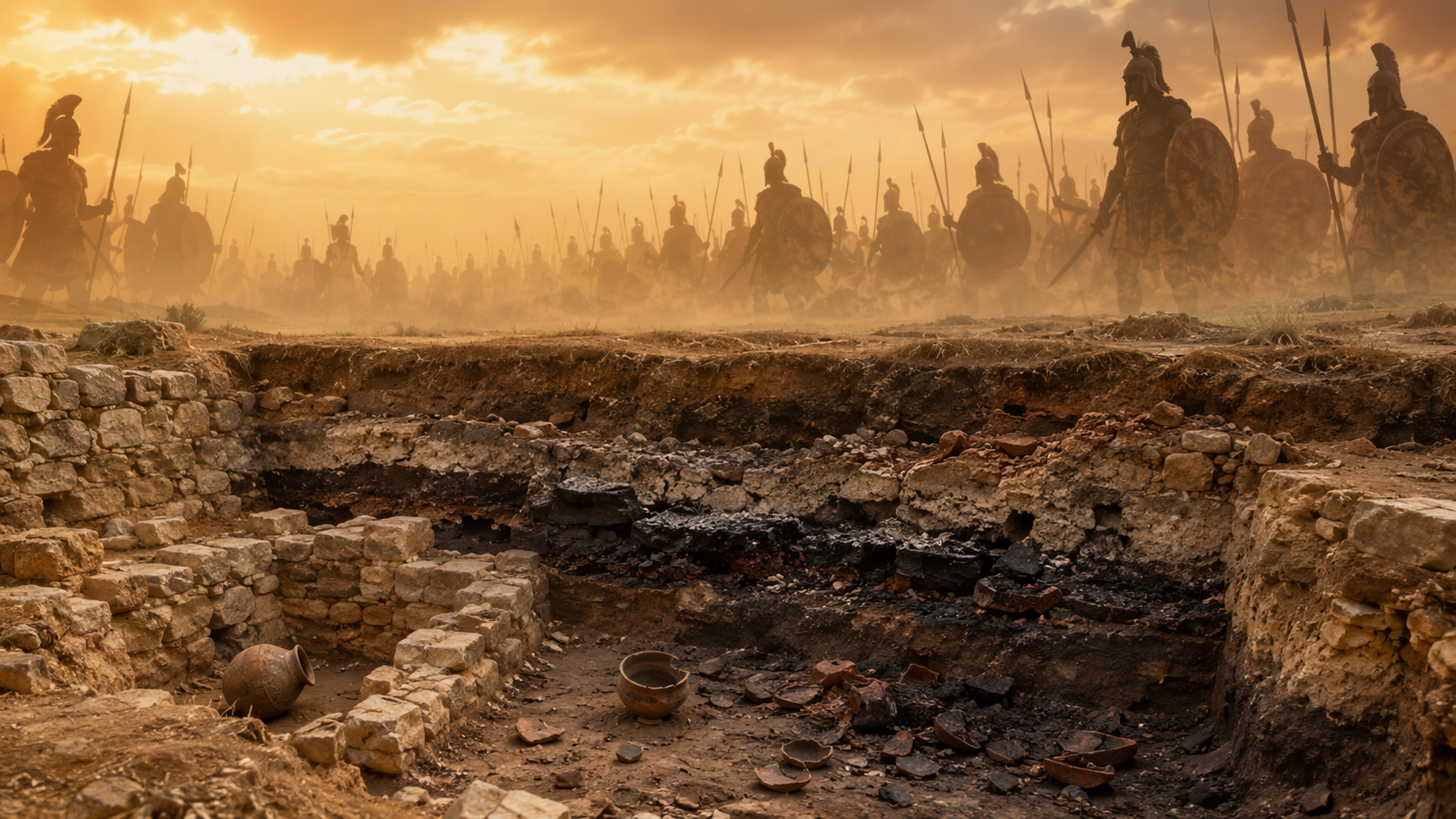
The strongest material evidence sits in the destruction layer usually identified as Troy VIIa. This level at Hisarlik, the archaeological site widely associated with ancient Troy, was violently destroyed around 1180 BC. Excavators have connected that destruction with fire, scattered skeletons, arrowheads, and caches of sling stones, all of which point toward danger, attack, or military crisis rather than a neat abandonment of the city.[1]
That does not make Troy VIIa a direct illustration of the Iliad. A burned city is excellent evidence for destruction; it is not evidence that Achilles chased Hector around the walls. Arrowheads and sling stones can show that people fought, or prepared to fight, at the site; they cannot name the armies, identify Helen as the cause, or stretch the event into a ten-year siege. This is where many student answers become too large for their evidence.
The 2025 sling stone discovery reported by Rüstem Aslan is useful precisely because it is concrete and limited. It adds recent support to the picture of military conflict at ancient Troy, but it does not suddenly turn the epic into a campaign diary.[1] In an essay, it is better to say that new battlefield-related finds strengthen the case for violence at the site than to say they “prove the Trojan War” without qualification.
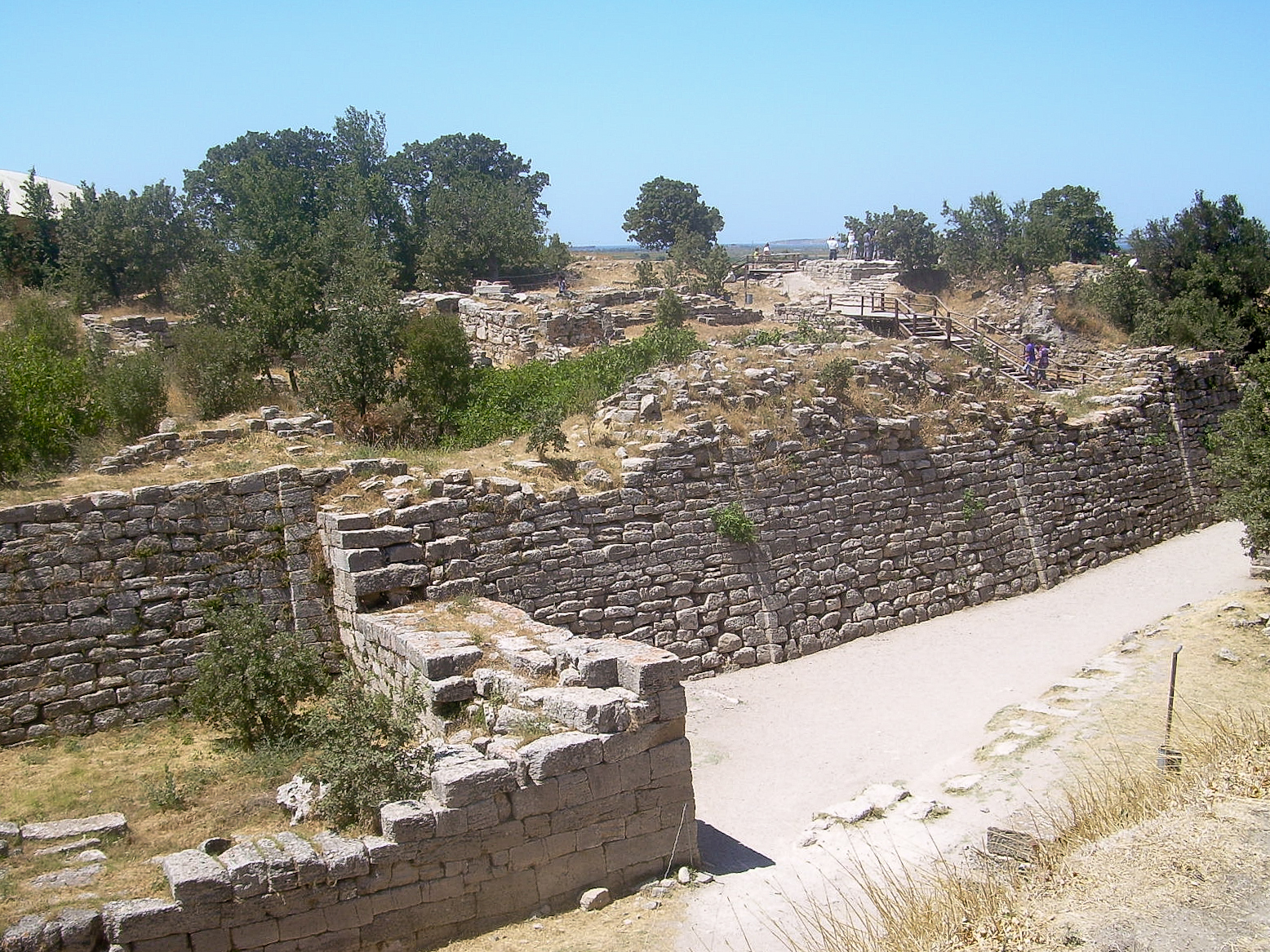
The British Museum’s account of the search for Troy makes the same broader point: Hisarlik is not an invented place from poetry but a layered archaeological site with a long settlement history.[2] The Past likewise presents the Trojan War as a story with an archaeological setting rather than as a story that archaeology can simply confirm line by line.[3] Those two ideas belong together: the place is real, the destruction is real, and the epic is still an epic.
| Evidence | What it can support | What it cannot support |
|---|---|---|
| Troy VIIa destruction layer | A violent destruction at Hisarlik around 1180 BC | The full Iliadic narrative |
| Fire, skeletons, arrowheads, sling stones | Warfare, attack, or military emergency at the site | Specific Homeric scenes or named heroes |
| 2025 sling stone find | Fresh evidence consistent with military conflict | Proof of Achilles, Hector, Helen, or a ten-year siege |
Why the Hittite records matter
Archaeology gives the destroyed city. Hittite records help place that city in a political world. Late Bronze Age texts refer to Wilusa, a name widely linked linguistically with Greek Ilios, one of Troy’s names in the Greek tradition. They also refer to Ahhiyawa, often associated with the Achaeans or Mycenaean Greeks.[4]
This matters because it moves the discussion away from a lonely poem and into international politics. The Manapa-Tarhunta letter and the Tawagalawa letter are especially important because they suggest that western Anatolia was a contested region and that Ahhiyawa had enough importance to appear in Hittite diplomatic material.[4] That does not prove Agamemnon commanded a united Greek expedition, but it does make conflict between Anatolian powers and Mycenaean-linked forces historically plausible.

The Alaksandu treaty is a useful essay detail, but it needs careful handling. A treaty from the reign of Muwatalli II, dated around 1280 BC, names Alaksandu of Wilusa; the name resembles Alexandros, the alternate name of Paris in the Iliad.[4] That parallel is striking. It is not, by itself, evidence that Homer’s Paris existed or that his abduction of Helen caused a war. It is better used as evidence that names and political structures later remembered in Greek tradition may have had Bronze Age roots.
A strong exam sentence might therefore read: Hittite texts do not verify the Iliad’s plot, but they do independently support the existence of a place called Wilusa in the relevant region and a diplomatic-military world in which Ahhiyawa and western Anatolian states could come into conflict. That is a narrower claim, but it is much harder to knock down.
The landscape helps, but it does not prove the story
Geological reconstruction adds another layer of plausibility. John C. Kraft’s 2001 University of Delaware study argued that the ancient topography around Hisarlik fits important features of the Iliadic setting, including the Trojan plain and the shoreline where ships could have been beached.[5]
This is helpful evidence for setting, not for plot. A landscape that fits the poem makes it easier to imagine how a real conflict in that region could have entered later tradition. It does not authenticate the speeches, duels, gods, or sequence of events in Homer. In source terms, geography can make a story’s setting plausible while leaving the story’s details unverified.
How far do historians go?
The scholarly spectrum is useful because it prevents false certainty. Moses Finley represents a skeptical position, rejecting historicity for the Trojan War as told; Trevor Bryce is more cautious, treating the evidence as suggestive but limited; Manfred Korfmann argued more strongly from the archaeological fit, suggesting that skeptics had to reckon seriously with the material evidence from Troy.[4]
Those positions are not just names to memorize. They show how the same evidence can be scaled differently. One historian may accept a historical conflict behind the tradition while rejecting the epic story. Another may stress how little the evidence says about Homer’s named characters. Encyclopaedia Britannica’s treatment of the Trojan War also preserves that caution by presenting the war as a legendary conflict rooted in Greek tradition rather than as a fully documented historical campaign.[6]
For students, the practical lesson is to avoid writing as if “some historical basis” means “the Iliad happened.” A historical basis can be thin, partial, and transformed by centuries of oral poetry. Homer may preserve distant memory of Bronze Age conflicts, but memory is not the same kind of evidence as a destruction layer or a diplomatic tablet.
What about Achilles?
The evidence for Achilles is much weaker than the evidence for Troy. Linear B tablets from Knossos and Pylos preserve the name a-ki-re-u, usually understood as an early form related to Achilles, in the period around 1400–1200 BC.[7] That is genuinely interesting: the name was available in the Bronze Age, so Achilles is not simply a later impossible invention at the level of name form.
But the tablet evidence does not give us Achilles the hero. The British Museum notes that a-ki-re-u appears as a shepherd’s name, not as a warrior, king, or identifiable Iliadic figure.[7] That distinction matters. Evidence that a name existed is not evidence that the famous bearer of the name existed, just as finding the name “Arthur” in a medieval document would not automatically prove every story told about King Arthur.
Encyclopaedia Britannica treats Achilles as a figure of Greek mythology, the son of Peleus and Thetis and the central Greek hero of the Iliad.[8] That is the category the evidence currently supports: Achilles is historically important as a literary and mythological figure, but he is not historically confirmed as a Bronze Age warrior.
The Achilles heel problem
One common trap is to treat “Achilles’ heel” as if it were part of Homer’s evidence. It is not. The famous invulnerability story is a later tradition, associated with the Roman poet Statius in the 1st century AD, not with the Iliad itself.[7] Homer’s Achilles is terrifyingly powerful, but he is not protected by the heel story in the poem students usually cite.
That correction is small, but it is useful. It reminds us that “the Trojan War story” is not one single ancient source. It is a layered tradition: Homer, later Greek mythographers, Roman poets, vase painters, tragedians, modern retellings, and classroom summaries all contribute to what people think they know. Evidence must be attached to the right layer.
A reliable way to phrase it in an essay
If you are revising the narrative itself — Helen, Paris, Hector, the Trojan Horse, and the fall of the city — use a story-focused resource such as The Complete Trojan War History Study Guide. If you are answering an evidence question, keep the categories separate: material destruction, Hittite political context, geographical plausibility, later epic tradition, and the much thinner evidence for named individuals.
A compact answer might be: Troy at Hisarlik was a real Bronze Age city, and the Troy VIIa destruction layer around 1180 BC gives strong archaeological support for violent conflict at the site. Hittite references to Wilusa and Ahhiyawa make such a conflict historically plausible within Late Bronze Age politics. However, Homer’s Iliad cannot be verified as literal history: its ten-year siege, gods, speeches, duels, Trojan Horse tradition, and named heroes remain unproved. Achilles’ historicity is especially weak, because the evidence shows only that a similar name, a-ki-re-u, existed in Linear B records, not that the Homeric warrior existed.
References
- New Evidence Alludes to Military Conflict at Ancient Troy, Archaeology Magazine, July 2025.
- The search for the lost city of Troy, British Museum.
- Trojan War: the archaeology of a story, The Past.
- Did the Trojan War actually happen?, BBC Culture.
- Historicity of the Iliad, Wikipedia.
- Trojan War, Encyclopaedia Britannica.
- Who was Achilles?, British Museum.
- Achilles, Encyclopaedia Britannica.
Comments
Join the discussion with an anonymous comment.