
Tom Watson's Three-Part Wind Golf Strategy That Won Five Opens
Tom Watson's five Open Championship victories were built on a systematic three-part wind strategy any golfer can learn. This analysis breaks down his goalpost visualization, low-trajectory technique, and two-club decision rule with specific examples from his championship rounds.
Updated:
The hard part of a windy approach shot is not knowing that the ball will move. Everyone knows that. The hard part is standing there with a flag, a crosswind, a yardage number, and no honest way to decide whether the shot should start at the bunker, the edge of the green, or somewhere that feels absurdly far away.
That is where Watson’s wind strategy becomes useful for ordinary players. Watson’s five Open Championship wins give him the authority, but the useful part is not the trophy count. It is the order of his thinking: widen the target, read wind like break, choose the flight that fits the wind, then keep two clubs alive until rollout and risk make the decision.
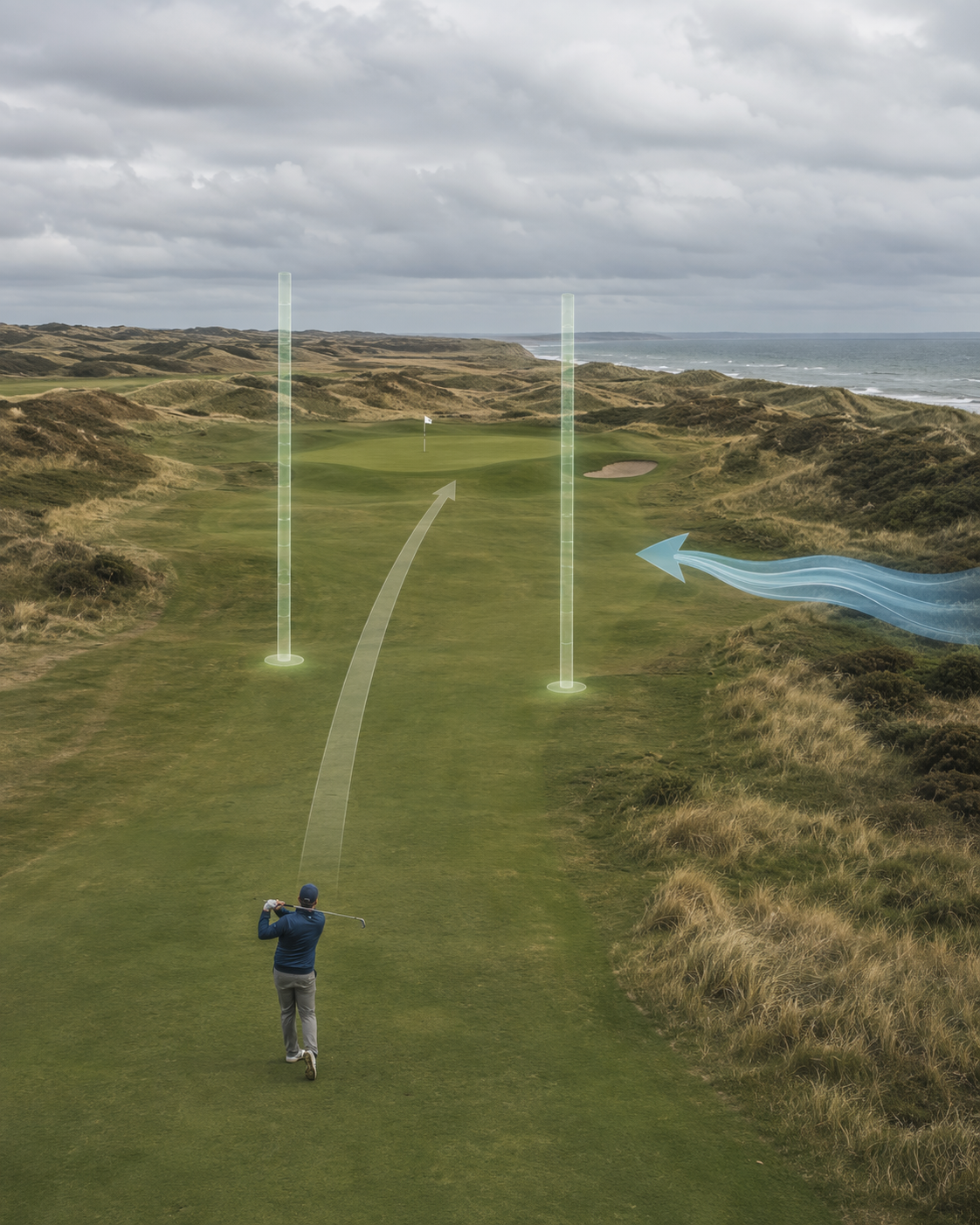
The first change is visual. Watson has described picturing two invisible goalposts, like football uprights, and sending the ball through the space between them rather than trying to fire at a single point.[1] That sounds simple, but it changes the whole job. In wind, the target is no longer the flag. The target is a corridor the ball can travel through while the wind is working on it.
Start With Goalposts, Not the Flag
A single target makes a windy shot feel like a pass-fail test. The ball either finishes close or it looks wrong from the moment it leaves the club. Watson’s goalpost idea gives the player permission to aim at a space wide enough for the conditions. In calm air, the posts can be narrow. In a crosswind, they move apart.
The most vivid version comes from Royal Birkdale in 2008, where Watson reportedly adjusted his aim by 40 yards in a 40-mile-per-hour crosswind.[2] That number should be treated as an illustration, not a formula. A mid-handicap player should not walk to the first windy par 3 and automatically aim 40 yards off the green. The useful point is that Watson was not guessing at the flag. He was setting a start line that gave the wind room to do its work.
For a 10–25 handicap golfer, this is the first repeatable piece. Before thinking about a knockdown swing, pick the corridor. Ask where the ball must start, where the wind is likely to move it, and what finish still counts as a playable result. The goalposts can be as plain as “left edge of the green to center bunker” or “right half of the fairway to right rough.” What matters is that the target has width before the swing starts.
| Wind question | Watson-style decision |
|---|---|
| Where is the wind pushing the ball? | Move the goalposts before choosing the shot. |
| Is the wind mainly across the ball? | Treat it like break and aim for drift. |
| Will a lower flight reduce the main risk? | Use the low-trajectory package when it fits, especially in crosswinds. |
| Which club controls landing and rollout? | Keep two clubs in mind until wind, lie, spin, and trouble decide. |
Read Crosswind the Way You Read Break
The goalpost picture works because it sits on top of Watson’s better mental model: wind equals break. On a green, a left-to-right putt is not aimed at the hole unless the break is tiny. You start it higher and let gravity bring it back. Watson applied the same logic in the air. A left-to-right wind is not an annoyance to deny. It is a force to borrow, resist, or ride.
At Carnoustie’s 13th hole in 1975, Watson described aiming at the right edge and intentionally slicing the ball into the crosswind, letting the wind push it back toward the green.[3] That is a more advanced shot than most amateurs need to copy exactly. The transferable part is the sequence: identify the wind’s direction, pick a start line that accounts for it, and decide whether the shot shape should fight the wind or move with it.
This is where many weekend players lose the plot. They notice a right-to-left wind, aim a little right, and then make their normal swing while hoping the ball behaves. Watson’s version is more deliberate. If the wind is the break, the player has to choose the high side. The stronger the break, the more the start line matters. The flag is just the cup at the end of the putt.
The idea also keeps “keep it low” from becoming a lazy answer. A low shot is one response to wind. It is not the response to every windy shot. Sometimes the smarter play is a normal flight started farther into the wind. Sometimes it is a ball that lands short and releases. Sometimes the safest result is simply accepting the fat side of the green instead of trying to carve a heroic finish toward a tucked pin.
The Low Shot Has a Specific Job
Watson’s low-flight method is not vague. For windy conditions, he has described teeing the ball a half-inch lower, gripping down one inch, making a shorter backswing, striking with a level or slightly descending blow, and keeping the wrists quiet through impact.[4] Those are small setup and motion changes, not a demand to invent a new swing on the course.
The half-inch lower tee reduces how much the ball launches above the wind. Gripping down shortens the club and makes center contact more likely. The shorter backswing helps keep speed from outrunning balance. Quiet wrists reduce the extra flip that can add loft and spin at the worst possible time. For amateurs, the most practical version is a three-quarter motion with a stable finish, not a squeezed punch that jams the handle forward and forgets the face.
The important nuance is that Watson specifically frames this lower-driving shot as especially useful in crosswinds, where the main danger is lateral drift.[4] That cuts against the common instinct to think only about headwinds. Into a headwind, lower launch can help, but the shot also has to carry the necessary distance and hold enough shape to avoid trouble. In a crosswind, keeping the ball under the worst of the sideways push often has a clearer payoff.
There is a good example from Turnberry’s 10th hole in 2009. Watson hit a 5-iron that landed 30 feet short of the green and rolled up to the hole, using the ground instead of asking the ball to hang in the wind.[5] That shot is worth studying because the landing spot was not the final target. The ball was supposed to finish after the wind and turf had their say.
Hold Two Clubs Until the Shot Explains Itself
The most useful Watson habit for amateurs may be his two-club decision rule. He did not reduce a windy approach to “the yardage says 8-iron.” He kept two clubs in mind, then made the final choice after weighing wind, lie, landing area, rollout, spin, and the cost of the miss.[5]
The 72nd hole at Turnberry in 2009 shows the rule clearly. Watson had 142 yards into a 15-mile-per-hour headwind. The 8-iron could carry to the hole, but it brought spin-back risk into play. The 9-iron could land short and release. He chose the 9-iron, landed it 30 feet short of the flag, and the ball rolled to 10 feet.[5]
That decision is easy to misunderstand if it is flattened into “take less club and run it.” The point was not that the shorter club is always smarter. The point was that the shot was judged by its landing behavior. An 8-iron flying all the way to the flag had a different spin profile, a different stopping pattern, and a different penalty if it came back off the green. The 9-iron used the front portion of the green as part of the shot.
For a mid-handicap player, this rule is better than trying to calculate wind with false precision. Stand behind the ball with two clubs in mind. One is the club that can reach the number. The other is the club that may land in a safer place and finish better after bounce and roll. If the front is open and firm, the lower-running option deserves attention. If a bunker guards the front or the turf is soft, carrying the ball farther may be the safer choice.
This also helps with ego. Into wind, many players take extra club only after they have already committed to the full swing they wanted to hit. Watson’s process reverses that. He lets the shot’s finish decide the club. A club that looks conservative in the air may be aggressive on the ground; a club that looks bold at impact may be dead if it spins back into trouble.
What to Borrow Without Pretending to Be Watson
Nobody with a 15 handicap should expect to reproduce Watson’s strike quality. That is not the assignment. The assignment is to copy the order of operations. Windy golf punishes players who make one decision too early and the rest too late: aim late, club late, adjust the swing mid-downswing, then complain that the gust won.
- Name the wind first: hurting, helping, across, or some blend.
- Set goalposts before choosing the club, widening them when the ball will drift.
- Read crosswind like break, choosing the high side instead of staring at the flag.
- Use the lower-flight setup when it solves the actual problem, especially sideways drift.
- Keep two clubs in mind until landing spot, rollout, and miss pattern decide.
There are limits to the evidence. The reported 40-yard Birkdale adjustment is a single vivid account, not a measured rule.[2] A secondary estimate that a 10-mile-per-hour headwind can cost a tour drive about 17 yards is useful only as a reminder that wind changes carry; it should not be treated as a universal conversion chart for every player, ball flight, and club.[2]
The safer lesson is narrower and more playable. Watson’s wind system does not ask an amateur to feel everything perfectly. It asks the player to make the invisible forces visible: a corridor instead of a flag, break instead of mystery, landing zone instead of yardage alone, two clubs instead of one rushed answer.
A good windy pre-shot routine can be that plain: see the posts, read the wind as break, choose the flight, compare two clubs. The swing still has to be made. The contact still belongs to the player. But at least the ball is no longer being sent into the wind with only a hope and a yardage number.
References
- Wind Cheater, Golf Digest, https://www.golfdigest.com/story/tom-watson-wind
- Watson's Winning Ways: Adapting to the Elements, LevelUp Sporting, https://levelupsporting.com/tom-watson-golf/
- Wind = Break, Golf Digest, https://www.golfdigest.com/story/tomwatson_0707
- Drive It Lower In Crosswinds, Golf Digest, https://www.golfdigest.com/story/tom-watson-drive-it-lower-in-crosswinds
- British Open 2019: What Tom Watson Learned from Turnberry, Golf Digest, https://www.golfdigest.com/story/tom-watson-turnberry
Comments
Join the discussion with an anonymous comment.