
How Fans Own the Cascadia Cup: A Sports Management Case Study
Sports management students can learn how fans created, owned, and legally defended the Cascadia Cup against MLS's trademark claim, resulting in a supporter-governed trophy that remains unique in North American professional soccer.
Updated:
For sports management students, the useful starting point in Cascadia Cup history is not a chant, a sellout, or a rivalry montage. It is a trademark filing. In December 2012, Major League Soccer filed a federal trademark application for “Cascadia Cup” without first notifying the supporters who had created and maintained the trophy.[1] That small procedural choice exposed the real question in the case: when a league professionalizes a fan-made tradition, does commercial scale give it control over an asset it did not build?
MLS’s instinct was not mysterious. Portland Timbers, Seattle Sounders, and Vancouver Whitecaps matches had become some of the league’s most visible rivalry fixtures, and a named trophy gives a marketer something clean to package. The problem was ownership. The Cascadia Cup was not an MLS invention, not a club promotion, and not a league-designed fan-engagement program. It was a supporter-created object with a supporter-created set of rules. By early 2013, representatives of the Timbers Army, Emerald City Supporters, and Vancouver Southsiders were publicly contesting the filing and preparing their own legal response.[1][2]
Before MLS, It Was a Supporter Asset
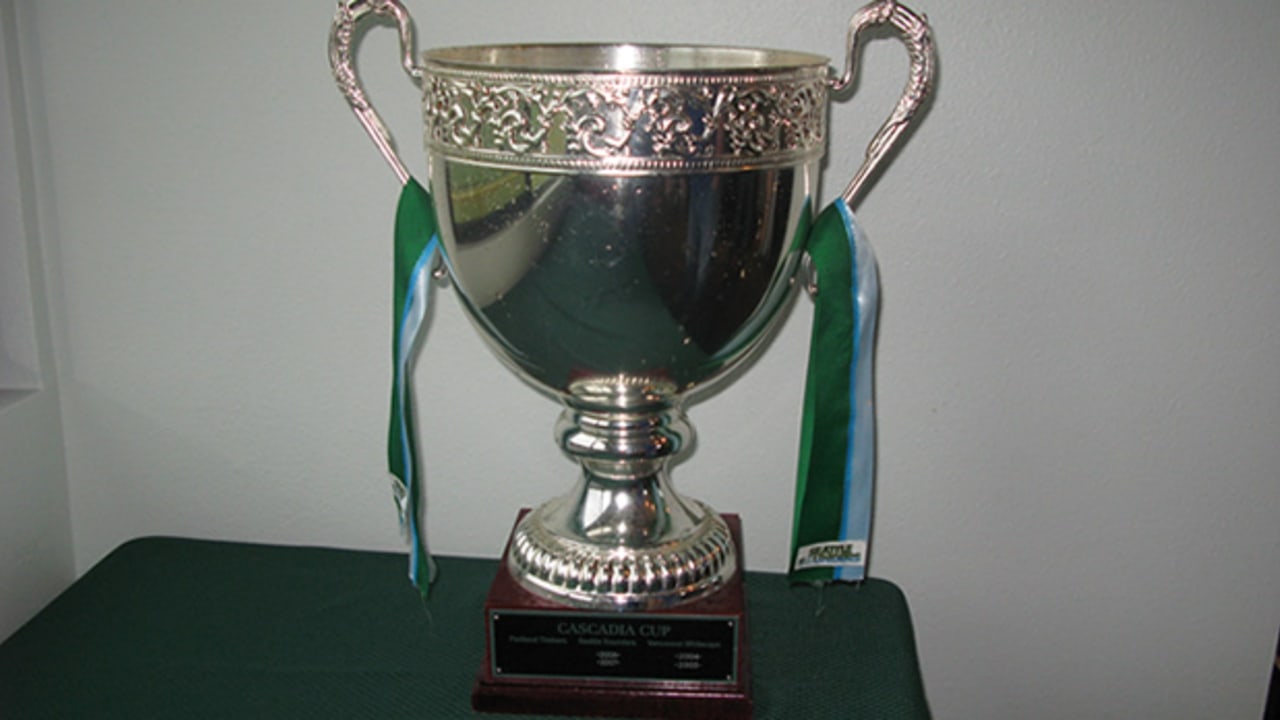
The older Portland-Seattle-Vancouver soccer rivalry reaches back to 1974, when the cities competed in the North American Soccer League.[3] That history matters, but only as the soil. The Cascadia Cup as a trophy began in 2004, when the three supporter groups pooled fan donations to commission a two-foot silver cup for matches among the Portland Timbers, Seattle Sounders, and Vancouver Whitecaps, then competing below MLS.[3][4]
That origin is not just charming background. It establishes the chain of legitimacy. The supporters did not merely name an existing league competition. They funded the trophy, defined the competition, and maintained the tradition before all three clubs were together in MLS. The cup moved into the top division with the clubs; it was not handed down from the league office.
This is where many student analyses go soft. “Fan passion” is too vague to explain what happened next. Passion did not answer a trademark filing. Organization did. The supporter groups had enough shared history, enough internal legitimacy, and enough practical coordination to convert a cultural claim into a governance claim.
The Trademark Fight Turned Emotion Into Structure
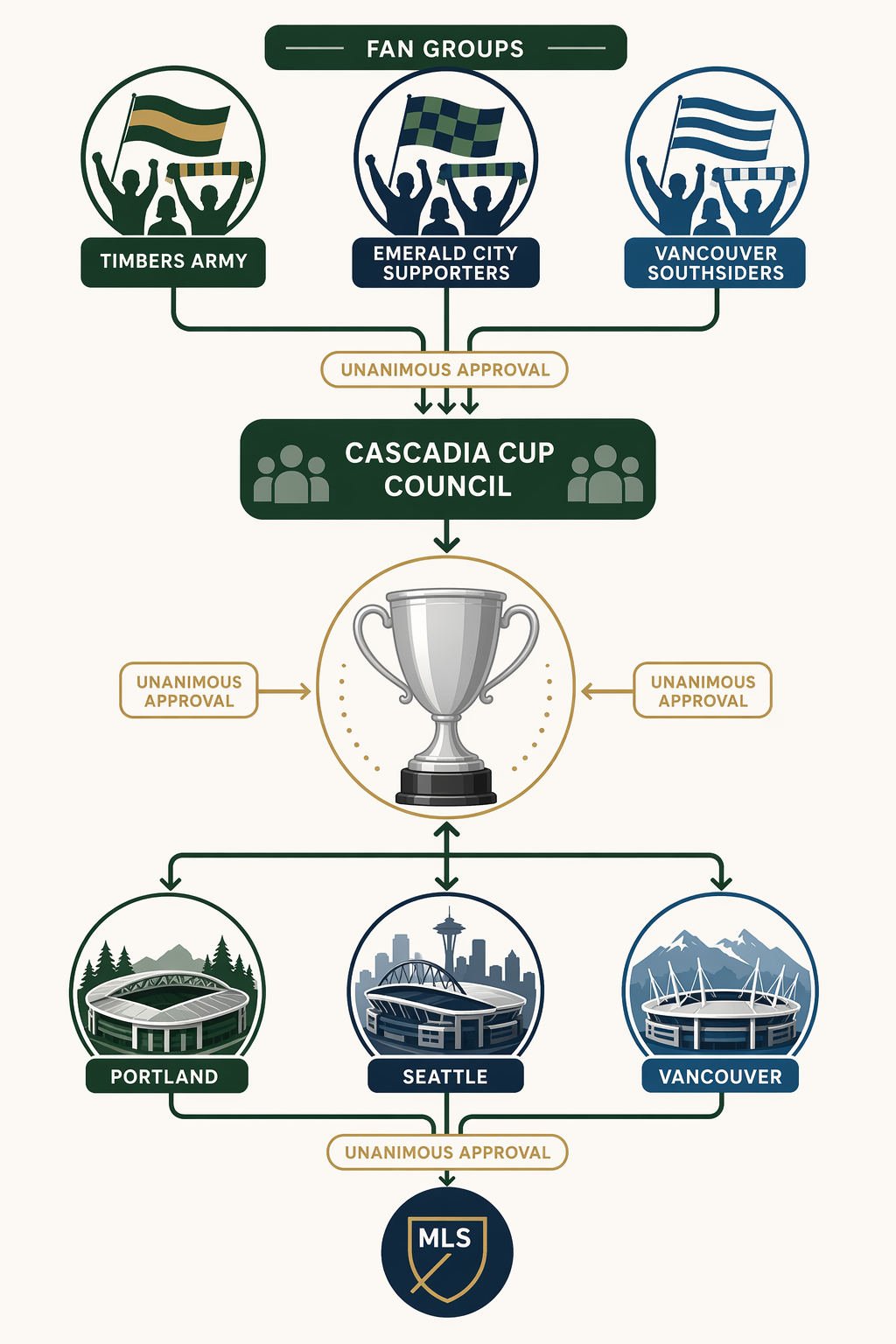
After MLS filed for the Cascadia Cup trademark, the supporter groups formed the Cascadia Cup Council as a legal entity to oppose the league’s claim and protect the trophy’s name and identity.[1][2] That move changed the dispute from a public-relations disagreement into a rights question. The supporters were no longer only saying, “This matters to us.” They were saying, “We have standing to control it.”
The July 2013 resolution is the case’s most important management lesson. Under the agreement, the Cascadia Cup Council owns the Cascadia Cup name, logo, and likeness. Just as important, no party may sell, trade, or barter sponsorship of the cup without unanimous approval from the Council, all three clubs, and MLS.[5][6]
| Governance Question | Resolution |
|---|---|
| Who owns the Cascadia Cup name, logo, and likeness? | The Cascadia Cup Council. |
| Can MLS independently commercialize the cup? | No. Sponsorship requires unanimous approval. |
| Can one club independently sell a cup sponsorship? | No. The Council, all three clubs, and MLS must approve. |
| Can the Council sell sponsorship alone? | No. The same unanimous-approval structure applies. |
That is a much cleaner teaching point than “fans beat the league.” The agreement did not remove MLS or the clubs from the structure. It placed them inside a multi-stakeholder approval system. The supporters gained ownership and veto power; the league and clubs retained a role in commercial decisions that would touch their brands, venues, broadcasts, and sponsorship ecosystems.
A sports property can be emotionally important and still be commercially messy. The 2013 resolution recognized that mess instead of pretending it did not exist. Sponsorship was not banned as a moral category. It was made conditional. If someone wanted to monetize the cup, they had to get every relevant rights-holder to say yes.
Why This Is Different From Ordinary MLS Rivalry Cups
MLS has several named rivalry cups, including the Rocky Mountain Cup, Brimstone Cup, Copa Tejas, Texas Derby, Heritage Cup, Atlantic Cup, and Trillium Cup.[7] The Cascadia Cup is not unique because supporters care more in the Pacific Northwest than supporters care elsewhere. That is not a serious governance distinction. Its structural difference is that supporters own and legally control the trophy asset.
A 2025 ranking of MLS rivalry cups placed the Cascadia Cup first and specifically highlighted supporter ownership and its pre-MLS history.[8] Rankings are not legal authority, but the reasoning is useful: most rivalry cups operate as club, league, or media-recognized traditions. The Cascadia Cup has a separate supporter body with defined rights over the name, logo, likeness, and sponsorship approval.
For a student studying fan engagement, this distinction matters. Symbolic engagement asks supporters to supply atmosphere, visuals, noise, and authenticity while the institution keeps the commercial levers. The Cascadia model gives supporters a seat that can block exploitation of the asset. That does not make every decision easy, and it does not make supporter groups automatically wise. It does make the rights structure different.
The Scoring Rules Are Governance, Too
The Cascadia Cup is a three-team competition, which makes it harder to administer than a standard head-to-head rivalry cup. Portland, Seattle, and Vancouver earn points from their matches against one another, but MLS schedules are not always balanced in a way that gives every club the same number of relevant home and away games. Because of that, supporters renegotiate the competition formula annually to account for the season’s schedule.[4]
That detail can look minor until you try to run the competition. If a cup’s rules cannot adapt to the league schedule, the trophy becomes either unfair or ceremonial. The annual rules process is an example of operational governance: the Council is not only guarding a trademark in a drawer; it is keeping the competition legible as the league’s scheduling environment changes.
| Ordinary Rivalry Cup Problem | Cascadia Cup Complication | Governance Response |
|---|---|---|
| Two teams play each other | Three teams must be compared | A shared points structure is used |
| Schedule is usually easier to read | Unbalanced MLS schedules can distort the table | Supporters review and adjust the formula annually |
| Commercial control often sits with clubs or league | Supporter-created asset has separate ownership | Monetization requires unanimous multi-party approval |
This is also why the cup is a better sports management case than a simple rivalry story. The interesting work is administrative: defining eligible matches, publishing standings, handling schedule imbalance, protecting marks, and deciding what kinds of commercial use are acceptable. None of that photographs as well as a tifo, but it is where control sits.
The Council Has Not Stayed Frozen in 2013
A trademark settlement can become a museum label if the organization behind it stops acting. The Cascadia Cup Council has not disappeared into that role. In May 2026, the Council issued a “Save the Caps” statement opposing the potential relocation of the Vancouver Whitecaps, presenting the issue as a matter affecting the Cascadia supporter community rather than only one club’s local fan base.[9]
That statement should be handled carefully. It does not settle the future of the Whitecaps, and the situation may continue to change after publication. What it does show is that the Council still functions as a collective supporter voice. It can speak across club lines when a league-level business issue threatens the structure that makes the cup possible.
The competitive record gives history-minded readers a quick map of the trophy without changing the main lesson. Through 2026, Vancouver has won eight Cascadia Cup titles, Seattle seven, and Portland six; the 2020 cup was not awarded because of COVID-19.[10] Those totals matter to supporters, but they are not what makes the case unusual in sports management terms. Plenty of trophies have standings. Very few have supporter-controlled intellectual property and a formal veto over sponsorship.
What Sports Management Students Should Take From the Case
The Cascadia Cup is a useful case because it separates three ideas that often get blurred together: cultural legitimacy, legal ownership, and commercial control. The supporters had cultural legitimacy in 2004 because they created and funded the trophy. They strengthened that position in 2013 by organizing through the Cascadia Cup Council and securing ownership of the name, logo, and likeness. They preserved commercial control by making sponsorship subject to unanimous approval.
For leagues and clubs, the case is not a warning to avoid fan traditions. It is a warning to map rights before trying to monetize them. A tradition can sit inside a league product without belonging to the league. If the people who created it have organized, documented their role, and secured legal rights, then “engagement” is no longer just an atmosphere strategy. It is a governance relationship.
That is the reason the Cascadia Cup history belongs in a sports management classroom. It shows how a fan-created asset can survive professionalization when supporters do more than express attachment. They build the asset, defend the mark, create a representative council, and keep approval rights over monetization.
References
- MLS, NW supporter groups battle over Cascadia Cup trademark, OregonLive, January 2013
- MLS to meet with supporters groups over Cascadia Cup trademark tussle, MLSsoccer.com
- Cascadia Cup: A quick primer on the historic three-team competition between Portland, Vancouver and Seattle, Portland Timbers
- About, Cascadia Cup
- MLS and Cascadia supporters reach resolution on Cup trademark issue, MLSsoccer.com, July 2013
- MLS, supporters reach Cascadia Cup trademark agreement, SBI Soccer, July 2013
- MLS rivalry cups, Wikipedia
- Ranking the 7 MLS rivalry cups, Sports Illustrated, 2025
- Cascadia Cup Council Statement on Save the Caps, Emerald City Supporters, May 3, 2026
- Standings, Cascadia Cup
Comments
Join the discussion with an anonymous comment.