
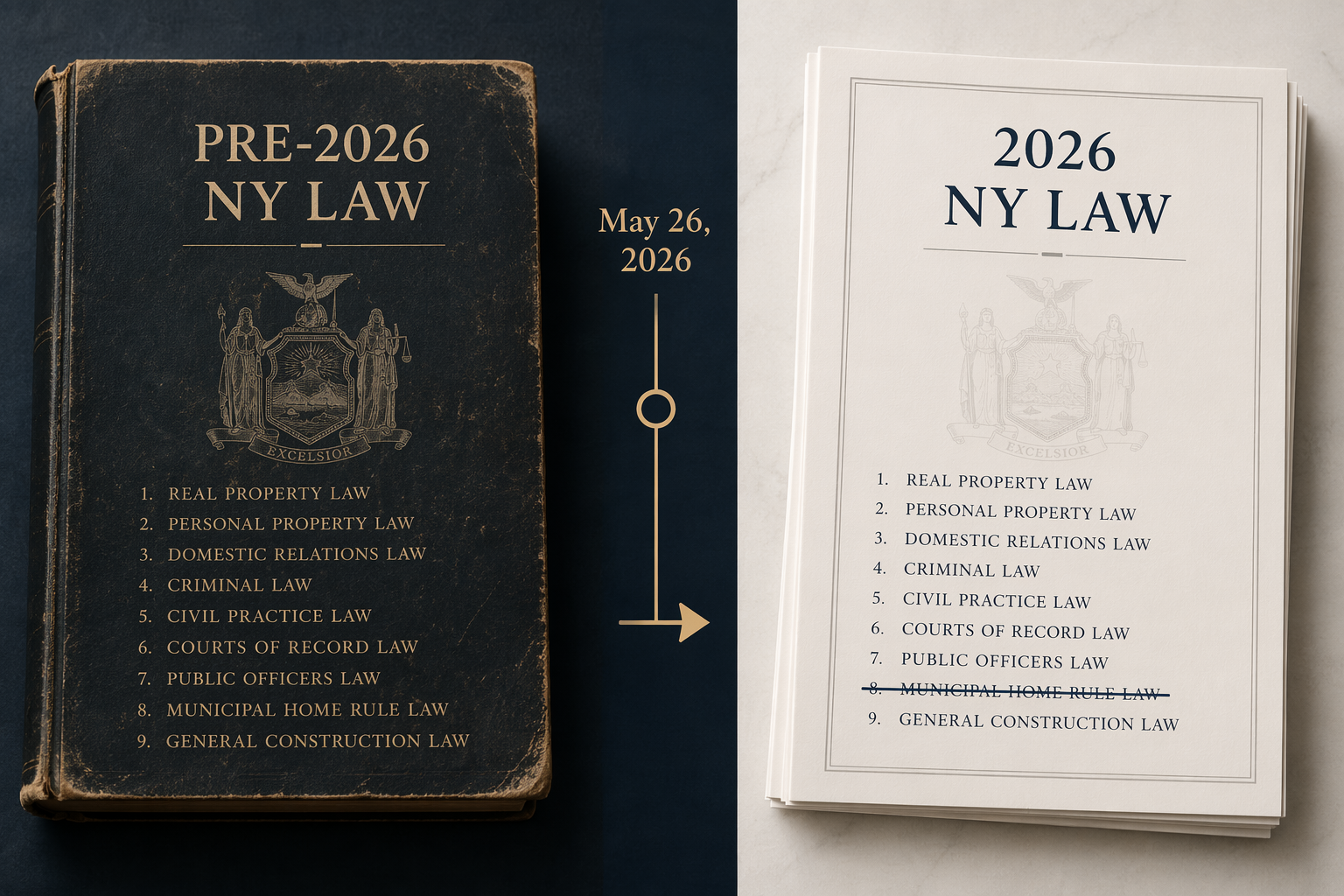
New York's 2026 Car Accident Law Changes: A Bar Exam Study Guide
This guide explains what exactly changed in New York car accident law in 2026 — covering the eliminated 90/180-day injury category, the new comparative fault bar, and the $100k damage cap — with before-and-after comparisons and exam-style practice questions to help law students prepare for the bar exam.
Updated:
If your old New York auto-accident outline still says “90/180,” “pure comparative fault,” and “no new damages cap” without qualification, it is now partly wrong. The 2026 reforms did not rewrite every New York tort rule. They did change enough of Article 51 motor vehicle practice that a familiar fact pattern can now turn on the filing date, the claimant’s fault percentage, the damages category, or one narrow statutory trigger.
The core reform package is Part EE of Chapter 58 and Part F of Chapter 55, effective May 26, 2026. The three exam rules to separate are: the serious-injury threshold in Insurance Law §5102(d), the Article 51 comparative-fault rule in CPLR §1411(b), and the new $100,000 non-economic damages cap in Insurance Law §5104(d). Alerts and statutory summaries describe these as the most substantial restructuring of New York motor vehicle accident law in decades, but for exam purposes the safer habit is narrower: statute, effective date, claim type, damages type.
The Change Map to Memorize First
| Issue | Before the 2026 reform | After May 26, 2026 | Exam trap |
|---|---|---|---|
| Serious injury threshold | Insurance Law §5102(d) was commonly taught as nine categories, including the 90/180-day inability-to-perform category. | The 90/180-day category is eliminated for actions commenced on or after May 26, 2026, reducing the listed categories from nine to eight. [1] | Do not use an old outline to let a plaintiff cross the §5104(a) threshold merely by pleading the eliminated 90/180 category. |
| Comparative fault | New York’s ordinary comparative negligence rule reduced damages by plaintiff fault but did not bar recovery at 51%. | CPLR §1411(b) bars non-economic recovery in Article 51 motor vehicle claims when the claimant’s fault exceeds 50%. [2] | This is not a universal rewrite of New York tort law. |
| $100,000 cap | No comparable Article 51 cap applied to the specified at-fault claimant categories. | Insurance Law §5104(d) caps non-economic damages at $100,000 for certain at-fault claimants: uninsured lapse over 30 days, impaired-by-alcohol/drugs with conviction, or committing/fleeing a felony with conviction. [3] | The cap does not apply to wrongful death or economic damages. [3] |
| Jury sequencing | Serious injury often occupied early attention in litigation and motion practice. | Reported commentary describes a fault-first sequencing rule under which juries decide fault percentage before serious injury evidence. [4] | A claimant over 50% at fault in an Article 51 claim may never reach the pain-and-suffering threshold fight. |
| License consequences | DMV suspension threshold was 11 points in 18 months. | As of February 16, 2026, the threshold is 10 points in 24 months, with new high point values for selected violations. [5] | This is a licensing consequence, not the tort threshold. |
That table is the attack sheet. The rest of the guide explains why each line matters and where students tend to lose points.
Serious Injury: The 90/180 Category Is the One to Unlearn
Insurance Law §5104(a) still matters because an injured person generally cannot sue for non-economic loss arising from covered motor vehicle use unless the plaintiff has sustained a “serious injury” as defined in Insurance Law §5102(d). The 2026 change does not abolish the serious-injury threshold. It removes the familiar 90/180-day category for actions commenced on or after May 26, 2026. Hinshaw’s reform alert and Rivkin Radler’s analysis both describe the change as a reduction from nine qualifying categories to eight. [1][2]
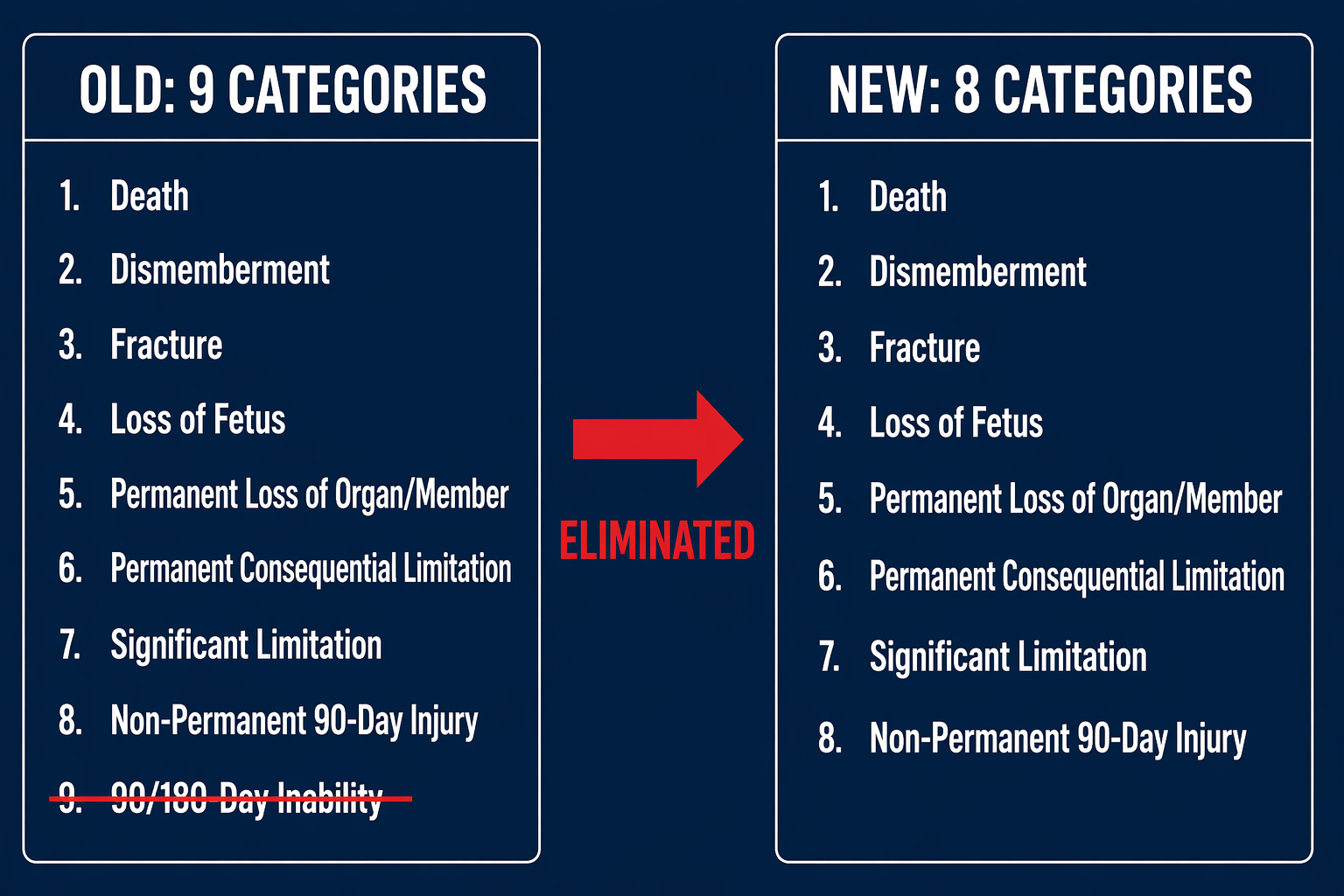
The old 90/180 category was easy to spot in a fact pattern because it sounded less catastrophic than death, dismemberment, fracture, or permanent loss. A plaintiff could point to a medically determined injury or impairment that prevented performance of substantially all usual and customary daily activities for the required period. That pathway is the trap. In a post-effective-date action, a plaintiff who only has that old 90/180 theory has not cleared the new threshold under the reform summaries. [1]
| Serious-injury point | Pre-2026 outline instinct | Post-May 26, 2026 answer |
|---|---|---|
| Claimant missed ordinary activities for the old 90/180 period | Analyze as a possible serious injury category. | Do not treat that category as available for actions commenced on or after May 26, 2026. [1] |
| Claimant has death, dismemberment, fracture, loss of fetus, or other remaining statutory category | Analyze the specific category and evidence. | Still analyze the specific remaining §5102(d) category; the threshold itself was not abolished. [1] |
| Claimant wants pain and suffering | Ask whether serious injury exists under §5102(d). | Still ask threshold under §5104(a), unless another exception applies. |
| Question gives a commencement date before May 26, 2026 | Use the old category list. | Do not automatically apply the 2026 deletion unless the action is within the new effective-date rule. [1] |
Notice the date word: commenced. A crash date alone may not answer the threshold question if the tested rule is framed around actions commenced on or after May 26, 2026. If an exam gives both the accident date and the filing date, assume both are there for a reason.
Comparative Fault: CPLR §1411(b) Is Narrower Than the Headline
The new comparative-fault rule is not “New York abandoned pure comparative negligence.” That sentence is too broad. CPLR §1411(b) creates a modified comparative negligence rule for Article 51 motor vehicle claims: if the claimant is more than 50% at fault, the claimant is barred from recovering non-economic damages. Rivkin Radler and JTNY both emphasize the Article 51 scope and distinguish pain-and-suffering recovery from economic damages. [2][3]
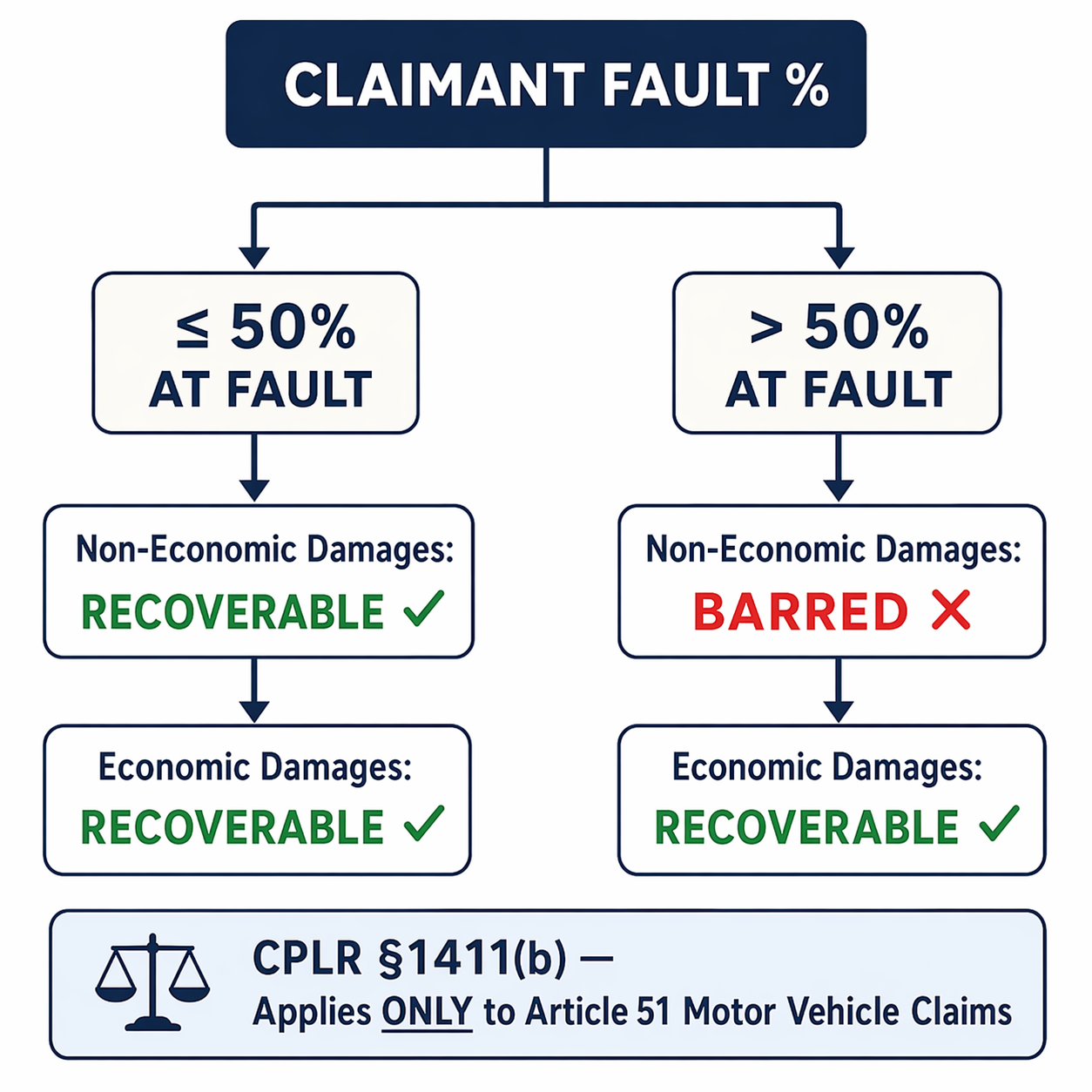
For timed analysis, separate three questions that students often collapse into one:
- Is this an Article 51 motor vehicle claim?
- Is the claimant’s fault greater than 50%, not merely equal to 50%?
- Is the claimant seeking non-economic damages, economic damages, or both?
A claimant who is 50% at fault is not over 50%. A claimant who is 51% at fault is over 50%. That one percentage point changes the non-economic damages answer under CPLR §1411(b), but it does not, by itself, erase economic damages in the examples discussed by the reform commentary. [2][3]
| Fault finding | Non-economic damages in Article 51 claim | Economic damages |
|---|---|---|
| Claimant 40% at fault | Not barred by CPLR §1411(b); ordinary fault reduction still matters. | Analyze separately. |
| Claimant exactly 50% at fault | Not barred, because the statutory bar is triggered when fault exceeds 50%. [2] | Analyze separately. |
| Claimant 51% at fault | Barred from non-economic recovery in an Article 51 motor vehicle claim. [2] | Not treated as barred by that non-economic damages rule in the cited examples. [2][3] |
| Non-Article 51 tort claim | Do not automatically import CPLR §1411(b). | Use the governing tort rule for that claim. |
The procedural wrinkle is also testable. Stanley Law Offices describes a fault-first sequencing change: juries decide fault percentage before serious injury. [4] In a post-reform Article 51 claim, that sequence can matter because a claimant found more than 50% at fault may be out of the non-economic damages case before the medical threshold consumes the exam answer.
The $100,000 Cap: Three Triggers, Two Big Exclusions
Insurance Law §5104(d) is a different rule from CPLR §1411(b). Do not blend them. The comparative-fault rule can bar non-economic damages when the claimant is over 50% at fault in an Article 51 motor vehicle claim. The §5104(d) rule caps non-economic damages at $100,000 for certain at-fault claimants who fall into specified categories. JTNY’s summary identifies the triggers as an uninsured lapse over 30 days, impaired-by-alcohol/drugs conduct with conviction, or committing or fleeing a felony with conviction. [3]
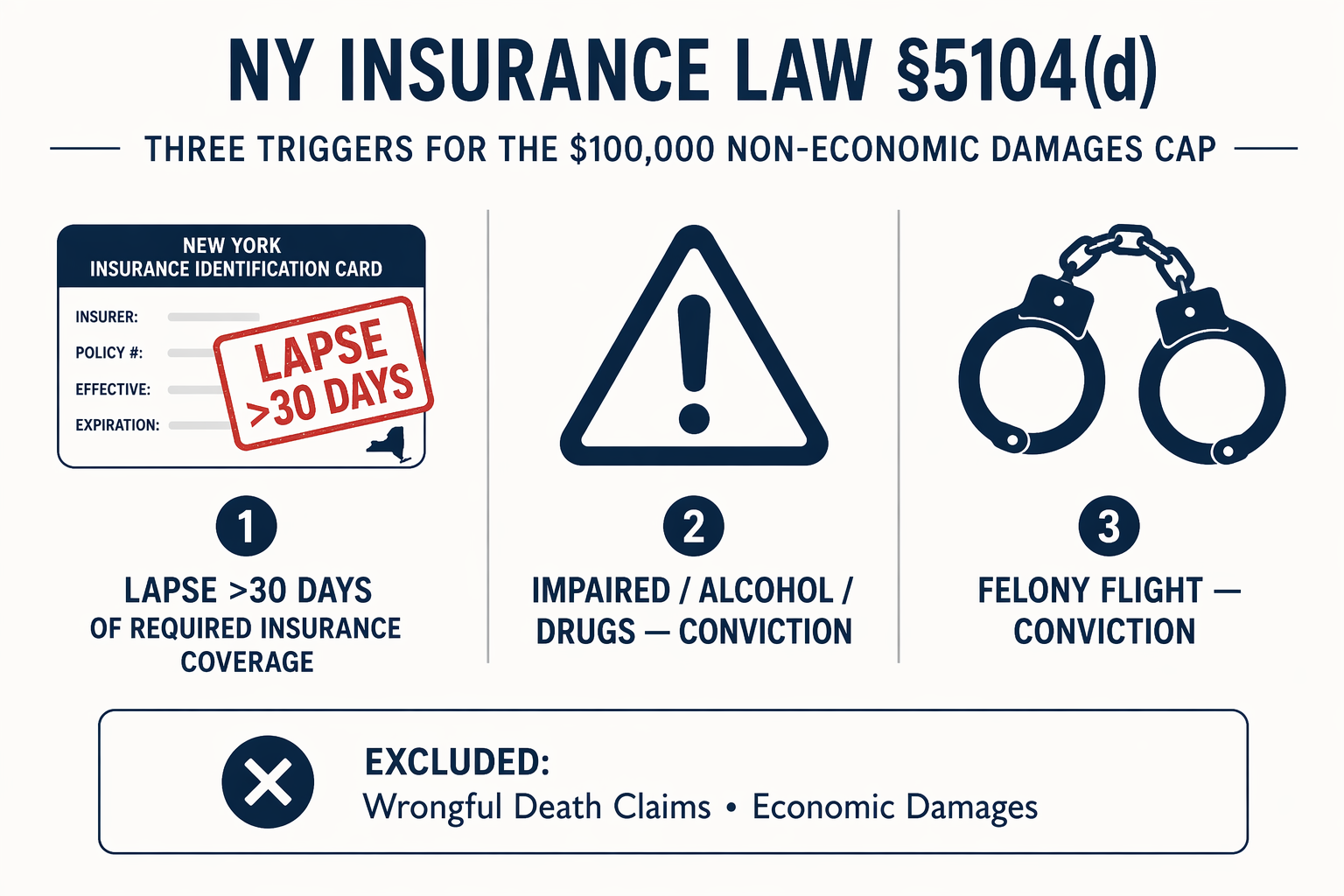
| Trigger | What to look for | Why students miss it |
|---|---|---|
| Uninsured claimant | Insurance lapse over 30 days. [3] | A mere insurance issue is not enough unless the statutory lapse trigger is satisfied. |
| Impaired claimant | Alcohol or drug impairment plus conviction. [3] | The conviction requirement matters; do not treat every allegation of impairment as enough. |
| Felony-related claimant | Committing or fleeing a felony plus conviction. [3] | Again, conviction is part of the trigger described in the reform materials. |
| Wrongful death | Excluded from the $100,000 cap. [3] | The cap is not a universal ceiling on every motor vehicle recovery. |
| Economic damages | Excluded from the $100,000 cap. [3] | The cap is on non-economic damages, not medical bills or other economic loss. |
This is where a fact pattern can stack rules. A claimant might satisfy a serious-injury category, survive the over-50% comparative-fault bar, and still face the $100,000 non-economic cap because one of the §5104(d) triggers applies. Or a claimant might be over 50% at fault, in which case the non-economic claim is barred before the cap does any work. The order of analysis is not decorative; it prevents double-counting the wrong rule.
What Did Not Change
The fastest way to miss a New York essay or multiple-choice item is to turn “2026 auto reform” into a fog machine. Several familiar rules remain in place, and at least one rumored change did not become law.
- No-fault PIP: the $50,000 basic no-fault benefit remains unchanged in the cited reform summaries. [3]
- Limitations period: the general three-year statute of limitations for personal injury remains unchanged in the cited summaries. [3]
- Municipal Notice of Claim: the 90-day Notice of Claim requirement remains a separate procedural trap. [3]
- Motorcycle exception: the preserved motorcycle exception means the serious-injury threshold analysis is not automatically the same as for covered no-fault vehicles. [3]
- CPLR §1602(6): early reports discussed repeal of the motor vehicle exception to Article 16 joint-and-several limitations, but JTNY and LlamaLab describe that repeal as not enacted. [3][6]
The motorcycle point deserves caution rather than bravado. The sources identify the motorcycle exception to the serious-injury threshold as preserved, but they do not support a clean universal rule resolving whether the new Article 51 comparative-fault provision applies to motorcyclists outside Article 51. If a test question wants that answer, it should give you statutory framing. If it does not, flag the uncertainty instead of manufacturing certainty.
License Consequences Are Separate: DMV Points Changed Too
The DMV point changes are worth knowing, but they belong in a different mental drawer. Alter Law Firm’s comparison describes the suspension threshold as moving from 11 points in 18 months to 10 points in 24 months as of February 16, 2026. It also identifies 11-point values for alcohol/drug incidents and aggravated unlicensed operation, and an 8-point value for construction-zone speeding. [5]
| DMV issue | Pre-change | As of February 16, 2026 |
|---|---|---|
| Suspension threshold | 11 points in 18 months | 10 points in 24 months [5] |
| Alcohol/drug incidents | Lower or different prior treatment under the old schedule | 11 points in the cited comparison [5] |
| Aggravated unlicensed operation | Lower or different prior treatment under the old schedule | 11 points in the cited comparison [5] |
| Construction-zone speeding | Lower or different prior treatment under the old schedule | 8 points in the cited comparison [5] |
Do not use DMV points to answer serious injury, comparative fault, or damages-cap questions. A license suspension issue may appear in the same fact pattern as a tort claim, but the legal consequences travel on separate tracks.
Policy Context, Not a Bar Rule: Premium Filings
The Department of Financial Services issued Circular Letter No. 3 in 2026 requiring insurers to file Exhibit TR-1 showing projected claims and loss-adjustment-expense percentage decreases from the reforms by August 31, 2026. [7] The Citizens Budget Commission has projected roughly a 10% premium reduction, but that is a projection rather than a statutory entitlement; actual rate effects depend on carrier filings and regulatory review. [8]
For studying, treat premium relief as context. It may explain why the Legislature and regulators cared about the reform, but it does not tell you whether the plaintiff clears §5102(d), is barred under §1411(b), or is capped under §5104(d).
Exam-Style Applications
Hypo 1: The Old 90/180 Theory
A driver is injured in a covered motor vehicle accident. The complaint is commenced after May 26, 2026. The only alleged serious injury is that the driver could not perform substantially all customary daily activities for the old 90/180 period. The driver seeks pain and suffering.
Answer: The plaintiff has a threshold problem. For actions commenced on or after May 26, 2026, the 90/180-day category is eliminated from Insurance Law §5102(d). The serious-injury threshold under §5104(a) still exists, but this old category no longer supplies it. [1]
Hypo 2: Exactly 50% at Fault
A claimant in an Article 51 motor vehicle claim proves a remaining serious-injury category. The jury assigns the claimant exactly 50% fault. The claimant seeks non-economic damages.
Answer: CPLR §1411(b) does not bar the non-economic claim because the statutory bar applies when claimant fault exceeds 50%. The claimant’s recovery may still be reduced for comparative fault, but 50% is not more than 50%. [2]
Hypo 3: 51% at Fault, Medical Bills Included
A claimant in an Article 51 motor vehicle claim is found 51% at fault. The claimant seeks pain and suffering and economic losses.
Answer: The claimant is barred from non-economic recovery under CPLR §1411(b). Do not say “recovers nothing” unless the question limits the claim to non-economic damages. The cited examples distinguish economic damages from the non-economic bar. [2][3]
Hypo 4: Uninsured Lapse and the Cap
A claimant is at fault in a motor vehicle accident and had an insurance lapse exceeding 30 days. The claimant is not over 50% at fault and seeks substantial pain-and-suffering damages plus economic damages.
Answer: The over-50% bar does not apply on these facts, but Insurance Law §5104(d) may cap non-economic damages at $100,000 because the uninsured lapse trigger is present. The cap does not apply to economic damages. [3]
Hypo 5: Felony Allegation Without Conviction
A defendant argues that the claimant was fleeing a felony and therefore the $100,000 cap applies. The facts mention an allegation but no conviction.
Answer: Be careful. The reform summaries describe the felony and impaired-driving triggers as conviction-dependent. Without the conviction fact, do not assume the §5104(d) cap applies. [3]
Hypo 6: Rumored Article 16 Repeal
A question states that a defendant invokes CPLR §1602(6), and one answer choice says the 2026 reform repealed the motor vehicle exception.
Answer: Reject that answer on the materials provided. Early commentary reportedly discussed repeal, but JTNY and LlamaLab identify the CPLR §1602(6) repeal as not enacted. [3][6]
Memorization Checklist
- Effective date: May 26, 2026 for the core tort reforms; February 16, 2026 for the DMV point changes. [1][5]
- Serious injury: Insurance Law §5102(d) drops the 90/180-day category for actions commenced on or after May 26, 2026. [1]
- Threshold statute: Insurance Law §5104(a) still limits non-economic suits absent serious injury or another applicable exception.
- Comparative fault: CPLR §1411(b) bars non-economic damages only when claimant fault exceeds 50% in Article 51 motor vehicle claims. [2]
- Damages cap: Insurance Law §5104(d) caps non-economic damages at $100,000 only for specified at-fault claimant categories and does not cap wrongful death or economic damages. [3]
- Do-not-change list: $50,000 PIP, three-year personal injury limitations period, 90-day Notice of Claim, motorcycle exception, and unrepealed CPLR §1602(6). [3][6]
The clean answer is rarely “New York changed car accident law.” The clean answer is which statute changed, for which claim, as of which date, and for which damages category. Students who study the reforms as headlines will blur threshold, fault, and cap. Students who study the before-and-after statutory map will see the traps before the clock makes them expensive.
References
- New York's Sweeping Motor Vehicle Tort Law Reforms, Hinshaw
- NY's New Motor Vehicle Accident Amendment a Win for Insurers, Rivkin Radler
- NY Auto Tort Reform 2026: What It Means for Insurers, JTNY Law
- New York's 2026 Car Accident Injury Claim Law Changes, Stanley Law Offices
- NY DMV Point System: Previous Rules vs Feb 16, 2026 Changes, Alter Law Firm
- New York Auto Insurance Reform 2026, LlamaLab
- Insurance Circular Letter No. 3 (2026), New York State Department of Financial Services, 2026
- New York Auto Insurance Reform Premium Reduction Projection, Citizens Budget Commission
Comments
Join the discussion with an anonymous comment.