
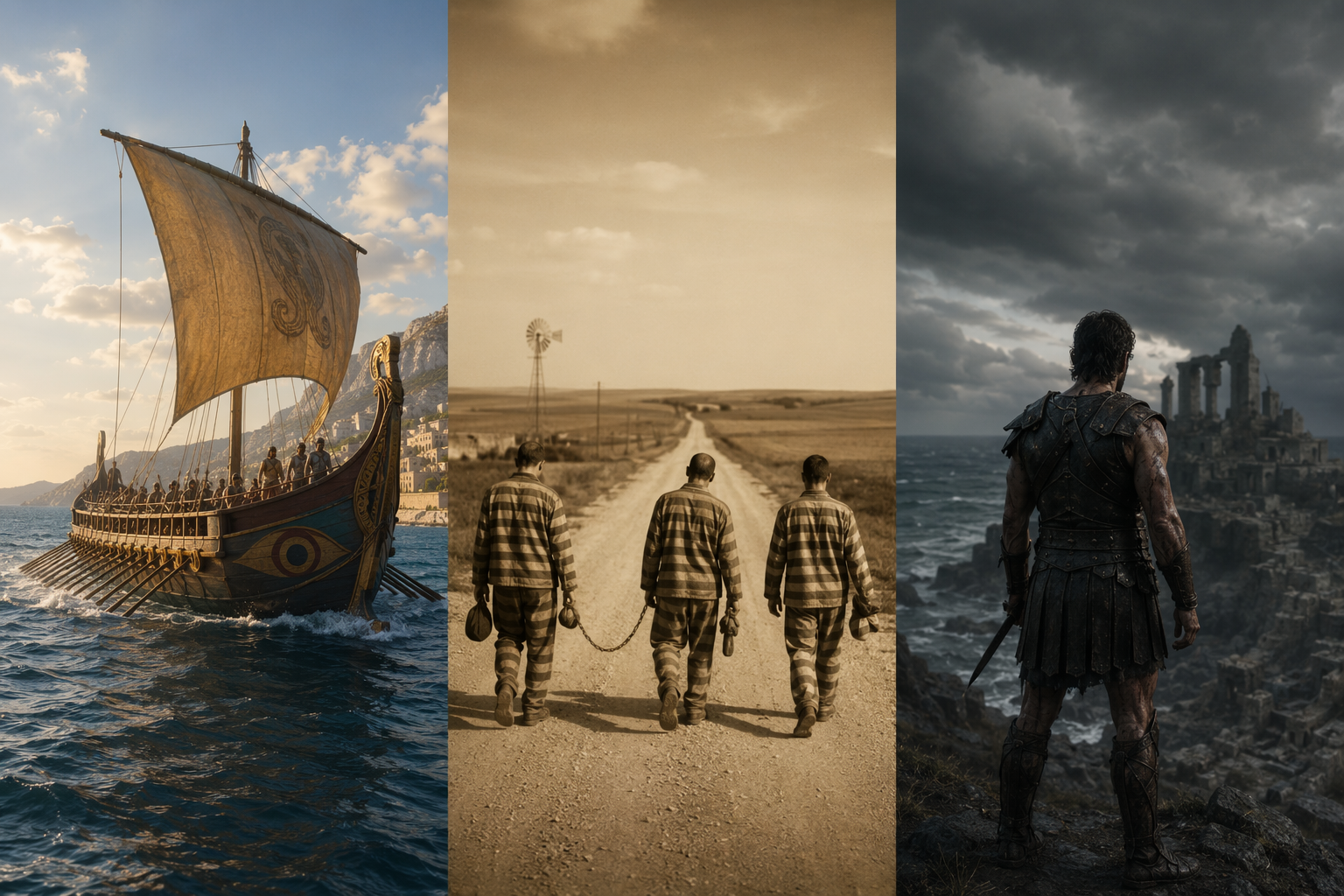
The Odyssey Book vs Movie Analysis for Students
This guide helps students compare Homer's The Odyssey to its major film adaptations, highlighting key differences from the 1997 miniseries to Christopher Nolan's 2026 film, and provides a framework for writing a strong analytical essay.
Updated:
Most weak book-vs-movie essays about The Odyssey begin with a true but unfinished sentence: the movie changed the book. That is an observation, not an argument. A stronger analysis asks what the change lets the adaptation say. The 1997 miniseries keeps much of Homer’s plot but makes the story easier to follow by arranging it chronologically. O Brother, Where Art Thou? borrows Homeric patterns and relocates them to Depression-era America. Christopher Nolan’s 2026 film makes the sharpest turn, treating Odysseus less as a triumphant returning hero than as a damaged survivor whose homecoming cannot repair what war has done to him.
For a student writing an essay, the useful question is not “Which version is best?” but “What kind of Odyssey does this version need?” A classroom essay can compare plot, structure, characters, violence, gender, or the idea of home. It does not need to mention every difference. In fact, the more mature essay usually chooses fewer differences and explains them more carefully.
A Quick Map of the Major Versions
| Version | What kind of adaptation is it? | Useful student angle |
|---|---|---|
| Homer’s Odyssey | Epic poem centered on nostos, divine intervention, storytelling, recognition, and revenge | Use it as the standard for structure, heroic identity, hospitality, gender, and homecoming |
| The Odyssey miniseries (1997) | A relatively faithful screen version that preserves many major adventures but presents them in chronological order | Analyze how simplifying the poem’s structure changes suspense, memory, and Odysseus’s control over his own story [1] |
| O Brother, Where Art Thou? (2000) | A loose reimagining, not a direct adaptation, that translates Homeric motifs into Depression-era comic and political episodes | Analyze how myth becomes American folk comedy, music, and social satire [2] |
| The Odyssey (2026) | A radical reinterpretation with an R rating, 173-minute runtime, reported $250 million budget, and early 96% Rotten Tomatoes score two days after release | Analyze how the film changes the meaning of Odysseus from victorious king to traumatized exile [3] |
Those orientation details help place the adaptations, but they should not carry the essay. Runtime, rating, and Rotten Tomatoes scores can explain what kind of object a student is discussing; they cannot prove what the adaptation means. Nolan’s early 96% critical reception, for example, is worth treating cautiously because the film was released on July 17, 2026, only two days before the current date of this article.[3]
What the Book Gives You First
Homer’s Odyssey does not begin at the beginning of Odysseus’s travels. By the time the poem opens, the Trojan War is already over, Odysseus has been gone for years, Telemachus is trying to understand what kind of father he has inherited, and Ithaca is under pressure from the suitors. The adventures with the Cyclops, Circe, the Sirens, Scylla and Charybdis, and the underworld arrive through narration and memory rather than simple chronological sequence.
That structure matters because Odysseus is not only a man who has had adventures. He is a man who tells adventures. The poem makes the audience listen to him shape his past, defend himself, conceal himself, and reveal himself. A film that puts events in chronological order is not merely “making it clearer.” It changes the viewer’s access to Odysseus’s mind and to the poem’s interest in storytelling.
The poem’s ending also gives students serious material. Odysseus returns, tests loyalties, kills the suitors, and resumes his place in Ithaca. The hanging of the twelve enslaved women is one of the most ethically uncomfortable moments for modern readers. The available adaptation summaries indicate that screen versions tend to cut or simplify that material rather than dwell on its full force. A careful essay should not exaggerate that into a universal claim about every possible Odyssey adaptation, but it can note that the treatment of these women is a revealing pressure point.
The 1997 Miniseries: Faithful Plot, Simpler Structure
The 1997 Odyssey miniseries is often the easiest adaptation for students to compare with the poem because it keeps many of the recognizable episodes. SparkNotes describes it as a 165-minute, PG-13, Emmy-winning version starring Armand Assante, with a 79% Rotten Tomatoes score, while also noting the major formal trade-off: it preserves the island sequence but loses the poem’s non-linear flashback structure.[1]
That is the essay opportunity. A student could write, “The miniseries is faithful to Homer’s events but less faithful to Homer’s method of revealing those events.” That thesis is stronger than “the miniseries follows the book” because it separates plot fidelity from structural fidelity. A film can keep the Cyclops, Circe, and the Sirens and still change the experience of encountering them.
Chronology gives the viewer a cleaner adventure narrative. It reduces confusion, which can be useful in a classroom, but it also reduces the poem’s layered sense of memory. In Homer, Odysseus’s past is not simply placed before us; it is performed, selected, and narrated. In the miniseries, the viewer watches the journey unfold more directly. The result is not a failure. It is a priority: accessibility over the poem’s more intricate narrative design.
Teach with Movies treats the 1997 version as a classroom tool and frames discussion around comparing the film with the book, which is exactly where the miniseries remains useful.[4] It gives students enough shared plot material to make comparison possible. The danger is that students stop at matching: “this scene is included,” “this scene is changed,” “this scene is missing.” The better move is to ask how the miniseries turns an epic about memory, disguise, and delayed recognition into a more straightforward journey home.
O Brother, Where Art Thou?: Motifs Instead of Direct Translation
O Brother, Where Art Thou? should not be treated as if it were trying to film Homer scene by scene. It is a loose reimagining. Mental Floss identifies several Homeric parallels: the Cyclops becomes a one-eyed Bible salesman, the Sirens become laundresses, and the bag of winds becomes a political campaign trick.[2] These are not minor substitutions inside an otherwise faithful plot. They are a new system of meaning.
The important phrase for students is “translated into another cultural language.” The film moves mythic obstacles into Depression-era America, where folk music, chain gangs, religion, racial politics, and electoral performance reshape the journey. A Cyclops in Homer tests Odysseus’s cunning and the laws of hospitality. A one-eyed Bible salesman in O Brother turns that mythic danger into a comic and predatory American encounter.
A good essay on O Brother will not spend all its space proving that parallels exist. That becomes a scavenger hunt. The better argument asks what happens when epic grandeur is converted into comic deflation. Odysseus’s heroic cunning becomes the survival craft of men trying to move through poverty, spectacle, and absurdity. The journey still matters, but it no longer asks the audience to admire heroic restoration in the same way.
Nolan’s 2026 Odyssey: Homecoming Without Restoration
Nolan’s 2026 film gives students the largest interpretive shift because its changes are not mainly about shortening the poem or relocating its setting. They revise the moral center of the story. Den of Geek’s comparison describes the film’s Odysseus as shaped by PTSD, removes the famous “Nobody” trick, reframes Athena as a psychological projection connected to a murdered Trojan woman, and ends with exile instead of restored rule in Ithaca.[5]
Those choices move the adaptation away from the poem’s central pattern of nostos, or homecoming, as recovery of place and status. In Homer, Odysseus’s return is violent and morally complicated, but it restores him to his household and kingdom. In Nolan’s version, the return appears to expose damage rather than heal it. The journey does not prove that the hero can come home unchanged. It suggests that some forms of violence continue inside the survivor.
The missing “Nobody” trick changes Odysseus’s intelligence
In the poem, Odysseus’s “Nobody” trick against the Cyclops is one of the cleanest examples of his metis: cunning intelligence, verbal skill, and tactical patience. If an adaptation removes that trick, it is not just trimming a famous scene. It reduces one of the poem’s most memorable demonstrations of how Odysseus survives.
That change gives a student a focused claim: Nolan is less interested in Odysseus as a master of language than in Odysseus as a man whose violence and trauma have made cleverness insufficient. The point is not that the film “forgot” an important episode. The point is that a different kind of hero requires a different kind of scene logic.
Athena becomes less divine guide than inward haunting
Homer’s Athena is a divine strategist. She protects, disguises, prompts, and tests. Nolan’s film, according to Den of Geek, reframes Athena as a psychological projection of a murdered Trojan woman.[5] That is a drastic change because it relocates authority. Guidance no longer comes from Olympus in the same way; it comes from memory, guilt, and psychic disturbance.
This is exactly the sort of change students should slow down for. It affects genre, theology, and character at once. The poem’s world is one in which gods shape human action. Nolan’s version appears to make the divine harder to separate from trauma. A student could argue that the film modernizes the epic by turning supernatural intervention into psychological consequence.
The women are rewritten through captivity, trauma, and exile
Vanity Fair’s list of major changes identifies several revisions to female characters in Nolan’s film: Circe becomes a trauma survivor, Helen is shown as a captive with a battered face, Penelope joins Odysseus in exile, and the poem’s twelve hanged enslaved girls are reduced to a single character, Melantho.[6] These details matter because they show that the film’s revision of heroism is also a revision of who bears the cost of heroic stories.
The reduction of the twelve enslaved girls to one character should be handled carefully. It does not automatically mean the film has solved the ethical problem of the poem. It means the film has made that problem more concentrated and perhaps more narratively manageable. A student can compare the poem’s disturbing collective punishment with Nolan’s narrower characterization and ask what is gained and what is softened.
Penelope’s exile with Odysseus is especially important because it changes the meaning of marriage and home. In Homer, Penelope’s endurance helps preserve the household until Odysseus returns. In Nolan’s version, if she leaves Ithaca with him, home is no longer simply recovered. It is abandoned, or at least no longer available as the stable prize at the end of suffering.
The ending turns return into punishment
The ending is the clearest place to build a Nolan-focused thesis. Den of Geek reports that the film replaces Odysseus’s restored kingship with exile.[5] In a traditional student comparison, the ending is often treated as one more difference on a list. It deserves more weight than that. Endings teach the audience how to judge everything that came before.
If Odysseus rules Ithaca again, the journey bends toward restoration, however bloody and uneasy. If Odysseus is exiled, the journey bends toward consequence. The film’s Odysseus may physically survive, but survival is not the same as reintegration. That distinction can anchor an essay about guilt, war, masculinity, and the cost of revenge.
Side-by-Side Differences That Can Become Arguments
| Point of comparison | Homer’s poem | 1997 miniseries | O Brother, Where Art Thou? | Nolan 2026 |
|---|---|---|---|---|
| Structure | Begins in medias res and uses delayed narration of Odysseus’s travels | Moves more chronologically, making the plot easier to follow but less structurally layered [1] | Uses selected Homeric echoes inside a new Depression-era plot [2] | Uses Homer as the basis for a darker psychological reinterpretation [5] |
| Odysseus figure | Cunning survivor, storyteller, warrior, husband, king | Recognizable epic hero moving through major adventures | Comic wanderer figure translated into American folk-satire terms | Traumatized veteran marked by guilt and violence [5] |
| Supernatural or mythic material | Gods, monsters, prophecy, and divine tests structure the world | Keeps many mythic episodes in accessible screen form | Turns mythic figures into American comic or social equivalents [2] | Psychologizes at least some divine material, especially Athena [5] |
| Women | Penelope preserves the household; Circe, Calypso, Athena, Helen, and enslaved women raise questions of power and loyalty | Useful for comparing which major figures and episodes are retained | Uses Homeric motifs more loosely than character-for-character fidelity | Reworks Circe, Helen, Penelope, and Melantho around trauma, captivity, and exile [6] |
| Homecoming | Odysseus returns to Ithaca and resumes kingship | Preserves the broad return arc | Transforms homecoming into a comic American quest | Replaces restored rule with exile [5] |
The table is not a substitute for analysis. It is a way to find pressure points. If two versions handle the same element differently, ask what value each version is protecting. The 1997 miniseries protects narrative clarity. O Brother protects the pleasure of transformation across culture and genre. Nolan protects a darker moral question: what if the heroic journey does not cleanse the hero?
How to Turn Differences Into a Thesis
Start with the difference, but do not stay there. A useful student method is to move through four steps: observation, pattern, purpose, and claim.
- Observation: Name the change accurately. Example: “The 1997 miniseries presents Odysseus’s journey more chronologically than the poem.”
- Pattern: Connect that change to one or two related choices. Example: “The miniseries also emphasizes major adventures as visible action rather than as narrated memory.”
- Purpose: Explain what the adaptation gains. Example: “This makes the story more accessible for viewers but reduces Homer’s interest in storytelling and self-presentation.”
- Claim: State the argument in a sentence that can organize an essay. Example: “The 1997 miniseries is faithful to the Odyssey’s plot but less faithful to its narrative method, turning a poem about memory and narration into a clearer adventure story.”
Notice that the sample thesis does not insult the adaptation. It also does not praise it vaguely. It identifies a trade-off. That is usually the safest and most convincing form of book-vs-movie argument.
If you are writing about the 1997 miniseries
Choose structure as your main angle. The obvious point is that the miniseries includes many famous episodes. The better point is that it changes how the audience receives them. You might compare one adventure as Homer tells it with the way the miniseries stages it, then ask whether the film version gives Odysseus more or less control over his own story.
- Possible thesis: “The 1997 miniseries preserves the Odyssey’s major adventures, but its chronological structure turns Homer’s layered act of storytelling into a more direct heroic journey.”
- Best evidence to use: the poem’s delayed narration of the wanderings, the miniseries’ chronological order, and one major retained episode such as the Cyclops or Circe.
- Avoid: a paragraph that only lists which monsters appear in both versions.
If you are writing about O Brother, Where Art Thou?
Begin by calling it a loose reimagining. That one phrase prevents a lot of weak criticism. The film is not failing to include Homer’s gods and monsters in their original form; it is converting them into another setting, tone, and genre. Your essay can then focus on what Depression-era America does to Homeric material.
- Possible thesis: “O Brother, Where Art Thou? uses the Odyssey as a pattern rather than a plot, transforming epic obstacles into comic episodes that expose American performance, poverty, religion, and politics.”
- Best evidence to use: the one-eyed Bible salesman, the laundress Sirens, and the political campaign version of the bag of winds [2].
- Avoid: treating every similarity as proof that the film is secretly a direct adaptation.
If you are writing about Nolan’s 2026 film
Do not let the essay become a report on how new, expensive, or well-reviewed the film is. Those facts can introduce the adaptation, but the argument should rest on its changes to character and meaning. The strongest Nolan essay will probably connect two or three choices: PTSD Odysseus, Athena as psychological projection, the altered treatment of women, and exile instead of kingship.
- Possible thesis: “Nolan’s 2026 Odyssey changes Homer’s homecoming epic into a study of trauma by removing key signs of heroic mastery and replacing restored kingship with exile.”
- Best evidence to use: the missing “Nobody” trick, Athena’s psychological reframing, Penelope joining Odysseus in exile, and the ending away from restored rule [5][6].
- Avoid: arguing that the film is simply “darker” without explaining which formal and plot choices create that darkness.
A Practical Essay Structure
A defensible classroom essay does not need to cover every adaptation. If the assignment asks for one film, stay with one film. If it asks for multiple versions, compare them around one shared issue instead of writing three separate mini-reviews.
| Essay part | What it should do | What to avoid |
|---|---|---|
| Introduction | Name the poem, the adaptation, and the main interpretive issue | Opening with a long biography of Homer or the director |
| Thesis | Explain how the adaptation’s changes create a different meaning | Saying only that the book and movie are similar and different |
| Body paragraph 1 | Analyze the biggest structural or plot change | Retelling the whole story |
| Body paragraph 2 | Analyze a character change and connect it to the adaptation’s priority | Judging the change only as accurate or inaccurate |
| Body paragraph 3 | Analyze the ending or moral consequence of the adaptation | Ending with personal preference alone |
| Conclusion | Return to what the adaptation makes possible as an interpretation of Odysseus’s journey | Repeating the thesis word for word |
Here is the test for each paragraph: if the paragraph only says that something was changed, it is not finished. Add the effect. A changed order affects suspense and memory. A changed monster affects the meaning of danger. A changed goddess affects the role of divine authority. A changed ending affects the judgment of the whole journey.
The Most Useful Comparisons for Students
If you are choosing evidence under time pressure, choose changes that alter meaning rather than changes that are merely noticeable. Costumes, omitted minor scenes, and casting choices may matter, but only if you can connect them to a larger pattern. These comparison points usually produce stronger essays:
- Structure: Does the adaptation keep Homer’s in medias res opening and flashback pattern, or does it make the journey chronological?
- Heroism: Is Odysseus admired for cunning, endurance, violence, survival, guilt, or some mixture of these?
- The gods: Are divine forces active beings, cultural symbols, comic echoes, or psychological projections?
- Women: Does the adaptation preserve, reduce, or revise the roles of Penelope, Athena, Circe, Helen, and the enslaved women?
- Home: Does the ending restore Odysseus to Ithaca, transform home into something unstable, or deny restoration altogether?
Those categories share one feature: each one can support a claim about interpretation. They are not just inventory. A student who writes about home, for instance, can compare Homer’s restored kingship with Nolan’s exile and explain how the same journey moves from recovery to consequence.
Final Check Before You Write
The strongest Odyssey book vs movie analysis for students is not the one with the longest list of differences. It is the one that explains how an adaptation changes the meaning of Odysseus’s journey. The 1997 miniseries is useful for showing how plot fidelity can still simplify structure. O Brother, Where Art Thou? is useful for showing how Homeric motifs can survive in a different culture and genre. Nolan’s 2026 film is useful for showing how radical changes can turn homecoming into an argument about guilt, violence, women, and exile.
Choose one adaptation. Identify two or three major changes. Connect each change to the director’s apparent priority. Then write a thesis that names the pattern. That is how “the book was different from the movie” becomes an argument a teacher can actually respond to.
References
- The Odyssey: Movie Adaptations, SparkNotes
- 5 Adaptations of 'The Odyssey,' Ranked By Rotten Tomatoes, Mental Floss
- The Odyssey (2026 film), Wikipedia
- THE ODYSSEY, Teach with Movies
- Christopher Nolan's The Odyssey vs. Homer's Epic Poem: What Are the Differences?, Den of Geek, July 17, 2026
- 'The Odyssey': 10 Major Changes From Book to Screen, Vanity Fair, 2026
Comments
Join the discussion with an anonymous comment.