
How Students Can Spot Ticket Refund Scams Online
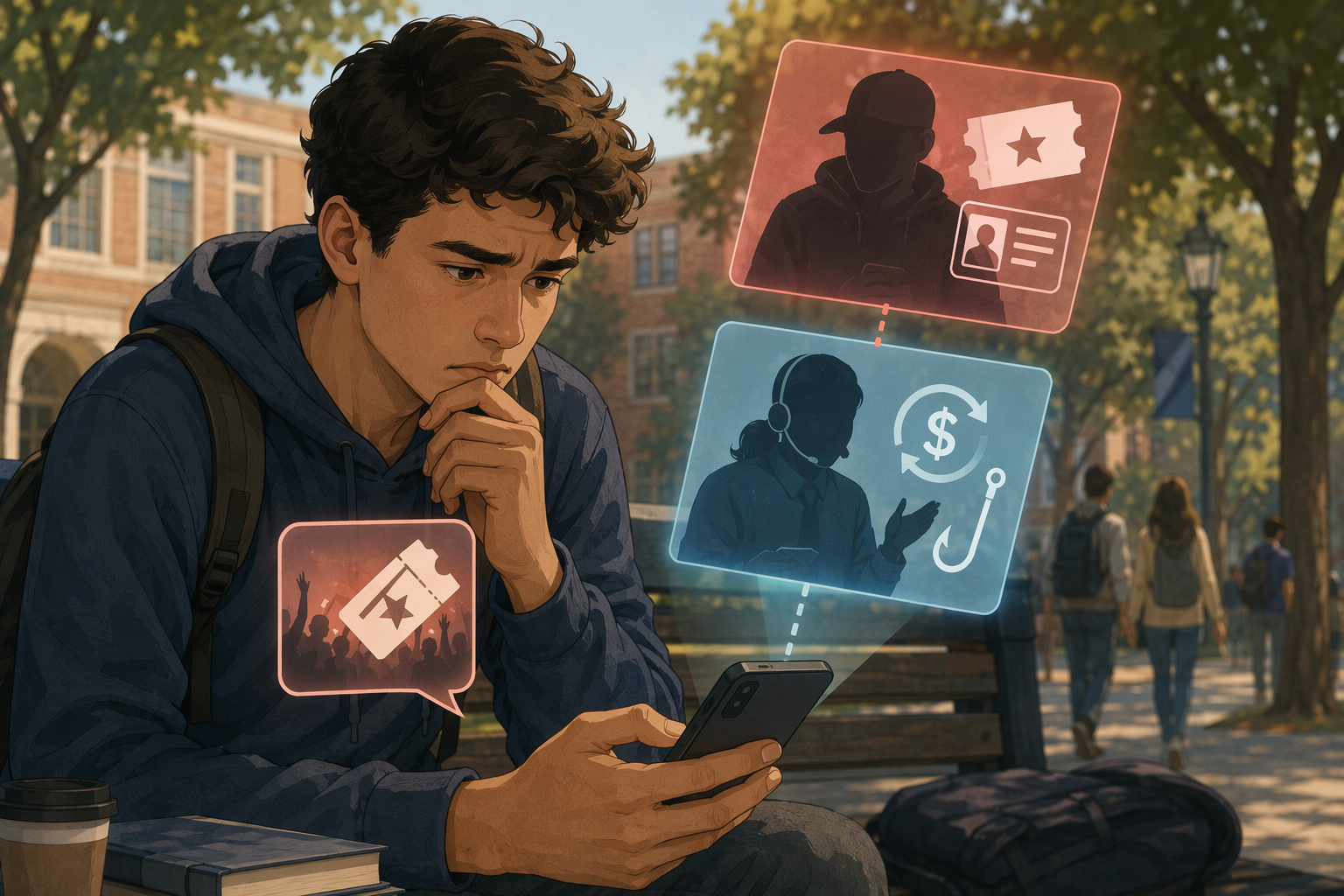
This article explains the two-phase structure of ticket refund scams that target students on GroupMe, Snapchat, and campus groups — from fake sellers to recovery scammers — and provides actionable red flags to avoid both layers of fraud.
Updated:
The ticket offer usually does not feel like a scam at first. It looks like a message in GroupMe, Snapchat, Facebook, Discord, or another campus space where students already trade rides, textbooks, sublets, and last-minute plans. The seller may sound like another student. The price may be lower than resale sites. The pressure is familiar too: someone else wants the ticket, the game is almost sold out, the concert is tonight.
That is why students searching for how to spot ticket refund scams online need to think in two phases, not one. First, a fake seller takes payment for a ticket that does not exist, cannot be transferred, or is not theirs to sell. In some campus cases, the scammer also collects student IDs or other personal information. Second, after the money is gone, another scammer may appear as a refund agent, investigator, payment-support worker, or helpful stranger who says they can recover the loss — for a fee, login, code, or more personal data.
The scam starts by borrowing campus trust
Cornell’s public IT alert gives the cleanest version of the student-specific pattern: scammers targeted students through GroupMe with fake concert ticket sales, students lost money, and student IDs were stolen.[1] That last detail matters. A fake ticket sale can become more than a bad purchase. If a scammer gets a student ID, school email, phone number, payment handle, or account screenshots, they may have material for impersonation, phishing, or future scams.
The campus setting changes the way the scam feels. A stranger on a generic marketplace is easier to doubt. A person posting in a class chat, dorm group, club server, or student-ticket thread benefits from the room itself. The group name quietly does part of the persuasion: if they are here, they must be connected somehow. That assumption is useful for real student life, and scammers know how to use it.
The safer move is not to treat every student resale as criminal. Students really do sell tickets informally when plans change. The problem is that the same informal speed that makes those channels useful also makes it easier for a fake seller to push payment before verification catches up.
What the fake sale looks like before you pay
Most ticket scams are built from small trust signals rather than one obvious lie. A profile photo, a campus reference, a screenshot of a ticket, and a rushed tone can combine into something that feels normal enough. The red flag is often not one message by itself; it is the way each message moves you away from verification and toward irreversible payment.
- The seller pressures you to pay quickly because there are “other buyers,” the event is close, or the offer will disappear.
- They refuse to use the official ticketing platform’s transfer process, or they claim it is broken, slow, or unnecessary.
- They want payment through a method that gives you little protection or makes the transfer hard to reverse.
- They send screenshots as proof, but the screenshots do not lead to a verified ticket transfer inside the official app or account.
- They use school identity cues — a student email, mascot language, a campus group, or a borrowed student profile — while avoiding a verification step that would actually prove control of the ticket.
- They ask for your student ID, a photo of your ID, login information, one-time codes, or extra personal details that are not needed to transfer a ticket.
UW-Madison Police warn students to watch for too-good-to-be-true prices, pressure to act fast, suspicious payment requests, and screenshots that do not prove a real transferable ticket.[2] The University of Alabama made a similar warning in 2025 as football-ticket scams ramped up, urging students not to get rushed into unsafe transactions.[3] The University of Michigan’s football-ticket scam guidance also points students toward safer verification and cautions against trusting messages just because they appear to come through familiar channels.[4]
A screenshot deserves special suspicion because it answers the wrong question. It may show that a ticket image exists. It does not prove the seller controls the ticket right now, that the barcode has not been reused, that the ticket is transferable, or that it will land in your account after payment. For student tickets, it also may not prove the ticket is valid for your eligibility, school account, section, or event rules.
A student ID request should slow everything down. There are legitimate campus situations where IDs matter at gates or pickup windows, but a random seller in a chat does not need a photo of your ID to prove they own a ticket. If the transaction suddenly requires your ID, school login, password reset code, payment-app verification code, or a picture of your face holding the ID, the ticket is no longer the only issue.
A quick way to test the offer
Before paying, move the conversation from vibes to verification. Ask whether the ticket can be transferred through the official ticketing system before money changes hands. Check whether the account name, transfer method, event, section, and eligibility all match what you are buying. If the seller keeps redirecting you back to speed — “trust me,” “send now,” “I have someone else waiting” — treat that as information, not just awkwardness.
| Seller behavior | What it may mean | Safer response |
|---|---|---|
| Sends a ticket screenshot only | The image may not prove ownership or transferability | Require an official transfer route before payment |
| Asks for your student ID photo | The scam may be moving into identity theft | Do not send it; verify through the school or ticket office instead |
| Insists on a rushed payment method | You may lose dispute or recovery options | Pause and use a payment route with buyer protection where available |
| Claims campus affiliation but avoids verification | The identity cue may be borrowed or fake | Confirm through an independent channel, not the same chat thread |
The refund scam begins after the embarrassment hits
The second phase is easier to miss because it arrives when the student is already stressed. Maybe the seller vanished. Maybe the ticket failed at the gate. Maybe the payment app will not reverse the transfer. Now the search changes from “cheap ticket” to “how do I get my money back?” That is exactly where recovery scammers operate.
The FTC describes refund and recovery scams as schemes where someone contacts people who have already lost money and claims they can help recover it. The catch is that they ask for an upfront fee, personal information, financial details, or access to accounts, and the promised recovery does not happen.[5] The FTC also warns that scammers may use lists of prior victims, sometimes called “sucker lists,” to target people who have already shown they can be pressured or deceived.[5]

This is the part that makes a ticket scam feel especially unfair. The student who hesitates before buying may get told they are being paranoid. The student who reports the loss may then get targeted again for trying to fix it. A recovery scammer can sound official, calm, and helpful — the opposite of the rushed ticket seller — while still moving toward the same result: more money or more access.
Recovery-scam lines to stop on
- “We can recover your payment, but you need to pay a processing fee first.”
- “Send your bank login, payment-app login, or school account login so we can verify the case.”
- “Read back the code we just sent you.”
- “We work with the platform, police, ticket office, or bank, but you must act before the refund window closes.”
- “Do not contact the school, bank, payment app, or police yourself because it will slow down the recovery.”
Real reporting, banking, ticketing, and campus processes do not need your password. They do not need you to buy a gift card, send crypto, pay a “release” fee, or hand over a one-time verification code. If someone says they can get your ticket money back only after you pay them first, that is not a refund path. It is the second trap.
Big fraud numbers matter, but they are not the playbook
Consumer fraud is not a small problem. Reported fraud losses to the FTC reached $15.9 billion in 2025, and the actual scale may be much higher because many losses are never reported.[6] That number is useful for perspective, but it does not tell a student what to do in the ten minutes before sending money to someone in a campus chat.
Ticket fraud also is not limited to U.S. campuses. In the UK, Action Fraud reported £1.6 million lost to gig ticket scams, showing how common the broader event-ticket pattern can be outside a university setting.[7] Still, the campus version has its own pressure points: student-only tickets, school IDs, group chats, rivalry games, homecoming weekends, and the assumption that a person in the group must be part of the community.
A canceled event refund is different from a stranger promising recovery
Some refund rights are real, but they are narrower than scammers make them sound. California’s 30-day refund rule applies to canceled events in that state; it is not a national guarantee for every concert, game, festival, or peer-to-peer resale.[8] It also does not mean a random person in your DMs has special access to recover money from a fake seller.
If an event is actually canceled, start with the original ticket seller, official ticketing platform, event organizer, venue, or the payment provider you used. If your problem is that a stranger sold you a fake ticket, the path is different: report the scam, preserve evidence, contact your payment provider quickly, and protect any accounts or IDs you exposed. Mixing those two situations is how recovery scammers make a fake promise sound like a real consumer right.
What to do if you already paid
If you already sent money, the first goal is to stop the damage from spreading. Take screenshots of the profile, messages, payment request, payment confirmation, ticket images, usernames, phone numbers, email addresses, and group name. Do not keep arguing with the seller if the conversation is only creating more pressure or requests.
- Contact the payment app, bank, or card issuer through its official app or website and ask what dispute, fraud, or reversal options exist.
- Report the account or post inside the social platform or campus group so moderators can remove it and warn others.
- Report the incident to campus police, IT security, student affairs, or the ticket office if school accounts, student tickets, or IDs are involved.
- If you sent your student ID, school login, password, or verification code, change passwords immediately and contact campus IT.
- Report the scam to the FTC at its official reporting site rather than trusting anyone who contacts you first and offers recovery help.
If the scam involved a school login, ID photo, or official-looking message, it may overlap with broader student phishing patterns. A separate guide to phishing scams that target college students can help you check whether the same information could be used in another attack.
Before the next ticket offer
Campus ticket buying works best when students slow down only the parts scammers depend on. Verify the ticket through an official transfer system when possible. Keep your student ID out of casual resale chats. Treat screenshots as weak evidence. Use payment methods with protection where available. Report fake sellers quickly, even if the amount feels too small or the mistake feels embarrassing.
And if the first scam already happened, be just as careful with anyone promising a refund. The person offering to recover your money may not be the solution. They may be the next seller.
References
- Concert Ticket Scam Targets Students, Cornell IT
- Ticket Scams: What to Watch For, UW-Madison Police Department
- Ticket Scams Are Kicking Off: Don’t Get Played, University of Alabama, 2025
- Football Ticket Scam, University of Michigan Safe Computing
- Refund and Recovery Scams, Federal Trade Commission
- FTC: Record $15.9 billion in consumer fraud losses in 2025, Detroit Free Press, March 28, 2026
- £1.6m lost to gig ticket scams as public urged to take caution, GOV.UK
- Ticket Refund Rights 2026, California Today
Comments
Join the discussion with an anonymous comment.