ACLU Lawsuits Challenge Social Media Bans for Students
State social media bans for minors are being blocked by courts as unconstitutional. This article explains the ACLU's First Amendment challenges, the current legal status, and what it means for students' rights.
Updated:
If you are trying to follow the 2026 headlines about social media bans in schools, ACLU lawsuits, and student rights, they can feel like they are arguing with each other. One says most Americans support keeping kids under 16 off social media. Another says courts are blocking state laws. Another says the Supreme Court let a Mississippi law stay in effect for now. All three can be true at the same time.
The first thing to clear up is the search phrase itself. There is not one neat, famous case called “ACLU sues school over social media ban” that answers everything. The real map has two lanes. One lane is state laws that restrict minors’ access to social media platforms, often through age checks, parental consent, or account limits. The ACLU has challenged or supported challenges to these laws through litigation and amicus briefs. The other lane is school discipline for what students say online, especially when the post happens off campus. The ACLU’s 2021 Mahanoy student-speech victory matters there because it limits how far schools can reach into a student's off-campus online life.
That distinction matters because a state platform ban and a school punishment case do not affect students in the same way. A state law can decide whether a teenager can open or keep an account at all. A school discipline case asks whether a principal can punish a student for a post, joke, complaint, protest, or insult. Both touch student rights, but they move through different legal doors.
Why These Laws Keep Coming Back
The political pressure behind these bans is real. Pew Research Center reported in July 2026 that 56% of Americans support banning social media for children under 16, and 85% support requiring parental consent before minors can use social media sites.[1] That helps explain why lawmakers keep writing these bills even after courts block earlier versions.
Those numbers should not be waved away as panic or censorship theater. Parents have seen sleep, bullying, attention, self-image, group chats, anonymous accounts, and school drama collapse into the same glowing rectangle. Teachers and administrators are often the adults who have to manage the fallout the next morning. A lawmaker who says “something has to change” is not inventing the worry from nothing.
But popularity does not answer the constitutional question. If young people use social media to talk with friends, follow news, organize walkouts, criticize school officials, join fan communities, learn about politics, or complain about adults in power, the state is not only regulating a product. It is regulating access to places where speech happens.
The State Ban Map Is Already Fragmented
By late 2025, eight states had enacted minor social media bans or access restrictions while 18 more had attempted similar legislation, according to MultiState Insider’s overview of the state-law wave.[2] The important part is not just how many states tried. It is what happened after the laws reached court.
| State or Law | Status described in the research record | What that means for students |
|---|---|---|
| Arkansas | Permanently blocked | The law is not currently enforceable under the ruling described. |
| Ohio | Permanently blocked | The state cannot enforce that broad minor-access restriction unless the legal posture changes through a later proceeding. |
| Florida HB 3 | Temporarily halted | The law is paused while litigation continues; students should not treat the pause as the same thing as a final ruling. |
| Virginia SB 854 | Blocked by a federal judge in February 2026 | The one-hour daily limit is not enforceable while blocked. |
| Mississippi HB 1126 | Temporarily allowed to remain in place | The law survived an emergency posture for now, but its constitutionality remains contested. |
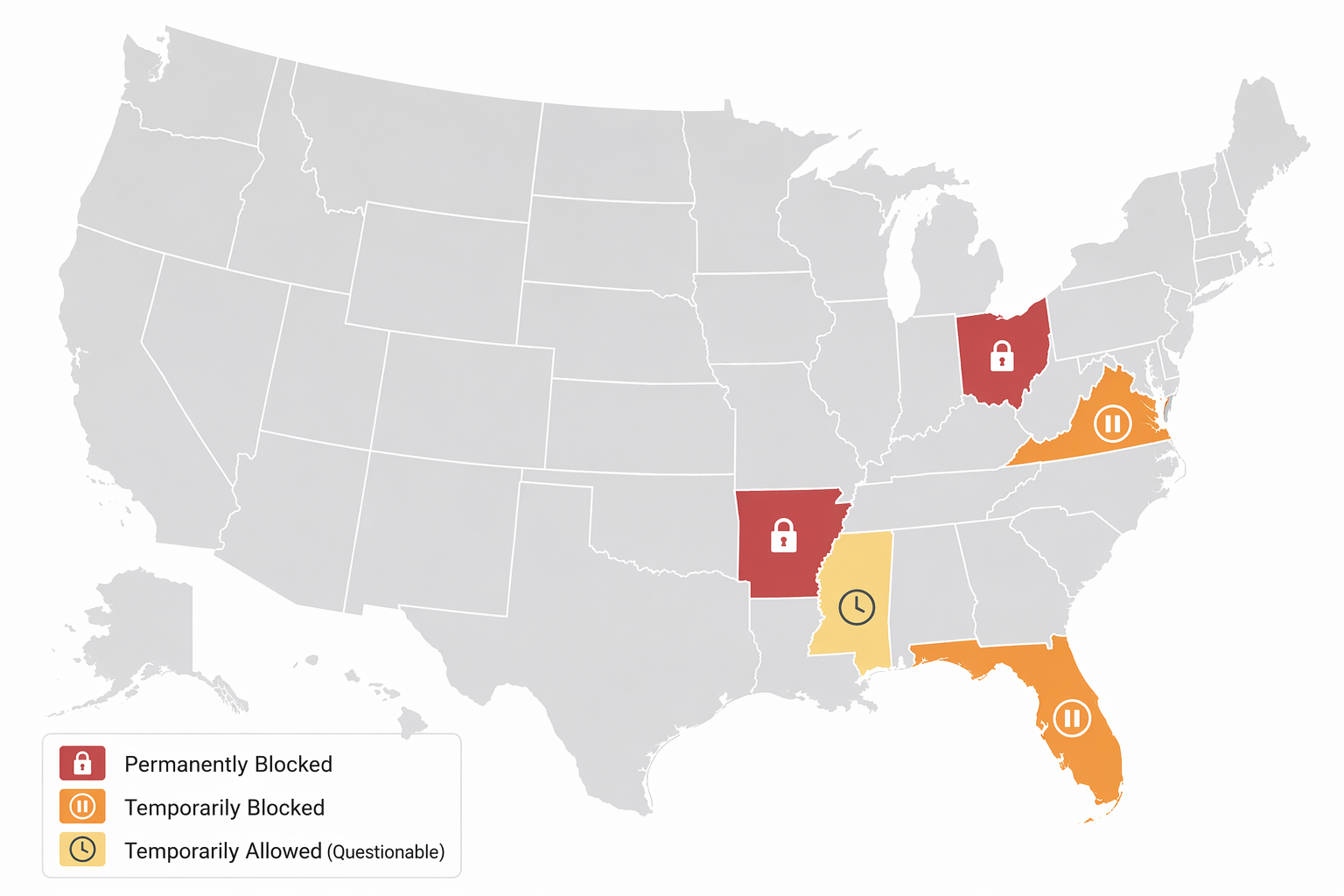
Permanent and temporary rulings are not interchangeable. A permanent block means the court has reached a final decision against the law at that stage. A temporary injunction means the court has stopped enforcement while the case continues, often because the challengers showed a strong likelihood of success or serious constitutional problems. A temporary allowance means a higher court declined to stop the law immediately; it does not automatically mean the law is constitutional.
That is why Mississippi’s position is easy to misunderstand. In August 2025, the Supreme Court allowed Mississippi’s restrictions on children’s access to social media to remain in place temporarily, but Justice Brett Kavanaugh wrote separately that the law was “likely unconstitutional.”[3] For a student reading headlines, that means “allowed for now” is not the same as “approved.”
Florida sits in a different category. A federal judge halted Florida’s social media ban for minors in June 2025, pausing enforcement of HB 3 while the case continued.[4] Virginia’s one-hour daily limit met a similar First Amendment problem in February 2026, when a federal judge blocked SB 854 and found the restriction was not narrowly tailored.[5]
What Courts Are Actually Asking
Courts are not saying that minors face no online risks. They are asking a narrower and harder question: can the government restrict access to broad social media platforms where protected speech takes place, and has it chosen a method that burdens speech no more than necessary?
When a law targets platforms because they host certain kinds of communication, feeds, profiles, messages, or user-generated content, judges may treat the rule as a speech restriction rather than a simple consumer-safety rule. That raises the level of constitutional scrutiny. The state then has to do more than identify a serious problem. It has to show that the law is carefully fitted to that problem.
This is where many broad minor-access laws struggle. A parental-consent rule may sound modest, but it can still block a teenager from reading, posting, joining communities, or speaking anonymously unless an adult approves. A time-limit rule may sound like a screen-management tool, but if it limits access to entire platforms used for news, advocacy, art, school clubs, or political speech, a court may ask why less speech-restrictive tools would not work.
The legal issue is not whether Instagram, TikTok, Snapchat, YouTube, or similar platforms are healthy in every use. A lot of student speech happens in messy places. The First Amendment does not protect only ideal study-group conversations and carefully edited debate-club posts. It also protects criticism, jokes, complaints, unpopular opinions, and awkward political expression.
Where The ACLU Fits In
The ACLU’s role in this area is broader than one school-ban lawsuit. It has supported First Amendment challenges to state laws affecting minors’ access to social media, including amicus work related to Texas’s SCOPE Act, Florida’s HB 3, and Mississippi’s HB 1126.[6] The basic argument is that states cannot use child-safety concerns to impose sweeping speech restrictions without meeting constitutional limits.
That does not mean every student post is immune from consequences. It means the government needs a constitutionally valid reason and a properly tailored rule before it can restrict speech or access to speech spaces. The difference is not technical. It is the difference between a student being told “your account is blocked because the state says minors cannot be here” and “you are being disciplined because this specific post caused a specific school disruption.”
The School Discipline Lane: Mahanoy Still Matters
For school discipline, the landmark student-rights case is Mahanoy Area School District v. B.L. The case involved a student punished after posting a profane Snapchat message off campus. In 2021, the Supreme Court ruled for the student, and the ACLU described the decision as a major victory for students’ free speech rights.[7]
Mahanoy did not say schools are powerless whenever a phone is outside the building. Schools can still respond to serious bullying, threats, harassment, cheating, or speech that substantially disrupts school. But the ruling rejected the idea that schools have a free-floating right to punish everything students say online after hours.
For students, that distinction is practical. A complaint about a coach, a sarcastic post about school, a political argument, or criticism of administrators does not automatically become school property because classmates can see it. At the same time, a post that targets another student, threatens violence, exposes private information, or triggers a real disruption may move into territory where school authority is stronger.
That is why “social media ban in schools” can be misleading. A school phone policy, a classroom app rule, a district discipline code, and a state age-verification law are different things. They may all affect the same student’s day, but they do not all raise the same legal question.
Why Parental Consent Is Politically Easier Than Legally Simple
Parental-consent requirements poll especially well, which makes sense. Many adults hear “parental consent” and think of a permission slip, not a speech restriction. Pew’s 85% support figure shows why lawmakers return to that model.[1]
The legal problem is that consent systems can burden more than harmful conduct. They may affect a student looking up mental-health resources, following local news, organizing around school policy, exploring identity, or speaking under a pseudonym. For some students, asking a parent is easy. For others, it can be unsafe, humiliating, or impossible. The Constitution does not make every parental-consent law invalid, but it does require courts to ask what speech is being blocked and whether the state used a careful enough tool.
That is also why judges care about tailoring. A law aimed at specific harmful design practices, deceptive data use, or unlawful conduct may be easier to defend than a broad rule that keeps minors off whole platforms. The more a law sweeps in ordinary speech, the heavier the First Amendment problem becomes.
Effectiveness Is A Separate Question
Even if a law could survive a First Amendment challenge, it would still have to work in the real world. Brookings argued in December 2025 that there is “little evidence” bans on social media are effective and warned that bans may push young users toward “darker corners of the internet.”[8] That is not the same as proving every ban fails. It is a warning that access restrictions can create workarounds, underground use, and harder-to-see risks.
This matters because constitutional fights sometimes make the debate sound binary: either social media is dangerous and bans are justified, or social media is harmless and bans are censorship. The evidence in the current record does not require that cartoon version. It is possible to believe that platforms can harm young people and still doubt that broad government bans are lawful, precise, or effective.
What Students Should Check Before Trusting A Headline
A headline about a social media ban rarely tells you enough. Before assuming your rights changed, check three things: the state, the type of rule, and the current court status.
- State: Arkansas, Ohio, Florida, Virginia, and Mississippi are not in the same legal position. A blocked law and an allowed-for-now law have different day-to-day effects.
- Type of rule: A state platform-access law is different from a school phone policy, a classroom rule, or discipline for a specific post.
- Court status: “Permanently blocked,” “temporarily halted,” and “temporarily allowed” are different legal categories.
- Speech involved: Political speech, criticism, organizing, threats, harassment, and targeted bullying are not treated the same way.
- Decision-maker: A parent, teacher, principal, platform, legislature, and federal judge each has a different kind of authority.
For a high school student, the most immediate question may be whether the school can punish a post. Mahanoy gives students real protection for off-campus speech, but it does not protect threats, harassment, or speech that seriously disrupts school. For a student in a state with a minor-access law, the question may be whether a platform must verify age, require parental consent, or limit use. That depends on whether the state law is in force.
For college students under 18, the issue can feel especially strange. You may be old enough to live away from home, take college classes, work, and participate in campus politics, while still falling inside a minor-access law. That is one reason broad age-based rules can collide so awkwardly with speech rights: they do not just affect entertainment. They can affect civic life.
The July 2026 Bottom Line
As of July 2026, public support for restricting minors’ social media access is high, especially for parental consent. But broad state restrictions remain constitutionally unstable. Arkansas and Ohio bans are permanently blocked. Florida is temporarily halted. Virginia’s one-hour limit is blocked. Mississippi is temporarily allowed, but even that posture came with a warning from Justice Kavanaugh that the law is likely unconstitutional.[2][3][4][5]
Students’ rights are real, but uneven. The answer depends on where you live, whether the rule comes from a state legislature or a school administrator, whether it blocks platform access or punishes a specific post, and whether a court has already stepped in. The safest way to read any new headline is to ask: which state, which rule, and what is its current court status?
References
- Majority of Americans support banning social media for kids under 16, Pew Research Center, July 2026.
- Eight States Enact Minor Social Media Bans Despite Court Fights, MultiState Insider, October 2025.
- Supreme Court allows restrictions on children’s access to social media to remain in place, SCOTUSblog, August 2025.
- Judge halts Florida’s social media ban for minors, Courthouse News, June 2025.
- Court Hits Pause on Virginia’s Social Media Restrictions for Minors, Syracuse Law Review, February 2026.
- ACLU amicus briefs and policy materials on social media restrictions for minors, ACLU.
- Mahanoy Area School District v. B.L. student speech victory, ACLU, 2021.
- How will bans on social media affect children?, Brookings, December 2025.
Comments
Join the discussion with an anonymous comment.