
How the Texas Delta-8 Ban Study Affects Students
Texas lawmakers are considering a delta-8 ban based on studies about youth use, poison center calls, and mental health impacts. This article breaks down the key research so students can weigh the evidence for themselves.
Updated:
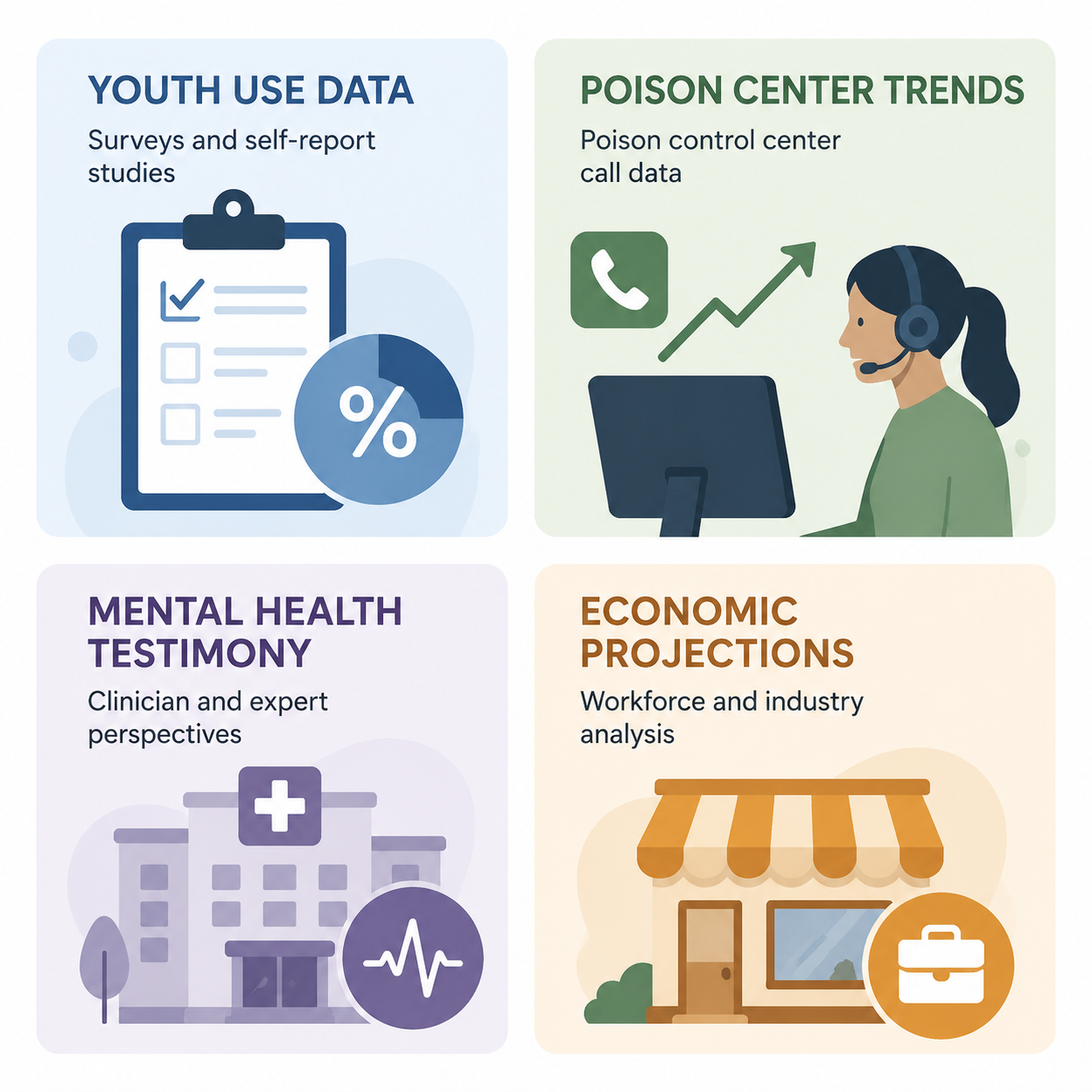
When people talk about a Texas delta-8 ban study, they usually mean several different kinds of evidence getting pulled into the same argument. One number comes from a national student survey. Another comes from Texas poison center calls. Another comes from testimony at a Senate interim hearing about THC and mental health. Another comes from an economist estimating what a ban would do to hemp jobs and storefronts.
Those sources are not interchangeable. A survey can show how common delta-8 use is among 12th graders, but it cannot by itself show how many students were harmed. Poison center calls can show rising exposure reports, but they do not tell us how many Texans used cannabinoids without calling. Hearing testimony can put hospital strain into public view, but testimony is not the same thing as a published causal study. Economic projections can show disruption to workers and businesses, but they do not answer whether a product is safe for teenagers.
That distinction matters for students because young people are often the object of the debate, not the audience for it. If a lawmaker says students are at risk, or an industry group says a ban would destroy jobs, the first useful question is not which side sounds more confident. It is what kind of evidence is being used, and what that evidence can actually prove.
| Evidence bucket | Main number being cited | What it can show | What it cannot show by itself |
|---|---|---|---|
| National youth survey | 11.4% of U.S. 12th graders reported past-year delta-8 use in 2023; 14% in the South | Delta-8 use was not rare among surveyed 12th graders | Whether delta-8 caused specific health outcomes |
| Texas poison center data | Cannabinoid exposure calls rose from 923 in 2019 to 2,363 in 2023 | Reported exposures increased sharply, including among children and teenagers | The total number of users or the rate of harm per user |
| Senate hearing testimony | Testimony stated 37,000 emergency mental-health detentions at 17 Texas teaching hospitals in 2025, costing $275 million | Hospitals and lawmakers are treating THC-related mental health as a serious concern | That delta-8 alone caused those detentions |
| Economic-impact projection | An economist estimated about 53,000 jobs and 6,350 businesses at risk | A broad ban could disrupt workers, retailers, and local businesses | Whether youth access or health risk is acceptable |
The Student-Use Number Is Real, but It Has a Narrow Job
The clearest student-facing number comes from Monitoring the Future, a long-running national survey of adolescent substance use. In 2023, 11.4% of U.S. 12th graders reported using delta-8 THC in the past year. In Southern states, the figure was 14%.[1][2]
That number changes the conversation because it moves delta-8 out of the category of obscure product. For a high school senior class, a past-year-use rate around one in nine nationally is not background noise. For the South, where Texas belongs, the survey estimate is higher. The study also matters because 2023 was the first year Monitoring the Future asked specifically about delta-8, so it gave researchers a baseline where before there had mostly been argument, marketing, and scattered local reports.[1][2]
But a prevalence number has a job description. It tells us how many surveyed students said they used delta-8 over a time period. It does not say whether those students used it once or often. It does not say whether a specific student experienced panic, psychosis, dependency, or no obvious health effect. It also does not tell us whether a Texas ban would reduce use, shift students to other products, or change who gets punished.
The strongest way to use the Monitoring the Future finding is as a warning against pretending teen delta-8 use is imaginary. The weakest way to use it is as a shortcut for every other claim. A survey result can justify asking harder health and enforcement questions. It cannot answer all of them.
Poison Center Calls Show a Sharper Texas-Specific Signal
The Texas poison center data is harder to brush off because it is not just about attitudes or reported use. According to data cited in a Baker Institute report and in Texas Senate hearing testimony, Texas Poison Center Network cannabinoid exposure calls rose from 923 in 2019 to 2,363 in 2023, a 156% increase. More than half of those calls involved people under age 20, and roughly one-third involved children under age 6.[3]
That age breakdown is the part that should make students slow down. The under-20 share speaks to teenagers and young adults directly. The under-6 share points to a different problem: products being left where children can reach them, packaging that may not signal danger to a child, or adults underestimating how quickly an edible or vape product can become someone else’s emergency.
A poison center call is not the same as a confirmed poisoning in a hospital chart, and it is not a population denominator. If calls rise, that can reflect more exposures, more severe exposures, more public awareness of poison centers, more willingness to call, or some combination of those. Still, the trend is not just a vibe check. It is a Texas-specific public-health signal showing that cannabinoid exposure problems were being reported much more often by 2023 than in 2019.[3]
For students, this is where “I know people who use it and they’re fine” becomes a weak argument. Personal experience can be true and still miss the cases that end up on a poison center line. At the same time, poison center data should not be stretched into saying that every delta-8 product or every user is headed for an emergency. The evidence supports a narrower, still serious conclusion: reported cannabinoid exposures in Texas rose sharply, and young people made up a large share of those reports.

The Mental-Health Hearing Was Serious, but It Was Still Testimony
On July 7, 2026, the Texas Senate Health and Human Services Committee held an interim study hearing focused on THC and mental health. Reporting from the hearing said Sen. Charles Perry confirmed he planned to re-file a ban bill in 2027, and witnesses discussed THC-related psychosis concerns involving young people.[4][5]
One of the most striking claims from the hearing was that 17 Texas teaching hospitals had 37,000 emergency mental-health detentions in 2025, with a stated cost of $275 million.[4] That number belongs in the debate because it shows why hospitals and lawmakers are not treating the issue as campus gossip or culture-war decoration. Emergency detention is not a casual intervention. It means someone reached a point where immediate psychiatric evaluation and safety concerns were involved.
Still, the wording matters. As of July 17, 2026, formal recommendations from that interim work had not yet been published in the materials reviewed for this article. The 37,000 figure was stated in hearing coverage and testimony context; it was not presented here as a published study finding that delta-8 caused 37,000 detentions. THC, cannabis use, mental illness, age, product potency, other substances, and prior vulnerability can overlap in ways that are difficult to untangle from a hearing clip.
That does not make the testimony useless. It means the testimony should be read as a policy signal and a clinical warning, not as a clean causal equation. If someone uses it to say hospitals are seeing costly mental-health crises connected to THC, that is within the shape of the evidence. If someone uses it to say every emergency detention was caused by delta-8 products sold in Texas stores, the claim has outrun the source.
Economic Harm Is Not a Side Note
The health evidence is the reason students are being talked about so intensely. The economic evidence is the reason a ban is not just a public-health lever with no human cost attached. Houston Public Media reported that economist Beau Whitney estimated a THC ban would put about 53,000 hemp-industry jobs and 6,350 businesses at risk in Texas. The same reporting described about $4 billion in retail activity at risk and more than $10 billion in total economic contribution connected to the industry.[6]
Those numbers measure disruption. They point to shop owners, retail workers, suppliers, landlords, and local tax bases. In smaller towns or student-heavy neighborhoods, a storefront closing is not an abstraction. It can mean fewer hourly jobs, empty commercial space, and people losing businesses they built around a product category that existed in a legally unstable space.
But the economic projection has its own boundary. It does not prove delta-8 is safe for teenagers. It does not cancel out poison center calls. It also comes from an economic-impact frame, so its strongest claim is about what a ban could disrupt, not what level of youth risk Texas should tolerate. That distinction is easy to lose when a debate turns into “kids versus jobs,” as if either side gets to make the other disappear.
The Legal Status Is Tangled, and This Is Not a Shopping Guide
As of mid-2026, Texas delta-8 legality was not a clean yes-or-no issue. Reporting after a May 1, 2026 Texas Supreme Court ruling said the court cleared the way for the state health department to classify manufactured delta-8 as Schedule I, while also noting that the department said it would not actively enforce at that time.[7] Other legal updates described practical conflict with a Travis County injunction involving a total-THC rule and pointed to federal changes scheduled to take effect on November 12, 2026, affecting chemically converted cannabinoids.[8][9]
For this article, the legal tangle matters only because it affects how people talk about the evidence. A product can sit in a gray or shifting legal space and still raise real health questions. A product can create real jobs and still face legitimate age-access concerns. Students looking for current legal advice, purchase locations, or product recommendations need a different resource, and probably a lawyer rather than a comment thread.
Public Opinion Does Not Settle the Evidence Either
Public opinion adds one more layer without replacing the research. A June 2025 University of Texas/Texas Politics Project poll reported by The Texas Tribune found that 53% of Texas voters opposed a full THC ban like SB 3, while Republican voters were split, with 46% in support and 39% opposed.[10]
That polling is useful if the question is political appetite. It is less useful if the question is whether delta-8 increases a particular health risk or whether a ban would reduce youth use. Voters can be worried about teen exposure and still dislike a total ban. They can support a ban because of mental-health testimony without knowing the limits of the data. Attitudes matter in a democracy, but they are not lab results.
How Students Can Read the Claims Without Getting Used by Them
The useful move is to match each claim to the evidence type behind it. If someone says “students are using delta-8,” the Monitoring the Future data supports taking that seriously among 12th graders, especially with the higher estimate reported for the South.[1][2] If someone says “Texas is seeing more cannabinoid exposure calls,” the poison center trend supports that.[3] If someone says “delta-8 caused every mental-health detention being discussed at the Capitol,” ask for the study that proves that specific causal claim. If someone says “a ban has no economic downside,” the Whitney Economics estimates make that hard to defend.[6]
- Prevalence is not harm: a student-use survey shows how common reported use is, not how many users were injured.
- Exposure calls are not total usage: poison center data captures reported incidents, not everyone who used a cannabinoid product.
- Hearing testimony is not a completed study: it can surface urgent clinical concerns before formal recommendations are published.
- Economic impact is not a safety finding: job and business losses matter, but they do not prove a product is low-risk for young people.
- Legal status is not moral clarity: a shifting rule does not automatically tell students what is safe, fair, or enforceable.
A cleaner debate would stop making one number do four jobs. The youth survey says delta-8 use among 12th graders was common enough to measure nationally. The Texas poison center data says reported cannabinoid exposures rose sharply and involved many young people. The Senate hearing testimony says THC and mental health have become a serious concern for hospitals and lawmakers, while still needing careful causal language. The economic projection says a ban could hit thousands of workers and businesses.
Students do not have to flatten those points into one slogan. The Texas delta-8 ban debate is being driven by real youth-risk concerns, real uncertainty about causation and enforcement, and real economic costs. Taking the evidence seriously means letting all three stay visible at the same time.
References
- “Delta-8-THC use reported by 11% of 12th graders in 2023” — NIH / NIDA
- “Adolescent Δ8-THC and Marijuana Use in the US” — JAMA, Harlow et al., March 2024
- “How a Well-Regulated Texas Hemp Industry Can Promote Public Safety” — Baker Institute, December 2024
- “THC, mental health take center stage at Texas Senate hearing” — KXAN, July 7, 2026
- “Texas lawmakers continue push to ban THC at public hearing” — The Texas Tribune, July 7, 2026
- “THC ban is ‘an extinction-level event’ for Texas hemp industry, economist says” — Houston Public Media, November 13, 2025
- “Texas Supreme Court clears way for delta-8 ban as White House addresses hemp products” — KCBD, May 5, 2026
- “Is Delta-8 THC Legal in Texas? 2026 Status After Sky Marketing” — CannabisRegulations.ai
- “September Update on Texas Hemp Regulation” — Buchanan Ingersoll & Rooney PC, September 2025 update
- “Majority of Texans oppose total THC ban like the one vetoed by Gov. Greg Abbott” — The Texas Tribune, June 25, 2025
Comments
Join the discussion with an anonymous comment.