

Can the 2026 Public Charge Rule Deny Your Green Card as a Student?
The September 2026 public charge rule change expands the benefits USCIS can weigh when evaluating green card applications. This article explains what international students need to know to avoid denial, including pre-September 18 filing windows and financial preparation steps.
Updated:
Last updated: July 19, 2026.
Yes, the 2026 public charge rule can affect a green card application filed by an international student after September 18, 2026. That does not mean most F-1 or J-1 students are suddenly likely to be denied. The practical question is narrower: which public benefits, if any, has the student used; whether Form I-485 can be filed before the cutoff; and whether the financial record is strong enough to show self-sufficiency after the rule changes.
USCIS announced on July 16, 2026, that it is rescinding the 2022 public charge regulation, with the new approach taking effect on September 18, 2026.[1] The Immigrant Legal Resource Center explains the immediate timing point students need most: the 2022 rule remains in effect through September 17, 2026.[2] For a student who is already eligible to adjust status, that filing window may matter more than any general discussion of immigration politics.
What Changes On September 18
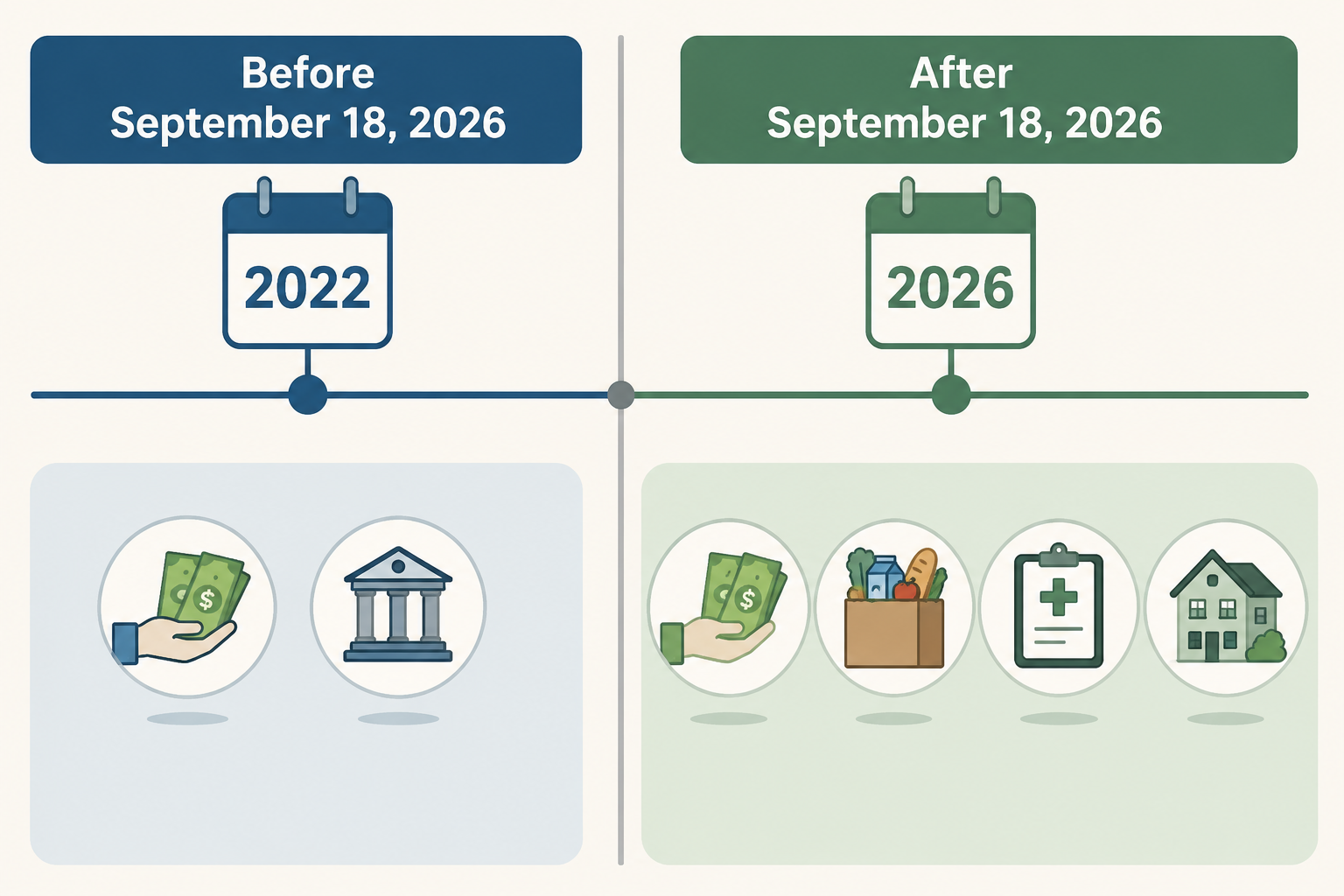
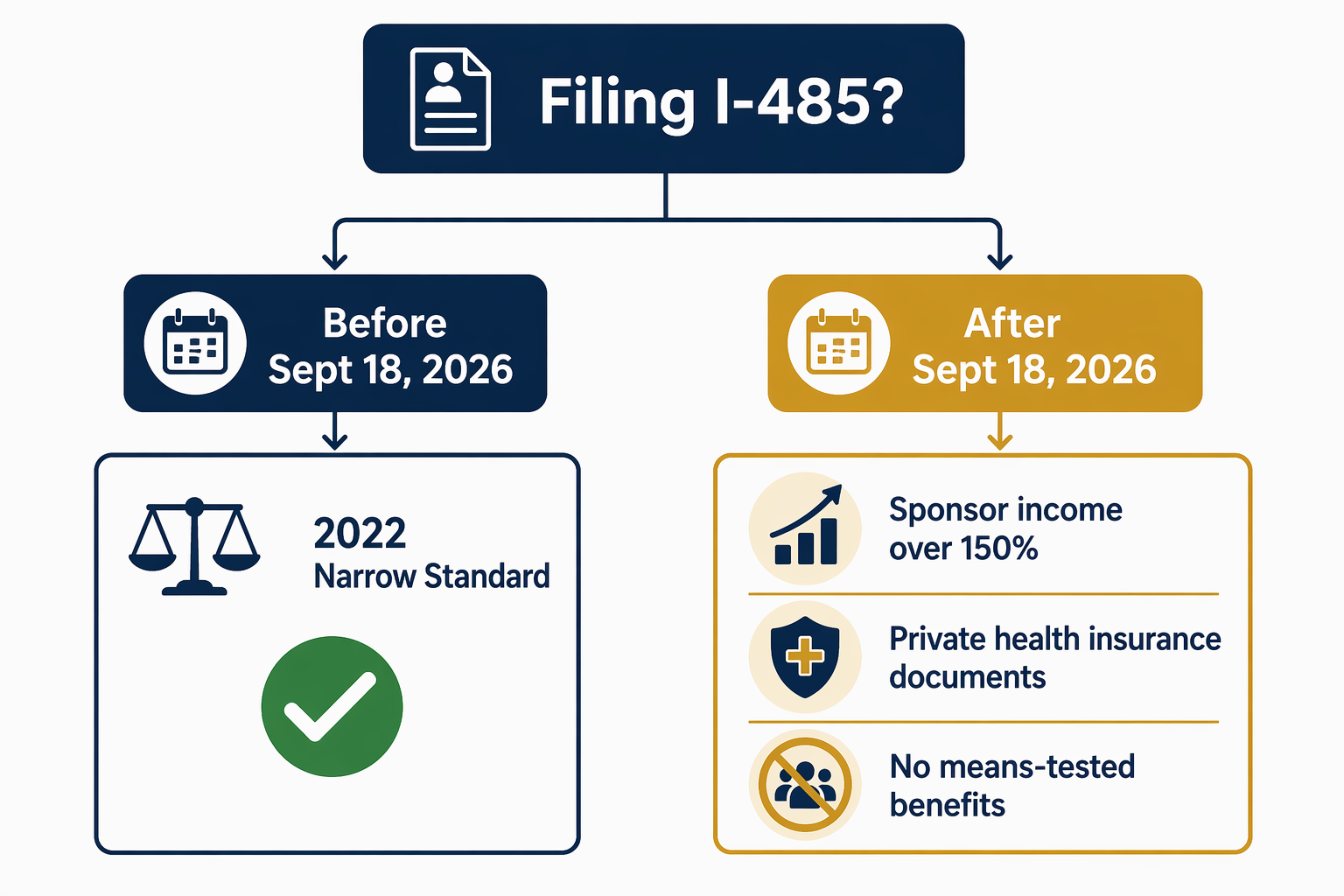
Before September 18, USCIS applies the narrower 2022 public charge standard. Under that standard, the main public-charge concern is whether the applicant is likely to become primarily dependent on the government through cash assistance for income maintenance or long-term institutionalization at government expense.[1][2]
After September 18, USCIS may weigh a broader set of means-tested public benefits. Examples include SNAP, non-emergency Medicaid, and housing assistance, in addition to the older cash-assistance and long-term-care concerns.[1][2] That expansion is why a student who looked low risk under the 2022 rule may still need to prepare a fuller financial file if filing after the effective date.
| Filing Timing | Standard USCIS Applies | Student Preparation Focus |
|---|---|---|
| I-485 filed by September 17, 2026 | 2022 public charge rule remains in effect | Confirm no cash assistance or long-term institutionalization issue; still submit a complete I-864 if required |
| I-485 filed on or after September 18, 2026 | Expanded public charge approach after rescission of the 2022 rule | Document sponsor strength, private health insurance, assets/resources, education, skills, and no means-tested benefit use |
Some benefits remain outside the public charge analysis. ILRC identifies emergency Medicaid, disaster relief, and unemployment as excluded examples.[2] That distinction matters because students sometimes remember one interaction with a public agency and assume it automatically damages the green card case. It may not. The exact benefit, the recipient, and the timing all matter.
Why Many International Students Start From A Better Position
Most international students are not regular users of means-tested public benefits. F-1 and J-1 students usually enter with school funding, family support, personal funds, assistantships, employment authorization tied to student status, or a combination of those sources. Many are also ineligible for the very benefits that create public charge concerns.
That is an advantage, not a guarantee. A student with no means-tested benefit use, current private health insurance, a solid I-864 sponsor, and a clear education or employment path is in a very different posture from a student with recent non-emergency Medicaid use, weak sponsor income, no health coverage, and unclear support after graduation.
The expanded rule also arrives during a year when students are already tracking several immigration changes at once. Herman Legal Group notes that 242,782 students were on OPT or STEM OPT in the 2023/24 period, a reminder that many students are not only studying but also building employment records that may become part of a later adjustment file.[5] The public charge question should be separated from those other issues so one policy does not get mistaken for another.
First Decision: Can You File I-485 Before September 18?
For students close to eligibility, the first task is not to predict how every officer will apply the new rule. It is to find out whether adjustment of status is actually available before September 18. That means checking the basis for the green card, visa availability if a category is subject to the Visa Bulletin, admissibility issues, required forms, medical exam timing, and whether the sponsor documents can be gathered without rushing into mistakes.
- If the student is not yet eligible to file I-485, the September 17 window does not create eligibility.
- If the student is eligible but missing core evidence, filing fast may still be risky.
- If the student is eligible and the packet can be prepared accurately, filing before September 18 may keep the case under the narrower 2022 public charge standard.
- If the case must be filed after September 18, preparation should shift from ordinary form completion to a fuller financial self-sufficiency presentation.
This is where students should be careful with online advice that says simply to “file before the deadline.” A half-finished I-485 packet can create its own problems. Missing signatures, incorrect fees, weak I-864 evidence, or a filing made before eligibility exists can waste the very window the student is trying to protect.
Practical Pre-Cutoff Steps
- Confirm the green card category and whether adjustment of status is available inside the United States.
- Check whether a visa number is available, if the category requires one.
- Identify whether Form I-864 is required and who will sign it.
- Collect sponsor tax returns, W-2s, pay records, employment verification, and proof of status or citizenship.
- Review all public benefit history before answering forms or preparing explanations.
- File only when the packet is eligible, signed, complete, and supported.
The deadline is real, but it does not reward guessing. If a student cannot confidently identify the basis for adjustment, the required sponsor, and the benefit history, that student needs qualified immigration help before choosing speed over accuracy.
What A Post-September 18 Student File Should Prove
After September 18, the file should answer a simple concern before the officer has to search for it: how will this applicant support themself without relying on means-tested public benefits? Ozek Law describes the public charge analysis through five statutory factors: age, health, family status, assets/resources/financial status, and education/skills.[3] For students, those factors often overlap with documents they already have, but they need to be organized with the public charge question in mind.
| Factor | What A Student Can Usually Document | Why It Matters |
|---|---|---|
| Age | Passport biographic page, birth certificate, government ID | Many students are of working age, which can be a favorable practical fact when paired with education and support |
| Health | Private insurance card, policy letter, school health plan documents, medical exam records | Coverage can reduce concern that future medical costs will lead to benefit reliance |
| Family status | Household size, dependents, marriage records, children’s records if applicable | A sponsor income that is adequate for one person may be thin for a larger household |
| Assets and resources | Bank statements, scholarships, assistantship letters, employment authorization, pay records, sponsor evidence | This is the center of most post-cutoff public charge preparation |
| Education and skills | Transcripts, degree records, enrollment verification, resume, licenses, job offer or employment history | A credible path to work supports future self-sufficiency |
A strong student file does not need to pretend the applicant is wealthy. It should show a believable support structure: sponsor income, school funding if relevant, savings if available, lawful work history or employment authorization where applicable, and health insurance. The officer should not have to infer that support from scattered papers.
Sponsor Income: The Legal Floor Is Not The Same As A Safer Target
For family-based cases and some employment-based cases involving a qualifying relative or ownership interest, Form I-864 remains one of the most important financial documents. The familiar legal minimum is generally 125% of the federal poverty guidelines for the sponsor’s household size. USCIS has not replaced that statutory threshold with a new official 150% or 200% rule.
Dworsky Law, however, recommends treating 150% to 200% of the poverty guidelines as a safer practical target under the new financial self-sufficiency environment.[4] That is a cautious attorney interpretation, not a USCIS rule. Still, it reflects a point students should take seriously: a sponsor can technically meet the minimum and still look financially thin if the household is large, the income is unstable, or the documentation is weak.
- Stronger sponsor evidence includes recent tax returns, W-2s or 1099s, pay stubs, an employment verification letter, and proof the sponsor is a U.S. citizen or lawful permanent resident.
- Weak spots include self-employment with unclear net income, a recent job change without pay history, household-size mistakes, and income that barely clears the legal minimum.
- If the sponsor is close to the line, students should ask qualified counsel whether assets, a household member, or a joint sponsor can lawfully strengthen the filing.
The mistake I see students make is treating the I-864 as a box to check. After September 18, it is better to treat it as the backbone of the public charge file. If the sponsor’s income is comfortable, make that easy to see. If it is not comfortable, do not hide the problem in a pile of bank statements and hope no one notices.
Private Health Insurance Deserves Its Own Folder
Health is one of the five public charge factors, and Dworsky Law describes private health insurance as one of the most important positive factors under that prong in the 2026 environment.[4] For students, this may be a school plan, employer plan, spouse’s plan, or private individual coverage. The point is not just to have coverage; it is to document it clearly.
- Keep the insurance card and a letter or portal printout showing active coverage dates.
- If coverage comes through a university, include proof that the plan is current for the relevant academic term.
- If coverage recently changed, keep records showing there was no unexplained gap or explaining why the gap occurred.
- Do not assume the officer will understand a university health fee, campus clinic access, and actual insurance coverage are the same thing.
Students who used non-emergency Medicaid need individualized legal advice before filing after September 18, because the expanded rule may allow USCIS to weigh that benefit.[1][2] Students who only received emergency Medicaid should not automatically treat that as the same issue, because ILRC identifies emergency Medicaid as excluded.[2]
Benefit History: Name The Exact Program
A vague memory is not enough for public charge preparation. “I got help from the state once” could mean emergency Medicaid, unemployment, disaster relief, SNAP, housing assistance, or something else entirely. Those are not treated the same way.[2]
Before filing, students should identify the exact program name, who received the benefit, when it was received, whether it was cash or non-cash, and whether it was means-tested. If the student is unsure, it is better to request records or speak with counsel than to answer based on a guess. Public charge risk often turns on details that sound small until they are placed on an immigration form.
Low-Risk Profiles And Warning Signs
A lower-risk international student profile usually has several facts working together: no means-tested benefit use, active private health insurance, a sponsor comfortably above the required income level, clean documentation of school or work history, and no unexplained financial dependence on public programs. None of those facts makes approval automatic, but together they answer the public charge concern directly.
Warning signs deserve attention before filing, especially after September 18. Recent SNAP, non-emergency Medicaid, or housing assistance; a sponsor barely meeting the 125% level; no current health insurance; a large household with limited income; or inconsistent financial documents can all make the case harder to present under the expanded public charge approach.[1][2][4]
| Student Situation | Likely Public Charge Concern | Preparation Response |
|---|---|---|
| No means-tested benefits, strong sponsor, insured | Usually lower public charge exposure | Organize proof clearly; do not overcomplicate the file |
| Sponsor meets 125% but income is unstable | Officer may question whether support is reliable | Add stronger income records or ask counsel about lawful supplementing options |
| Used non-emergency Medicaid after the rule change | Expanded rule may allow USCIS to weigh the benefit | Get individualized legal advice before filing |
| Only emergency Medicaid, disaster relief, or unemployment | These examples are identified as excluded in ILRC guidance | Still document the exact program so it is not mistaken for something else |
| No private health insurance | Health factor may become a weak point | Obtain and document coverage if available before filing |
Do Not Confuse Public Charge With The May 2026 I-485 Memo
The public charge rule is about whether an applicant is likely to become dependent on covered public benefits. The May 2026 I-485 memo is different. Herman Legal Group and GBH News describe that memo as framing adjustment of status as an “extraordinary act of grace,” with broader discretionary review of I-485 applications.[5][6]
Those policies can affect the same student, but they are not the same test. A student can have a strong public charge record and still need to care about discretionary factors in the I-485 file. Likewise, a student should not label every I-485 concern as “public charge.” Keeping the issues separate helps the student prepare the right evidence instead of responding to a general feeling of danger.
The same caution applies to other 2026 student immigration changes. JQK Law places the public charge rule within a wider year of policy changes affecting international students and immigrants.[7] Students also may be tracking the separate four-year student visa cap issue; for that, see what international students face under the 4-year visa limit. Each policy has its own trigger, date, and consequence.
One more distinction matters for students from countries affected by the January 2026 visa ban discussion: the 75-country visa ban applies to consular processing abroad, not adjustment of status inside the United States.[7] A student filing I-485 in the U.S. should not assume a consular-processing restriction automatically controls an adjustment case, though travel decisions may need careful legal review.
Litigation May Change The Rule, But Do Not Build A Filing Plan Around That Hope
Litigation is expected against the July 2026 final rule. That means the effective date, implementation details, or agency instructions may change. It does not mean students should ignore the September 18 date while waiting for a court to act.
Migration Policy Institute has warned that expanded public charge standards can create chilling effects for immigrant families, including fear and confusion around benefits.[8] Students should take that concern seriously without letting fear replace fact-checking. The right response is to identify the exact filing date, the exact benefit history, and the exact financial evidence available.
A Student Filing Plan Before And After The Cutoff
If you can file by September 17, prepare the packet under the assumption that the 2022 rule still applies, because ILRC identifies that date as the last day before the new rule takes effect.[2] That does not excuse a weak I-864 or incomplete evidence. It simply means the public charge analysis should remain narrower if the filing is properly made before the cutoff.
- For a pre-cutoff filing, prioritize eligibility, form accuracy, signatures, fees, sponsor documents, medical exam requirements, and proof that no counted public charge issue exists under the 2022 standard.
- For a post-cutoff filing, build a fuller financial record around sponsor strength, private insurance, education and skills, lawful work history where relevant, and exact benefit documentation.
- For a student with any means-tested benefit history, get legal review before filing rather than relying on general student-focused guidance.
- For a student whose sponsor only barely meets the legal minimum, consider whether the file can be strengthened before submission.
International students are often better positioned than they fear because many have no means-tested benefit history and can document education, work authorization, family support, or school-based funding. After September 18, though, the application should be prepared as a financial self-sufficiency file, not just a routine student-to-green-card paperwork package.
References
- US Citizenship and Immigration Services Rescinds 2022 Public Charge Regulation, USCIS, July 16, 2026.
- Latest on Public Charge, Immigrant Legal Resource Center.
- New Public Charge Rule (2026): What It Means for Your Green Card, Ozek Law, July 2026.
- Public Charge in 2026: Understanding the New Financial Self-Sufficiency Standards, Dworsky Law, 2026.
- F-1 Students Green Cards 2026: Can International Students Still Adjust Status Under the New USCIS I-485 Memo?, Herman Legal Group, 2026.
- GBH News report on the May 2026 I-485 memo, GBH News, May 22, 2026.
- Immigration Policy Updates: What International Students and Immigrants Need to Know in 2026, JQK Law, 2026.
- Trump Administration Public-Charge Rule Would Amplify Harms to Immigrant Families, Migration Policy Institute.
Comments
Join the discussion with an anonymous comment.