
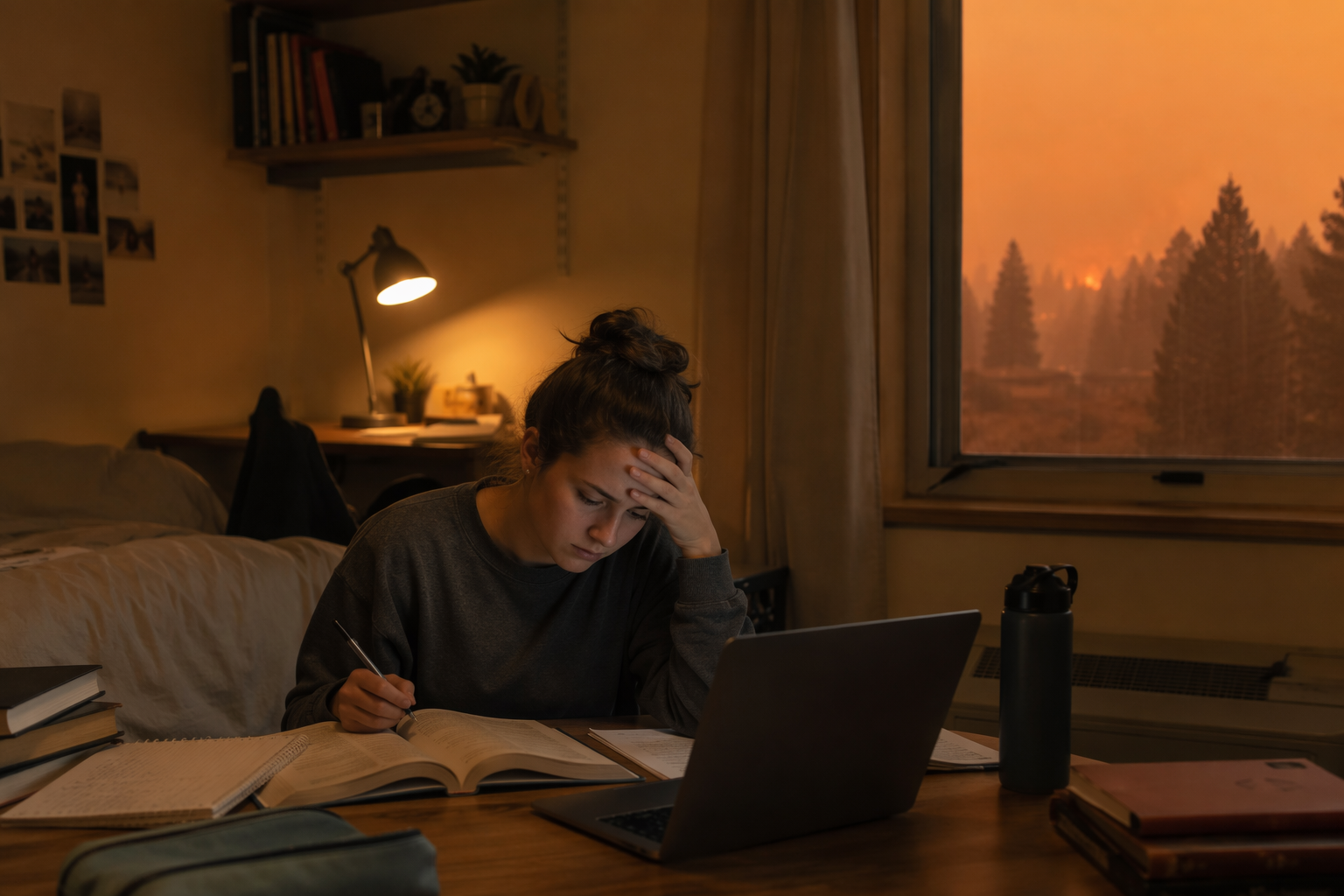
Protect Your Study Sessions from Wildfire Smoke
Wildfire smoke can impair concentration and lower test scores, but students can fight back with air quality monitoring, HEPA filtration, N95 masks, and smart study scheduling. This guide explains the science and gives practical, budget-friendly strategies to protect your cognitive performance during wildfire season.
Updated:
The impact of wildfire smoke on learning often starts as a simple reread loop: the paragraph looks familiar, but it will not stick. That is not a character flaw. It can be the air, the room, and the timing of the work pushing attention below its usual level.
Smoke Can Lower Academic Output
In a 2022 Stanford analysis of 11,700 U.S. school districts, test scores in ELA and math fell even at low smoke levels, and a single high-smoke year in 2016 could have lowered cumulative lifetime earnings by about $1.9 billion.[1] The same study found the weekday exposure hit was nearly twice the weekend hit, which points to smoke interfering most when students are trying to do active cognitive work.[1] A 2025 Brazil study of more than 40 million students found wildfire events were linked to 0.33% lower essay scores and 0.54% lower general subject scores.[2]
The mechanism is not mysterious enough to require alarmism. Wildfire PM2.5 can get into the body through the blood-brain barrier and the olfactory nerve, where it can drive neuroinflammation and oxidative stress.[3] A January 2026 study summarized by CP24 reported that, among 1.2 million people, each 1-unit increase in wildfire PM2.5 was associated with an 18% higher dementia risk, versus 1% for non-wildfire PM.[4] That is a long-term signal, not a reason to panic on a single smoke day, but it does explain why focus can feel unusually expensive.
Build a Cleaner Place to Study
The goal is not to smoke-proof every room. It is to lower the particle load in the place where you need your best attention, because cleaner indoor air has been linked to better performance: classrooms with HEPA purifiers saw test scores 0.2 SD higher, and the Harvard office-worker study reported cognitive scores 61% higher on better-air days and 101% higher when better air and better ventilation came together.[5] That office result is a proxy, not a student or wildfire study, but it is useful because it shows performance moving with air quality, not just comfort.[5]
- Put the cleaner setup in the room where you do the hardest work, not the room you only sleep in.
- If you already have a HEPA unit, run it in that room with the door closed.
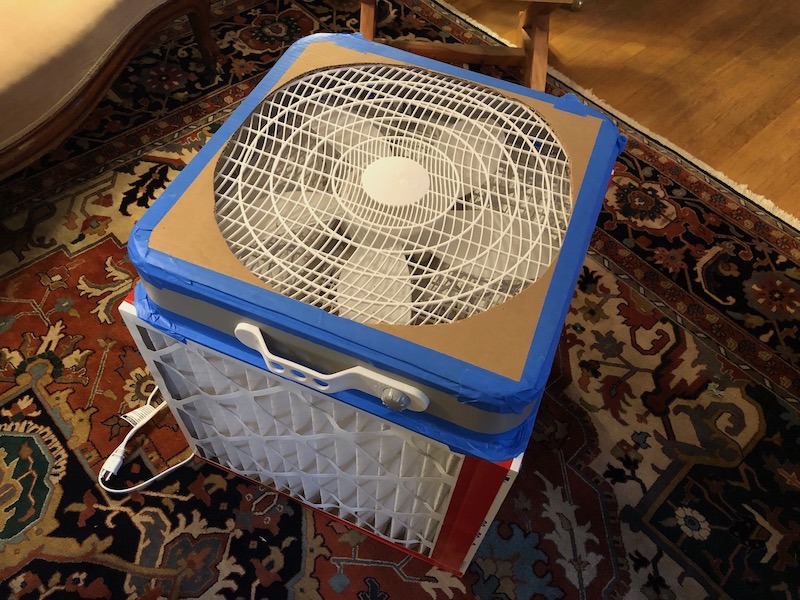
- If you do not, a Corsi-Rosenthal cube uses four MERV-13 filters and a box fan and has been described by UC Davis as a roughly $75 alternative to a $200 commercial unit.[6]
- Tape obvious window and door gaps if your housing allows it, then move your desk away from the leakiest opening.
- If your school controls the HVAC, ask for filtration in the room where you take exams or long study sessions.
A bedroom filter does not erase regional smoke, and it will not fix every classroom or library you use. It does, however, buy back a cleaner patch of air inside one study block, which is enough to matter when the alternative is trying to think through the haze.
Schedule the Hardest Work for Cleaner Hours
Check real-time AQI before the study block starts, then look at the hourly forecast. Put the work that needs the most active thinking into the cleanest window and let worse hours absorb reading cleanup, flashcards, email, or notes organization. Stanford's weekday signal suggests smoke harms active learning more than passive time in the same building.[1]
| Task | Best timing | Why it belongs there |
|---|---|---|
| Practice tests and problem sets | Cleanest hour of the day | These need the most sustained attention. |
| Dense reading and new concepts | Cleaner window after filtration has been running | They benefit from uninterrupted focus. |
| Flashcards, drills, and light review | Moderate AQI hours if the room is filtered | They can absorb a little more drift. |
| Email, forms, file cleanup, and admin | Worse AQI window | They are lower-load work. |
| Walks to class, the bus, or the library | Only when the forecast is better, and with an N95 outdoors | It limits exposure while moving. |
If you know a smoky afternoon is coming, front-load the day. Do the exam review or math set early, then leave the low-stakes work for the spike.
Use N95s for the Trip Between Rooms
When you need to cross smoky air to reach class, the library, or the bus, an N95 is the mask that materially changes exposure. A review found that a non-fit-tested N95 reduced particle exposure by about 80%, compared with about 20% for a surgical mask and minimal protection from cloth against ultrafine wildfire particles.[7] Fit still matters, but even an ordinary N95 is doing a different job from the masks many people reach for by default.[7]
That makes the mask a bridge, not a cure. It helps on the walk, not while you are sleeping in a leaky room or sitting in a classroom with no filtration.
When Resources Are Tight
- Spend first on the room where the longest study block happens.
- If you can only afford one intervention, build the Corsi-Rosenthal cube before upgrading to a fancier device.[6]
- If you cannot change the room, change the clock: use cleaner hours for reading-heavy or exam-like work and push admin tasks into worse hours.
- If you are in a district with less filtration control, remember that Stanford found about 80% of the smoke burden fell on low-income and minority-serving districts.[1]
- Ask for the cleaner room, the moved exam, or the filtered library space when those options exist; the burden is not evenly distributed, and the fix should not be treated as a private luxury.[1][6]
Wildfire season cannot be studied away, and no student should have to pretend otherwise. But the next study session is still adjustable: cleaner air, better timing, and an N95 for the trip outside can reduce the cognitive load that smoke adds before it turns into lost work.
References
- Wildfire smoke exposure hurts learning outcomes — Stanford Report, 2022-09-29 — https://news.stanford.edu/stories/2022/09/wildfire-smoke-exposure-hurts-learning-outcomes
- Wildfire events and student academic performance in Brazil — ScienceDirect, 2025 — https://www.sciencedirect.com/science/article/abs/pii/S0161813X25000324
- Fighting haze: effects of wildfire smoke and particulate matter on brain function — EPA Science Matters — https://www.epa.gov/sciencematters/fighting-haze-effects-wildfire-smoke-and-particulate-matter-brain-function
- How does wildfire smoke affect your brain today and down the road? — CP24, 2026-07-17 — https://www.cp24.com/news/canada/2026/07/17/how-does-wildfire-smoke-affect-your-brain-today-and-down-the-road/
- How does air quality impact learning and productivity in schools: air pollution and productivity explained — Camfil Blog, 2021-12-16 — https://cleanair.camfil.us/2021/12/16/how-does-air-quality-impact-learning-and-productivity-in-schools-air-pollution-and-productivity-explained/
- Student-built air purifiers tackle wildfire smoke and COVID-19 — UC Davis — https://www.ucdavis.edu/climate/what-can-i-do/student-built-air-purifiers-tackle-wildfire-smoke-and-covid-19
- Review of mask effectiveness against wildfire smoke particles — PubMed Central, 2020 — https://pmc.ncbi.nlm.nih.gov/articles/PMC7502220/
Comments
Join the discussion with an anonymous comment.