
Offshore Wind: Environmental Costs vs. Climate Benefits
A structured, evidence-based overview of how offshore wind farms affect marine ecosystems across their full lifecycle, from seabed construction noise to decommissioning gaps, and why the carbon math decisively favors development.
Updated:
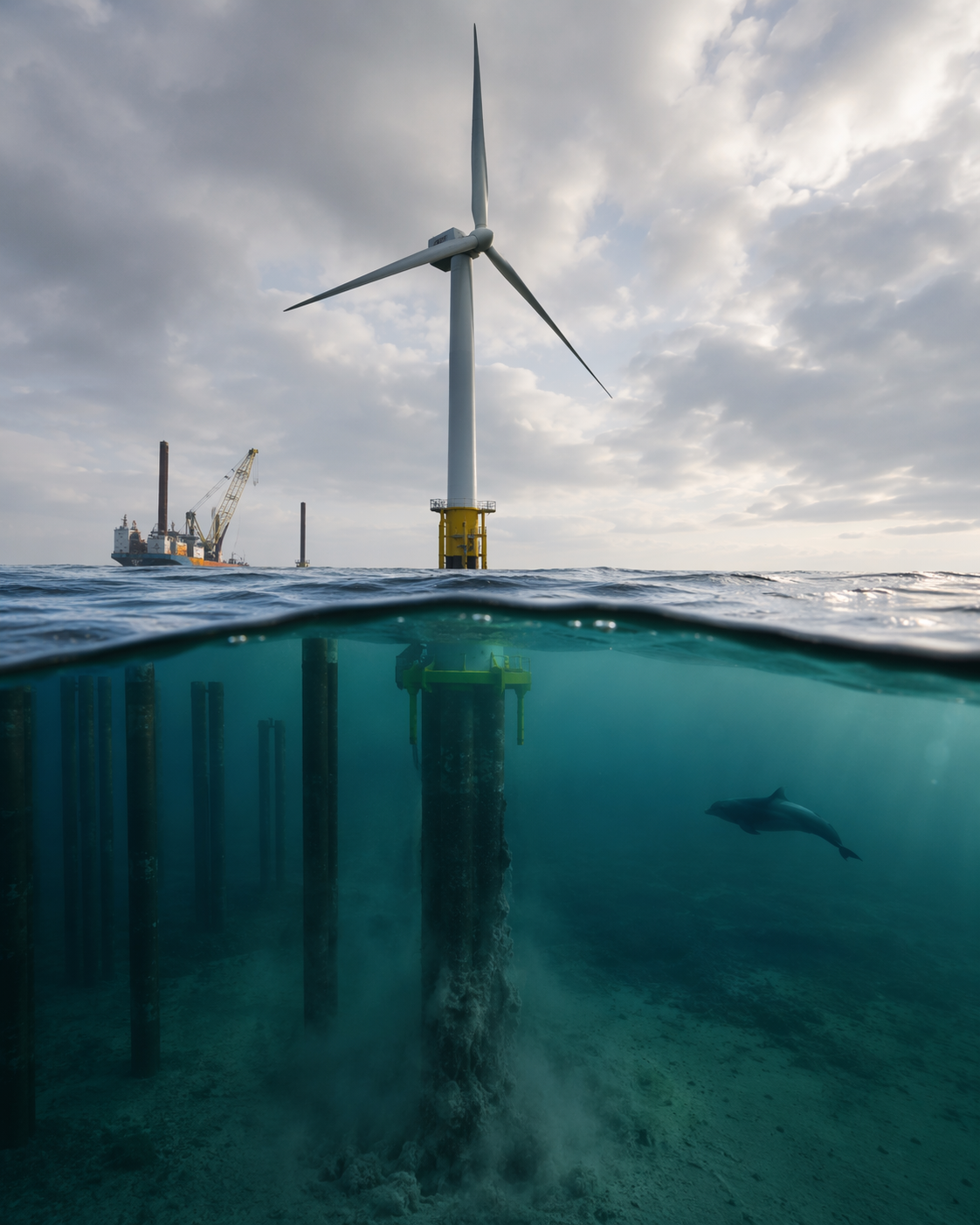
The offshore wind farm environmental impact begins before a turbine produces a single kilowatt-hour. It begins in the water column, when survey vessels, seabed preparation, cable laying, and pile driving turn a patch of ocean into an industrial construction site. For a harbor porpoise that depends on sound to navigate and feed, the relevant fact is not the future carbon balance. It is the immediate acoustic disturbance.
That starting point matters because offshore wind is often argued from the wrong scale. At the site scale, construction can disturb seabed habitats and displace marine mammals. At the energy-system scale, the same project can displace fossil generation and its air pollution, heat-trapping gases, and public-health burden. A serious assessment has to keep both scales visible at once.
A 2022 review in npj Ocean Sustainability gives the clearest starting frame. It analyzed 867 findings from 158 publications on offshore wind farm impacts. Of those findings, 72% were negative, concentrated mainly around birds and marine mammals; 13% were positive, mostly involving fish and macroinvertebrates; and 45% of impacts were rated high-to-moderate in severity. The same review also warns against overgeneralizing: 66% of the studies came from the North Sea, and 90% were from waters shallower than 30 meters.[1]
So the evidence does not support a simple verdict that offshore wind is environmentally harmless. It also does not support the opposite claim that local disturbance cancels the climate case. The better question is phase-specific: what happens during construction, operation, and end of life, and which harms can be reduced by siting, timing, and design?
Construction Is the Sharpest Ecological Disturbance
Construction concentrates several disturbances into a short window. The seabed is surveyed, foundations are installed, cables are buried or protected, sediment is resuspended, and vessel traffic increases. The most conspicuous biological concern is underwater noise from pile driving, especially for marine mammals that rely on sound.
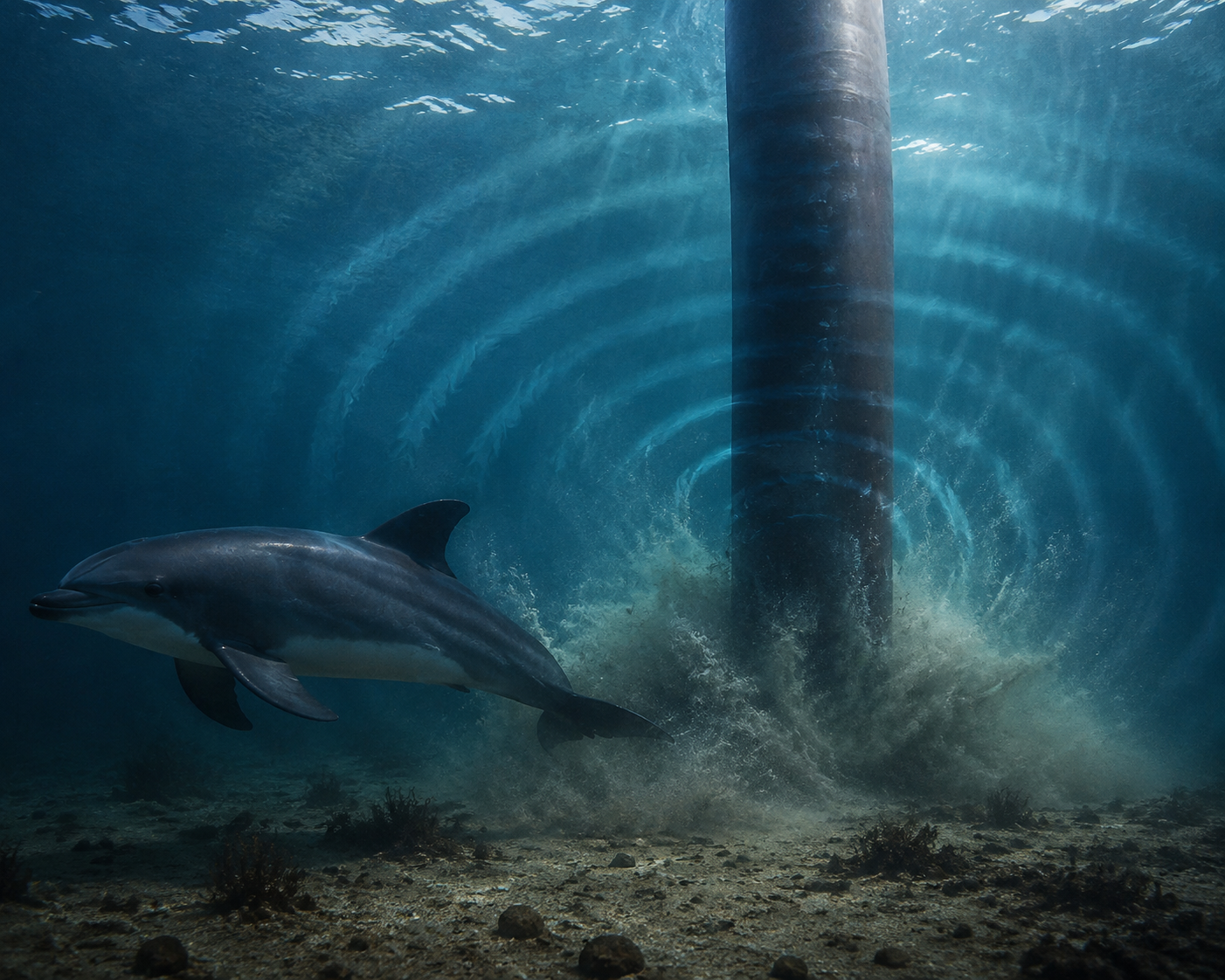
Porpoise displacement is not a symbolic concern. It is a mechanism with a clear pathway: loud impulsive sound changes the usable habitat around the construction zone. If animals avoid an area, feeding, movement, and energy budgets can change, even if the animals later return. The seriousness depends on where the project is, when construction occurs, how many animals use the area, whether alternative habitat is available, and how repeated the exposure becomes.
Seabed disturbance works differently. It is less dramatic than a sound pulse but more physically direct. Foundation installation and cable work can disturb benthic organisms, alter sediment structure, and affect species that live in or on the seabed. In sandy or muddy habitats, the immediate effect may be burial, removal, or changed sediment conditions. In more structurally complex habitats, the ecological stakes can be higher because recovery may be slower and the species assemblage less easily replaced.
This is where siting does real environmental work. Avoiding sensitive habitats is not a decorative mitigation step; it changes the impact pathway before construction begins. A project placed away from key feeding, breeding, migration, or benthic habitat has a different risk profile from one pushed into an ecologically crowded area and then patched with monitoring plans.
| Lifecycle phase | Main ecological pressure | What the evidence can support |
|---|---|---|
| Construction | Pile-driving noise, seabed disturbance, sediment movement, vessel activity | Local harms can be significant, especially for marine mammals and benthic habitats |
| Operation | Collision risk, habitat change around foundations, altered food webs, vessel maintenance | Impacts are mixed: some negative for birds and marine mammals, some positive for fish and macroinvertebrates |
| Decommissioning | Removal disturbance, seabed disruption, waste handling | Evidence is weak; ecosystem effects of removal remain poorly studied |
Operation Changes Habitat Rather Than Simply Damaging It
Once turbines are operating, the disturbance shifts. Pile driving stops. Maintenance traffic continues. Rotors introduce collision risk for birds and bats. Foundations and scour protection create hard surfaces in places that may previously have been mostly sand or mud. The ecological question becomes less about one loud construction episode and more about altered habitat, movement, and food-web structure.
The artificial reef effect deserves careful handling. Offshore wind foundations can provide hard substrate for organisms such as blue mussels. Those organisms can attract fish and other species, changing local abundance and feeding relationships. A synthesis in Oceanography reports that offshore wind farm foundations can attract blue mussels, increase fish abundance, and raise catch rates up to 7% near farms.[2]
That is a real ecological benefit in some settings, especially homogeneous sandy seabeds where hard structure is scarce. It is not a universal conversion of industrial infrastructure into habitat restoration. Adding structure can favor some species over others, concentrate fish without necessarily increasing regional production, and change predator-prey interactions. A local increase in biomass near foundations does not automatically mean the whole marine ecosystem is better off.
The distinction matters for students reading environmental claims. “More fish near turbines” is not the same claim as “offshore wind restores marine ecosystems.” The first can be supported in particular cases. The second requires broader evidence about population-level effects, food-web changes, fishing pressure, and long-term habitat quality.
Bird Risk Is Real, But Proportion Matters
Bird collision risk is one of the best-known objections to wind energy, and it should not be waved away. Offshore turbines can affect birds through collision, displacement from feeding areas, and barrier effects that alter flight paths. The Nature review’s concentration of negative findings around birds is a reason to take monitoring and siting seriously, not a reason to abandon proportion.[1]
The proportion problem is that bird mortality is often discussed as if turbines were the dominant human-caused threat to birds. The narrower comparison is that offshore wind bird collision risks are real but minor relative to cats, which kill birds in the billions per year, and buildings, which kill birds in the hundreds of millions. That comparison does not make turbine deaths irrelevant. It helps prevent one visible risk from swallowing the larger conservation picture.
Whale Claims Need a Firmer Filter
Marine mammals are a legitimate concern during offshore wind development, particularly because of construction noise. Whale-death claims, however, require a separate evidence filter. Hakai Magazine’s 2024 synthesis of two meta-analyses by Lemasson reported no observed operational offshore wind effects on whales.[3] NOAA Fisheries states that it has found no link between offshore wind activities and whale deaths, and identifies vessel strikes and entanglement in fishing gear as documented causes of whale mortality.[4]
That distinction is not semantic. It separates a documented concern—noise, disturbance, habitat use—from a claim that current evidence does not support. EDF has also documented disinformation that misattributes whale deaths to offshore wind, including campaigns connected to fossil-fuel interests.[5] The point is not that offshore wind poses no marine-mammal risk. The point is that unsupported whale-death claims should not be used to replace the harder work of assessing actual mechanisms.
The Carbon Accounting Widens the Frame
Local ecological impacts are experienced by animals and habitats near the project. Climate benefits are distributed across a much wider public: people who breathe less fossil-fuel pollution, communities exposed to less climate risk, and ecosystems affected by warming oceans. That wider frame does not erase the local cost. It explains why the comparison cannot stop at the construction site.
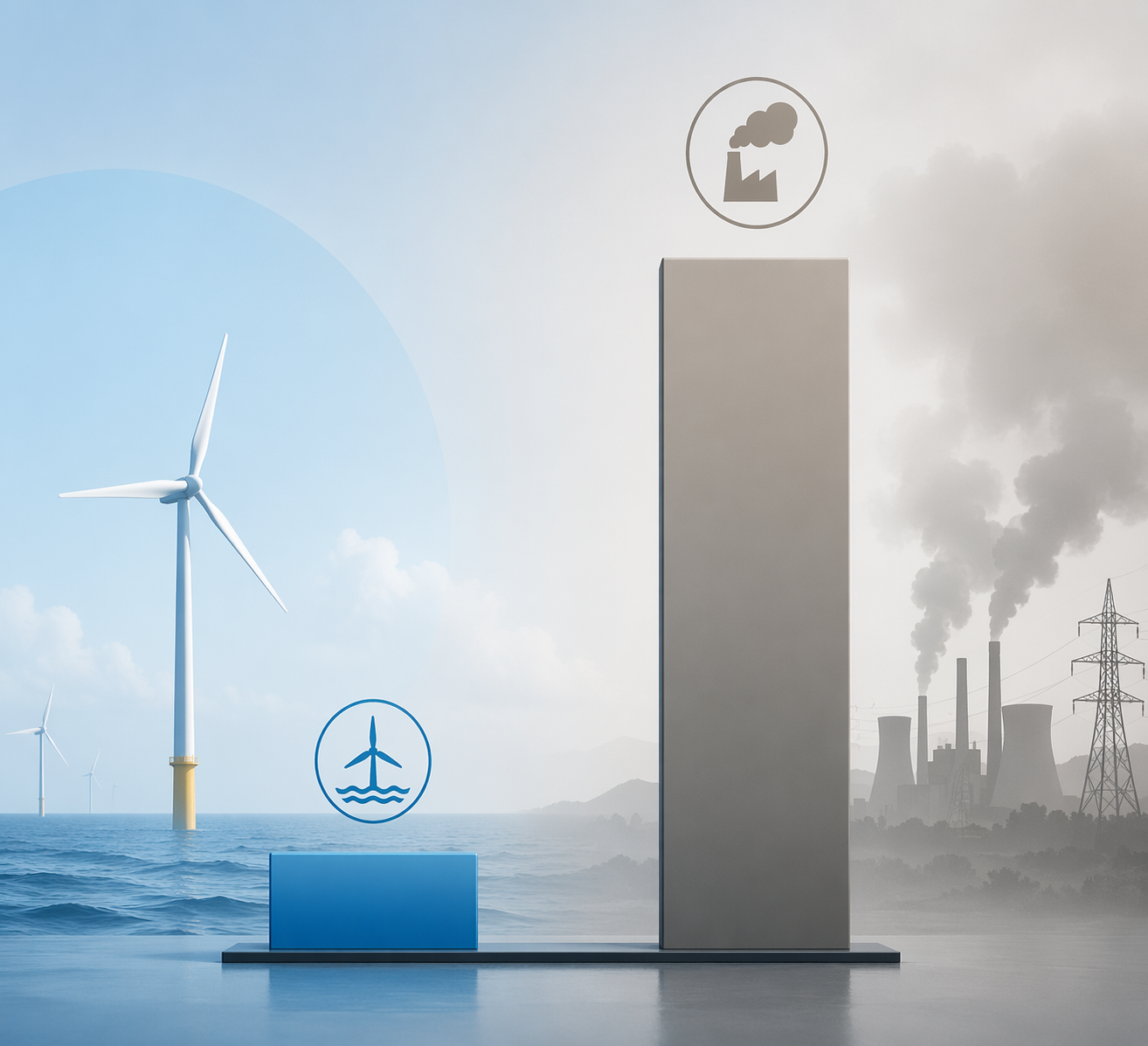
Li et al.’s prospective lifecycle assessment in Environmental Science & Technology is decisive on this point. It estimates offshore wind greenhouse gas intensity at 15–20 kilograms of CO₂-equivalent per megawatt-hour, which is 48–58 times lower than the 2020 global grid mix. The same study projects that cumulative global offshore wind deployment through 2040 could avoid 124–207 gigatons of CO₂-equivalent while emitting 2.6–3.6 gigatons across its lifecycle.[6]
Those numbers change the moral arithmetic. Offshore wind does not become impact-free because its carbon intensity is low. It becomes environmentally justified because the avoided fossil emissions are so much larger than the emissions caused by manufacturing, installing, operating, and eventually retiring the turbines.
The lifecycle framing also prevents a common mistake: counting only what happens at the turbine. Steel, blades, foundations, vessels, installation, operations, and end-of-life handling all belong in the ledger. Li et al. identify steel manufacturing as about 45% of offshore wind energy lifecycle climate impacts and blade fiber as about 17%. End-of-life recycling could reduce cumulative impacts by 6–9%.[6]
That still leaves offshore wind far below fossil-heavy electricity. It also points to where the next round of improvement belongs: cleaner steel, lower-impact manufacturing, better blade materials, and credible end-of-life systems rather than a vague promise that future recycling will take care of it.
Climate Benefits Also Show Up as Public Health
Carbon dioxide is not the only displaced harm. When offshore wind replaces fossil generation, it can reduce air pollutants from power plants that affect human health. Resources for the Future modeled 32 planned U.S. offshore wind projects and estimated they would prevent about 2,100 premature deaths per year and avoid 41 million short tons of CO₂ per year.[7]
Those modeled benefits are not the same kind of evidence as a field observation of fish near a foundation or porpoise avoidance during construction. They depend on the grid mix, which fossil generators are displaced, and how electricity markets respond. But they are part of the environmental impact because energy choices do not only affect the places where infrastructure is built. They also affect the air downwind of power plants and the climate conditions under which ecosystems must survive.
The Weakest Part of the Lifecycle Is the End
Decommissioning is where the evidence thins out. As of 2021, fewer than 10 offshore wind farms had been decommissioned worldwide, and there were zero peer-reviewed studies on the ecosystem effects of removal. That is not a small gap. Removing foundations, cables, and scour protection could disturb seabed communities that developed around the structures, while leaving materials in place could create other ecological and legal questions.
Blade waste is another unresolved condition on the verdict. Offshore wind turbines are often described as mostly recyclable by mass, and the evidence supports an 85–95% figure. But fiber composite blades have historically gone to landfill, even as Siemens Gamesa and Vestas have announced recyclable blade programs targeting 2030. The distinction between recyclable in principle and actually recycled at scale is not a detail; it is the difference between a material claim and a functioning waste system.
This does not overturn the carbon case. It does mean decommissioning should be treated as part of project approval and lifecycle accounting, not postponed until the first generation of large projects ages out. A project that documents construction impacts carefully but hand-waves removal is not doing full lifecycle environmental assessment.
A Conditional Environmental Verdict
Offshore wind farms cause real local ecological impacts. The strongest concerns appear during construction, when underwater noise can displace porpoises and seabed work can disturb benthic habitats. During operation, effects are mixed: some risks persist for birds and marine mammals, while foundations can create artificial reef effects that benefit fish and macroinvertebrates in some settings. Decommissioning remains the least understood part of the lifecycle.
The climate case, however, is not marginal. Lifecycle greenhouse gas emissions of 15–20 kilograms CO₂-equivalent per megawatt-hour, far below the global grid average, make offshore wind one of the clearer cases where a local environmental burden can be justified by a much larger avoided harm.[6]
The right conclusion is therefore conditional, not lukewarm. Build offshore wind where it can displace fossil generation, but make the ecological costs visible enough to govern the project. Avoid sensitive habitats. Time construction to reduce exposure for vulnerable species. Use noise mitigation where pile driving creates marine-mammal risk. Monitor bird, fish, and marine-mammal effects during operation. Require credible plans for blades, steel, foundations, cables, and end-of-life disturbance.
Offshore wind is environmentally justified when mitigation is treated as infrastructure, not public relations.
References
- Reviewing the ecological impacts of offshore wind farms, npj Ocean Sustainability, 2022, link
- Offshore Wind Farm Artificial Reefs Affect Ecosystem Structure and Functioning: A Synthesis, Oceanography, link
- Offshore Wind Is Environmentally Fine, Hakai Magazine, July 2024, link
- Assessing Impacts to Marine Life, NOAA Fisheries, link
- Common disinformation about offshore wind power, Environmental Defense Fund, link
- Climate Impacts of Global Offshore Wind Energy Development to 2040, Environmental Science & Technology, link
- New Modeling Shows Offshore Wind’s Benefits to Climate, Health, and Energy Bills, Resources for the Future, link
Comments
Join the discussion with an anonymous comment.