
Inside the nuclear aircraft carrier dismantling process
Dismantling a nuclear-powered aircraft carrier is a four-phase process that takes 5–15 years and costs hundreds of millions of dollars. This article explains the step-by-step dismantling of the USS Enterprise (CVN-65) — from defueling and reactor removal to commercial scrapping and waste disposal — and why nuclear carriers cannot be sold for scrap like conventional warships.
Updated:
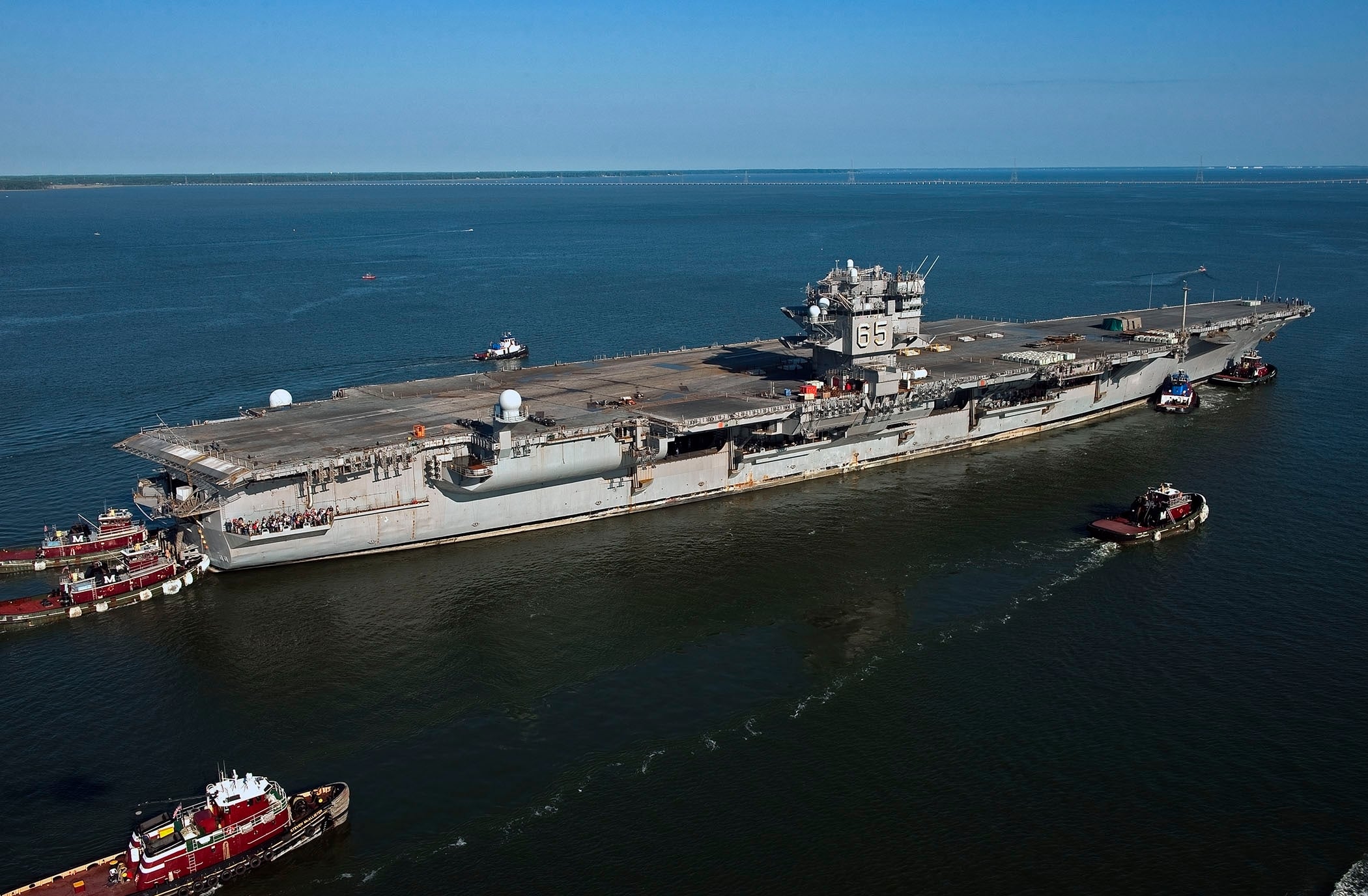
The easiest way to see why the nuclear aircraft carrier dismantling process is different is to start with two ships that did not have nuclear plants. The Navy sold the retired conventional carriers Kitty Hawk and John F. Kennedy for scrapping at one cent each. That price did not mean the ships were worthless; it meant the scrap contractor could recover enough metal to make the job work. USS Enterprise, the world’s first nuclear-powered aircraft carrier, cannot enter that kind of transaction. Before anyone treats the hull as scrap, the Navy has to account for nuclear fuel, reactor compartments, contaminated systems, asbestos, hazardous materials, federal custody, and licensed disposal paths. Those obligations turn a carrier that is mostly steel into a project measured in years, permits, transport plans, and hundreds of millions of dollars.[1]
Enterprise is also an awkward first case. It was not just a nuclear carrier; it was a nuclear carrier with eight A2W reactor plants, a propulsion layout never repeated in later U.S. carriers. Nimitz- and Ford-class carriers have two reactors each, so Enterprise carries a larger reactor-compartment removal problem than the ships that will follow it. That makes the dismantlement less like a routine disposal job and more like a live rehearsal for the Navy’s next generation of nuclear carrier retirements.
The Four-Phase Route From Carrier To Scrap
The work is easiest to follow as a chain of custody. The ship does not simply move from Navy pier to scrapyard. It passes through distinct conditions: active warship, inactive ship with fuel still to remove, defueled hull with reactor compartments still inside, hull opened for compartment removal, then recyclable structure and segregated waste.
| Phase | What happens | Why it matters |
|---|---|---|
| 1. Inactivation and defueling | Fluids and equipment are removed, systems are made safe, and spent nuclear fuel is extracted and shipped to Idaho National Laboratory. | The ship cannot proceed as scrap while nuclear fuel remains aboard. |
| 2. Reactor compartment removal | Enterprise’s eight A2W reactor compartments are cut out, sealed, and prepared for transport. | This is the physical reason the carrier cannot be handled like a conventional hull. |
| 3. Commercial dismantlement | The defueled hull is towed to Mobile, Alabama, where NorthStar/MARRS cuts and sections the ship under a fixed-price contract. | The Navy chose this path to avoid a much longer and more expensive public-yard option. |
| 4. Recycling and waste disposal | Non-hazardous steel is separated for recycling, while low-level radioactive waste, asbestos, and other hazardous materials go to licensed disposal facilities. | The end product is not one scrap pile but several regulated material streams. |
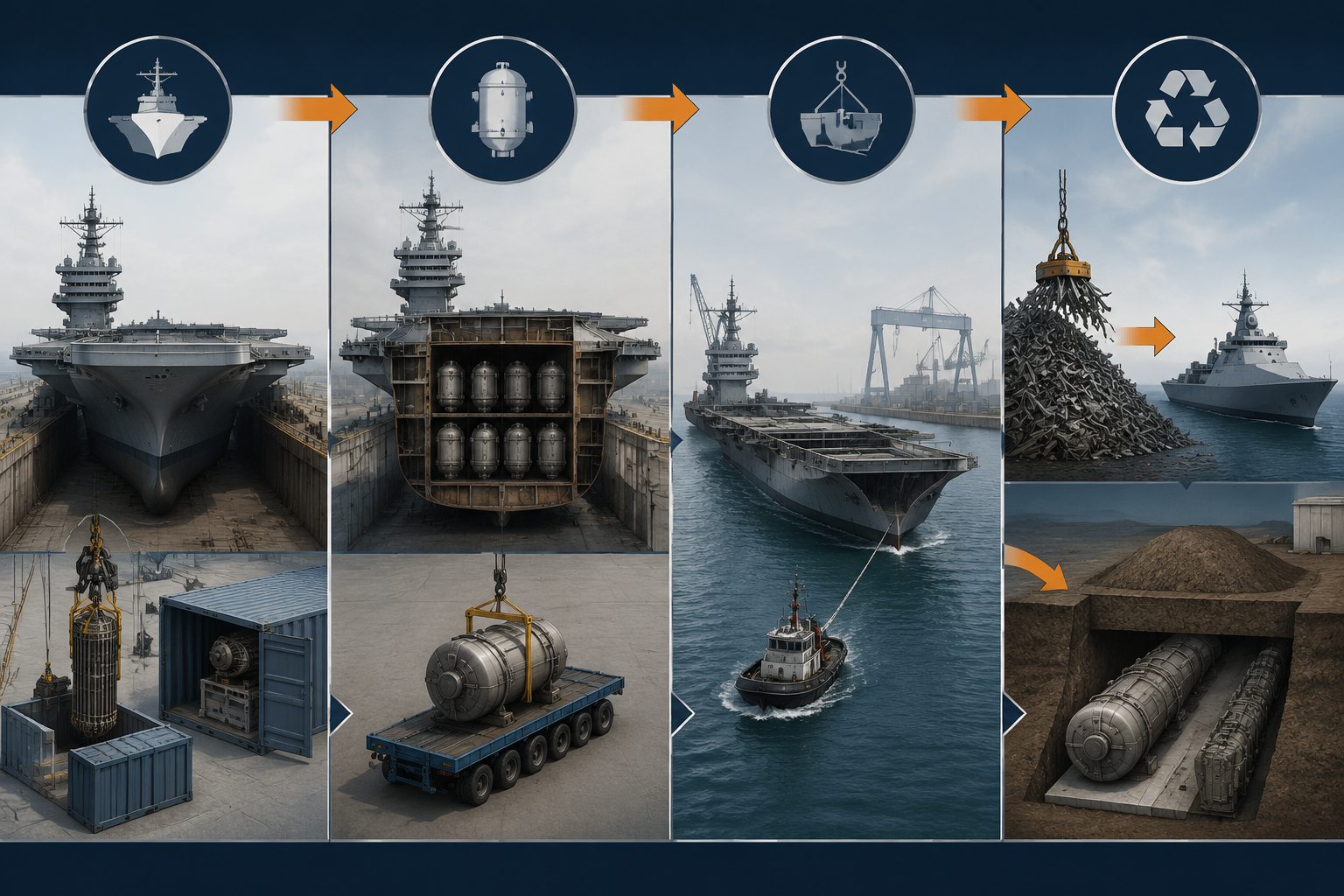
The real ship is less tidy. Each phase depends on the previous one being accepted by the offices that control nuclear safety, environmental compliance, transport, and disposal. Enterprise has already spent years in the early part of that chain, and as of July 2026 its commercial dismantlement remains an active project rather than a completed precedent.
Phase 1: Inactivation Starts Before The Hull Can Be Treated As Scrap
Inactivation is the part of the nuclear aircraft carrier dismantling process that looks least like scrapping from the outside. The ship is still recognizable, but the job is not to recover steel. It is to reduce the carrier from an operating nuclear vessel into a condition where the remaining work can be planned, licensed, transported, and insured.
For Enterprise, that meant draining fluids, removing selected equipment, isolating systems, and preparing the propulsion plants for defueling. The important handoff is the spent nuclear fuel. It does not stay with the ship and it does not go to a commercial scrapyard. Under the Navy’s process, spent fuel is removed and shipped to Idaho National Laboratory, separating the fuel problem from the hull-disposal problem.[1]
This step is slow because the workers are not only emptying tanks and cutting loose machinery. They are changing the legal and technical status of the ship. Once the fuel is removed, Enterprise is still not ordinary scrap, but the most tightly controlled material has left the hull. That distinction matters for every later decision: where the ship can be stored, who can cut it, which agencies have oversight, and what kind of waste each cut will create.
The Government Accountability Office’s 2018 review treated inactivation and defueling as the first major phase in a disposal pathway that would later have to answer cost, schedule, and regulatory questions. The GAO did not present Enterprise as a ship that simply needed a buyer. It presented a sequence of options, each constrained by nuclear-propulsion work that had to remain under federal control.[1]
Why The Navy Cannot Just Sell A Nuclear Carrier
The one-cent sale of a conventional carrier works only because the buyer receives a ship it can legally dismantle for recoverable material. A nuclear-powered carrier is different even after defueling. U.S. law requires naval nuclear vessels to be recycled by the United States, closing off the ordinary logic of selling the ship abroad or letting a private buyer manage the entire risk as a normal scrap asset.[2]
The remaining hull contains reactor compartments, systems that have operated around the nuclear plant, and materials that must be characterized before disposal. Some metal can eventually become scrap. Some material has to be treated as low-level radioactive waste. Some has nothing to do with radioactivity but still matters: asbestos, lead, polychlorinated biphenyls, oils, paints, and other hazardous substances that are routine in old ships but not routine to dispose of casually.
This is why “expensive and complicated” is too vague. The expense comes from custody and separation. The complication comes from not being allowed to cut first and sort later. The Navy has to know which material stream a section belongs to before that section leaves the shipyard.
Phase 2: The Eight Reactor Compartments Become Their Own Disposal Job
Once fuel is gone, the reactor compartments remain. This is the part of Enterprise that turns a large shipbreaking job into a nuclear disposal project. Each A2W reactor compartment has to be isolated from the rest of the hull, cut out as a package, sealed, and prepared for overland or waterborne movement to an approved burial site. Enterprise has eight of them.[1]
The phrase “cut out” hides a great deal of planning. A carrier hull is not a box built around eight removable cartridges. Workers have to open surrounding structure, preserve safe boundaries, handle contaminated or potentially contaminated systems, and create sealed packages that can satisfy disposal-site requirements. The compartments are no longer operating reactors, but they are still regulated nuclear components with a traceable path.
The Navy’s established destination for sealed naval reactor compartments is Trench 94 at the Hanford Nuclear Reservation in Washington state. The Enterprise compartments are expected to follow that same disposal logic: sealed reactor-compartment packages transported to Hanford for burial rather than broken down into ordinary scrap.[1]
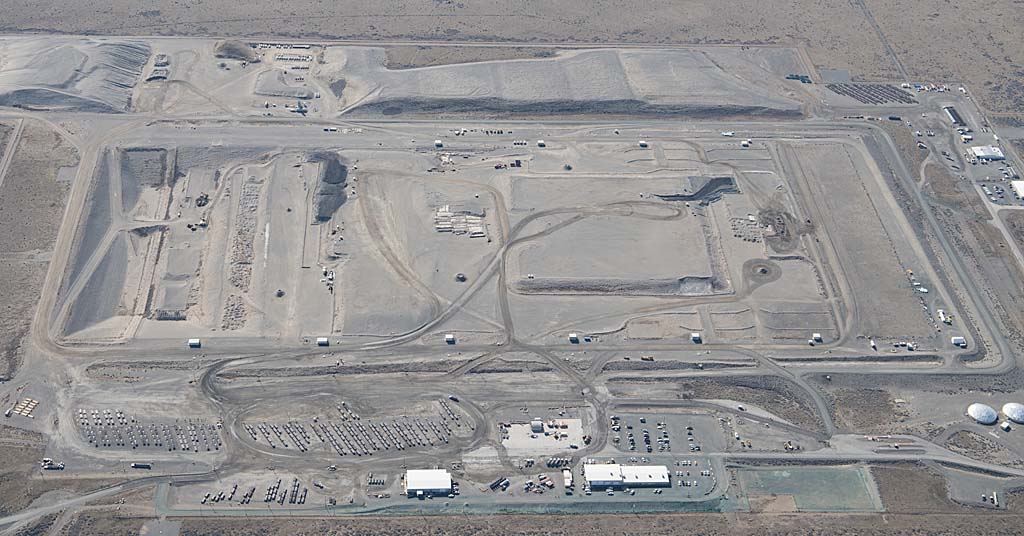
That destination explains much of the caution. The shipyard doing the cutting, the Navy offices controlling nuclear work, the transport planners, and the disposal site all need the same object to be acceptable at the next handoff. A shortcut that produces a package Hanford cannot receive is not a shortcut; it is a delay with a very large piece of sealed metal sitting in the wrong place.
The regulatory boundary has not always been perfectly settled. GAO found that Enterprise raised questions about how Naval Reactors, the Department of Energy, and the Nuclear Regulatory Commission would divide oversight for commercial dismantlement activities involving residual radioactive material. That finding matters less as an abstract jurisdictional dispute than as a schedule risk: if the agencies do not agree on who approves what, cutting plans wait.[1]
Phase 3: Why Mobile, Alabama Entered The Carrier Business
For years, one option was to send Enterprise through Puget Sound Naval Shipyard, the public yard that has long handled nuclear ship recycling work. That would have kept more of the job inside the Navy’s own industrial base. It also carried a long schedule and a high cost. GAO estimated a naval shipyard route at roughly 15 years or more and between $1.1 billion and $1.55 billion, depending on assumptions and scope.[1]
The commercial alternative moves the defueled hull into private-yard dismantlement while keeping the nuclear-specific controls and waste pathways attached to the job. The Navy awarded the Enterprise dismantling contract to NorthStar Maritime Dismantlement Services, working through the MARRS team, for $418.5 million after a rebid. Naval News reported the award in 2025, identifying the fixed-price structure and the contractor team selected for the work.[3]
The location matters because the hull is to be dismantled in Mobile, Alabama. That makes the project more than a paper comparison between public and private yards. Enterprise has to be towed as a defueled hull, received by a commercial facility, cut into sections, and sorted into material streams without losing the nuclear and hazardous-waste chain of custody. Seapower Magazine described the Navy’s selection of a Mobile company as a major step toward scrapping the world’s first nuclear-powered carrier outside the traditional public-yard path.[4]
The fixed-price arrangement is important because it changes who carries overrun risk. Under a cost-reimbursable model, the government remains more exposed when a first-of-kind job discovers surprises. Under a fixed-price contract, the contractor absorbs that risk within the contract terms. That does not make the physical work easier, and it does not eliminate government oversight, but it gives the Navy a cleaner cost boundary for a project that had already spent years waiting for a disposal decision.
Delay had its own price. Forbes reported in July 2026 that keeping Enterprise pier-side at Newport News Shipbuilding cost roughly $10 million per year, which made continued indecision expensive even before the first major commercial cut.[5]
The Cost Numbers Are Not Interchangeable
The usual shorthand says nuclear carrier dismantlement costs hundreds of millions to more than a billion dollars. That is true, but the figures should not be blended as if they measure the same contract in the same year.
| Figure | What it refers to | Source context |
|---|---|---|
| $418.5 million | Fixed-price commercial dismantlement contract for Enterprise after rebid | Reported in the Navy contract coverage and later accounts of the commercial route |
| $536.7 million | Earlier contract figure before the rebid described in the research record | Useful mainly to show that the award history changed |
| $1.1 billion–$1.55 billion | GAO estimate range for a public naval shipyard disposal option | Different approach and scope, not the same as the commercial contract |
| Roughly $10 million per year | Pier-side storage cost while Enterprise waited at Newport News | A delay cost, not a dismantlement contract price |
The Navy’s preference for the commercial path is therefore not hard to understand. Compared with the public-yard estimate, the commercial route promised a shorter schedule of about five years rather than 15 years or more, and a contract price far below GAO’s higher public-yard estimates.[1][3] The caution is that Enterprise is still underway as of July 2026. A fixed price is a contract structure, not proof that every first-of-kind problem has already been solved.
Phase 4: Recycling Is The Last Step, Not The Whole Job
Once the hull reaches commercial dismantlement, the visible work begins to look more familiar: cutting, lifting, staging, sorting, and hauling. But even here, the important action is separation. The contractor is not simply reducing Enterprise to a heap of metal. Workers have to distinguish non-hazardous steel from low-level radioactive waste, asbestos-containing material, and other hazardous substances that need licensed disposal.
About 35,000 tons of non-hazardous steel from Enterprise are slated for recycling into the next USS Enterprise, CVN-80, according to reporting on the Navy’s plan.[5] That is the cleanest symbolic loop in the whole project: steel from the first nuclear carrier returning to a future carrier with the same name. It is also only one material stream. The reactor compartments go to Hanford. Low-level radioactive waste goes to licensed facilities. Hazardous shipboard materials follow their own disposal rules.
That last distinction is where many simple descriptions of scrapping fail. Recycling is not the governing activity until the Navy has removed the material that cannot be recycled in the ordinary way. The salvage value of steel does not control the project; the disposal obligations do.
What Enterprise Teaches Before Nimitz Arrives
Enterprise is a difficult prototype because it is both unique and first. Its eight-reactor layout will not repeat, so later carriers should not require the same number of reactor-compartment removals. But the regulatory questions, commercial-yard controls, transport requirements, and waste-disposal pathways will return with the next nuclear carrier retirements.
That next wave is no longer theoretical. Nimitz arrived at Norfolk in July 2026 and is scheduled for decommissioning in March 2027, meaning Enterprise and Nimitz are expected to overlap in the disposal pipeline for years.[5] If the Enterprise contract works as planned, commercial dismantlement becomes easier to justify as the default path for later nuclear carriers. If it runs into unresolved regulatory or cost problems, the Navy will have to carry those lessons into a much larger retirement queue.
That is the operational meaning of the Enterprise job. The ship’s historic status matters, but the dismantling process matters because it establishes the handoff pattern: defuel, isolate the reactor compartments, move the hull to a controlled dismantlement yard, separate the waste, recycle what can be recycled, and bury what must remain sealed.
References
- Aircraft Carrier Dismantlement and Disposal: Options Warrant Additional Oversight and Raise Regulatory Questions, Government Accountability Office, 2018.
- Ship-Submarine Recycling Program, Wikipedia.
- US Navy Awards Dismantling Contract for Ex-USS Enterprise Aircraft Carrier, Naval News, June 2025.
- Navy Selects Mobile, Ala., Company to Scrap World's First Nuclear-Powered Aircraft Carrier, Seapower Magazine.
- Recycling Of Oldest U.S. Navy Aircraft Carrier Will Cost Millions, Forbes, July 16, 2026.
Comments
Join the discussion with an anonymous comment.