
Nolan's Laestrygonians Attack Shows Odysseus' Leadership Collapse
The Laestrygonians attack in Nolan's The Odyssey is more than a brutal set piece — it is a deliberate dramatization of Odysseus' leadership failure. This analysis breaks down the filmmaking choices that make the sequence land and what it reveals about the hero's arc.
Updated:
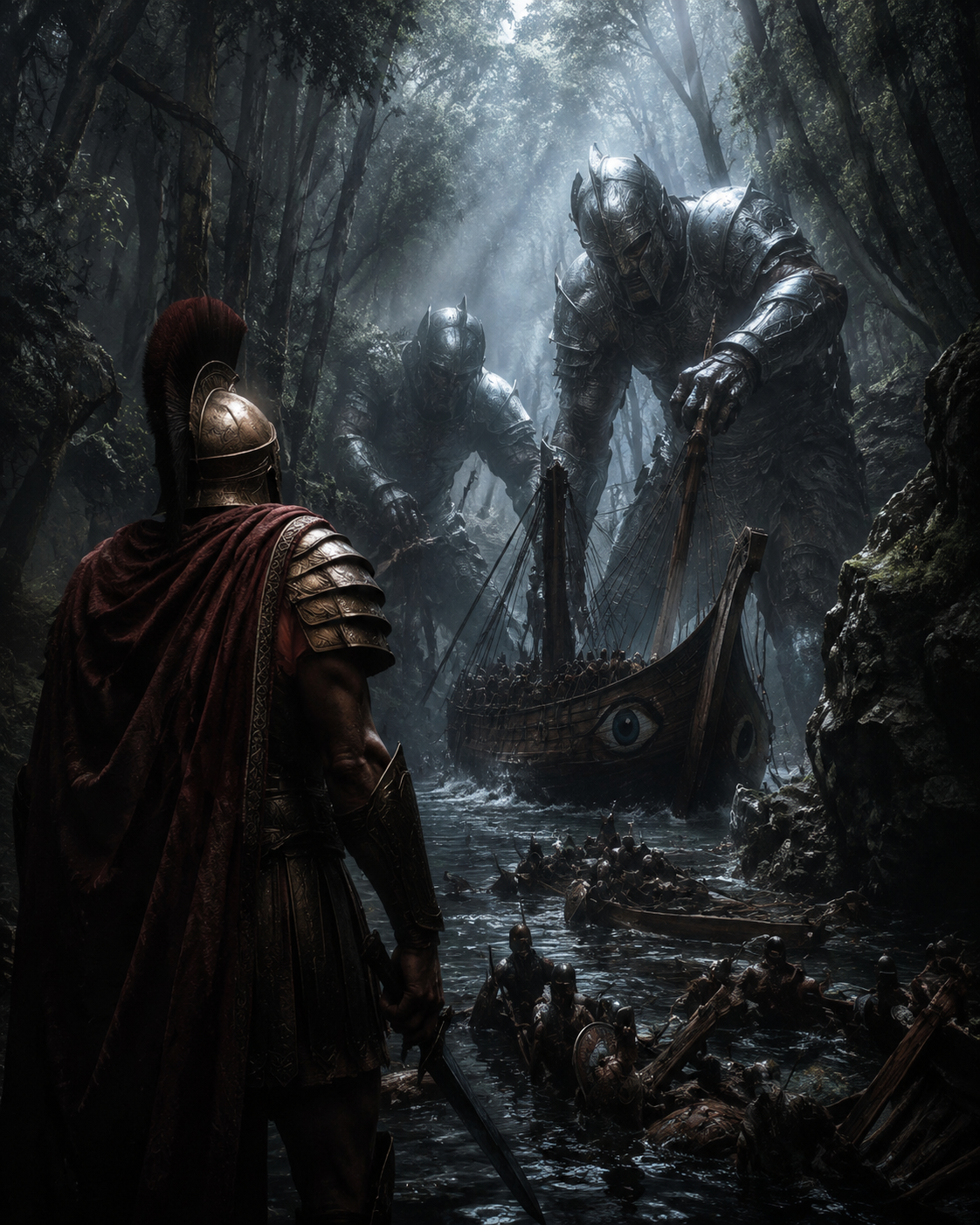
The Laestrygonians scene in Nolan’s The Odyssey turns the moment of attack into a judgment on command. It is not staged simply as a terrifying stop on the voyage, or as the film’s required giant-monster sequence. Odysseus has brought hungry, exhausted men into a place they do not understand, and the scene keeps pressing the same practical question from different angles: if a captain’s intelligence cannot read the world he has entered, how long does that intelligence remain a reason to follow him?
Nolan has been unusually direct about that intention. In Empire’s June 2026 coverage, he says the Laestrygonians sequence is meant to show “in some ways the questionable nature of Odysseus’ leadership,” and describes the giants’ armor as evidence of “a level of sophistication that Odysseus has never seen.”[1] That matters because it moves the scene away from the ordinary adaptation question — how big are the giants, how violent is the attack, how closely does it follow Homer — and toward the harder dramatic question: what does this catastrophe reveal about the man who led everyone there?
The Attack Begins Before the Violence
The most important adjustment happens before the slaughter. Motion Pictures describes the Greeks’ arrival as a “rude, desperate intrusion into somebody else’s world,” with the alarm beginning in the sound of a child’s scream.[2] That detail is easy to miss if the scene is treated as spectacle mechanics, but for analysis it changes the moral direction of the whole passage.
A child’s scream does not announce heroic peril in the usual adventure grammar. It announces disturbance. The Greeks are not framed first as noble victims crossing into a monster’s lair; they are bodies entering a defended space, frightening someone who belongs there. The sequence has not yet asked the audience to pity the giants, but it has already interrupted the fantasy that Odysseus’ men are only acted upon. They arrive as needful people, yes, but need does not erase intrusion.
That is where the scene begins to tighten around Odysseus. Hunger and exhaustion may explain the crew’s vulnerability, but they do not absolve the leader who converts vulnerability into exposure. A weaker version of the scene would let the giants function as weather: brutal, sudden, impersonal. Nolan’s version gives the place a social texture before it gives it a body count. There are inhabitants, alarms, and a world whose rules Odysseus has failed to read.
For students doing close scene analysis, this is the first useful move to mark: the moral pressure does not begin when the giants swing their weapons. It begins when point of view shifts. The Greeks’ desperation remains visible, but the scene refuses to let desperation become automatic innocence.
Armor Changes the Giants From Monsters Into a Military Problem
The silver medieval-style armor has been one of the most divisive design choices in the sequence, and for good reason. On a literal historical axis, it looks strange. Den of Geek’s complaint that the design is “bizarrely anachronistic” identifies a real friction point: the armor can pull a viewer out of the Homeric register if it reads merely as generic fantasy costuming.[3]
But the armor also performs the scene’s central argument. These Laestrygonians are not just enlarged appetite. They are organized force. Plate armor and giant swords give them a martial legibility that a more primitive monster design would not. Odysseus is not encountering a beast; he is encountering a defended power whose technology, coordination, and scale exceed the assumptions he brought with him.
That distinction matters for Odysseus’ reputation. His heroic identity depends on being the man who can interpret danger faster than others can. He can improvise, deceive, delay, and reframe a threat until it becomes solvable. The armor makes the Laestrygonians resistant to that heroic pattern. They are not waiting to be outwitted in a cave or tempted into a verbal trap. They are already equipped, already territorial, already operating from a position of force.
Read this way, the anachronism is not automatically a mistake, though it remains a risk. The more the armor looks like a shortcut to “cool medieval brutality,” the flatter the scene becomes. The more it registers as evidence of a civilization Odysseus has underestimated, the more damaging it becomes to him. The design is walking a narrow line: it has to make the giants feel politically and militarily developed without making the viewer feel that the film has wandered into an unrelated franchise.
The Practical Effects Matter Because the Greeks Cannot Solve the Space
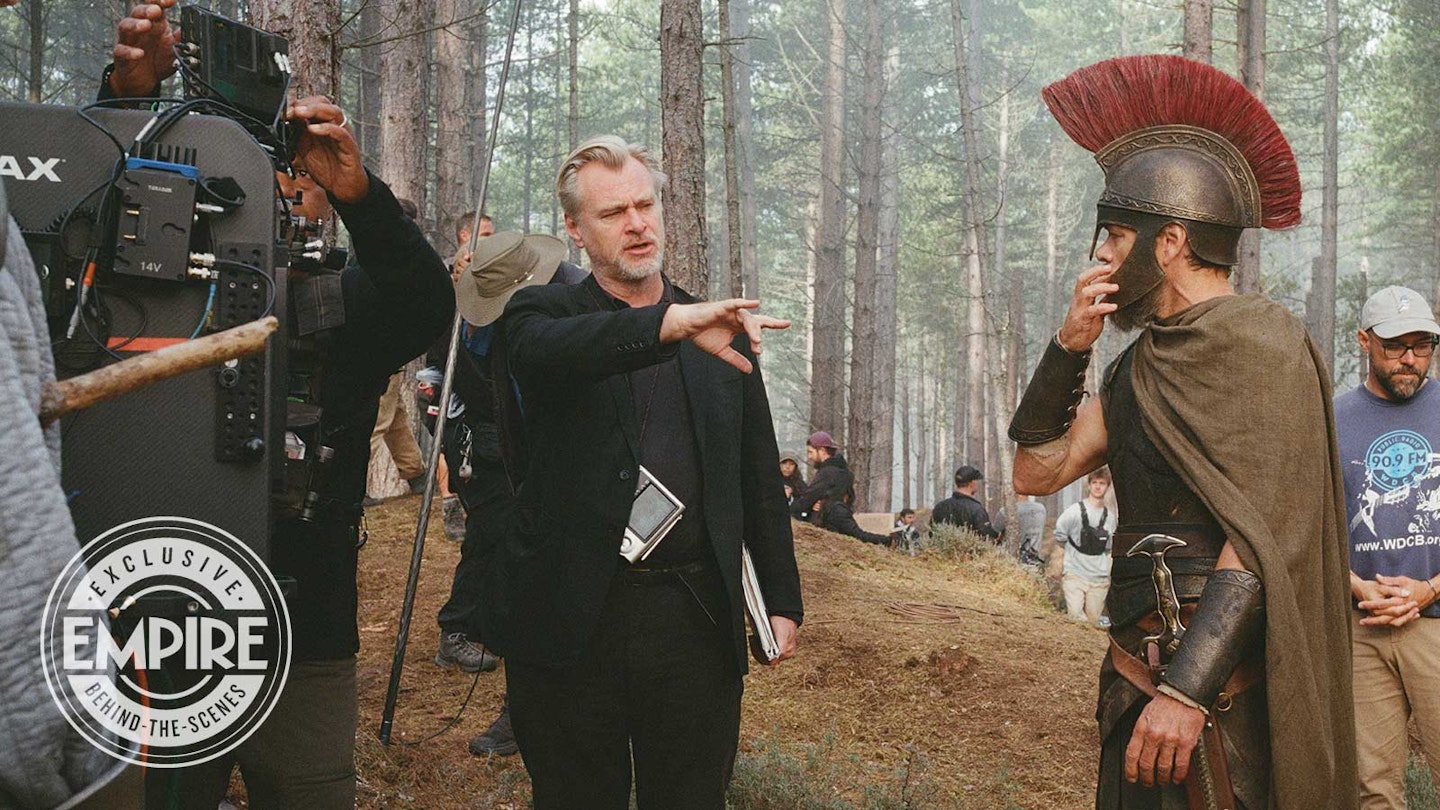
The technical achievement of the sequence is real, but its value is not that it is large. Empire reports that the scene used forced-perspective illusions, wirework, and seven IMAX cameras to capture the assault in Scotland’s Culbin Forest.[1] Those details matter because they support the experience of tactical collapse. The Greeks are not simply losing a fight; they cannot adequately measure the space, the bodies, or the angles of attack.
Forced perspective is especially apt for this kind of scene because it makes scale a problem inside the image rather than a statistic outside it. A digital giant can be impressive; a spatially convincing giant changes how the viewer reads every escape route. The men are boxed in by a world that suddenly has different proportions. Distance becomes unreliable. Cover becomes temporary. A ship, which should be a vehicle of departure, becomes a target trapped inside the composition.
Wirework contributes to the same pressure when bodies are lifted, thrown, or displaced with a weight that feels physically argued rather than merely animated. The violence is not clean choreography in which every movement displays skill. It is the destruction of a smaller tactical imagination by a larger one. That is why the sequence can feel so punishing: the Greeks keep trying to inhabit a battlefield that has not been built to their scale.
Culbin Forest gives the scene a useful strangeness without needing a location-history lecture. BBC News has described the Scottish site’s unusual background, and its screen presence helps the sequence avoid the blankness of an abstract fantasy arena.[4] Trees, channels, mist, and constricted movement make the assault feel less like an open battle than a mistake unfolding in terrain the Greeks have no time to understand.
Nolan Narrows Homer’s Disaster
The adaptation change that most clearly redirects the aftermath is the number of ships destroyed. ScreenRant notes that Homer’s Laestrygonians destroy eleven ships, while Nolan destroys only two, leaving Odysseus with just his own crew.[5] On paper, Nolan’s version is smaller. Dramatically, it is more intimate.
Homer’s larger destruction emphasizes the scale of communal loss. Nolan’s reduction concentrates the consequences around the people who must continue traveling under Odysseus’ command. The surviving men are not an anonymous remainder of a fleet. They are the witnesses who now have to decide what they have learned about their captain.
This is a small but important lesson in adaptation analysis: fidelity is not only a question of whether an event is retained. It is also a question of where the pressure falls after the event. By destroying fewer ships, Nolan does not soften the sequence. He changes its address. The catastrophe speaks less to epic arithmetic and more to a surviving group’s damaged trust.
That is why the scene functions as a pivot rather than an isolated ordeal. Before the attack, Odysseus’ risk-taking can still be absorbed into the familiar heroic account: he is bold, hungry for return, willing to enter danger because no path home is safe. After the attack, the same qualities look different to the men who remain. Boldness begins to resemble negligence when other people pay for the misreading.
The Dullness Objection Is Worth Taking Seriously
The strongest criticism of the sequence is not that it is too brutal, but that its brutality may not be imaginative enough. IndieWire calls the Laestrygonians “a crushing bore whose silver armor and giant swords betray a lack of better ideas.”[6] That objection should not be waved away as impatience with spectacle. It points to the scene’s main vulnerability: armor and scale can easily become a substitute for thought.
If a viewer sees only enormous armored figures smashing smaller men, the sequence risks becoming visually monotonous. Silver armor, giant blades, forest gloom, impact, panic: repeated too long, those elements can flatten into a single note. The moral argument depends on escalation, orientation, and consequence. Without those, the design would indeed look like decoration placed over a conventional massacre.
The defense of the scene, then, cannot be “Nolan made it big practically.” Practical filmmaking is not automatically meaningful filmmaking. The better defense is that the design choices keep returning pressure to Odysseus’ judgment: the child’s scream makes the Greeks intruders, the armor makes the giants organized power, the forest makes the space unreadable, and the reduced ship-loss makes the aftermath belong to the surviving crew.
Vanity Fair’s assessment that Nolan’s redesign was “the right call” is persuasive only if the redesign is judged by that dramatic function.[7] The scene does not become better merely by departing from familiar mythic imagery. It becomes better if the departure clarifies what kind of failure Odysseus has committed.
What the Scene Teaches Students to Look For
For a close reading, the Laestrygonians attack is useful because it shows how a scene can make an ethical argument without having a character announce it. The argument is distributed across entry, design, scale, and aftermath. Each element does a different kind of work.
| Scene Element | Analytical Function |
|---|---|
| The child’s scream | Reframes the Greeks as frightening intruders before the battle begins |
| Medieval-style armor | Turns the giants from appetite-driven monsters into a sophisticated defended force |
| Forced perspective and wirework | Makes the difference in scale feel physically and tactically inescapable |
| Culbin Forest | Gives the encounter a constricted terrain the Greeks cannot quickly read |
| Only two ships destroyed | Narrows the aftermath onto Odysseus’ remaining crew and their damaged trust |
The mistake to avoid is treating these elements as separate symbols to decode one by one. The child’s scream is not “about innocence” in isolation. The armor is not simply “about violence.” The forest is not just “atmosphere.” They become meaningful because they combine into a chain: Odysseus enters wrongly, perceives wrongly, measures wrongly, and leaves others to absorb the cost.
This is also where the scene connects to the larger work of reading The Odyssey as a moral universe rather than a travel itinerary. Hospitality, intrusion, command, appetite, survival, and cunning are not abstract themes floating above the action. They are tested by who enters whose space, who gets misread, who dies, and who still has to obey when the shouting stops.
The Pivot Is Not the Slaughter, but the Survivors
The Laestrygonians sequence works best when it is understood as a collapse of legitimacy. Odysseus survives the scene, but survival is not vindication. His special gift has always been the ability to turn danger into a problem he can solve. Here, the problem exceeds him before he has even understood its terms.
That is why the aftermath belongs to the surviving crew. They have seen the same captain make another dangerous decision, but this time the cost cannot be folded neatly into heroic necessity. The scene leaves them with a more frightening knowledge: Odysseus may still be brilliant, but brilliance has become one of the dangers of the voyage.
The sequence is not important because Nolan found a bigger way to stage giants. It is important because its design, adaptation choices, and violence force a new question onto every later scene: when a leader repeatedly survives consequences that others suffer, why should the survivors keep mistaking his survival for proof of judgment?
References
- Empire’s June 2026 article on Christopher Nolan’s The Odyssey, Empire, June 2026
- Motion Pictures’ July 2026 analysis of the Laestrygonians scene in The Odyssey, Motion Pictures, July 2026
- Den of Geek’s analysis of the Laestrygonians design in Nolan’s The Odyssey, Den of Geek
- BBC News coverage of Culbin Forest, BBC News
- ScreenRant’s comparison of Nolan’s The Odyssey and Homer’s epic, ScreenRant
- IndieWire review of Christopher Nolan’s The Odyssey, IndieWire
- Vanity Fair analysis of Nolan’s Laestrygonians redesign in The Odyssey, Vanity Fair
Comments
Join the discussion with an anonymous comment.