

Comparing Homer's and Nolan's Laestrygonians for Your Essay
Need concrete differences between Homer's and Nolan's Laestrygonians for your literature essay? This comparison breaks down cannibalism removal, ship destruction count, combat style, and what each version says about Odysseus' leadership.
Updated:
If you are writing a homer vs nolan laestrygonians comparison for study, start with the change you can actually prove: in Homer’s Odyssey Book 10, the Laestrygonians are cannibalistic giants who destroy 11 of Odysseus’ 12 ships by hurling boulders from cliffs; in Christopher Nolan’s 2026 film, the cannibalism is removed, only two ships are destroyed, and the giants become armored, technologically sophisticated fighters in a forest battle.[1][2] That is a large surface change, but it does not erase the episode’s job in the story: both versions leave Odysseus with only his own ship and make the cost of his leadership impossible to avoid.
That is the useful essay sentence. The mistake is to stop at “Homer is more brutal” or “Nolan makes it more realistic.” Those claims sound confident, but they do not give you much to analyze. A stronger comparison names the exact change—cannibal feast to armed combat, 11 ships to two ships, boulders to metal weapons—and then explains what that change does to Odysseus’ role in the scene.
The Quick Comparison
| Point of comparison | Homer’s Odyssey | Nolan’s The Odyssey | Essay use |
|---|---|---|---|
| What the Laestrygonians are | Cannibalistic giants ruled by Antiphates | Armored, medieval-ish giants with advanced weapons | Shows a shift from monstrous violation to militarized threat |
| Main violence | They eat men and smash ships with boulders from cliffs | They hack and fight Odysseus’ soldiers in tactical combat | Changes the kind of danger Odysseus faces |
| Ships destroyed | 11 of 12 ships are destroyed | Two ships are destroyed | The number changes, but Odysseus still ends with only his personal ship |
| Hospitality theme | The episode is an extreme violation of xenia | The xenia horror is reduced because cannibalism is removed | Good place to discuss what Nolan keeps and what he drops |
| Leadership function | Odysseus’ choices leave most of the fleet trapped in the harbor | Nolan frames the scene as a test of Odysseus’ questionable leadership | Best bridge between plot detail and interpretation |
Keep the ship count straight. Homer gives Odysseus 12 ships after the Trojan War; at Laestrygonia, 11 are destroyed, while Odysseus’ own ship survives because it is moored outside the harbor.[1] Nolan reduces the immediate destruction to two ships, but the functional endpoint remains similar: after the encounter, Odysseus is separated from the larger force and continues with only his personal crew.[2]
Homer’s Episode Is Built Around Cannibal Hospitality
In Homer, the Laestrygonian scene begins like many dangerous Odyssey episodes: Odysseus sends scouts to find out what kind of people live there. The answer is not simply “large enemies.” Antiphates, the Laestrygonian king, immediately seizes and eats one of the scouts, and his wife is also described as gigantic.[1] The horror is domestic before it becomes military. A household that should receive strangers becomes the first site of consumption.
That matters because the scene turns xenia, the Greek code of hospitality, inside out. Guests are not welcomed, fed, questioned, or sent away with gifts. They are eaten. Once the alarm spreads, the violence expands from the house to the harbor: the Laestrygonians spear men like fish and crush ships with boulders thrown from above.[1] Homer’s episode is brutal, but “brutal” is still too vague for an essay. The sharper point is that Homer makes the Laestrygonians a nightmare version of hosts, hunters, and giants all at once.
Odysseus’ survival also depends on a small tactical difference. He does not moor inside the harbor with the rest of the fleet. His ship stays outside, tied near the entrance, which lets him cut the cable and escape while the others are trapped.[1] That detail is easy to overlook because the boulder attack is so dramatic, but it gives you a clean comparison point: Homer makes geography part of the disaster. The harbor is not shelter; it becomes a trap.
Nolan Replaces Cannibal Giants With Armored Combatants
Nolan’s Laestrygonians are not a straight visual enlargement of Homer’s giants. Vanity Fair describes them as “giants wearing medieval-ish armor” who attack Odysseus’ soldiers with swords, and Empire reports Nolan’s emphasis on enemies with weapons and armor of a sophistication Odysseus has not seen before.[2][3] The danger shifts from being swallowed by monstrous hosts to being outmatched by a force that looks organized, equipped, and tactically prepared.
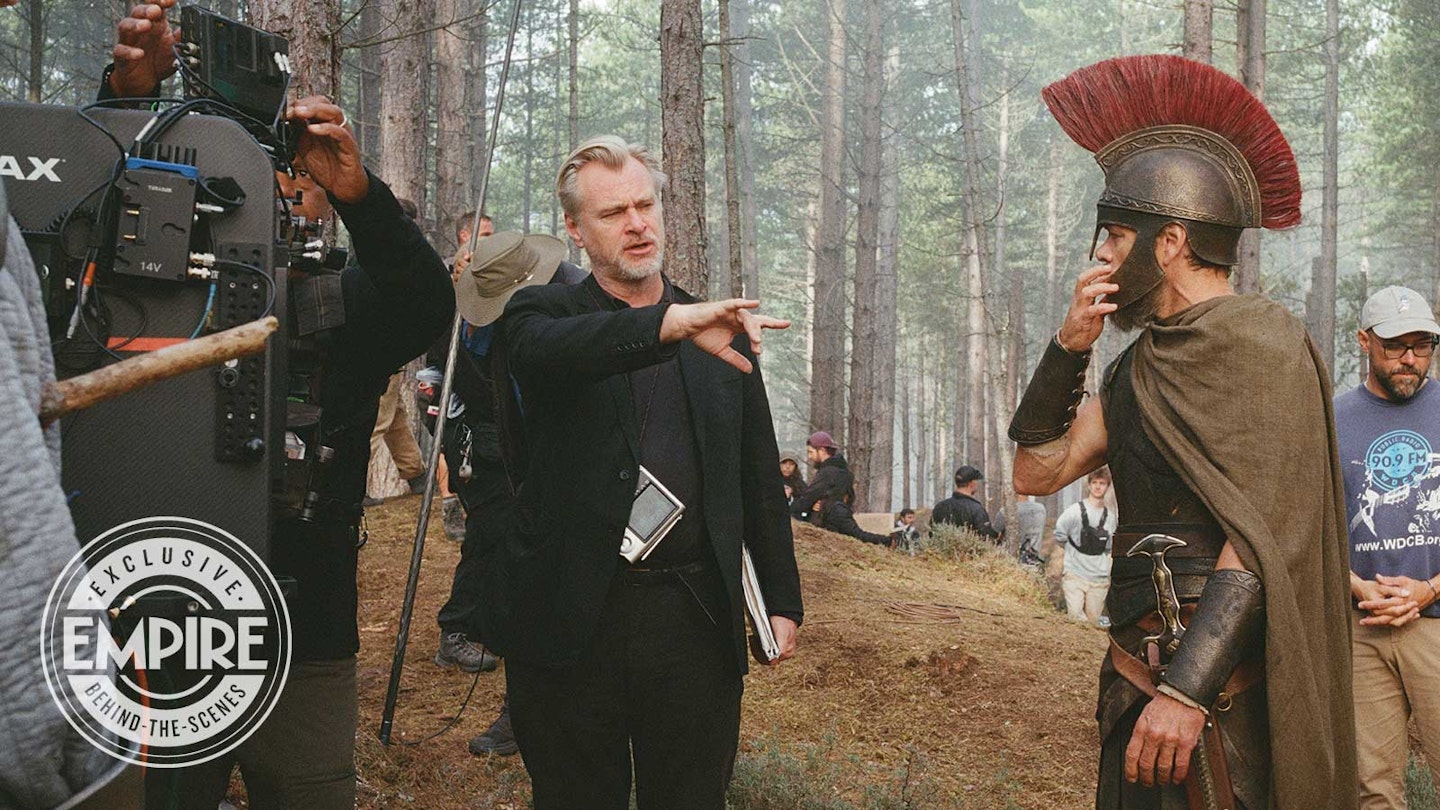
This is where “Nolan makes it more realistic” needs to be handled carefully. The film is not simply making the giants plausible. It is changing the category of threat. Homer’s Laestrygonians are terrifying because they violate the basic human expectation that strangers might be received according to a social code. Nolan’s are terrifying because they turn the encounter into a battlefield where Odysseus’ usual experience of war is no longer enough.
The removal of cannibalism appears to be deliberate rather than accidental. ScreenRant reports that the film reserves cannibalistic horror for Polyphemus, partly to avoid repeating the same kind of scare with the Laestrygonians.[4] That gives you a fair way to phrase the change: Nolan does not keep Homer’s cannibalistic violation of hospitality in this episode; he redistributes that horror elsewhere and lets the Laestrygonians carry a different kind of pressure.
The production choices support that redesign without becoming the whole point of the comparison. Empire reports that the scene used practical effects, forced perspective, wirework, seven IMAX cameras, and Scotland’s Culbin Forest.[2] Those details help explain why the scene reads as physical combat rather than distant mythological destruction. Still, for an essay, the important question is not how many cameras were used. It is what kind of danger the film asks Odysseus to manage.
The Ship Count Changes, But the Story Function Survives
The ship-count discrepancy is probably the easiest place to lose a point in a comparison paragraph. In Homer, Odysseus arrives with 12 ships, not 11. The Laestrygonians destroy 11 of those 12, leaving only the ship Odysseus commanded directly.[1] In Nolan’s version, two ships are destroyed.[2] Those numbers are not interchangeable.
The interpretive move is to notice both difference and continuity. Numerically, Homer’s disaster is much larger: almost the entire fleet is wiped out in one episode. Structurally, Nolan preserves the same narrowing effect. Before Laestrygonia, Odysseus has a fleet; after it, the story contracts around his own surviving ship. That contraction is what makes the scene more than an action sequence. It changes the scale of the journey.
A usable essay sentence might look like this: “Although Nolan reduces the number of ships destroyed from Homer’s 11 to two, he keeps the episode’s narrative function by making Laestrygonia the point where Odysseus’ command collapses from a fleet to a single surviving crew.” That sentence does not pretend the versions are the same. It explains why a major factual change can still preserve a major story function.
What the Change Does to Odysseus
The Laestrygonian episode is not only about the giants. It is also about what kind of commander Odysseus is when his decisions affect more than himself. In Homer, his caution saves his own ship, but the fleet as a whole pays the price. The poem does not need a modern speech about leadership failure; the arrangement of the ships already makes the point. Odysseus survives partly because he has kept himself outside the trap.
Nolan makes that leadership reading explicit. In his Empire interview, he says, “The point of the Laestrygonians in the story, as in the original poem, is to show in some ways the questionable nature of Odysseus’ leadership.”[2] That quote is useful because it keeps the comparison from becoming a loose debate about whether the movie is faithful. Nolan is naming the same pressure point that a careful reader can find in Book 10: Odysseus’ intelligence and caution may save him, but they do not save the men under his command.
This is also where Study.com’s note that the episode humanizes Odysseus through grief can fit, as long as it is not overstated.[5] The loss does not make him innocent. It makes him readable as a leader whose survival comes attached to damage. After Laestrygonia, the question is not just “How will Odysseus get home?” but “What has his command already cost?”
A Brief Note on Mythological Background
If your assignment asks for mythological context, keep it brief. Britannica identifies the Laestrygonians as a race of cannibal giants and notes their descent from Laestrygon, son of Gaea and Poseidon.[6] That genealogy can help you place them within the wider mythic world, but it probably should not become the center of a comparison essay unless your prompt specifically asks about divine ancestry or monster lineages.
For most student essays, the better use of background is one sentence of orientation: “Homer presents the Laestrygonians as mythic cannibal giants, whereas Nolan redesigns them as armored warriors.” Then return to the evidence that changes the reading of the scene: cannibalism, ships, weapons, setting, and Odysseus’ command.
How to Turn the Comparison Into a Paragraph
A strong paragraph should not list every difference. Choose one axis and follow it. If the paragraph is about violence, compare eating and boulder-hurling with armed combat. If it is about leadership, compare the harbor trap and ship loss with Nolan’s explicit leadership framing. If it is about adaptation, explain why removing cannibalism changes the theme of the encounter without removing its consequence.
- Weak claim: “Nolan makes the Laestrygonians more modern.”
- Stronger claim: “Nolan modernizes the threat by replacing Homer’s cannibalistic giants with armored fighters, shifting the episode from a violation of hospitality to a test of battlefield judgment.”
- Weak claim: “Homer’s version is worse for Odysseus.”
- Stronger claim: “Homer’s 11-ship loss makes Laestrygonia the clearest collapse of Odysseus’ command, while Nolan’s two-ship loss preserves the same narrowing of the story around Odysseus’ surviving crew.”
The most balanced judgment is not that one version is deeper than the other. Homer’s version uses cannibalism, xenia, cliffs, and boulders to make the Laestrygonians a monstrous breakdown of social order. Nolan’s version removes the cannibalistic violation and replaces it with militarized threat, advanced weapons, and close combat. Both versions, however, make the encounter the moment when Odysseus’ leadership costs become impossible to ignore.
References
- Book 10, CliffsNotes, https://www.cliffsnotes.com/literature/o/the-odyssey/summary-and-analysis/book-10
- The Odyssey: Christopher Nolan On The Brutality Of The Odyssey’s Laestrygonian Fight – Exclusive, Empire, June 2026, https://www.empireonline.com/movies/news/odyssey-christopher-nolan-brutality-odysseys-laestrygonian-fight-exclusive/
- The Odyssey: Christopher Nolan Changes From Homer, Vanity Fair, https://www.vanityfair.com/story/the-odyssey-christopher-nolan-changes-from-homer
- The Odyssey Biggest Changes, ScreenRant, https://screenrant.com/the-odyssey-biggest-changes/
- Laestrygonians in The Odyssey, Study.com, https://study.com/academy/lesson/laestrygonians-in-the-odyssey.html
- Laestrygones, Britannica, https://www.britannica.com/topic/Laestrygones
Comments
Join the discussion with an anonymous comment.