
How New Public Charge Rule Affects Student Visas and Spouses
Two new 2026 immigration rules — the end of Duration of Status and the rescission of the 2022 public charge regulation — collectively raise the financial and administrative bar for F-1 students with F-2 spouses. This guide explains how the changes work, when they take effect, and what steps students should take to maintain their status and avoid inadmissibility risks.
Updated:
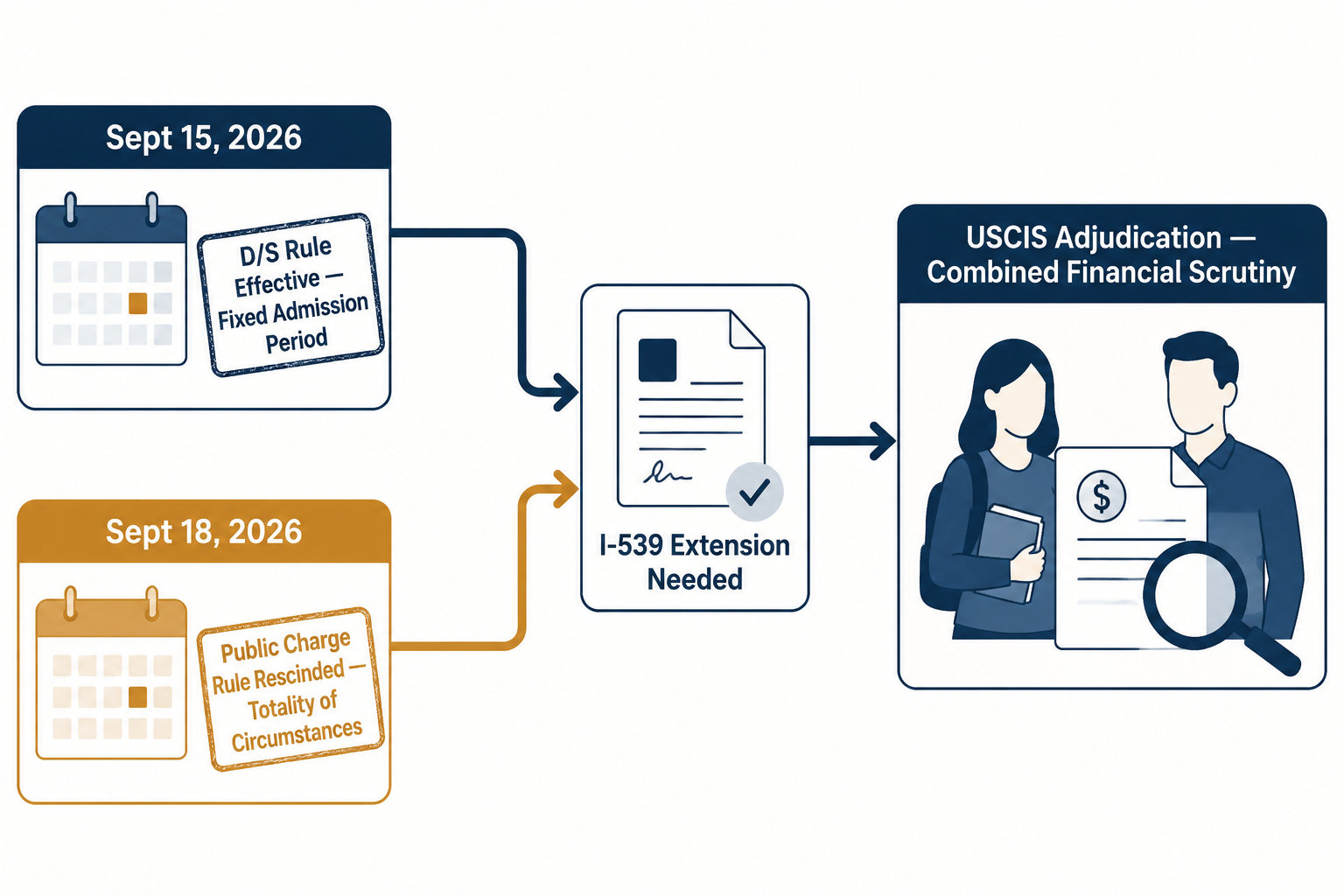
Yes, the 2026 changes can make life harder for an F-1 student with an F-2 spouse, though not because either rule says “married students are barred” or “spouses are disqualifying.” The harder part is how the rules meet in real paperwork. On September 15, 2026, the Duration of Status system is set to end for F, J, and I nonimmigrants, replacing open-ended admission with a fixed period tied to the program or a maximum of four years; students who need more time would have to seek an extension from USCIS, generally through Form I-539.[1] Three days later, on September 18, 2026, the public charge rescission is set to take effect, moving away from the 2022 regulation and back toward broader totality-of-circumstances discretion in public charge decisions.[2]
For a single student, that already means more attention to dates and financial records. For a student with an F-2 spouse, the question becomes more personal: if the student must ask USCIS for more time, will the same household finances supporting the spouse also be weighed under a broader public charge approach? That is where the issue stops being an abstract policy question and becomes a rent, tuition, insurance, and bank-letter problem.
The two effective dates create one planning problem
The first rule changes how long an F-1 student may remain in the United States without asking USCIS for an extension. Under Duration of Status, many students were admitted for the time needed to complete their academic program, as long as they maintained status. The final DHS rule ends that model and gives students a specific admission period, capped at four years or the program end date, whichever applies under the rule.[1]
That fixed period matters because real student timelines are rarely as clean as an acceptance letter. A doctoral student may need another semester for research. A master’s student may transfer schools. A student may change levels, lose time to a medical issue, or discover that a required course is offered only once a year. Under the new structure, those ordinary academic delays can become immigration filing events.
The second rule changes the financial atmosphere around immigration adjudications. USCIS says it is rescinding the 2022 public charge regulation; analysts describe the replacement as a return to policy guidance and wider adjudicator discretion, with officers considering the totality of circumstances rather than applying the narrower 2022 framework.[2][3]
| Rule change | Effective date | Practical student impact |
|---|---|---|
| End of Duration of Status | September 15, 2026 | F-1 admission is no longer open-ended; students may need USCIS extensions if the program or authorized stay exceeds the fixed period. |
| Rescission of 2022 public charge regulation | September 18, 2026 | Financial self-sufficiency may be reviewed under broader totality-of-circumstances discretion. |
Those dates are close enough that students should not treat the changes as separate folders. The D/S rule can create the USCIS touchpoint. The public charge shift can change the questions asked at that touchpoint. The F-2 spouse affects the financial record because the household is larger and because the dependent’s ability to produce income is limited by F-2 status.
Where the risk appears in the F-1 and F-2 workflow
A useful way to read the changes is to follow the student’s path from admission through a possible extension, instead of asking whether “student visas” or “public charge” are affected in isolation.
- The student receives an F-1 visa and enters for a fixed admission period rather than an open-ended Duration of Status period.
- The spouse enters or remains as an F-2 dependent, tied to the F-1 student’s status.
- The school record, program end date, funding, insurance, and dependent information must stay consistent across school and immigration documents.
- If the program runs beyond the admitted period, the student may need to file an extension with USCIS.
- At that filing point, household finances may receive closer attention under a broader public charge framework.
The spouse has not done anything wrong in that chain. The pressure comes from dependency. F-2 status generally does not authorize employment, so the family member who increases the household’s support need usually cannot offset that need with U.S. wages. The student may be doing everything correctly and still have a thinner financial margin on paper than a single student with the same scholarship.
What ending Duration of Status changes for students
Duration of Status used to absorb many normal academic timing problems. If a student maintained F-1 requirements, the immigration record could often follow the program timeline through school-controlled updates. The new rule puts an outer immigration date on the stay. NAFSA’s analysis of the DHS final rule describes a fixed admission period, with a maximum period of four years, and notes that affected students would need to apply for an extension of stay when more time is required.[1]
That does not mean every student gets only four years in every situation, and it does not mean every student will fall out of status automatically when a program becomes complicated. It does mean the student needs to know which date governs: the visa foil, the passport expiration, the I-94 admission period, the I-20 program end date, and any school record updates are not interchangeable documents.
This is the part students often underestimate. A transcript can be excellent and still not solve a timing problem. A department can support another semester and still not file the immigration extension for the student. A professor may understand why the thesis needs more lab time, while USCIS still needs a timely, documented request before the authorized period ends.
Forbes’ coverage of the DHS rule emphasizes that the change could imperil the status of many students because it replaces a flexible model with a more filing-dependent system.[4] That concern is especially practical for students in longer programs, students whose funding changes by year, and students whose family plans depend on a spouse remaining in F-2 status for the same period.
The extension filing becomes the pressure point
If an F-1 student needs more time than the fixed admission period allows, the likely practical issue is not only “Can the school extend my I-20?” It becomes “Can I file a complete and timely USCIS extension request, and does my household evidence still show that we can support ourselves?”
That extension packet may need to explain continued enrollment, academic need, financial support, and dependent status. If the spouse’s F-2 status depends on the student, a delay or denial for the F-1 can affect the spouse as well. Families should assume that one missing financial document can create stress for both people, not just for the student named on the admission letter.
Why an F-2 spouse changes the financial picture
F-2 dependency is easy to describe and hard to live with. The spouse’s status is connected to the F-1 student. The spouse generally cannot work in the United States. The household still has to pay rent, food, insurance, transportation, tuition-related costs, and sometimes childcare. When public charge review becomes more discretionary, that family structure matters.
A bank balance that looks adequate for one person may look different when it supports two. A scholarship that covers tuition may not cover dependent living costs. A sponsor letter may be helpful but weak if it does not match bank statements, income records, or the period of study. Health insurance also matters because uncovered medical risk can make an otherwise stable budget look fragile.
None of this means marriage itself is a negative factor. The narrower and safer conclusion is that a dependent spouse increases the amount of support the file must explain. When the dependent is not authorized to work, the student’s funding plan has to carry more weight.
Families sometimes try to solve this by describing a future job, a hoped-for assistantship, or informal help from relatives. Those may be part of a real household survival plan, but they are weaker than documented, available funds. Officers review records, not intentions shared at the kitchen table.
What the public charge rescission does and does not prove
USCIS says it is rescinding the 2022 public charge regulation, and Fragomen describes the replacement approach as relying on policy guidance and broad adjudicator discretion under a totality-of-circumstances test.[2][3] For students, the practical concern is not that every F-1 extension automatically becomes a public charge denial. The concern is that more filings can mean more occasions for financial self-sufficiency to be examined.
Under a totality-of-circumstances approach, officers may weigh factors such as age, health, family status, assets, resources, financial status, education, and skills. The research materials also identify English proficiency, family size, and means-tested benefits as factors that may receive attention under the broader framework.[2]
That list should be read carefully. Adoption of a broader discretionary framework is not the same thing as proof that every student with a spouse will be denied. A factor is not the same as an automatic rule. A larger family may require stronger support evidence, but the research does not support a fixed formula saying that one dependent equals inadmissibility.
USCIS guidance and revised forms are still pending as of July 19, 2026, so some operational details remain uncertain. That uncertainty matters. Students should prepare more carefully, but they should not treat private checklists, attorney commentary, or school handouts as official safe harbors unless USCIS adopts them.
Financial benchmarks are planning tools, not guarantees
Dworsky Law suggests practical public charge planning benchmarks such as income around 150% to 200% of the federal poverty guidelines and savings equal to 6 to 12 months of expenses.[5] Those figures can help a family stress-test a budget, especially when an F-2 spouse cannot work. They should not be presented as official USCIS thresholds for student extensions.
A student household can use benchmarks like these to ask better questions: Does the scholarship cover dependents? Is the sponsor’s income documented? Are funds liquid and accessible? Does the budget include insurance? If the program takes one extra semester, can the same records still support both the student and spouse?
Benefits questions need more caution than rumor
The broader public charge framework makes benefit-related assumptions more risky. The research materials refer to means-tested benefits as a possible factor, but students should not jump from that to a homemade rule that every public service, emergency resource, school service, or family support program has the same immigration consequence.[2]
The safer practice is to pause before applying for any benefit that may be means-tested, ask the school’s international office what it can and cannot advise on, and consult qualified legal help where immigration consequences are possible. This is especially important for households with a pregnant spouse, chronic health costs, a child, or a sudden loss of funding. Those families need accurate advice, not hallway certainty.
The Migration Policy Institute frames public charge policy as a broader family-impact issue, warning that expanded public charge approaches can amplify harms for immigrant families.[6] ILRC also tracks ongoing public charge developments and related government materials, including consular-facing concerns about factors such as health conditions, limited English, and large families.[7] Those sources are useful for context, but a student should still separate general policy concern from the exact standard that applies to a specific USCIS filing or visa process.
Do not confuse this with the separate visa-ban policy
The January 2026 75-country visa ban is a separate policy affecting initial visa issuance for people from covered countries. It may matter enormously to some prospective students and spouses, but it is not the same legal issue as the September D/S rule or the September public charge rescission. Mixing them together can lead to bad planning: a student may need one strategy for consular visa access and another for maintaining F-1 and F-2 status after admission.
What to prepare before the rules take effect
The goal is not to create a perfect file that eliminates discretion. No checklist can do that. The goal is to avoid preventable problems: missed dates, inconsistent records, unsupported dependents, unexplained funding gaps, and casual benefit decisions.
- Check the I-20 program end date, expected graduation date, passport expiration, visa expiration, and I-94 admission period; do not assume they all mean the same thing.
- Ask the DSO early whether the new fixed admission period could end before the academic plan does, especially for research degrees, transfers, delayed coursework, or level changes.
- Identify whether an extension filing may be needed and what lead time the school recommends before the fixed period expires.
- Keep clean status records: full-time enrollment, approved reduced course load if applicable, current address reporting, proper employment authorization, and timely school updates.
- Build financial documentation for the full household, not only the student: tuition, living expenses, spouse costs, insurance, dependent costs, sponsor support, and accessible savings.
- Before applying for any means-tested benefit, get advice from a qualified source that understands current public charge guidance.
- Monitor USCIS and ILRC updates because forms and guidance may change before or after the September effective dates.
For a married student, the financial file should read like one household, not like a student file with a spouse added at the end. Bank statements should match sponsor letters. Scholarship letters should say what they actually cover. If a parent abroad is supporting the couple, the record should show the parent’s ability and willingness to do so. If the spouse has health insurance, keep proof. If the spouse does not, understand how that risk looks in the broader budget.
There is also a timing discipline here. A student who waits until the final weeks of the admitted period may still have a valid academic reason for more time, but the household has less room to fix a missing document, a stale bank letter, a sponsor who is traveling, or a dependent record that does not match the school file. Early DSO conversations are not a formality; they are how a student finds out which problem is academic, which is immigration-related, and which needs outside legal advice.
What remains uncertain as of July 19, 2026
Both rules are final but not yet in effect as of July 19, 2026. Litigation, Congressional Review Act activity, agency guidance, or revised forms could affect implementation. USCIS has not yet published the promised replacement guidance or revised Form I-485 materials, so students should avoid treating today’s secondary explanations as the last word.
Still, waiting for every detail is not a good plan for families on F-1 and F-2 status. The known direction is enough to justify preparation: fixed dates will matter more, extension filings may become more common, and household finances will be harder to separate from dependent status. The new environment does not automatically make study in the United States impossible for students with spouses, but it does make timing, documentation, and family support part of the same risk map.
References
- DHS Final Rule Ending Duration of Status, NAFSA
- United States: DHS Replaces Public Charge Regulation with Policy Guidance and Broad Discretion for Adjudicators, Fragomen
- U.S. Citizenship and Immigration Services Rescinds 2022 Public Charge Regulation, USCIS
- DHS Finalizes Immigration Rule That Imperils Status Of Many Students, Forbes, July 17, 2026
- Public Charge in 2026: Understanding the New Financial Self-Sufficiency Standards, Dworsky Law
- Trump Administration Public-Charge Rule Would Amplify Harms to Immigrant Families, Migration Policy Institute
- Public Charge Updates, Immigrant Legal Resource Center
Comments
Join the discussion with an anonymous comment.